Enter your email address to receive your free PDF download. Please note that by doing so you agree to be added to our monthly email newsletter distribution list. Yes, sign me up for the Cureus monthly newsletter. You can unsubscribe anytime. New here? Sign up. Sign in to Cureus sign in using LinkedIn sign in
Meet Penn Engineering’s First Graduates in AI
In 2024, Penn Engineering launched the Ivy League’s first undergraduate engineering degree in AI. This year, the Raj and Neera Singh Bachelor’s of Science in Engineering Program in Artificial Intelligence graduated its first students.
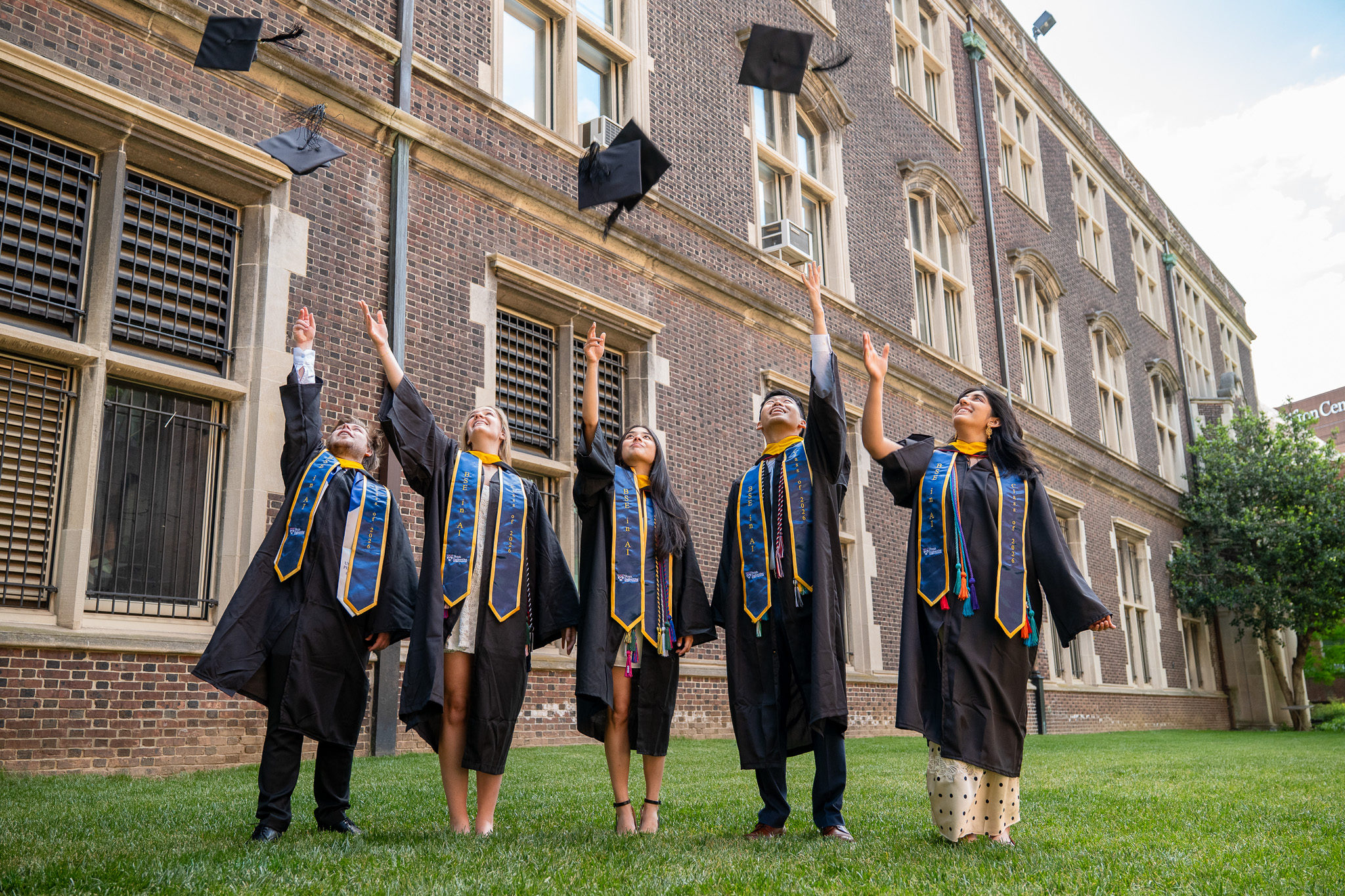
The inaugural graduates — Alexandra Oh, Brandon Tsai, Daniel Mika, Emma Twitmyer and Maya Gambhir — recently sat down with Penn Engineering to share their experiences as AI majors.

From left: Kat Buchanan, AI Program Coordinator and Academic Advisor; George J. Pappas, Director of the Raj and Neera Singh Program in Artificial Intelligence, UPS Foundation Professor of Transportation in Electrical and Systems Engineering, and Penn Engineering’s Associate Dean for Research; and the inaugural AI majors: Daniel Mika, Alexandra Oh, Maya Gambhir, Emma Twitmyer and Brandon Tsai (Credit: Sylvia Zhang)
Why did you choose to major in AI?
Alexandra Oh: I was excited to explore emerging technologies from both a technical and human-centered perspective. Being part of the first graduating class has been especially meaningful because the field is evolving so quickly; I feel grateful to have been part of a community that has helped define what it means to study AI at Penn Engineering.
Brandon Tsai: There is nothing like it at Penn; I was able to learn cutting-edge technologies while exploring my interest in data science. It was also incredibly exciting to be able to help pave the way for a major growing exponentially in importance.
Daniel Mika: I have been pursuing AI since 2014, with a particular focus on computer vision. One of my main goals at Penn Engineering was to continue deepening that focus, especially through research on world models and robotics. When the AI major was announced, it felt like the perfect fit for my academic interests and research direction.
Emma Twitmyer: Majoring in AI felt like the best of both worlds: It combined my interest in foundational math, especially linear algebra and systems thinking, with computer science concepts like algorithms and machine learning. I also appreciated the curriculum’s flexibility, which allowed students to either specialize in specific areas of AI or maintain a broad, interdisciplinary perspective.
Maya Gambhir: Most importantly, the major provided me with the flexibility to pursue the particular classes and electives that aligned with my interests. It also felt extremely empowering to have influence on parts of the curriculum as an early participant. The faculty and staff behind the scenes work tremendously hard to make sure we have any and all support we may need.

Emma Twitmyer (left) is entering management consulting while Maya Gambhir (right) is pursuing a Ph.D. in AI. (Credit: Sylvia Zhang)
What was the most surprising thing you learned as an AI major?
Alexandra: AI is as much about asking the right questions as it is about building the right models. While algorithms and performance metrics are incredibly important, context matters: the data you choose, the assumptions you make, the people affected by the system and the way you evaluate success. AI is powerful, but it requires judgment, creativity and responsibility.
Brandon: Going deep into the mathematics of AI, and how these popular models truly function. Being able to learn both the history and the current state of the algorithms used widely today genuinely surprised me because going into the major, the math behind the models seemed like magic to me.
Daniel: Taking a philosophy of mind course for my cognitive science elective. I did not expect it to be as useful or relevant as it ended up being. The course gave me a parallel perspective on many of the technical questions I had been exploring in AI research, especially around learning, representation and intelligence. It helped shape several of my later research questions and improved my intuition around learning theory.
Emma: How easily “anonymous” data can be de-anonymized when combined with other data sets. Even something as simple as movie ratings can be cross-referenced with public data to identify individuals, and aggregated fitness-tracking data have revealed the locations of military bases. This shifted my perspective from viewing data sets in isolation to understanding the risks that emerge when they are connected. It also reinforced that privacy and ethics must be treated as core design constraints in AI, since many of the most difficult challenges arise from how these technologies interact with people and society.
Maya: How much misinformation exists in the mainstream conversation around AI. Voices in academia often differ significantly from voices in media, and that can create really interesting conversations with both faculty and fellow students.

From left: Penn Engineering’s inaugural AI graduates Daniel Mika, Emma Twitmyer, Maya Gambhir, Alexandra Oh and Brandon Tsai outside Towne Hall. (Credit: Sylvia Zhang)
What challenged you the most in the program, and how did you grow from it?
Alexandra: Learning to work across disciplines: AI problems often require math, computer science, ethics, domain knowledge and communication. As an AI major, you have to learn to collaborate well with engineers and non-engineers, who bring different areas of expertise. I learned to be more comfortable asking questions, breaking down problems, and focusing on communication and teamwork.
Brandon: How rigorous the mathematics were behind this major. AI and machine learning are all built through extensive math. I had to adjust my mindset to understand how this math fits into the big picture of how these models function.
Daniel: For my situation, the biggest challenge was managing the intensity of a dual-degree program, an accelerated master’s, research and other responsibilities at the same time. It forced me to become much more deliberate about how I spent my time. I learned to prioritize more carefully and to be comfortable giving up opportunities that were interesting but not aligned with my most important goals. That was a difficult but important shift, and it helped me become more focused and disciplined.
Emma: Learning not just how to solve a problem, but how to define it. In many engineering and AI projects, there is no single “correct” formulation, and small decisions about how to frame a problem can significantly impact the outcome. I had to learn how to navigate ambiguity, make assumptions, and justify tradeoffs. I also learned when to pivot, recognizing when an approach wasn’t working and reframing the problem rather than forcing a solution. Over time, this helped me develop a more structured and thoughtful approach to problem solving.
Maya: Taking on my first research project was truly a defining challenge of my experience, transitioning from understanding and solving well-defined problems in class to developing and implementing new empirical and theoretical methods.
What’s next for you after graduation, and how do you hope to use AI?
Alexandra: I’m excited to begin my career in technology consulting, where I hope to apply what I’ve learned about AI and data to complex problems across industries. Long term, I hope to work at the intersection of technology, strategy and impact, helping organizations use AI in ways that are practical, responsible and grounded in real needs.
Brandon: I will be working in the healthcare tech industry. I would love to be able to apply ethical AI into an industry that could greatly benefit from it. You often see people trying to overuse AI in places where it does more harm than good. However, I believe there are a lot of very beneficial spaces within healthcare where AI can improve the lives of those in need.
Daniel: I am considering either joining a research startup working on world models and robotic applications, or founding my own research lab to pursue an approach that I believe could help enable truly advanced world models. Long term, I want to work on AI systems that can understand, predict and interact with the physical world in more general and robust ways.
Emma: I will be working in management consulting in New York City. I hope to focus on projects related to AI and technology implementation within organizations. As AI continues to evolve rapidly, the strategies for using it effectively are evolving as well. I am excited by the opportunity to help define best practices in a space that is still developing and to drive meaningful impact by integrating technology with system design and human behavior.
Maya: I am going to pursue a Ph.D. at Princeton’s Center for Information and Technology Policy with Professors Aleksandra Korolova and Jonathan Mayer. My research will focus on how algorithmic decision-making systems can be made more fair, accountable and trustworthy, especially by connecting technical methods with real-world social and policy constraints.
Learn more about the Raj and Neera Singh Program in Artificial Intelligence.

Related Posts