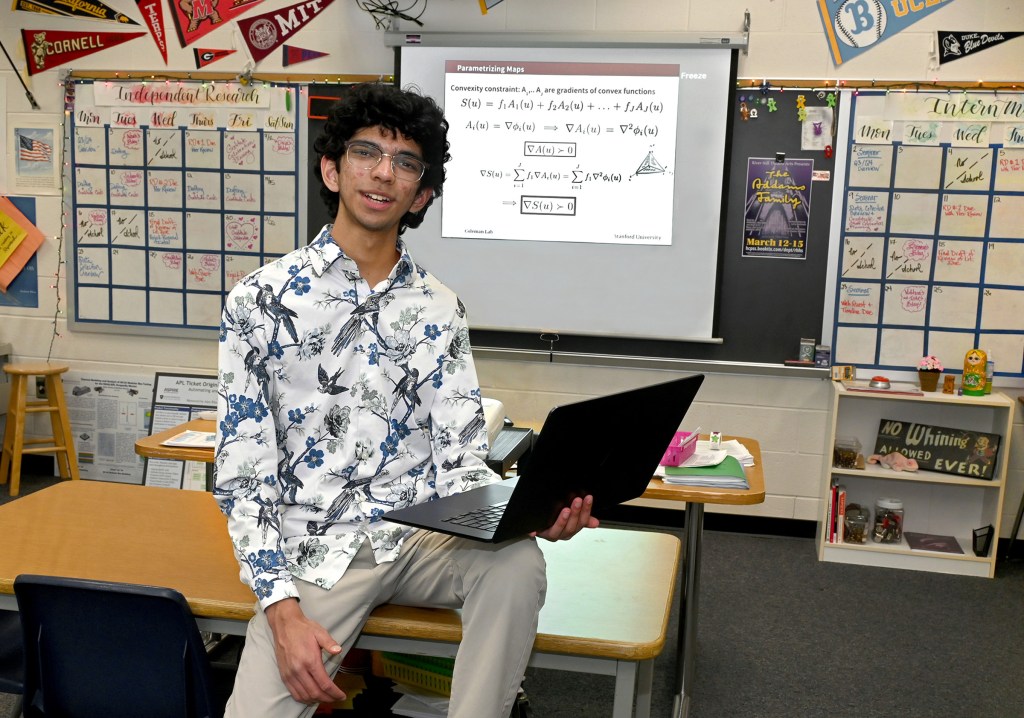
River Hill High School senior Vishnu Kannan has sold his AI startup company to Redwood Labs Inc. for $2 million in stocks. Projected on the screen in his research classroom are formulations for his applied math research. (Jeffrey F. Bill/Staff) By Kiersten Hacker PUBLISHED: March 4, 2026 at 3:38 PM EST | UPDATED: March 4

How Human Work Will Remain Valuable in an AI World | Towards Data Science
dominating the AI debate right now: that AI is going to replace all of us, that jobs will disappear within 18 months, that the collapse of the labor market is inevitable. Some say it with alarm, others, with enthusiasm. But almost no one stops to look at the real data.
This first episode in the series is not a blind defense of technological optimism, nor a rejection of pessimism. It’s an attempt to read reality as it is with its frictions, its limits, and its opportunities.
There’s a line from Friedrich Hayek that captures the spirit of this analysis:
Nobody can be a great economist who is only an economist and I am even tempted to add that the economist who is only an economist is likely to become a nuisance if not a positive danger.
The same applies today to anyone who looks at AI through only one lens. To understand what AI is actually doing to our reality, you have to cross technology, economics, history, and philosophy.
Reality as Competitive Advantage
David Beyer (@dbeyer123) published an analysis that perfectly captures the central tension of this moment. Imagine two medical companies. The first processes millions of radiology images. The second handles millions of medical insurance claims.
The first has a problem AI can solve brilliantly. The images don’t change; knowledge converges through data. With enough compute, anyone can reach the same level of precision. It’s a static problem.
The second faces something entirely different: a coupled system in constant flux. Regulations, policies, billing codes that get updated, disputes that evolve. The operational knowledge there cannot be studied or simulated from the outside; it’s earned by receiving rejections from the system, adjusting, and trying again. Beyer calls this “scar tissue”: the knowledge that only the real world can give you, through friction, in real time.
AI can accelerate learning when the rules are fixed. But it cannot generate the surprises of the real world. It cannot force regulators to change their rules faster, or competitors to attack before you’re ready. The learning speed in these systems is limited by the speed of reality, not the speed of compute.
Reality itself is your hardest-to-replicate competitive advantage.
The Adoption Crisis: Recursive Technology ≠ Recursive Adoption
AI models improve recursively; models training better models. That’s real and extraordinary. But many people extrapolate that recursiveness into the economy and assume that mass replacement of labor is equally imminent and exponential.
An analysis by Citadel Securities (@citsecurities) on the “Global Intelligence Crisis of 2026” dismantles that logic clearly: recursive technology is not the same as recursive adoption.
Real-world adoption is strongly constrained by factors that don’t scale at software speed:
- Physical capital and infrastructure construction
- Energy grid availability and capacity
- Regulatory approvals
- Organizational change, the slowest of all
To see these physical limits in action, look at manufacturing construction spending in the United States. The promise of AI requires monumental physical backing: semiconductor fabs, data centers, and energy networks.

Spending jumped from approximately $75 billion to more than $240 billion between 2021 and 2024, the largest recorded jump. And that physical backing takes years, not months.
Moreover, AI-driven productivity shocks are, historically, positive supply shocks: they reduce marginal costs, expand production, and increase real income. Keynes predicted (wrongly as usual) in 1930 that, thanks to productivity gains, by the 21st century we’d be working 15 hours a week. He was wrong because he underestimated the elasticity of human desire. As technology drives down costs, we don’t stop working; we simply expand our consumption frontier, demand higher quality, new services, and build industries that were previously unimaginable.
The real data bears this out: there has been an unprecedented jump in new business formation in the United States since 2020, at levels that have remained historically high in recent years. Far from contracting, humanity’s creative activity expands when the rules of the game change.

And contrary to the mass-displacement narrative, the demand for technical jobs like software engineering has found solid footing, stabilizing to 2019 levels despite the post-pandemic correction. This underlines how technology acts as a complement to our labor: restructuring work rather than eliminating it outright.

Will AI Replace Us? The Wrong Question
“AI is going to replace all of us.” “All jobs will be automated in 18 months.”
If you’ve been following the latest AI news and podcasts, you’ve probably read something like this. Some of it is sensationalist exaggeration; some of it has been said by CEOs, founders, and prominent figures at major companies and startups. But the question we need to ask is not whether AI replaces us; it’s how we remain valuable in what we do.
I don’t believe all jobs will be automated, nor that there won’t be room for developers, accountants, lawyers, and so many others. Not anytime soon. What I do believe is that we’ll enter a mode of work assisted by AI systems and agents, making our work potentially far more efficient. But that demands a different kind of effort from us.
The questions we should be asking are:
- How do we remain valuable in what we do?
- How do we keep improving and learning?
- How do I keep my mind active and my critical thinking sharp?
- In a world where my job is building prompts and guiding autonomous agents, how do I use AI in the best possible way? Being more efficient, without losing the thread of what I’m doing.
Our primary work in this new world will be:
- Systems design and solution architectures
- Strategy creation that agents can execute
- Business understanding and translation into concrete plans
- Skill-building alongside AI
- Critical thinking to steer AI-assisted work in the right direction
- Deep research alongside agents to solve real problems
- Metrics, orchestration, monitoring, and governance of systems and agents (and subagents).
But at the same time, we need to maintain a constant effort to read, learn, analyze, question, and validate what we’re doing. The answers that agents give us must be complemented by time, effort, and the active use of our own minds, our critical thinking, and the ability to make non-obvious cross-references that no model can make on its own.
Much may happen in the coming years. The narrative about the disappearance of work will keep intensifying. But don’t lose sight of the fact that the path to success remains what it has always been: preparation, study, research, and critical thinking toward everything we read and hear.
What If the World Doesn’t End? The Scenario Nobody Is Pricing In
There’s an analysis from The Kobeissi Letter (@KobeissiLetter) that I think is essential to complete this picture: “It’s Too Obvious. What If AI Doesn’t Actually End The World?” The core argument is powerful: when a narrative becomes too obvious, the market has already priced it in, and reality tends to surprise from the other direction.
The market has already absorbed the apocalyptic scenario: IBM suffers its worst day since 2000 when Claude automates COBOL code; Adobe falls 30% as AI compresses creative workflows; CrowdStrike loses $20 billion in market cap in two trading days when Anthropic launches an automated security tool, even Nvidia has struggled. These moves are real and they make sense: markets are repricing the cost of cognitive labor in real time.
But the catastrophist reasoning contains a fundamental logical trap: it assumes demand is fixed. The bearish loop goes: AI replaces workers → wages fall → consumption contracts → companies automate further to defend margins → the cycle feeds itself. It’s a completely static model of the economy.
Technological history systematically contradicts that logic. When the cost of producing something collapses, demand doesn’t stay flat, it expands. When computing became cheap, we didn’t consume the same amount of computation at a lower price: we built entire industries on top of that foundation. The price of personal computers has fallen 99.7% between 1980 and 2025:

The result? No collapse. There was the internet, mobile phones, e-commerce, streaming, social networks, cloud computing and an entire digital economy that today employs hundreds of millions of people in categories that simply didn’t exist in 1980.
Kobeissi introduces two concepts worth holding onto: “Ghost GDP”: output that appears in the data but doesn’t benefit households — versus “Abundance GDP”: growth combined with a real fall in the cost of living. The optimistic AI scenario doesn’t require nominal wages to rise; it requires service prices to fall faster than income. If AI reduces the cost of healthcare administration, legal services, accounting, education, and technical support, households gain real purchasing power even if their salary doesn’t move a single dollar.
And the most important signal is that this is already happening. U.S. labor productivity has accelerated to its fastest pace in two decades:

The shaded zone marks the generative AI era. The index isn’t just still rising, it’s rising faster. This is exactly what we’d expect to see from a positive supply shock: more output per hour worked, which historically translates into greater aggregate well-being.
The question Kobeissi raises: What if the most underpriced scenario isn’t dystopia, but abundance? That is the right question. Not because abundance is guaranteed, but because markets and public opinion have over-indexed the collapse narrative, leaving the expansion scenario dramatically underrepresented in the public debate.
The most underpriced scenario today isn’t dystopia. It’s abundance
What Does All This Mean?
We’ve looked at three distinct perspectives on the same question: what is AI doing to our reality?
Beyer tells us that reality has frictions AI cannot simulate: the operational knowledge earned through friction in complex systems is the hardest-to-replicate competitive advantage.
Citadel Securities reminds us that technological speed is not equal to adoption speed. The physical, regulatory, and organizational world sets its own speed limit, regardless of how fast models improve.
Kobeissi proposes that the most underpriced scenario is abundance, not collapse. That when cognitive costs fall, humanity doesn’t stand still, it creates.
These three points don’t contradict each other, they complement each other. Together they form a coherent picture: AI is a real and powerful transformative force, but it is embedded in a reality with its own rules, timelines, and frictions. The simulation is not reality. And in that gap, between what AI can calculate and what the real world demands, lives the opportunity for those willing to keep learning, thinking, and building.
AI will democratize access to capabilities that previously required years of technical training. What it cannot democratize is judgment, discernment, the experience earned through friction in the real world, and the willingness to do the work that no one else wants to do.
That is the “scar tissue” that no one can take from us.
This is only the beginning. In the coming episodes we’ll keep unraveling these dynamics connecting technology, science, economics, history, and our own human nature.
Welcome to The Road to Reality.
Follow me for more updates https://www.linkedin.com/in/faviovazquez/
Sources and References
- Beyer, David. “Reality’s Moat.” — Analysis on AI’s limitations against complex real-world systems and the concept of operational scar tissue.
- Citadel Securities. “Global Intelligence Crisis 2026.” — Macroeconomic analysis on recursive technology vs. recursive adoption and the physical limits of AI.
- The Kobeissi Letter. “It’s Too Obvious. What If AI Doesn’t Actually End The World?” (2026) — x.com/KobeissiLetter
- Penrose, Roger. The Road to Reality: A Complete Guide to the Laws of the Universe. Knopf, 2005.
- Hayek, Friedrich. Quote from “The Dilemma of Specialization” and related writings on interdisciplinary economics.
Data and statistical series
All five charts in this article were created by the author using data retrieved from the Federal Reserve Bank of St. Louis (FRED) database.
- U.S. Census Bureau. Business Formation Statistics — Business Applications (BABATOTALSAUS). Federal Reserve Bank of St. Louis (FRED). https://fred.stlouisfed.org/series/BABATOTALSAUS
- Indeed / Federal Reserve Bank of St. Louis. Indeed Job Postings: Software Development (IHLIDXUSTPSOFTDEVE). FRED. https://fred.stlouisfed.org/series/IHLIDXUSTPSOFTDEVE
- U.S. Census Bureau. Total Construction Spending: Manufacturing (TLMFGCONS). FRED. https://fred.stlouisfed.org/series/TLMFGCONS
- U.S. Bureau of Labor Statistics. Nonfarm Business Sector: Real Output Per Hour of All Persons (OPHNFB). FRED. https://fred.stlouisfed.org/series/OPHNFB
- Bureau of Economic Analysis (BEA). PCE Price Index: Computers and Related Equipment (DIPERG3A086NBEA). Federal Reserve Bank of St. Louis (FRED). https://fred.stlouisfed.org/series/DIPERG3A086NBEA

Related Posts