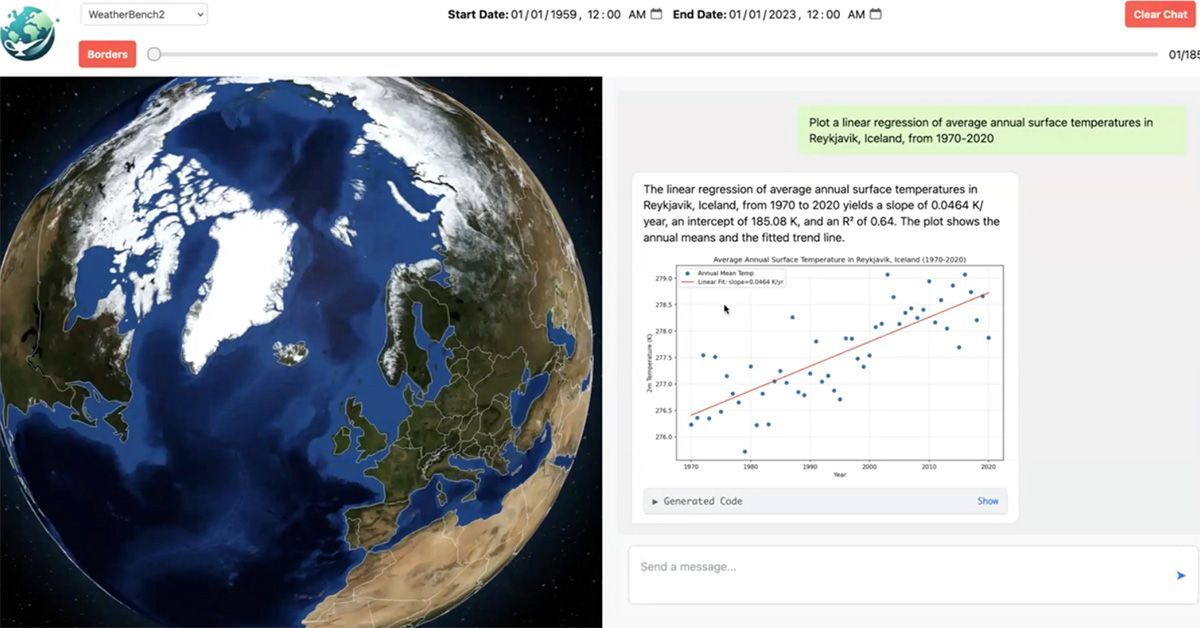
A new AI agent could help analyze complex data from weather forecasting models The tool could help democratize earth science Researchers hope to expand the tool to other areas, including climate science Computer scientists and weather scientists have taken the first steps toward creating an AI agent capable of analyzing and answering questions in natural

Is your workforce planning built for a world that no longer exists?
A 4,000-word financial memo recently drew significant attention from investors and economists, and HR leaders might use it as a tip.
Published in late February by Citrini Research and co-author Alap Shah, The 2028 Global Intelligence Crisis is framed explicitly as a thought exercise, a scenario, not a prediction.
Written as a fictional macro memo from June 2028, it traces a plausible chain of events in which AI succeeds spectacularly at improving productivity while simultaneously triggering a white-collar displacement spiral that unravels consumer spending, private credit markets and eventually the mortgage system. The authors are modeling a left-tail risk, not forecasting it. But left-tail risks may puncture workforce planning when no one has stress-tested for them.
Workforce planning in a time of change
The real-world backdrop makes the exercise harder to dismiss. (Take a deep breath and jump in.) Microsoft cut nearly 15,000 employees in 2025 while CEO Satya Nadella disclosed that AI now writes 20-30% of the company’s code. Amazon announced plans to reduce its corporate workforce by tens of thousands of roles. Industry trackers estimate that nearly 245,000 tech jobs were cut worldwide in 2025, with around 55,000 U.S. layoffs directly linked to AI-related workforce changes.
In interviews, Anthropic CEO Dario Amodei has warned that AI could eliminate up to half of all entry-level white‑collar jobs within roughly one to five years. In a recent interview with the Financial Times, Microsoft AI CEO Mustafa Suleyman said he expects AI to reach human-level performance on most professional tasks and predicted that most white‑collar tasks could be fully automated within about 12 to 18 months.
However, not everyone is convinced. Patrick Mullane, executive director of Harvard Business School Online and Executive Education, pushed back in a recent LinkedIn discussion.
“I’ve gotten old enough to become very, very skeptical of ‘this time it’s different,’ having heard it so many times before,” wrote Mullane. “While AI will have impact, we humans are often not creative enough to see into the future and predict all the new industries, jobs and products that will come from a disruptive technology.”
What does history say?
Economic historians note that over more than 200 years of industrial revolutions—from steam power and electrification to modern computing—new technologies have eliminated some occupations but ultimately expanded employment and created new roles.
However, the historical argument depends on reabsorption. And the Citrini scenario (even at a fraction of its severity) surfaces a vulnerability that workforce planning data already confirms.
According to a BearingPoint survey of 1,010 C‑suite executives, 92% report up to 20% workforce overcapacity today, while 94% simultaneously face acute shortages in AI‑critical skills. Only 46% have integrated workforce planning into their AI roadmaps.
Three‑year workforce plans built on assumptions of stable white‑collar pipelines and predictable reskilling timelines are already being stress‑tested by AI in ways many HR leaders haven’t modeled for.
What can HR do?
McKinsey advises CHROs to overhaul traditional multi‑year strategic workforce planning, arguing that AI‑driven shifts in role mix and skills demand require more frequent scenario updates and integration with automation strategies.
A Yoho Workplace Strategy finds that two in five U.K.-based HR leaders believe they need at least three years to prepare for AI, even as the technology advances much faster, highlighting a dangerous gap between planning cycles and the speed of disruption, according to Personnel Today.
KPMG likewise urges CHROs to proactively redesign roles, career paths and internal mobility to account for AI’s impact on white‑collar job architectures, rather than assuming historical role structures and hiring pipelines will hold.
The debate over whether AI will ultimately create more jobs than it destroys may never be fully resolved. History suggests it will, but history also assumed humans would always be the ones doing the new jobs. What’s clear is that the transition is already underway, and workforce plans built on pre-2025 assumptions about stable white-collar hiring pipelines and predictable mid-level role structures are being tested in real time.
The CHROs closest to this shift are asking the right question. As one executive at a multinational software company told KPMG researchers for its recent report: “Change is not just about implementing amazing technology powered by AI, but what are the human capabilities we need too?”

Related Posts