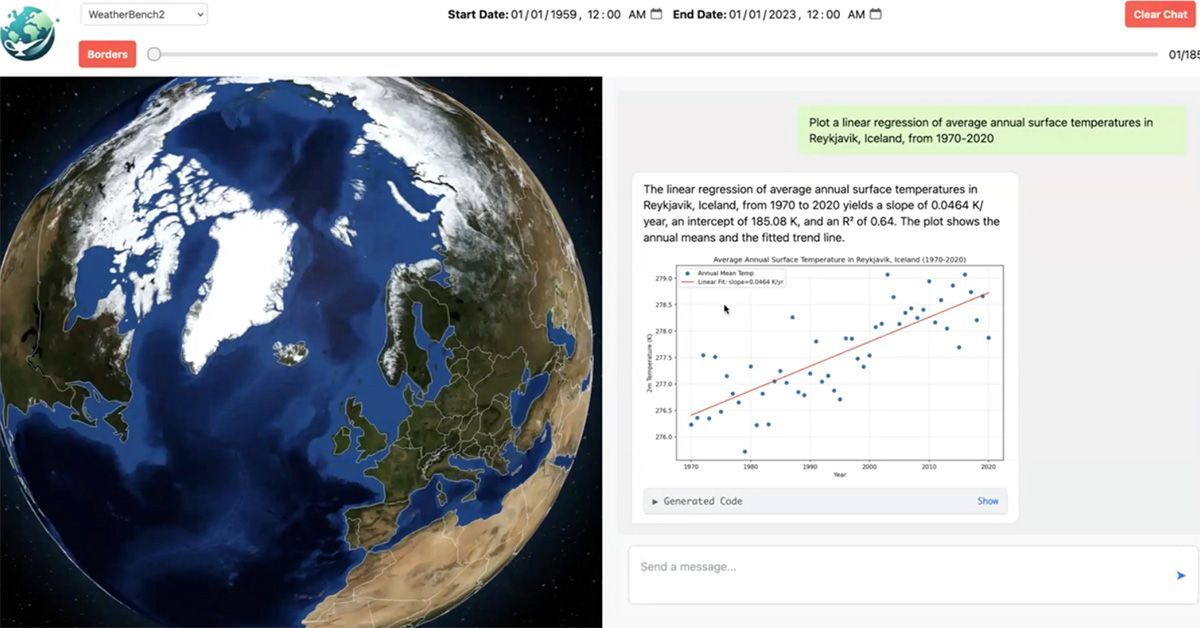
A new AI agent could help analyze complex data from weather forecasting models The tool could help democratize earth science Researchers hope to expand the tool to other areas, including climate science Computer scientists and weather scientists have taken the first steps toward creating an AI agent capable of analyzing and answering questions in natural

A
Introduction
Nowadays, a variety of F&V processing products are produced and consumed around the world, becoming an important pillar of the global food industry (Hassoun et al., 2024). However, F&V processing industry still faces multiple challenges, such as the biodiversity and variability of raw materials. How to accurately balance quality maximization and processing energy consumption, while ensuring safety is always a core problem in process optimization (Feng et al., 2025). Meanwhile, it has been reported that 15-20% of by-products rich in bioactive compounds during F&V processing has been produced but are not efficiently utilized. In special, the demand of modern consumers has evolved from basic “safe belly” to a pursuit of “clean labels”, personalized nutrition, unique sensory experiences, and environmental sustainability, which puts higher demands on product quality (Faulisi et al., 2024).
The traditional research and development (R&D) and production mode that relies on empirical formulas and limited trial error has become weak, and there is an urgent need for a paradigm shift that force the processing industry to undergo technological innovation (Holt et al., 2022).
The vigorous development of artificial intelligence (AI) technology has provided the core driving force for this transformation. AI, especially machine learning (ML) and deep learning (DL), can automatically learn complex modes and rules from massive and multi-dimensional data, and perform advanced tasks such as prediction, classification, optimization, and even creative generation, which has been extensively applied in the entire F&V industry chain (Figure 1) (Li et al., 2025; Wang, Bureau, et al., 2024). In F&V processing fields, AI shows great advantages in intelligent process monitoring. The intelligent control system realizes real-time monitoring and adjustment of processing parameters to guarantee the stability and consistency of F&V products quality (Lee & Ma, 2025).
In particular, with nutrition entering “precision nutrition”, customized and personalized future foods development for specific health needs (such as the elderly, diabetes patients, athletes) is an inevitable trend for F&V processing industry. At the same time, it depends on the deep integration of cutting-edge technologies, including generative AI, natural language processing and large-scale knowledge mapping (Wang et al., 2025). AI can not only meet multiple goals by predicting the characteristics of active ingredients in F&V, such as nutritional balance, high sensory acceptance, customized 3D/4D printing food, but also combine sensing technology to monitor the intake of active ingredients in real time (Escalante-Aburto et al., 2021).
Although previous studies on the advantages of AI technologies in F&V fields have summarized and published (Niu et al., 2024; Wang, Zhang, Li, et al., 2024; Zhang, Zhang, Mujumdar, et al., 2024). Nevertheless, these published reviews mainly concentrated on the introduction of AI technologies in frozen F&V, F&V juices, and F&V preservation. Reviews on the use prospect of AI technology in processing parameters optimization, as well as traceability for high-quality F&V products are scarce. Significantly, it is noteworthy that numerous researches on the development of F&V-based foods have been conducted, with the improvements of AI, involving an inevitable trend to design future foods for nutrition supplies, which have not been reviewed.
Accordingly, the review concentrates on the practical application of AI aided by emerging technologies on the processing parameters optimization and traceability prediction, then discusses their applications in processing degree prediction, and thoroughly explores the current status of AI technology in improving future foods design for nutrition enhancement. These insights are beneficial for promoting the development of an intelligent, precise, sustainable, and nutrition modern F&V processing industry system.
Access through your organization
Check access to the full text by signing in through your organization.
Access through your organization
Section snippets
Recognition and classification of F&V
The starting point of F&V processing process is a precise understanding of the raw materials. Although traditional manual sorting and RGB cameras combined with image processing algorithms have been applied for the size and color grading for a long time, they often lack the ability to handle the complex morphology and surface defects of F&V. AI, especially DL have endowed machines with intelligent perception and analysis capabilities, achieving a qualitative change in the front-end processing
AI-driven F&V processing degree prediction
The degree of food processing is highly relevant in nutrition and health, helping consumers identify “hidden unhealthy” foods and promoting rational choices. FoodProX, a ML classifier, accurately classified from raw onion, boiled onion, fried onion, to onion rings in view of nutrients as input that may be altered by different processing operations (Menichetti et al., 2023). According to discrepant metabolites, ML was integrated with metabolomics to discriminate various F&V processing products.
AI-driven future food design of F&V
AI technologies are used for optimizing important active ingredients in F&V, their interactions, bioavailability, sensory and flavor properties, and printed food structures to achieve precise nutritional design of foods (Agrawal et al., 2025). Based on consumer requirements, AI-assisted customization of 3D/4D printed F&V can provide personalized nutrition for food products. More importantly, AI enables real-time monitoring of nutrition, providing a basis for personalized F&V dietary
Challenges for AI in F&V processing
Significant progress has been made in the applications of AI for quality, safety, and nutrition control during F&V processing, accelerating high-quality products and future foods, improving processing efficiency, and reducing waste. However, a variety of problems and challenges remain to be solved, and following are some recommendations based on this review (Figure 4):
- (1)
Data quality and accessibility: high quality, standardized, and annotated F&V data (especially food design attribute data) are
Conclusions
This review systematically summarizes the significant improvements brought by AI technology in all aspects of F&V processing chain, emphasizing its core value in optimizing processing parameters, traceability, and processing degree prediction. Reiterating that AI-driven future food design is the next strategic high ground for industrial innovation, which will fundamentally change the product development model. With the help of big data analysis, AI efficiently designs innovative formulas that
CRediT authorship contribution statement
Shuixian Huang: Writing – review & editing. Qin Chen: Writing – review & editing, Writing – original draft, Supervision, Investigation, Formal analysis, Conceptualization. Fengxia Liu: Writing – review & editing, Writing – original draft, Supervision, Project administration, Funding acquisition, Conceptualization. Siyi Pan: Writing – review & editing, Supervision, Project administration. Xiaoyun Xu: Writing – review & editing, Supervision, Project administration. Zhenzhen Xu: Writing – review &
Uncited reference
CFOtech Australia, 2025; Chen et al., 2024; Wang et al., 2024; Wang et al., 2023; Wang et al., 2023; Wang et al., 2024; Yang et al., 2023; Zhang et al., 2024.
Declaration of competing interest
There are no conflicts to declare.
Declaration of Competing Interest
The authors declare that they have no known competing financial interests or personal relationships that could have appeared to influence the work reported in this paper.
Acknowledgements
This work was supported by the National Key Research and Development Program of China (
2022YFD210080102
).
© 2026 Elsevier Ltd. All rights are reserved, including those for text and data mining, AI training, and similar technologies.

Related Posts