
References Mehta, P. et al. A high-bias, low-variance introduction to machine learning for physicists. Phys. Rep. 810, 1–124 (2019). Google Scholar Carleo, G. et al. Machine learning and the physical sciences. Rev. Mod. Phys. 91, 045002 (2019). Google Scholar Mehrish, A., Majumder, N., Bharadwaj, R., Mihalcea, R. & Poria, S. A review of deep learning
Florida voters wanted AI restrictions. But power, policy and politics doomed legislation.
An overwhelming majority of voters want Florida to impose restrictions on artificial intelligence, concerned about its rapid expansion and unanswered questions about the potential risks to society, especially children.
Though polling showed almost nine out of 10 favored a proposed law, it failed — thanks to a web of personalities, policy, politics and power.
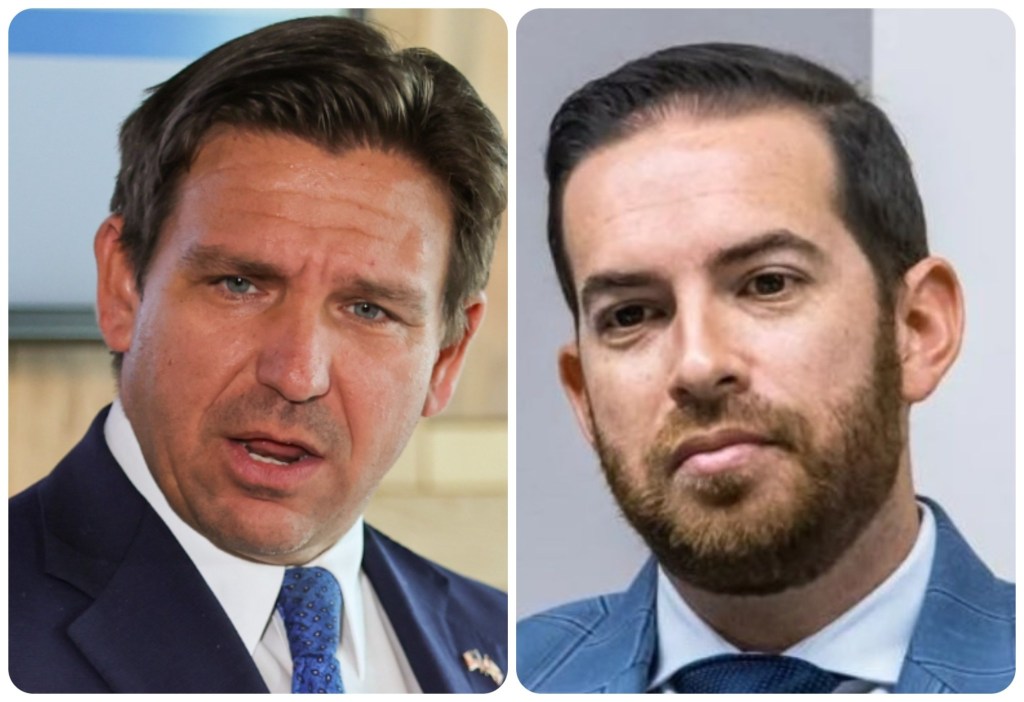
The result is a setback for Gov. Ron DeSantis, who couldn’t persuade the Florida Legislature to pass his AI agenda even though he spent months laying out his case and pushing for action.
“Things are happening very quickly, and the earth is moving underneath the feet of the American people without there really being any type of framework or safeguards or even a debate about whether this is actually going to be good for people,” DeSantis said at an event he convened at the state Capitol earlier this month to focus attention on the issue.
DeSantis said there are implications for jobs, for children, and for all of society. “There’s all these different questions that I think some people just want to put their head in the sand and act like just let big tech do what they want and everything’s going to be good.
“While we welcome technology that can enhance our experience as human beings, we should not be trying to generate technology that will supplant us as human beings,” the governor said. “You can’t have applications that are not controllable by human beings.”
Desantis was joined at that roundtable, as well as at other forums he’s held on the issue by people who described tragic consequences of artificial intelligence, including parents of children whose interactions with AI chatbots encouraged violence or suicide.
State government needs to step in to protect its residents, DeSantis repeatedly argued.
AI industry interests disagree and, especially significant, so does President Donald Trump.
The Trump administration wants the federal government, not the state, to deal with artificial intelligence. It wants a mostly hands-off approach to the technology, and wants the federal government to preempt state attempts at regulation.
Voter support
Close to nine in 10 of likely midterm election voters in Florida supported legislation along the lines of what DeSantis wanted.
A University of North Florida poll released on March 4 found widespread support for regulating AI in certain contexts, such as requiring chatbots to notify users that they are interacting with AI, prohibiting the alteration of images to create sexually explicit content, and restricting AI interactions for minors.
That policy prescription was supported by 86% of likely midterm election voters — including 68% who expressed strong support. Just 9% were opposed.
At least 83% of voters in every demographic group felt the same: Democrats, Republicans, no-party-affiliation independents, men, women, people with college degrees and people who don’t have college degrees.
“Seemingly ‘common sense’ AI regulations enjoy broad support,” Sean Freeder, a UNF political scientist and director of the university’s Public Opinion Research Lab, said in a written statement.
The proposal
DeSantis wanted an AI “bill of rights.”
Provisions included requiring companies to disclose to people if they were communicating with a human, an AI system or a chatbot. It also would set rules for unauthorized use of people’s names, images or likenesses, and restricted its use in licensed mental health settings.
It would have regulated companion chatbots, which are different from chatbots on many websites that people can use to ask routine questions. Companion chatbots can maintain a relationship that some may think is real. They couldn’t interact with children without parental consent and users would be reminded frequently that they weren’t speaking with a human being.
“There’s an inherent evilness when we allow machines to create and sustain a relationship that a user believes to be real,” state Sen. Tom Leek, R-Ormand Beach, the sponsor of Senate Bill 482, said during the debate. “That evilness is only magnified when that machine interacts with a child or vulnerable adult.”
Leek said AI wasn’t all bad, telling colleagues that it “holds promise of expanding and accelerating the application of knowledge to academic, economic, medical, and artistic pursuits.”
But he said, “some of its uses pose a novel and unique threat. … It is incumbent on us to protect Floridians from some of its problematic results.”
The bill passed the Senate 35-2. A few days later, on March 6, DeSantis made that final pitch at the Capitol. By then it was effectively dead.
The House
Policy and public sentiment aren’t the only factors in deciding whether proposed legislation is passed. For much of his time as governor, DeSantis was able to get the Legislature to implement all his policy agenda.
That changed in November 2024, when Speaker Daniel Perez, R-Miami, took charge of the state House of Representatives, putting him in position to advance or block any of DeSantis’ priorities for the final two legislative sessions of the governor’s time in office.
He’s become DeSantis’ most formidable foe of his tenure. The two men have been continually at odds — so much so that DeSantis didn’t shake Perez’s hand after he delivered his final State of the State address to a joint session of the House and Senate on the opening day of the annual legislative session.
At one point, it seemed as if the state House might act on AI.
Perez declared “Artificial Intelligence Week” for lawmakers from Dec. 8-12, featuring a series of hearings about the pluses and minuses of AI “to prepare us to deal with this topic for the upcoming session,” the speaker wrote in a memo to lawmakers.
On Dec. 11, President Donald Trump signed an order that sought to block state AI regulation on the grounds the industry could be stifled by a patchwork of state rules.
Subsequently, Perez said the issue should be handled at the federal level. The AI bill of rights never got a hearing in the Florida House.
Trump
As civil liberties and consumer rights groups have pushed for more regulations, the AI industry and Trump administration have pushed back, arguing that a patchwork of rules would hurt growth.
Trump outlined his view on federal supremacy of AI legislation in December, and the administration’s view strengthened this year. NBC News reported Trump’s AI czar David Sacks and other administration allies “directly lobbied against” DeSantis’ proposed legislation.
On March 20, the White House called on Congress to “preempt state AI laws” that it views as too burdensome.
The Trump administration’s framework calls for addressing some concerns about AI, but not curbing growth or innovation in the sector. The key points are protecting children, preventing electricity costs from surging, respecting intellectual property rights, preventing censorship and educating Americans on using the technology.
The Trump administration didn’t rule out all state regulation, including enforcement of general laws against AI developers, “to protect children, prevent fraud, and protect consumers.”
However, it says states “should not be permitted to regulate AI development,” shouldn’t penalize AI developers for a third party’s unlawful conduct using their product, and “should not unduly burden Americans’ use of AI for activity that would be lawful if performed without AI.”
In separate appearances, both DeSantis and Leek said depending on Congress to act means nothing will be done.
“This issue is too important to wait for Congress. If your plan is to wait for Congress, you know, God help you,” Leek told his colleagues.
Data centers
The Legislature passed one AI-related bill that DeSantis supported.
Under Senate Bill 484, companies looking to build the massive, power-hungry data centers used for AI will have to pay for their own electricity and water utilities — without affecting other ratepayers.
It includes language that reinforces the ability of local governments to refuse data centers.
“Data centers bring innovation and economic opportunities,” said state Rep. Griff Griffitts, R-Panama City Beach, sponsor of the House version of the bill. “This does not ban data centers. It simply puts guardrails in place so locals can have some controls.”
But the bill was made more industry-friendly with an amendment that allows local governments to enter into non-disclosure agreements with tech companies for up to 12 months, a provision that would hide data center proposals from the public.
The Trump policy said the federal government shouldn’t interfere with local authorities in deciding where to place data centers and other AI infrastructure.
Partisan divide
While voters want at least some regulation of AI, there is a deep political divide over the implications of the technology.
Overall, voters were evenly split — at 48% — about whether they support or oppose the rollout of artificial intelligence given its significant increase in usage over the past year.
But that tie masks significant partisan differences:
— A majority of Republicans, 57%, are in support, with 40% opposed.
— A majority of Democrats, 60%, are opposed, with 36% in support.
— No party affiliation/independent voters are effectively tied, with 48% support and 46% opposition.
“This is a huge partisan gap,” Freeder, the UNF political scientist, said in a telephone interview, with 17 percentage points positive among Republicans and 24 points negative among Democrats.
One factor that could be contributing to the greater Republican support for AI is Trump embracing its potential, Freeder said. Some Republicans could be following his lead as he has associated himself with AI.
There is also a noticeable gender gap on artificial intelligence. Men are supportive, 54% to 41%. Women are opposed, 54% to 43%. Illustrating the divide another way, men are supportive by 13 percentage points, women are opposed by 11 points.
Freeder said part of the reason for the gender gap could be that “some of the excesses of AI” such as deep fake nudes and revenge porn are “going to hit women harder than men.”
He said more research is needed to delve into the different outlooks.
There is a similar divide among college-educated voters, with 55% supportive to 41% opposed. It’s the mirror image among those without college degrees, with 52% opposed and 43% supportive.
Age is also a factor. Voters from 18-34, who may have the most familiarity with the technology and the greatest fears about the long-term implications for jobs, are far more negative than older voters.
— 18 to 34: 40% support, 56% oppose.
— 35 to 54: 55% support, 45% oppose.
— 55 and older: tied at 47%.
Fine print
The poll of 786 likely Florida midterm election voters was conducted by the University of North Florida’s Public Opinion Research Lab.
The poll, which used live callers for interviews by phone and online surveys distributed by text message, was conducted Feb. 21 through March 2.
The margin of error was plus or minus 4 percentage points for the full survey.
However, the margin of error for smaller groups, such as Republicans and Democrats, men and women, and younger and older voters, would be higher because the sample sizes are smaller.
This article includes information from The Associated Press and the News Service of Florida
Political writer Anthony Man can be reached at and can be found @browardpolitics on Bluesky, Threads, Facebook and Mastodon.

Related Posts