By Susan Svrluga THE WASHINGTON POST Something shifted in Dan Wang’s class at Columbia Business School in the fall of 2022. Instead of his students showing up prepared with persuasive arguments about business decisions, many students had asked ChatGPT to summarize case studies. It was understandable that they wanted to finish their homework more efficiently
New AI model detects multiple brain diseases from a single blood sample
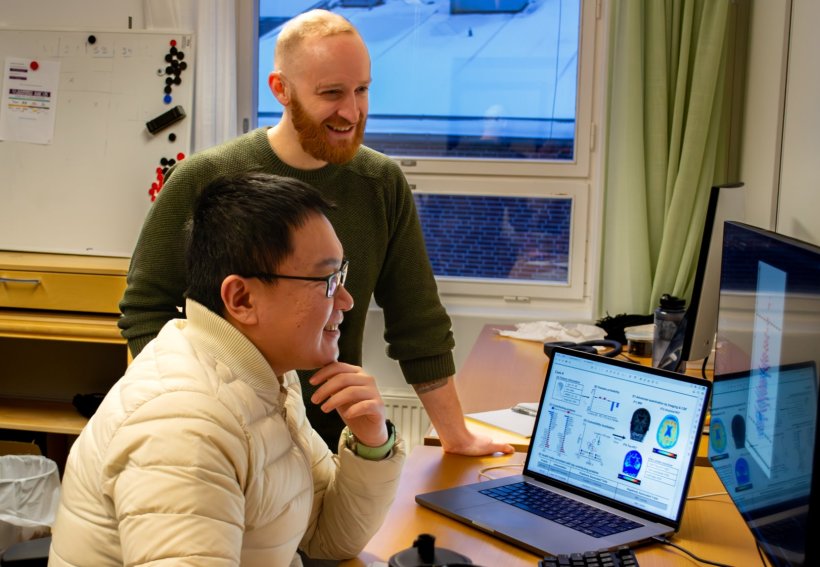
Two of the researchers behind the AI model, Jacob Vogel and Lijun An, show the results of their study.
Image source: Lund University; photo: Emma Nyberg
News • Deep joint-learning proteomics model
The symptom profiles of different neurodegenerative diseases often overlap, and diagnosing age-related cognitive symptoms is complex. A patient may have multiple overlapping disease processes in the brain at the same time.
Now, researchers at Lund University have developed an AI model showing that it is possible to detect several neurodegenerative diseases from a single blood sample. The study is published in Nature Medicine.
Different neurodegenerative conditions can present with similar symptoms, making it difficult to distinguish between them, for example, Alzheimer’s disease and Lewy body disease, especially in the early stages of cognitive decline.
We hope to inch closer toward a blood test that can make reliable diagnosis across disorders without aid from other clinical instruments
Jacob Vogel
Now, researchers Jacob Vogel and Lijun An, together with colleagues from the Swedish BioFINDER study and the Global Neurodegenerative Proteomics Consortium (GNPC, an international research consortium that has created the world’s largest proteomics database for neurodegenerative diseases) have developed an AI model capable of detecting multiple diseases at once. The model is based on protein measurements from more than 17,000 patients and control participants, collected from several datasets within GNPC’s proteomics database, the largest in the world for proteins related to neurodegenerative diseases.
“Our hope is to be able to accurately diagnose several diseases at once with a single blood test in the future,” says Jacob Vogel, who led the study. He is an assistant professor, head of a research group, and part of the strategic research area MultiPark at Lund University.
Using advanced statistical learning methods and a process known as “joint learning,” the researchers’ AI model was able to identify a specific set of proteins that form a general pattern for diseases involving brain degeneration. This learned pattern was then used to diagnose different neurodegenerative diseases. Vogel confirms that their AI model outperforms previous models, while also being able to diagnose five different dementia-related conditions: Alzheimer’s disease, Parkinson’s disease, ALS, frontotemporal dementia, and previous stroke.
The study stands out compared to similar research because the model’s results were validated across multiple independent datasets, according to the researchers. “We also found that the protein profile predicted cognitive decline better than the clinical diagnosis did, and it seems like individuals with the same clinical diagnosis may have different underlying biological subtypes,” says Lijun An, the study’s first author.
Many individuals diagnosed with Alzheimer’s disease showed a protein pattern more similar to other brain disorders. “This could mean they have more than one underlying disease, that Alzheimer’s can develop in multiple ways, or that the clinical diagnosis is incorrect. However, I don’t think current protein measurements from blood samples will be sufficient on their own to diagnose multiple diseases, we need to refine the method and combine it with other clinical diagnostic tools,” says Jacob Vogel.
At the same time, he emphasizes that diagnostics is not the only application of their model. Many of the proteins that contributed to the AI model point to areas where follow-up studies could lead to a better understanding of the disease-driving processes behind these neurodegenerative conditions.
The next step is to include more proteomic markers using advanced methods such as mass spectrometry to identify patterns unique to each disease. “We hope to inch closer toward a blood test that can make reliable diagnosis across disorders without aid from other clinical instruments,” says Jacob Vogel.
Source: Lund University; by Martina Svensson
05.04.2026

Related Posts