
New Version of MVTec HALCON Focuses on Speed and Performance of AI and Rule-Based Methods • New version HALCON 26.05 to be released on May 20, 2026 • HALCON 26.05 offers significant speed improvements for AI and rule-based methods • A new preview version of the IDE HDevelopEVO is also available as part of the
SwRI harnesses AI to find meaningful matches in solar data
Article Highlight | 14-Apr-2026
Novel tool combines generative machine learning model with supervised and self-supervised learning
Southwest Research Institute
image:
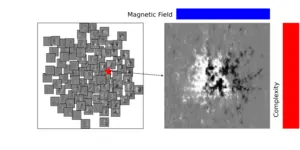
SwRI scientists integrated three types of machine learning models to generate images of solar magnetic patches with physically realistic properties and used those as a query to find matching patches in real observations. These artificial intelligence techniques allow scientists to tease out hidden magnetic data from real data (left panel). They work by structuring (ordering) data in a way that allows scientists to change the properties of objects by moving a slider along pre-defined directions that correspond to certain physical parameters. This illustration shows how scientists can explore the effects of increasing the magnetic field (blue bar) to the point that they develop the complexity (red slider) to potentially drive space weather events (right image).
view more
Credit: Southwest Research Institute
SAN ANTONIO — April 14, 2026 — New research led by Southwest Research Institute (SwRI) integrated three types of machine learning models to generate solar magnetic patches with physical properties and used those as a query to find matching patches in real observations. This elevates generative artificial intelligence (AI) from a means to produce artificial data to a novel tool for scientific data interrogation, supporting applicability beyond the heliophysics domain.
“Modern astronomical observatories may produce millions of gigabytes of data during their lifetime,” said SwRI’s Dr. Subhamoy Chatterjee, first author of a new Astrophysical Journal Supplement Series paper about this research. “Manually labeling and sifting through such a vast dataset is becoming impossible in a human lifetime. An even bigger problem is how to process these data and retrieve information hidden in such large datasets.”
Unraveling the rhythms of solar activity throughout its roughly 11-year cycle has fascinated scientists for over a century. Interpreting the patterns of solar active regions and their links to solar flares, coronal mass ejections, energetic particles and magnetic storms is crucial to protecting satellites and other Earth technology from space weather events. The active regions also carry information about the build-up of the Sun’s polar magnetic field, which is pivotal to understanding solar processes and to forecasting future solar cycles.
“For example, rogue active regions of unusual size, tilt and location have been found to make substantial impacts on solar cycles,” said SwRI’s Dr. Andrés Muñoz-Jaramillo, the paper’s second author. “However, such regions are rare occurrences. To efficiently explore possible outcomes and their impacts on solar cycles, a scientist might want to create additional artificial examples.”
Deep generative models have immense potential in generating unseen artificial data exhibiting properties of real data. These models learn complex high-dimensional data-generating distributions starting from lower-dimensional hidden data. Connecting physical properties to the hidden data allows scientists to create virtual representations of regions with interesting properties and use these to re-analyze historical data to find equivalent features, without having to look at every active region in the prior data.
Such techniques build confidence in the accuracy of generative AI models through direct interaction with real data familiar to scientists.
“We used magnetic field measurements from Space-weather HMI Active Region Patches (SHARPs) to train a generative AI model,” Chatterjee said. “We then trained a model to connect the physical space and hidden generative space through ‘directions’ that correspond to different specific physical properties of active regions, including polarity, magnetic flux, complexity, flaring nature, etc.”
These derived connections allow a user to physically manipulate a generated active region image so that a particular property is varied. The team then trained another machine learning model to make queries with generated images and find matching real images.
“The generative and supervised model combination enables users to make generative model outcomes physically consistent,” said Dr. Anna Malanushenko, the paper’s third author from the National Center for Atmospheric Research’s High Altitude Observatory. “Those outcomes can be used to retrieve real data that shares the same physical properties as the generated query.”
In heliophysics, this approach can serve as a generic framework for solving various problems such as instrument-to-instrument translation, artifact correction, reconstruction of far-side active regions and space weather forecasting.
To read the Astrophysical Journal Supplement Series paper, go to https://arxiv.org/pdf/2502.05351. DOI: https://doi.org/10.3847/1538-4365/ae47d9
For more information, visit https://www.swri.org/markets/earth-space/space-research-technology/space-science/heliophysics.
Disclaimer: AAAS and EurekAlert! are not responsible for the accuracy of news releases posted to EurekAlert! by contributing institutions or for the use of any information through the EurekAlert system.

Related Posts