The UK Government’s report on the copyright and AI consultation was recently published. While the report confirms that balancing the interests of copyrights holders and AI developers is a complex exercise, it also provides an indication of likely scenarios to consider in this fast-evolving environment. The consultation focused on whether AI developers should be permitted

AI Meets Quantum Computing and the Predictions Get Scary Accurate

Quantum computing is giving AI a major boost in predicting complex, chaotic systems. The new hybrid approach is more accurate, more stable, and far more efficient.
Researchers at UCL (University College London) have developed a new approach that combines quantum computing with artificial intelligence to better predict how complex physical systems behave over time. Their study shows that this hybrid method outperforms the most advanced AI models that rely only on traditional computing.
The findings, published in Science Advances, could lead to more accurate models of how liquids and gases move and interact (fluid dynamics). These types of predictions are essential in fields such as climate science, transportation, medicine, and energy production.
How Quantum Information Improves AI Performance
The team attributes the improved results to the way quantum computers store and process information. Traditional computers rely on bits that are either 1 or 0. In contrast, quantum computers use qubits, which can exist as 1, 0, or any value in between. In addition, qubits can influence each other, allowing even a small number of them to represent a vast range of possible states.
Professor Peter Coveney, senior author from UCL Chemistry and the Advanced Research Computing Centre, explained: “To make predictions about complex systems, we can either run a full simulation, which might take weeks – often too long to be useful – or we can use an AI model which is quicker but more unreliable over longer time scales.
“Our quantum-informed AI model means we could provide more accurate predictions quickly. Making predictions about fluid flow and turbulence is a fundamental science challenge but it also has many applications. Our method can be used in climate forecasting, in modeling blood flow and the interaction of molecules, or to better design wind farms so they generate more energy.”
Hybrid Quantum-AI Training Method
Although quantum computers are expected to surpass classical machines in power, their practical applications have so far been limited. This new method uses a quantum computer at a key stage in the AI training process.
Normally, AI models learn from large datasets generated through simulations or observations. In this approach, the data is first processed by a quantum computer, which identifies important statistical patterns that remain stable over time. These patterns, known as invariant statistical properties, are then used to train an AI model running on a conventional supercomputer.
Greater Accuracy and Efficiency
The results showed that the quantum-informed AI model was about 20 percent more accurate than a standard AI model that did not include quantum-derived patterns. It also maintained stability in its predictions over longer time periods when modeling chaotic systems.
In addition to improved accuracy, the method was far more efficient. It required hundreds of times less memory, making it a promising option for large-scale simulations.
Quantum Effects Behind the Advantage
This efficiency comes from two key features of quantum physics. Entanglement allows qubits to affect one another regardless of distance, while superposition enables a qubit to exist in multiple states at once until measured. Together, these properties give quantum systems significant computational power even with a small number of qubits.
Evidence of Practical Quantum Advantage
First author Maida Wang from the UCL Center for Computational Science said: “Our new method appears to demonstrate ‘quantum advantage’ in a practical way – that is, the quantum computer outperforms what is possible through classical computing alone. These findings could inspire the development of novel classical approaches that achieve even higher accuracy, though they would likely lack the remarkable data compression and parameter efficiency offered by our method. The next steps are to scale up the method using larger datasets and to apply it to real-world situations, which typically involve even more complexity. In addition, a provable theoretical framework will be proposed.”
Co-first author Xiao Xue from Advanced Research Computing at UCL added: “In this work, we demonstrate for the first time that quantum computing can be meaningfully integrated with classical machine learning methods to tackle complex dynamical systems, including fluid mechanics. It is exciting to see this kind of ‘quantum-informed’ approach moving towards practical use.”
Capturing the Nature of Chaos
The researchers believe quantum computers are especially well-suited to modeling these systems because they can efficiently represent the underlying physics. Many complex systems behave in ways that resemble quantum effects, where changes in one region can influence distant areas (much like entanglement).
Overcoming Current Quantum Limitations
Today’s quantum computers are still limited by noise, errors, and interference, which can require many repeated measurements. The team addressed this by using the quantum computer at only one stage of the process, rather than repeatedly transferring data between quantum and classical systems.
Study Details and Future Applications
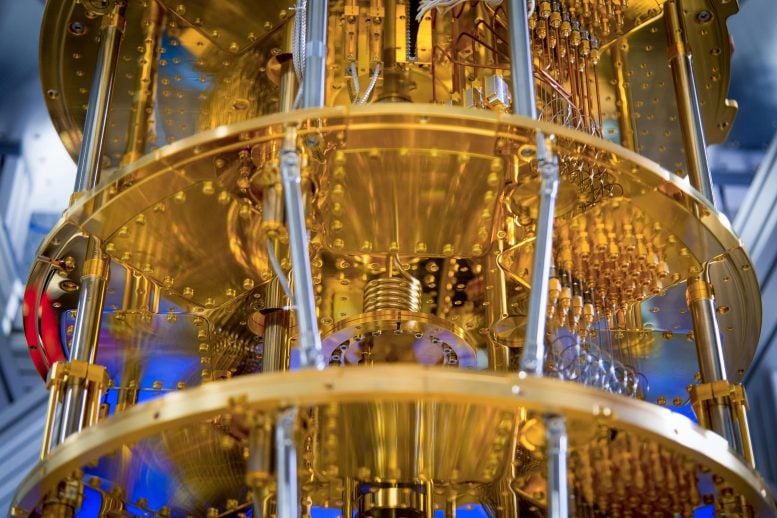
The research used a 20-qubit IQM quantum computer connected to classical supercomputing resources at the Leibniz Supercomputing Center in Germany.
To operate, quantum computers must be cooled to extremely low temperatures, around minus 273 °C (close to absolute zero, colder than anything in space).
Reference: “Quantum-informed machine learning for predicting spatiotemporal chaos with practical quantum advantage” by Maida Wang, Xiao Xue, Mingyang Gao and Peter V. Coveney, 17 April 2026, Science Advances.
DOI: 10.1126/sciadv.aec5049
The project was supported by funding from UCL and the UK’s Engineering and Physical Sciences Research Council (EPSRC), along with support from IQM Quantum Computers and the Leibniz Supercomputing Centre in Munich.
Never miss a breakthrough: Join the SciTechDaily newsletter.
Follow us on Google and Google News.

Related Posts