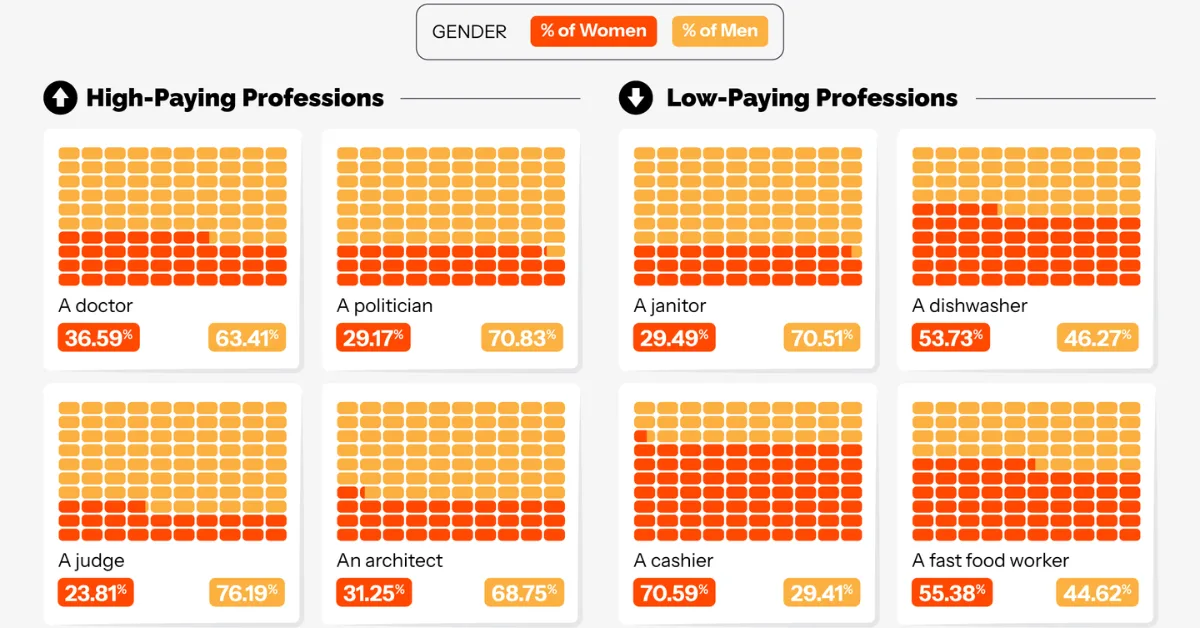
Male Doctors, Female Cashiers: AI’s Job Bias This was originally posted on our Voronoi app. Download the app for free on iOS or Android and discover incredible data-driven charts from a variety of trusted sources. Key Takeaways AI-generated videos depict roughly 70%+ of high-paying roles, such as CEOs, software engineers, and financial analysts, as male.

Why Machine Learning is Essential to Power Smarter Decision-Making
Agentic AI has quickly become the focal point of supply chain transformation. Research suggests that more than half of supply chain leaders view AI-driven changes as the single most influential force reshaping strategy over the next two years. Across the board, the growing ambition is to move toward autonomous, adaptive supply chains powered by AI.
But amid the excitement, many organizations are rushing ahead without laying the necessary groundwork. They are trying to deploy AI capabilities including more advanced agentic AI without first building the foundation that makes it effective. It’s like assembling a high-performance engine and expecting it to run, only to realize critical components were never installed.
The reality is that agentic AI is only as powerful as the tools it can access. And at the core of those tools is machine learning (ML).
The road to autonomous supply chains starts with machine learning
Agentic AI systems are fundamentally goal driven. They are designed to pursue outcomes (e.g. optimize inventory, improve service levels, reduce costs) rather than being constrained to static predefined tasks. To do this, they rely on a toolbox of capabilities: predictive models, optimization engines, reasoning frameworks, and data pipelines. Machine Learning is what powers much of that toolbox.
Without robust ML models, agentic systems lack the ability to interpret historical data, identify patterns, and generate meaningful predictions.
For supply chain leaders, this means the journey to agentic AI is an evolution. Mastering ML supports that journey.
ML delivers three foundational capabilities that are essential for modern supply chains and indispensable for agentic AI:
· Discovering hidden relationships in data. Supply chains are complex, with countless interdependencies across demand, supply, lead times, and external factors. ML models are critical for uncovering patterns that are not immediately visible, identifying causal relationships, detecting anomalies, and learning from historical behaviors. Agents leverage these insights. For example, an agent tasked with optimizing inventory can accomplish the task by understanding how demand variability, supplier performance, and seasonality interact – based on insights provided by ML.
· Improving data quality and completeness. While supply chain data is often fragmented, inconsistent, or incomplete, ML plays an important role in addressing these challenges by cleansing data, imputing missing values, enriching datasets, and detecting anomalies. Agents can orchestrate data workflows, but ML models do the heavy lifting to predict missing lead times, correct sales histories, and identify gaps through clustering and pattern recognition. This ensures that decisions are based on reliable, high-quality inputs.
· Enabling predictive and proactive decision-making. ML is key to transforming supply chain planning from reactive to proactive. By forecasting demand, predicting disruptions, and simulating outcomes, ML allows teams (and AI agents) to evaluate multiple scenarios and select optimal actions. As ML models learn over time, they continuously refine their accuracy, enabling better decisions with less human intervention.
3 ML use cases that enable agentic readiness
To build a strong foundation for agentic AI, organizations should focus on three key ML-driven capabilities:
1. Dynamic segmentation to meet business objectives. ML helps replace the traditionally static supply chain segmentation based on fixed attributes with a dynamic approach, using clustering techniques to group entities based on evolving patterns and business objectives. For example, this means products can be segmented based on demand variability, profitability, or risk exposure, while customers can be grouped by behavior or service requirements.
Agentic AI builds on this by using segmentation to tailor strategies. An agent might apply different inventory policies to different clusters or prioritize service levels based on customer value. But the segmentation and group identification come from ML.
2. Continuous improvement of model accuracy. ML enhances accuracy by identifying hidden relationships, tuning features, and adapting to new data, using advanced techniques such as causal modeling and refining prediction inputs. ML models can also evaluate their own performance and adjust accordingly.
Agentic depends on this continuous improvement. When an agent evaluates multiple courses of action, it relies on ML models to predict outcomes. The better the models, the better the inputs into decision-making.
3. Data enhancement. ML augments data by filling gaps and adding signals. Through clustering, pattern recognition, and predictive modeling, ML can infer missing attributes, harmonize datasets, and create a more complete picture of the supply chain. For example, if lead time data is missing, ML can estimate it based on similar attributes, suppliers, routes, etc.
Agentic AI can oversee and orchestrate data processes, while ML is a supporting tool that provides predictive signals.
A practical path forward
Machine learning is essential to power smarter decisions today and to support autonomous supply chains tomorrow.
AI agents can continuously interact with their environment, learn from outcomes, and adjust their strategies. But autonomy does not emerge overnight. It is built on layers of capability, starting with ML.
Organizations that invest in ML today and develop strong models to improve data quality, and embed predictive intelligence into their processes, are effectively preparing their systems for agentic AI. They are setting their supply chains up for success, building the tools, the logic, and the data foundation that agents will rely on.
The lesson here is to treat ML and agentic AI as deeply connected initiatives, where ML is a key component for a productive agentic system.
Before scaling agentic AI, ask these critical questions:
· Do we have reliable ML models in place?
· Are we leveraging ML to uncover insights and improve our data?
· Can our models support scenario analysis and decision-making?
Depending on the answers to these questions, you might want to shift your focus to build those capabilities first.
In the race toward agentic AI, ML is not a stepping stone to skip. It is part of the engine that makes the journey possible.

Related Posts