Credit: Zunaid Ali / How-To Geek Published Jun 27, 2026, 10:30 AM EDT Zunaid Ali first became interested in technology after using a computer for the first time in 2006. He's been producing how-to content since 2018, reaching thousands of people in the process. As a kid, Zunaid used to read tech tutorials and troubleshooting guides on
Machine learning-enhanced nano-QSAR and multiscale modeling for predictive nanomedicine: applications in herbal therapeutics and neglected tropical diseases – Discover Nano
1 Introduction
1.1 Nanomedicine and the growing importance of predictive modeling
Nanomedicine has undergone rapid expansion over the past two decades, driven by advances in engineering lipid nanoparticles (LNPs), polymeric nanocarriers, inorganic NPs, and hybrid nanosystems designed for targeted and controlled drug delivery [1]. LNPs have become central to nucleic acid therapeutics, particularly following their success in mRNA vaccine platforms, while polymeric systems such as PLGA, PEGylated polymers, and dendrimers are increasingly employed to enhance drug stability and circulation time [2, 3]. Inorganic nanomaterials, including gold, silica, and iron oxide NPs, further broaden the chemical and structural diversity of platforms available for therapeutic delivery and imaging applications [4]. This proliferation of nanocarrier architectures has made rational design essential, as reliance on empirical trial-and-error approaches is neither scalable nor efficient in the face of growing material complexity [5, 6].
As nanocarrier architectures increase in structural and compositional complexity, empirical optimization strategies become progressively inefficient, underscoring the need for systematic and predictive design frameworks capable of navigating high-dimensional formulation spaces [7,8,9,10]. Although numerous studies have explored individual nanocarrier platforms and their biomedical applications, existing reviews largely focus either on material development or application-specific outcomes in isolation [9, 11, 12]. Prior works have addressed nano-QSAR modeling [13,14,15,16,17,18,19,20], machine learning applications in nanomedicine [8, 21,22,23,24,25,26,27], or multiscale simulation approaches [24, 28] as separate topics, yet to our knowledge, no review has yet provided a unified framework that systematically combines descriptor engineering, predictive modeling, mechanistic simulations, and digital twin systems within a single translational roadmap [8, 11, 21, 23, 24, 29]. Addressing this gap is important, as the translational potential of these approaches is likely maximized when they are developed and applied in an integrated manner rather than independently.
The present review addresses this gap by synthesizing these domains into a hierarchical computational framework that links molecular-scale interactions to patient-level prediction. To illustrate the generalizability and practical utility of this framework across therapeutically and contextually distinct settings, we employ herbal nanomedicine and neglected tropical diseases as structured case studies, demonstrating how integrative predictive approaches can address complex, resource-constrained, and phytochemically diverse therapeutic challenges that existing modeling frameworks have not adequately served.
1.2 The nano-bio interface in drug delivery
The nano-bio interface encompasses the molecular and cellular interactions that occur when nanoparticles (NPs) encounter physiological environments. One of the earliest and most influential events is the formation of the protein corona, a dynamic layer of adsorbed biomolecules that confers a new “biological identity” on the NP surface [30]. The corona evolves temporally, with fast-exchanging soft components eventually giving way to more stable hard corona layers enriched in high-affinity proteins such as apolipoproteins, immunoglobulins, complement factors, and coagulation proteins, which collectively influence recognition by immune cells and endothelial surfaces [31].
Beyond corona formation, nanocarriers interact with blood components, including complement proteins, coagulation factors, and lipoproteins, modulating opsonization, immune clearance, and circulation half-life. Cellular uptake occurs through multiple endocytic pathways, including clathrin-mediated, caveolae-dependent, macropinocytosis, or phagocytosis, depending on NP size, shape, surface chemistry, and corona composition. Once internalized, NPs traffic through endosomal–lysosomal compartments and, for certain formulations, escape into the cytosol to release their therapeutic cargo in a controlled manner [32,33].
Figure 1 illustrates the sequential biological fate of NPs after systemic administration, including corona formation, immune recognition, cellular uptake, and intracellular trafficking. The unpredictable nature of corona formation and its impact on biodistribution and immune response represents a major translational challenge. The dynamic and context-dependent behavior of these interactions, coupled with patient- and disease-specific variability, makes empirical prediction of nanoparticle behavior difficult, highlighting the need for predictive computational strategies such as ML and nano-QSAR, which are discussed in the next section.
Sequential stages of nanoparticle interactions within biological systems, including protein corona formation, immune recognition, cellular uptake, and intracellular trafficking. These dynamic and context-dependent interactions influence biodistribution, therapeutic efficacy, and highlight the need for predictive computational modeling approaches
1.3 The need for machine learning in nano-QSAR
The complexity and multidimensionality of nanoparticle design, encompassing variations in size, shape, surface chemistry, material composition, and corona profiles, make exhaustive experimental evaluation impractical. Biological variability further amplifies this challenge, as nano-bio interactions differ across patients, disease states, and microenvironments. Traditional experimental approaches, while essential, cannot efficiently map these expansive parameter spaces, leading to high development costs and unpredictable translational outcomes [34].
1.3.1 Multi-parameter challenges in nanoparticle synthesis and optimization
Nanoparticle synthesis involves multiple interacting parameters, including solvent composition, precursor concentration, temperature, stirring rate, ligand density, and purification conditions. Traditional one-variable-at-a-time strategies fail to capture nonlinear interactions, while Design of Experiment (DoE) approaches offer only partial solutions and remain limited when descriptor dimensionality increases. Machine learning provides a scalable alternative, capable of modeling high-dimensional synthesis–property relationships and enabling rational optimization of nanoparticle formulations [35,36,37].
1.3.2 Machine learning in nanoparticle design and translation
A major challenge in nanomedicine is bridging the gap between in vitro characterization and in vivo performance. Protein corona formation, immune recognition, biodistribution, and clearance kinetics vary across biological systems and patient populations, making empirical prediction difficult. Machine learning models that integrate physicochemical descriptors, simulation-derived features, and biological endpoints can reduce this translational uncertainty by identifying patterns that link nanoparticle properties to systemic outcomes [8, 23, 38].
For example, ML models have been successfully applied to predict protein corona composition, macrophage uptake, and lipid nanoparticle optimization for nucleic acid delivery. Unlike conventional QSAR methods for small molecules, nano-QSAR frameworks incorporate multidomain descriptors capturing morphology, surface reactivity, and dynamic corona evolution [8, 38, 39]. Integration with multiscale simulations, from quantum mechanical calculations to coarse-grained molecular dynamics, further enhances predictive capacity by providing mechanistic insight and improving generalization. These approaches support a long-term vision of simulation-informed, AI-driven nanomedicine design capable of rapidly screening and optimizing formulations prior to in vivo testing [40].
Building on this rationale, the following review systematically synthesizes developments in nano-QSAR, machine learning, multiscale simulations, and emerging digital twin frameworks to provide a unified perspective on predictive nanomedicine, with a focus on translational applications in herbal nanomedicine and neglected tropical diseases.
2 Literature identification and scope
This review presents a structured narrative synthesis of computational approaches in predictive nanomedicine, integrating developments in nano-QSAR modeling, machine learning (ML), multiscale simulations, and emerging digital twin frameworks. Relevant literature was identified through systematic searches of PubMed, Web of Science, Scopus, and Google Scholar, covering publications from 2005 to 2024. Search terms included combinations of “nano-QSAR,” “nanoparticle modeling,” “machine learning in nanomedicine,” “protein corona modeling,” “digital twins,” “multiscale simulation,” “herbal nanomedicine,” and “neglected tropical diseases nanotechnology.” Articles were selected if they reported methodological advances, applied modeling frameworks to nanotherapeutics, or discussed translational applications, with priority given to studies demonstrating integration across modeling scales or linking physicochemical descriptors to biological outcomes. While not a systematic meta-analysis, this review synthesizes key strategies for integrating computational and experimental approaches and proposes a unified framework to guide predictive nanotherapeutic development.
3 Nano-QSAR: fundamentals and unique challenges
3.1 From classical QSAR to nano-specific modeling
Classical QSAR modeling was developed for small molecules, where well-defined descriptors capture topology, reactivity, and thermodynamics. These models assume structural homogeneity and predictable biological interactions [41, 42]. However, nanoparticles (NPs) possess multidimensional architectures, heterogeneous surface chemistries, and dynamic interfaces that interact with complex biological environments. Emergent features such as protein corona formation, aggregation tendencies, and shape anisotropy limit the direct applicability of classical QSAR [37, 43].
Nano-QSAR extends QSAR principles to nanoparticles, enabling systematic correlation of NP attributes with biological responses, toxicity, or therapeutic performance. Unlike classical QSAR, nano-QSAR accounts for particle size distributions, morphology, surface coatings, and dynamic transformations during biological exposure, making the models inherently multiscale and data-intensive [44, 45].
Accurate nano-QSAR models rely on descriptors capturing structural and interfacial NP features [46, 47]. Physicochemical descriptors include particle size, polydispersity index, zeta potential, aspect ratio, surface area, and crystallinity. Surface chemistry descriptors quantify ligand density, charge distribution, hydrophobicity, PEG conformation, and reactivity. Morphological descriptors capture core-shell organization, porosity, rigidity, flexibility, and surface roughness [48].
Quantum mechanical descriptors, such as frontier molecular orbital energies and electron density distributions, predict reactive hotspots and NP-biomolecule interaction strengths. Dynamic protein corona descriptors, such as protein abundance, binding affinity, and stability indices, encode evolving NP identity. Biological descriptors like cellular uptake, hemolytic activity, cytokine induction, and complement activation bridge NP properties with biological outcomes(see Fig. 2; Table 1 for a summary of descriptor categories) [31, 49].
3.2 Data heterogeneity and modeling constraints
Robust nano-QSAR models are limited by data heterogeneity and reproducibility challenges. Variability arises from batch-to-batch differences in size, surface chemistry, and morphology, as well as inconsistencies in characterization techniques (such as DLS vs. TEM) and biological endpoints. Public datasets are often small, incompletely annotated, and lack standardized reporting of protein corona composition, intracellular fate, and in vivo biodistribution [48,50]. This heterogeneity poses challenges for constructing datasets that meet the statistical requirements of ML models, particularly deep learning architectures that rely on large and standardized inputs.
Emerging initiatives, including standardized characterization protocols, community data repositories, and FAIR-compliant databases, are beginning to address these limitations. Addressing data gaps is critical not only for model robustness but also for regulatory acceptance of predictive nano-QSAR frameworks [51].
Conceptual overview of nano-QSAR modeling. Figure illustrates the evolution from classical to nano QSAR as well as the key descriptor categories (physicochemical, surface chemistry, morphological, quantum mechanical, protein corona, biological) involved
Full size table
4 Machine learning approaches for predicting nano-bio interactions
4.1 Classical machine learning models
Classical machine learning (ML) models have been widely employed to correlate nanoparticle descriptors with biological outcomes, forming the foundation of predictive nano-QSAR frameworks [63, 64]. Techniques such as random forests, support vector machines (SVMs), k-nearest neighbors (kNN), and decision trees have demonstrated the ability to predict cytotoxicity, cellular uptake, protein corona composition, and other biointeractions from curated physicochemical and surface chemistry descriptors [37, 65]. These models excel in interpretability and can handle moderate dataset sizes, allowing researchers to identify key descriptors driving specific biological effects (Fig. 3,A). For instance, random forest algorithms have been applied to classify metal oxide nanoparticle cytotoxicity, revealing size and surface charge as dominant predictors of reactive oxygen species generation [66]. Random forest models have been used to predict protein corona composition on nanoparticles, identifying physicochemical features such as zeta potential and hydrodynamic diameter as key predictors and demonstrating high predictive performance in cross validation [67]. Additionally, meta-analysis combined with machine learning achieved strong quantitative predictions of functional corona composition and associated cellular recognition outcomes (R² > 0.75) [68]. Despite their utility, classical models often struggle with very high-dimensional descriptor spaces or nonlinear relationships, motivating the development of more advanced deep learning strategies.
4.2 Deep learning methods
Deep learning approaches, including feedforward neural networks, convolutional neural networks (CNNs), recurrent neural networks (RNNs), and graph neural networks (GNNs), have emerged as powerful tools to capture complex, nonlinear, and high-dimensional relationships in nano-bio interactions [69]. CNNs can analyze three-dimensional nanoparticle structures or microscopy images, extracting spatial features relevant for predicting cellular uptake or aggregation tendencies. GNNs represent NPs as nodes and edges encoding atomic or ligand interactions, facilitating prediction of corona formation and binding affinities. Graph neural networks and related graph-based deep learning methods have shown strong performance in predicting complex biomolecular interactions such as protein–protein or protein–ligand binding, demonstrating the potential of such methods to capture structural interaction patterns that may be applicable to nanoparticle–protein interaction prediction in future studies [70, 71]. RNNs and transformer-based architectures are particularly useful for modeling sequential or dynamic data, such as time-dependent corona evolution or ligand exchange processes (Fig. 3,B). Deep learning models can also integrate heterogeneous datasets, including physicochemical descriptors, quantum mechanics-derived features, and molecular dynamics simulations, allowing for more mechanistic predictions of nanoparticle behavior in biological environments [4, 72].
4.3 Multi-task and ensemble learning
Multi-task learning (MTL) and ensemble strategies enhance prediction accuracy by leveraging correlated endpoints or complementary models [73]. In MTL, a single model simultaneously predicts multiple outcomes, such as cellular uptake, ROS generation, and cytokine induction, to enable shared representation learning and reduce overfitting on small datasets [74]. Ensemble methods, including gradient boosting and model stacking, combine predictions from multiple base learners to improve robustness and generalization across diverse nanoparticle types. These approaches are particularly valuable for predicting complex nano-bio phenomena, where single models may fail to capture multifactorial effects spanning physicochemical, surface chemistry, and biological descriptor spaces (Fig. 3,C).
4.4 Explainable AI (XAI)
A critical requirement for clinical translation of ML-based nano-QSAR models is interpretability. Explainable AI (XAI) methods, such as SHapley Additive exPlanations (SHAP), feature importance ranking, and partial dependence plots, allow researchers to quantify the contribution of individual descriptors to predicted outcomes [75, 76]. XAI is particularly important for regulatory and clinical translation because regulatory agencies require interpretable models that clearly link nanoparticle properties to predicted biological outcomes. Transparent models help justify safety decisions, support reproducibility, and provide mechanistic rationale for in vivo studies, facilitating adoption in therapeutic development pipelines [77,78,79] For instance, SHAP analysis can identify specific ligand densities or surface charges as dominant determinants of macrophage uptake, guiding subsequent synthesis strategies (Fig. 3,D).
Machine learning approaches for predicting nano-bio interactions. A schematic overview of computational strategies used to predict nanoparticle-biological interactions. A illustrates classical machine learning models linking curated nanoparticle descriptors to cytotoxicity, cellular uptake, and protein corona formation. B depicts deep learning architectures capturing complex, high-dimensional, and time-dependent nanoparticle behaviors while C shows multi-tasking and ensemble learning frameworks integrating correlated biological endpoints and complementary models to improve predictive performance. D highlights explainable AI methods that identify key nanoparticle features driving predictions, supporting mechanistic insight and regulatory transparency
5 Simulations and multiscale modeling at the nano–bio interface
5.1 Molecular and electronic-level modeling
Molecular simulations provide detailed insight into nanoscale interactions between nanoparticles (NPs) and biological systems [80, 81]. Atomistic molecular dynamics (MD) simulations provide detailed insight into nanoscale interactions between NPs (NPs) and biomolecules, capturing the dynamics of protein adsorption, lipid membrane insertion, and nanoparticle stability under physiological conditions. MD has been applied to study the binding of plasma proteins to nanoparticle surfaces, elucidating the formation and evolution of the protein corona [49, 58]. These simulations at this scale can also explore endosomal uptake pathways, nanoparticle-induced membrane deformation, and drug release kinetics at atomic resolution to support rational design of nanocarriers with optimized uptake and intracellular trafficking [32, 33].
To extend spatial and temporal scales, coarse-grained (CG) MD simulations reduce computational complexity by grouping atoms into larger interaction units, enabling modeling of larger systems over longer timescales. CG-MD is particularly useful for studying corona evolution over minutes to hours, nanoparticle aggregation, and membrane-wrapping during endocytosis [82, 83]. Liposomes, polymeric micelles, and other complex nanosystems can be simulated efficiently, providing predictions of uptake propensity, stability in circulation, and interactions with cellular membranes [84].
At the electronic scale, quantum mechanical (QM) and density functional theory (DFT) methods calculate electronic properties, reactive hotspots, and binding energies between NPs and small molecules or biomolecules [85]. Key descriptors such as HOMO-LUMO gaps, electron density distributions, and surface reactivity indices can inform nano-QSAR and ML models. For instance, DFT has been used to predict the energetics of drug-nanocarrier interactions and the redox activity of metal NPs in biological fluids [86].
5.2 Continuum and mesoscale modeling
Continuum and mesoscale models bridge molecular-level simulations with tissue- or organ-level predictions. Techniques including dissipative particle dynamics, finite element modeling, and lattice Boltzmann methods simulate nanoparticle transport through blood vessels, extracellular matrices diffusion, and circulation dynamics [87]. These approaches allow quantitative prediction of biodistribution, tissue accumulation, and clearance kinetics to provide a mechanistic link between molecular properties and systemic pharmacokinetics (Fig. 4).
5.3 Modeling challenges
Despite significant advances, simulation-based modeling of the nano-bio interface faces multiple challenges. Force field limitations, especially for hybrid or functionalized NPs, can reduce accuracy [88]. Computational cost remains high for large or long-timescale simulations, while reproducibility across NP types is hindered by parameter heterogeneity. Integrating results across scales, from quantum mechanical interactions to tissue-level transport, requires robust validation against experimental data and standardized protocols [89].
Simulations and multiscale modeling at the nano-bio interface. Hierarchical schematic of multiscale computational approaches for modeling nano-bio interactions, from atomistic simulations of protein adsorption and membrane interactions (Panel A), to coarse-grained dynamics of aggregation and corona evolution (Panel B), quantum mechanical calculations of reactivity (Panel C), mesoscale and continuum models of transport and tissue distribution (Panel D), and key challenges in cross-scale integration and computational cost (Panel E)
6 Integrating machine learning, simulations, and nano-QSAR
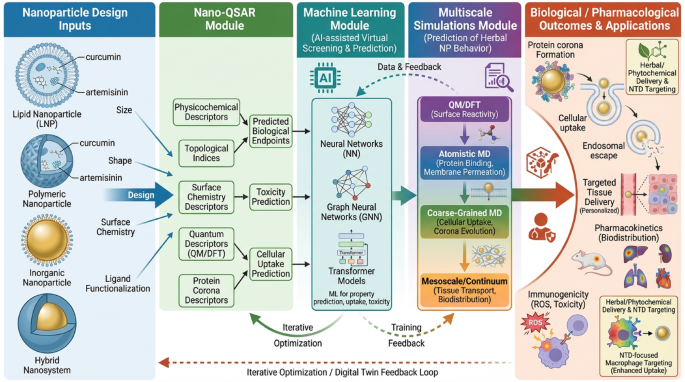
This section presents an integrated workflow for predictive nanomedicine, where multiscale simulations generate mechanistic descriptors that feed into ML and nano-QSAR models, hybrid physics-informed networks enhance interpretability and predictive accuracy, and ML-assisted surrogate models accelerate computational pipelines. Together, these approaches form a virtual design ecosystem capable of predicting nanoparticle uptake, toxicity, biodistribution, dynamic nano–bio phenomena, and systemic pharmacokinetics, enabling rational optimization of nanocarrier properties prior to experimental testing.
6.1 Simulation-derived descriptors
Integrating simulation-derived descriptors into machine learning (ML) and nano-QSAR frameworks enhances predictive accuracy by capturing mechanistic details inaccessible from experimental measurements alone [90]. Atomistic and coarse-grained molecular dynamics (MD) simulations provide features such as binding free energies, solvent-accessible surface area (SASA), radius of gyration, membrane-wrapping propensity, and corona stability, while quantum mechanical (QM) descriptors offer electronic properties including HOMO-LUMO gaps, electron density distributions, and reactive hotspots [37]. These simulation-informed descriptors serve as inputs for ML models, enabling more mechanistically grounded predictions of cellular uptake, toxicity, and biodistribution.
6.2 Hybrid physics-ML models
Hybrid physics-ML models combine mechanistic simulation data with experimental measurements to create predictive frameworks that retain interpretability while accommodating complex, nonlinear relationships. Physics-informed neural networks (PINNs) have been applied to nanoparticle behavior prediction, incorporating MD- or QM-derived physical constraints into deep learning architectures [91, 92]. This approach allows simultaneous prediction of multiple nano-bio outcomes while ensuring consistency with fundamental chemical and physical principles, enhancing reliability for design optimization.
6.3 ML-assisted accelerated simulations
Machine learning can accelerate computationally intensive simulations through surrogate modeling, parameter estimation, and trajectory prediction. For instance, ML models can predict force-field parameters or approximate long MD simulations, reducing computational cost while retaining high fidelity for large NPs or multicomponent systems [93]. This acceleration enables rapid screening of nanocarriers under varying biological conditions, including complex fluids or multicomponent corona formation.
6.4 ML for dynamic nano-bio phenomena
Dynamic nano–bio phenomena such as time-dependent corona evolution, endocytosis, intracellular trafficking, and drug release kinetics can be modeled using ML approaches trained on simulation and experimental data [33, 40]. Models can predict corona exchange rates, surface ligand rearrangements, and time-dependent uptake across different cell types, allowing virtual optimization of nanoparticle surfaces for improved targeting and reduced clearance. These frameworks facilitate iterative in silico design prior to experimental synthesis (Fig. 5).
6.5 Integrated Virtual Design Pipelines
The integration of nano-QSAR, ML, and multiscale simulations enables fully in silico design pipelines. Such pipelines can virtually screen nanoparticle libraries for optimal physicochemical properties, corona profiles, and cellular uptake, and predict pharmacokinetics, biodistribution, and toxicity [94]. Digital twin approaches extend this concept, creating computational replicas of NPs interacting with cells and tissues to optimize formulation parameters, drug loading, targeting ligands, and circulation time. These integrated pipelines drastically reduce trial-and-error experimentation, accelerating rational nanomedicine development [95].
Integrating machine learning, simulations, and nano-QSAR for predictive nanomedicine. This schematic illustrates the end-to-end workflow in which multiscale simulations, ML, and nano-QSAR models are integrated to enable predictive, mechanistic, and accelerated nanoparticle design
Multiscale simulations generate mechanistic descriptors that feed into machine learning and nano-QSAR models, while hybrid physics-informed networks and surrogate modeling enhance interpretability, predictive accuracy, and computational efficiency. Together, these approaches form a virtual workflow for rationally optimizing nanoparticle properties, pharmacokinetics, biodistribution, and safety prior to experimental testing, providing a roadmap for end-to-end predictive nanomedicine design.
6.6 Case study I: Herbal nanomedicine
Phytochemicals such as curcumin, resveratrol, artemisinin, quercetin, and berberine exhibit significant therapeutic potential but face challenges including poor solubility, rapid metabolism, and low bioavailability [96]. Nanocarrier encapsulation overcomes these challenges by improving solubility, protecting compounds from degradation, and enabling targeted delivery. Green-synthesized nanoparticles (NPs) and plant-derived capping agents have gained attention for their biocompatibility and sustainable production [59]. Predictive modeling, including machine learning and nano-QSAR, improves reproducibility in herbal nanomedicine by accounting for variability in plant extracts and formulation conditions, enabling consistent prediction of stability, loading efficiency, and bioactivity across different batches [97].
6.6.1 Unique descriptor considerations for herbal-derived nanostructures
Herbal-derived nanostructures present distinct nano-QSAR challenges [98]. Plant-extract-mediated synthesis of metallic NPs, such as silver, gold, or zinc oxide, produces surfaces coated with secondary metabolites including flavonoids, terpenoids, polyphenols, and tannins [99,100,101]. These biomolecules influence nucleation, particle morphology, oxidation state, and long-term stability, creating surface signatures that differ quantitatively from conventional chemically synthesized NPs, which rely on defined ligands or polymers [102, 102,103,104]. For example, silver nanoparticles synthesized using curcumin or plant extracts display variable corona composition and surface reactivity that can be captured using phytochemical-binding indices, metabolite–surface interaction energies predicted via molecular docking or quantum simulations, and spectral fingerprints of plant-derived capping agents [61].
Phytochemical-rich coronas can also alter protein adsorption patterns, membrane interactions, and immune recognition. Incorporating descriptors for secondary metabolite density, antioxidant surface activity, and corona shifts enhances predictive accuracy and provides mechanistic insight into cellular uptake, immune interactions, and antimicrobial activity [49, 96].
6.6.2 Machine learning models for herbal nanocarriers
Machine learning is increasingly applied to optimize loading, stability, and delivery efficiency of phytochemical nanocarriers [90]. Predictive models can estimate encapsulation efficiency for hydrophobic compounds such as curcumin, resveratrol, and artemisinin based on nanoparticle size, surface chemistry, and formulation parameters [54, 105]. ML can also guide solvent selection and extraction conditions for green NP synthesis, optimizing particle size and surface functionalization. Integrating descriptors from quantum mechanics, molecular docking, and physicochemical characterization accelerates rational design while improving reproducibility by predicting outcomes despite natural variability in plant extracts.
6.6.3 Simulation of herbal molecules and plant-derived capping agents
NPs derived from plant extracts or loaded with phytochemicals pose unique simulation challenges [103, 106]. Atomistic MD can model the adsorption and orientation of flavonoids, terpenoids, and other bioactive molecules on NP surfaces, predicting loading efficiency and release kinetics [54, 61]. DFT approaches can simulate plant-extract-mediated reduction of metal ions during green synthesis, revealing electronic factors that stabilize NP cores and modulate surface reactivity [106]. These simulation-based descriptors can be fed into ML and nano-QSAR frameworks to anticipate stability, bioactivity, and corona formation, linking molecular-level interactions to cellular and systemic behavior.
6.6.4 Integrating green-nanotechnology (herbal) data into ML pipelines
Incorporating biogenic and phytochemical-based NPs into ML pipelines presents unique opportunities for herbal nanomedicine design. Models can predict optimal ratios of secondary metabolites for nanoparticle synthesis, optimizing loading efficiency, particle stability, and bioactivity [61]. Environmental stability of plant-extract-capped NPs, including thermal and oxidative resilience, can also be predicted computationally, facilitating the design of robust biogenic nanocarriers suitable for variable storage and transport conditions. Phytochemical-loaded NPs, such as curcumin, resveratrol, and artemisinin formulations, often suffer from poor solubility and bioavailability. Surrogate ML models and simulation-assisted pipelines can forecast optimal NP composition, solvent choice, and surface modifications to improve solubility, cellular uptake, and therapeutic efficacy. For instance, curcumin-loaded lipid or polymeric NPs designed using these predictive tools demonstrate improved gastrointestinal absorption and reduced degradation, effectively translating traditional herbal therapeutics into modern nanomedicine formulations [61, 105]. Overall, these frameworks create an end-to-end virtual workflow that complements the simulation and ML strategies described in Sects. 4 and 5, bridging herbal nanomedicine design with mechanistic predictive tools.
6.7 Case study II: Nanomedicine for neglected tropical diseases
Neglected tropical diseases (NTDs), including leishmaniasis, schistosomiasis, trypanosomiasis, and lymphatic filariasis, disproportionately affect low- and middle-income countries where access to affordable therapeutics is limited. Nanomedicine offers promising solutions to improve treatment efficacy through targeted delivery, reduced toxicity, and enhanced drug stability under challenging environmental conditions [107].
Liposomal amphotericin B, polymeric nanocarriers for anti-helminthic drugs, and metallic NPs with antiparasitic activity exemplify emerging nano-based interventions. Predictive modeling frameworks that integrate machine learning (ML), nano-QSAR, and multiscale simulations can accelerate design, optimize formulation properties, and reduce experimental burden, while specifically addressing constraints such as cost, environmental stability, and heat- and humidity-resilience required for deployment in endemic regions [108].
6.7.1 Nano-QSAR descriptors relevant to NTD-targeting nanocarriers
Effective NTD-targeting nanocarriers interact with both parasites and host immune cells in disease-specific ways. For intracellular pathogens like Leishmania spp., macrophage-targeting descriptors such as surface mannose density, net charge, and ligand–receptor affinity are critical. Parasite membrane descriptors, such as binding energies to ergosterol-rich membranes or surface glycoproteins, can be derived from MD simulations or experimental assays [62].
For diseases requiring mucosal penetration, including schistosomiasis and helminth infections, descriptors capturing nanoparticle diffusion in mucus, adhesion to mucin, and aggregation in gastrointestinal conditions are essential to predict oral bioavailability, tissue penetration, and therapeutic distribution. Limited experimental datasets for NTD-targeted nanomedicines present challenges for model robustness, but simulation-derived descriptors and transfer learning approaches can partially mitigate this issue. By tailoring nano-QSAR frameworks to incorporate parasite-specific and tissue-specific descriptors, ML-enabled predictions can guide the design of cost-effective nanocarriers optimized for endemic regions where NTDs are prevalent [60, 62].
6.7.2 ML for nanomedicines targeting neglected tropical diseases (NTDs)
The development of nanocarriers for NTDs faces additional challenges due to parasitic intracellular localization, tissue-specific delivery requirements, and environmental constraints in endemic regions. Machine learning models can predict macrophage uptake for intracellular pathogens, such as Leishmania spp., based on nanoparticle surface chemistry, size, and ligand density [60, 62]. Similarly, ML can identify features enhancing blood-tissue migration in trypanosome infections, facilitating systemic parasite targeting. Predicting nanoparticle stability under tropical climatic conditions, including high temperature and humidity, is another critical application, allowing rational design of formulations suitable for low- and middle-income countries (LMICs). Integration of ML with nano-QSAR and simulation data allows in silico screening of multiple nanoparticle properties simultaneously, including size, surface chemistry, ligand density, and release kinetics, while accounting for constraints specific to low-resource settings [107].
6.7.3 Simulation of nano–parasite interfaces in NTDs
Neglected tropical disease (NTD) applications require modeling NP interactions with parasite membranes and infected host tissues. Atomistic MD can simulate nanoparticle penetration through parasitic membranes, predicting uptake efficiency and potential toxicity [109]. Coarse-grained or mesoscale simulations enable analysis of transport through granulomatous or fibrotic tissue common in visceral leishmaniasis and schistosomiasis, informing macrophage targeting and tissue penetration strategies [109]. Combining these simulations with ML and nano-QSAR enables in silico optimization of nanomedicines for NTDs under physiologically relevant and environmentally constrained conditions.
6.7.4 ML and multiscale models for NTD therapeutics
For neglected tropical diseases (NTDs), ML and multiscale simulations can guide nanoparticle optimization for parasite-targeted therapy. Predictive models can estimate macrophage uptake and distribution within infected tissues, accounting for granulomatous or fibrotic microenvironments [62]. Coupled with PK/PD models, these frameworks can simulate nanoparticle-parasite interactions, drug release kinetics, and therapeutic efficacy, providing a rational design strategy for nanomedicines against intracellular pathogens such as Leishmania or systemic parasites like Trypanosoma [55, 62]. NPs must reach intracellular parasites, often within macrophages, and survive challenging environmental conditions such as heat and humidity. Liposomal amphotericin B for Leishmania treatment has been optimized using ML to improve macrophage targeting and minimize systemic toxicity. Similarly, NPs delivering trypanosomal or schistosomal drugs can be designed to enhance tissue penetration and controlled release, enabling cost-effective, heat-stable formulations suitable for low-resource settings [56, 110]. Integration of simulation-derived descriptors into ML pipelines allows rapid in silico optimization of parasite-targeted nanocarriers, balancing efficacy, stability, and manufacturability.
This case study demonstrates how predictive modeling frameworks, previously applied to herbal nanomedicine, can be extended to NTD therapeutics. By tailoring descriptors, ML models, and simulations to disease-specific biological and environmental constraints, these approaches enable rational design of nanomedicines with high translational potential in resource-limited settings (Fig. 6).
Machine learning-integrated nano-QSAR in herbal and NTD therapeutics. Schematic overview of AI-integrated nano-QSAR and multiscale modeling frameworks applied to herbal nanomedicine and nanocarriers for neglected tropical diseases (NTDs). For phytochemical systems, simulation-derived descriptors and surface chemistry parameters guide machine learning models to optimize encapsulation, stability, release, and bioavailability A. For NTD applications, predictive models can incorporate macrophage targeting, parasite membrane affinity, tissue penetration, and environmental stability to enable rational nanocarrier design B.
7 Translational applications of ML-enhanced nano-QSAR in drug delivery
The integration of machine learning (ML) with nano-quantitative structure-activity relationship (nano-QSAR) modeling has transformed nanomedicine from empirical formulation toward predictive, mechanism-driven design. Rather than treating nanoparticle (NP) properties, biological interactions, pharmacokinetics, and safety as independent endpoints, ML-enhanced nano-QSAR frameworks enable multiscale modeling that links physicochemical descriptors to biological performance across systemic, cellular, and molecular levels. Translational applications of this framework requires integration across three hierarchical layers: mechanistic determinants of nanoparticle behavior, platform-specific computational optimization, and disease-level implementation.
7.1 Mechanistic determinants of nanoparticle performance
Nanoparticle behavior in vivo emerges from interconnected mechanistic processes that begin at the nano-bio interface and extend to systemic pharmacological response. Among these, protein corona formation represents the earliest biological event following exposure to physiological fluids. Nanoparticles rapidly adsorb plasma proteins and biomolecules, forming a dynamic corona that defines their biological identity rather than their synthetic surface chemistry alone [111]. Corona composition is strongly influenced by size, curvature, surface charge, hydrophobicity, and surface functionalization [112, 113]. This acquired layer governs circulation time, immune recognition, cellular uptake, and biodistribution [111, 114].
ML-enhanced nano-QSAR models leverage high-dimensional proteomic datasets to predict corona composition directly from nanoparticle descriptors. Mechanistic studies have demonstrated that curvature and charge density modulate selective adsorption of opsonins such as immunoglobulins and complement proteins [112, 115]. Contemporary ML approaches extend this by integrating engineered descriptors, including zeta potential, hydrophobicity indices, PEG surface density, and topological surface parameters, to generate predictive “corona fingerprints,” probabilistic adsorption profiles that anticipate immune surveillance and clearance behavior [116, 117]. Increasingly, hybrid simulation-ML pipelines incorporate molecular dynamics modeling to capture competitive binding kinetics and temporal remodeling of the corona [118]. Because corona evolution influences mononuclear phagocyte system (MPS) recognition and clearance [114, 119], these models enable early prediction of systemic persistence and complement activation risk.
Following systemic circulation, nanoparticle efficacy depends on cellular internalization and intracellular trafficking. Uptake mechanisms, including clathrin-mediated endocytosis, caveolae-mediated endocytosis, and micropinocytosis, are highly sensitive to size, shape, elasticity, and ligand density [120,121,122]. Nano-QSAR models trained on uptake datasets use nonlinear classifiers to distinguish predominant endocytic pathways from physicochemical descriptor spaces [123]. Ligand density modeling has revealed threshold-dependent multivalent receptor engagement effects that are not captured by linear models, underscoring the value of ML in decoding nonlinear uptake behavior [124].
Intracellular trafficking introduces additional complexity. Endosomal escape is a primary bottleneck for nucleic acid and biologic delivery systems. Predictive modeling incorporates descriptors such as ionizable group pKa, buffering capacity, and membrane-disruptive potential to estimate cytosolic release probability. Ionizable lipids with optimal pKa values of 6.2–6.5 have been identified as critical determinants of efficient siRNA delivery, with only approximately 1–2% of siRNA molecules escaping from endosomes under suboptimal conditions [125]. ML-guided screening of delivery systems has improved prediction of transfection efficiency compared with heuristic design rules [126]. Furthermore, intracellular persistence modeling integrates degradation kinetics and lysosomal stability to predict payload release timing and subcellular residence [127]. These integrated models bridge nanoparticle structure to intracellular function.
At the organismal level, pharmacokinetics and pharmacodynamics (PK/PD) define therapeutic exposure. Biodistribution is shaped by size, surface chemistry, elasticity, and corona composition [119, 128]. Particles below renal filtration thresholds are rapidly cleared, whereas opsonized or larger particles accumulate in liver and spleen via MPS uptake [128, 129]. ML-enhanced nano-QSAR models trained on quantitative biodistribution datasets predict organ-specific accumulation patterns using descriptor-based regression and deep learning architectures [130]. When coupled with physiologically based pharmacokinetic (PBPK) modeling, these approaches enable simulation-informed refinement of tissue distribution and cross-species extrapolation [131]. PBPK models for nanoparticles must incorporate nano-specific transport mechanisms, including opsonization and uptake by the MPS, recognition and internalization by cells, the enhanced permeability and retention (EPR) effect, lymphatic transfer, and enzymatic degradation. The phagocytic cells (PCs)-PBPK model structure, which integrates cellular processes such as phagocytosis and EPR effects, has demonstrated superior performance compared to simpler EPR-only models in predicting concentration-time profiles across organs. Clearance modeling incorporates renal filtration constraints, hepatic uptake predictors, and opsonization-mediated macrophage recognition [129], while circulation half-life prediction is closely associated with PEGylation density and surface neutrality [132]. Mapping nano-QSAR descriptors to PK parameters such as area under the curve (AUC), maximum concentration (Cmax), and tissue exposure ratios provides a unified framework linking nanoparticle design to systemic pharmacodynamics.
From a translational perspective, safety and immunogenicity are inseparable from efficacy. Nanoparticle-induced toxicity may arise from oxidative stress, cytokine release, complement activation, and gene expression perturbations [133]. Surface reactivity descriptors, including redox potential and catalytic activity, have been integrated into nano-QSAR models predicting reactive oxygen species (ROS) generation [134]. Supervised ML models trained on immune cell assays can forecast cytokine induction profiles based on charge density, hydrophobicity, and corona features [135], while complement activation risk, an important determinant of infusion-related reactions, can be predicted using physicochemical and adsorption descriptors [136]. Integration of toxicogenomic data further enables mapping of nanoparticle properties to gene expression signatures associated with inflammatory and apoptotic pathways [137]. Explainable AI approaches enhance interpretability by identifying dominant safety-driving features, thereby increasing regulatory confidence and supporting rational risk mitigation during design [138]. Collectively, mechanistic nano-QSAR modeling transforms safety assessment from a retrospective screening process into a predictive design parameter.
7.2 Platform-specific nano-QSAR optimization
Lipid nanoparticles (LNPs) represent a prominent translational platform in which ionizable lipids, helper lipids, cholesterol, and PEG-lipids collectively determine delivery performance. Ionizable lipid pKa strongly influences endosomal escape and transfection efficiency [139, 140]. ML-guided screening of combinatorial lipid libraries has enabled identification of structural motifs associated with improved mRNA delivery, with one notable effort applying large-scale in silico screening of nearly 20 million ionizable lipids to discover novel candidates that outperformed well-established benchmarks including MC3 (the primary ionizable lipid in Onpattro, the first FDA-approved RNAi therapy) and SM-102 (used in Moderna’s COVID-19 mRNA vaccines) [139].
PEGylation density modeling refines predictions of steric stabilization, reduced opsonization, and extended circulation, while balancing immunological considerations [141]. Integrated nano-QSAR frameworks correlate lipid composition descriptors with protein expression levels and tolerability, accelerating rational LNP design [139]. The importance of proton-buffering capacity and specific lipid-membrane interactions as descriptors for endosomal escape prediction has been highlighted, with ML models capable of identifying patterns in physicochemical descriptor spaces that conventional experiments might overlook [139].
Polymeric nanoparticles offer tunable degradation kinetics and controlled release behavior. In poly(lactic-co-glycolic acid) (PLGA) systems, degradation depends on copolymer ratio, molecular weight, and crystallinity [142]. ML models trained on hydrolysis and release datasets can predict degradation half-life and drug release profiles under physiological conditions [142]. Surface functionalization parameters, including ligand density and charge distribution, are incorporated into descriptor spaces to predict receptor-mediated uptake and biodistribution changes [139]. Such ML-guided polymer selection enables simultaneous optimization of stability, targeting efficiency, and biocompatibility.
Metallic nanoparticles require careful control of surface reactivity to balance therapeutic function and toxicity. Surface energy, oxidation potential, and crystal facet exposure influence ROS generation and cytotoxicity [143]. Nano-QSAR models integrating these descriptors can predict oxidative stress induction and viability outcomes [143]. Early attempts at applying QSAR to metallic and metal oxide nanoparticles incorporated molecular-level descriptors such as electronegativity and oxidation state but largely overlooked size-dependent phenomena and surface effects critical at the nanoscale, underscoring the need for nano-specific approaches [143]. Multi-task learning approaches allow concurrent modeling of efficacy and adverse effects, supporting safer metallic nanoparticle development [142].
The PBPK-informed ML framework developed for inorganic nanoparticles demonstrates the power of integrating mechanistic exposure modeling with data-driven toxicity prediction [143]. A minimal PBPK model comprising six compartments (plasma, liver, spleen, lungs, kidneys, and others) successfully simulated nanoparticle biodistribution kinetics across diverse physicochemical and physiological conditions, with NP-specific parameters estimated using nonlinear least-squares fitting [143]. Retraining ML classifiers with PBPK-derived time-averaged organ concentrations yielded robust predictions of organ-specific nanotoxicity, validating the hybrid framework [143].
Carbon-based nanomaterials, including graphene derivatives and carbon nanotubes, exhibit high surface area and mechanical rigidity. Surface area and topological descriptors correlate with adsorption capacity and cellular interaction strength [144]. Nano-QSAR models for carbon nanomaterials must account for the unique structural properties of these materials, including aspect ratio and surface functionalization, which influence phagocytic uptake and biodistribution patterns [144]. ML representations of carbon frameworks improve prediction of systemic distribution, persistence, and immune compatibility, highlighting the importance of structure-aware descriptor engineering in nano-QSAR [142].
7.3 Disease-level translational implementation
The ultimate translational value of ML-enhanced nano-QSAR lies in disease-specific deployment. In oncology, tumor microenvironment heterogeneity, including abnormal vasculature, acidic pH, dense extracellular matrix, and hypoxia, modulates nanoparticle penetration and retention [145]. Nano-QSAR models incorporating permeability and diffusion descriptors can predict EPR efficiency and intratumoral distribution [26, 145]. PBPK analysis has demonstrated that permeability coefficients of nanoparticles greatly influence tumor delivery, and these coefficients are directly related to the physical properties of the nanoparticle material [26].
The Nano-Tumor Database has enabled development of ML models predicting delivery efficiency to tumors and major tissues based on physicochemical properties and study design factors [26]. A web-based Nano-AI-QSAR dashboard has been developed to facilitate high-throughput pre-screening of nanoparticle candidates for tumor delivery without animal experimentation [26, 146]. PBPK modeling of tumor compartments has investigated the effects of systemic clearance, tumor blood perfusion, vascular permeability, diffusion coefficient, and nanoparticle release constants on tumor delivery efficacy, EPR magnitude, and heterogeneous distribution [145].
In vaccines and mRNA therapeutics, computational optimization of lipid composition directly influences immune activation and antigen expression [139, 140]. ML models linking formulation descriptors to cytokine induction profiles enable prediction of innate immune stimulation [142]. Endosomal escape modeling remains central for nucleic acid delivery, with ionizable lipid pKa identified as a critical determinant of delivery efficiency [139, 140]. The proton-sponge effect and membrane-disruptive mechanisms can be incorporated as descriptors in predictive models, with ML capable of identifying optimal physicochemical profiles for endosomal escape [139].
Integrated frameworks that connect delivery efficiency with predicted antigen presentation enhance forecasting of immunogenic potency [139]. The development of large-scale in silico screening pipelines for ionizable lipids, capable of evaluating millions of candidate structures, demonstrates the power of ML-enhanced nano-QSAR in accelerating rational nucleic acid nanomedicine development [139]. These advances are particularly relevant given the clinical success of LNP-based mRNA vaccines, which has validated the translational potential of computationally guided nanoparticle design (Fig. 7).
For metabolic and chronic diseases, sustained systemic exposure and tissue-specific targeting are critical. Nano-QSAR models predict organ accumulation based on size, elasticity, and ligand descriptors [26], while long-term circulation optimization balances PEG density and immune compatibility [141]. PBPK modeling provides a mechanistic framework for predicting organ-specific and whole-body distribution of nanoparticles, enabling simulation of tissue distribution under different dosing regimens and physiological conditions [145, 147].
The integration of PBPK modeling with ML-enhanced nano-QSAR enables cross-species extrapolation of nanoparticle pharmacokinetics, a critical capability for translating preclinical findings to human applications [142, 147]. Multi-route PBPK models for nanoparticles, developed using route-specific data rather than traditional route-to-route extrapolation approaches, have demonstrated superior performance in predicting biodistribution across different administration routes [148]. QSAR-based multivariate linear regressions have been established to predict route-specific key biodistribution parameters based on nanoparticle physicochemical properties, with size and surface area identified as main determinants for endocytic/phagocytic uptake rates [148].
Unified computational framework integrating simulations, machine learning, and nano-QSAR for drug delivery.
Multiscale simulations generate mechanistic descriptors of nano–bio interactions, which are integrated into machine learning and hybrid models to predict cellular uptake, toxicity, biodistribution, and dynamic processes, supporting a digital twin–enabled pipeline for nanoparticle design and drug-delivery optimization.
8 Challenges, limitations, and knowledge gaps
Despite the tremendous promise of machine learning (ML), nano-QSAR, and multiscale simulations in guiding nanomedicine design, several challenges remain that limit their full translation into clinical and industrial applications. One of the primary limitations is data scarcity and lack of standardization. Reliable nano-QSAR and ML models require high-quality, reproducible datasets describing both nanoparticle physicochemical properties and biological endpoints. However, nanoparticle synthesis and characterization methods vary widely between laboratories, leading to inconsistencies in size, surface charge, ligand density, and other descriptors [35, 57]. Moreover, biological assays, whether in vitro or in vivo, often differ in cell type, media composition, and experimental protocol, further complicating data integration. This lack of standardized datasets is particularly problematic for herbal nanocarriers, where natural variability in plant extracts introduces additional heterogeneity, and for neglected tropical diseases (NTDs), where high-quality experimental data on parasite-nanoparticle interactions are limited [105, 149].
Closely related is the challenge of model validity and defining the applicability domain (AD) for heterogeneous nanomaterials. Unlike small-molecule drugs, NPs vary not only in size and composition but also in surface topology, morphology, and corona formation. This multidimensional heterogeneity makes it difficult to delineate the boundaries within which a given ML or QSAR model can make reliable predictions. A model trained on one class of NPs, such as polymeric or lipid-based systems, may not generalize to metallic or carbon-based NPs, let alone hybrid or phytochemical-capped formulations [48, 89]. For NTD-targeted nanocarriers, additional complexity arises from the diversity of parasitic membranes and intracellular niches, which further restrict the predictive applicability of current models.
Another significant issue is uncertainty and reproducibility. Predictive models inherently carry uncertainty due to incomplete data, measurement errors, and biological variability. For clinical translation, it is essential not only to report predicted outcomes but also to quantify the confidence intervals around these predictions. Techniques such as probabilistic ML, ensemble modeling, and uncertainty quantification can improve trust in predictions, but these approaches are not yet widely standardized in nanomedicine research [58]. This becomes critical when dealing with herbal nanocarriers, where natural extract variability may introduce additional sources of uncertainty, and for NTD applications, where small changes in nanoparticle design can dramatically affect macrophage targeting or parasite killing efficacy.
A fundamental scientific challenge is bridging scales from molecular interactions to systemic outcomes. While simulations and ML models can accurately predict protein corona formation, ligand-receptor binding, or cellular uptake, linking these microscopic events to organ-level biodistribution, therapeutic efficacy, or patient-level outcomes remains difficult [52]. Multiscale models that connect atomistic simulations, coarse-grained dynamics, and pharmacokinetics are emerging, but the lack of integrated experimental validation limits their utility. This is especially true for herbal nanocarriers and NTD-targeted NPs where biological complexity and variable physiological conditions further complicate translation from in silico predictions to in vivo efficacy.
Regulatory agencies such as the U.S. Food and Drug Administration (FDA) and European Medicines Agency (EMA) are increasingly receptive to computational evidence in nanomedicine design but place strong emphasis on model credibility, defined context of use, transparency, and reproducibility. The FDA’s draft guidance on the use of artificial intelligence to support regulatory decision-making highlights the importance of establishing trustworthy workflows, clearly documenting model development and performance metrics, and defining the applicability domain for each model to ensure safe and reliable predictions [150]. Similarly, EMA guiding principles on AI in medicine emphasize responsible and transparent use of computational models throughout the product lifecycle, ensuring interpretability and traceability of predictions [151]. Demonstrating interpretable models, standardized data reporting, and quantified uncertainty is particularly critical for complex systems such as herbal nanocarriers or NTD-targeted nanomedicines, facilitating regulatory acceptance and accelerating safe clinical translation [45, 152].
Finally, integrating herbal and NTD data introduces specific challenges. Standardized datasets for phytochemical NPs are sparse, and natural variability in plant sources affects reproducibility and predictive accuracy. Similarly, high-quality datasets for NTD-specific nano-bio interactions, such as nanoparticle-parasite membrane affinity, macrophage uptake, or tissue diffusion in granulomatous lesions, are extremely limited. Without sufficient data, ML models and nano-QSAR frameworks struggle to make accurate predictions, creating a bottleneck in the rational design of effective and safe nanomedicines for these applications [62, 105, 110].
Addressing these challenges will require concerted efforts in data standardization, development of robust and interpretable models, uncertainty quantification, and multi-scale experimental validation. Collaborative initiatives combining computational modeling, high-throughput screening, and in vivo testing, particularly for herbal therapeutics and NTDs, are essential to bridge the gap between prediction and clinical translation. Ultimately, the critical bottlenecks remain high-quality, standardized datasets, reliable and transparent ML/nano-QSAR models, multiscale integration, and adherence to evolving regulatory expectations, which collectively define the path toward safe and effective predictive nanomedicine.
9 Future directions
The convergence of machine learning, nano-QSAR, and multiscale simulations has already begun to transform nanomedicine research, and further advances may be achieved through several near-term strategies. Expanding large-scale, standardized nano-bio databases to include physicochemical properties, biological interactions, protein corona profiles, pharmacokinetics, and toxicity endpoints could improve model generalizability and predictive accuracy [57, 58]. Integrating simulation-derived descriptors, omics datasets, and experimental results may enrich training sets, particularly for herbal nanocarriers where phytochemical composition, extraction methods, and plant source variability influence predictive modeling .
A second transformative direction lies in the development of foundation AI models for NPs, analogous to large-scale pretrained models in protein and small-molecule research. In the long term, these models, trained on massive datasets of nanoparticle structures, surface chemistries, and biological interactions, may serve as universal encoders for novel nanocarriers, enabling rapid transfer learning for new drug delivery applications. Such foundation models could capture complex, multidimensional relationships between nanoparticle features and biological outcomes, reducing the reliance on labor-intensive experimental screening. For phytochemical NPs, foundation AI models could predict optimal encapsulation strategies, solubility enhancements, and surface modifications, streamlining the translation of herbal therapeutics into nanomedicine formats [61, 105, 149].
The autonomous design of nanomedicines represents another frontier. By combining ML-driven predictions with robotics and high-throughput screening, closed-loop systems can iteratively design, synthesize, and test NPs with minimal human intervention. These systems can optimize multiple objectives simultaneously, including drug loading, release kinetics, stability, and targeting efficacy. For NTD therapies, autonomous platforms could rapidly generate NPs optimized for macrophage targeting, oral bioavailability, or tissue-specific distribution, while accounting for the environmental and logistical constraints of low-resource settings [60, 107].
Patient-specific nano-bio modeling is likely to eventually transform personalized medicine. Computational pipelines that integrate patient-specific data, including genetic profiles, immune status, and disease localization, can predict individual responses to nanomedicine. This approach has profound implications for both conventional and herbal nanomedicines. For example, personalized corona predictions could indicate how a patient’s plasma proteins will interact with phytochemical-loaded NPs, guiding dosage and formulation choices to maximize therapeutic effect while minimizing toxicity [49].
The concept of digital twins for nanomedicine, virtual replicas of NPs interacting within biological systems, offers a comprehensive approach to predict in vivo behavior. Digital twins can simulate particle biodistribution, uptake, release, and clearance, allowing researchers to test multiple design iterations virtually before experimental validation. For NTD-targeted NPs, digital twins could incorporate population-specific data, environmental variables such as temperature and humidity, and pathogen-specific interactions to optimize therapeutic performance in resource-limited settings. Such predictive platforms could drastically reduce development time and cost while improving clinical outcomes [52, 152].
Looking specifically at herbal nanomedicine, AI-driven strategies can revolutionize green nanotechnology. Machine learning models trained in the structural space of phytochemicals can identify optimal plant extracts, solvent systems, and nanoparticle capping strategies, enabling sustainable and reproducible nanoparticle synthesis. Combined with digital twin simulations and multiscale modeling, these approaches can predict how natural compounds behave at the nano-bio interface, enhancing stability, solubility, and targeted delivery. Furthermore, integration of large-scale green nanotechnology databases can allow researchers to benchmark and optimize herbal nanocarriers with unprecedented efficiency [61, 153, 154].
AI for NTD nanotherapeutics offers the potential to overcome longstanding barriers in global health. Population-specific modeling can predict variability in nanoparticle uptake and efficacy, accounting for differences in genetics, nutrition, and endemic pathogen strains. Climate-dependent models can simulate how tropical temperature and humidity affect nanoparticle stability and shelf-life, guiding formulation strategies suitable for low-resource environments. Digital twin simulations can integrate these factors to optimize delivery systems for diseases such as leishmaniasis, schistosomiasis, and trypanosomiasis, enabling cost-effective, targeted, and safe therapies in endemic regions [60, 107].
Overall, near-term priorities should include data standardization, integration of simulation-derived and experimental descriptors, and machine learning-guided optimization of nanoparticle design to improve reproducibility and predictive accuracy. Longer-term developments focus on foundation AI models, autonomous design platforms, digital twins, and patient-specific predictive frameworks, which together have the potential to transform translational nanomedicine and enable personalized, efficient, and safe therapies.
10 Conclusion
The integration of machine learning, nano-QSAR, and multiscale modeling is transforming nanomedicine by enabling predictive, data-driven design of nanoparticles. By linking mechanistic insights from quantum and molecular interactions to cellular and tissue-level outcomes, these approaches accelerate the development of nanocarriers with optimized pharmacokinetics, targeted delivery, and minimal toxicity, moving the field beyond empirical trial-and-error strategies.
Applying these frameworks to herbal nanomedicine and neglected tropical disease (NTD) therapeutics highlight their translational potential. Phytochemical-loaded nanoparticles benefit from predictive modeling to improve solubility, stability, and bioavailability, while NTD-focused nanocarriers can be optimized for macrophage targeting, tissue penetration, and stability under challenging environmental conditions.
Successful translation depends on high-quality, standardized datasets, model interpretability, and integration of simulations with experimental pipelines. Explainable AI and multiscale modeling enable reproducible predictions that are actionable for regulatory and clinical decision-making. By combining computational innovation with experimental validation and interdisciplinary collaboration, predictive nanomedicine can deliver safer, more effective, and globally accessible therapies.
References
-
Kashapov R, Ibragimova A, Pavlov R, et al. Nanocarriers for biomedicine: from lipid formulations to inorganic and hybrid nanoparticles. Int J Mol Sci. 2021;22(13):7055.
Article CAS PubMed PubMed Central Google Scholar
-
Yang L, Gong L, Wang P, et al. Recent advances in lipid nanoparticles for delivery of mRNA. Pharmaceutics. 2022;14(12):2682.
Article CAS PubMed PubMed Central Google Scholar
-
Yang J, Zeng H, Luo Y, et al. Recent applications of PLGA in drug delivery systems. Polymers. 2024;16(18):2606.
Article CAS PubMed PubMed Central Google Scholar
-
Han Y, Kim DH, Pack SP. Nanomaterials in drug delivery: leveraging artificial intelligence and big data for predictive design. Int J Mol Sci. 2025;26(22):11121.
Article CAS PubMed PubMed Central Google Scholar
-
Alshawwa SZ, Kassem AA, Farid RM, et al. Nanocarrier drug delivery systems: characterization, limitations, future perspectives and implementation of artificial intelligence. Pharmaceutics. 2022;14(4):883.
Article CAS PubMed PubMed Central Google Scholar
-
Chen S, Hao X, Liang X, et al. Inorganic nanomaterials as carriers for drug delivery. J Biomed Nanotechnol. 2016;12(1):1–27.
Article PubMed Google Scholar
-
Sason H, Shamay Y. Nanoinformatics in drug delivery. Isr J Chem. 2020;60(12):1108–17.
Article CAS Google Scholar
-
Chou W-C, Canchola A, Zhang F, et al. Machine learning and artificial intelligence in nanomedicine. WIREs Nanomed Nanobiotechnol. 2025;17(4):e70027.
Article CAS Google Scholar
-
Girigoswami K, Girigoswami A. Integration of data-driven techniques in nanomedicines to address diagnosis and drug delivery strategy for therapy. Biopharm Drug Dispos. 2025;46(5–6):183–97.
Article CAS PubMed Google Scholar
-
The current landscape of novel formulations. and… : The journal of clinical pharmacology [Internet]. Ovid. [cited 2026 Feb 22]. Available from: https://www.ovid.com/journals/jclph/fulltext/10.1002/jcph.1715~the-current-landscape-of-novel-formulations-and-the-role-of
-
Cottura N, Howarth A, Rajoli R, et al. The current landscape of novel formulations and the role of mathematical modeling in their development. J Clin Pharmacol. 2020;60:S77–97.
Article CAS PubMed Google Scholar
-
Domingues C, Santos A, Alvarez-Lorenzo C, et al. Where is nano today and where is it headed? a review of nanomedicine and the dilemma of nanotoxicology. ACS Nano. 2022;16(7):9994–10041.
Article CAS PubMed Google Scholar
-
Singh AV, Shelar A, Rai M, et al. Harmonization risks and rewards: nano-QSAR for agricultural nanomaterials. J Agric Food Chem. 2024;72(6):2835–52.
Article CAS PubMed Google Scholar
-
Puzyn T, Jeliazkova N, Sarimveis H, et al. Perspectives from the nanosafety modelling cluster on the validation criteria for (Q)SAR models used in nanotechnology. Food Chem Toxicol Int J Publ Br Ind Biol Res Assoc. 2018;112:478–94.
Article CAS Google Scholar
-
Villaverde JJ, Sevilla-Morán B, López-Goti C, et al. Considerations of nano-QSAR/QSPR models for nanopesticide risk assessment within the European legislative framework. Sci Total Environ. 2018;634:1530–9.
Article CAS PubMed Google Scholar
-
Jarzynska K, Gajewicz-Skretna A, Ciura K, et al. Predicting zeta potential of liposomes from their structure: a nano-QSPR model for DOPE, DC-Chol, DOTAP, and EPC formulations. Comput Struct Biotechnol J. 2024;25:3–8.
Article CAS PubMed PubMed Central Google Scholar
-
Roy J, Roy K. Evaluating metal oxide nanoparticle (MeOx NP) toxicity with different types of nano descriptors mainly focusing on simple periodic table-based descriptors: a mini-review. Environ Sci Nano. 2023;10(11):2989–3011.
Article CAS Google Scholar
-
Roy J, Roy K. Risk assessment and data gap filling of toxicity of metal oxide nanoparticles (MeOx NPs) used in nanomedicines: a mechanistic QSAR approach. Environ Sci Nano. 2022;9(9):3456–70.
Article CAS Google Scholar
-
Escorihuela L, Martorell B, Rallo R, et al. Toward computational and experimental characterisation for risk assessment of metal oxide nanoparticles. Environ Sci Nano. 2018;5(10):2241–51.
Article CAS Google Scholar
-
Ciura K, Moschini E, Stępnik M, et al. Toward nano-specific in silico NAMs: how to adjust nano-QSAR to the recent advancements of nanotoxicology? Small. 2024;20(6):e2305581.
Article PubMed Google Scholar
-
Jones DE, Ghandehari H, Facelli JC. A review of the applications of data mining and machine learning for the prediction of biomedical properties of nanoparticles. Comput Methods Programs Biomed. 2016;132:93–103.
Article PubMed PubMed Central Google Scholar
-
Ji Z, Guo W, Wood EL, et al. Machine learning models for predicting cytotoxicity of nanomaterials. Chem Res Toxicol. 2022;35(2):125–39.
Article CAS PubMed Google Scholar
-
Singh AV, Ansari MHD, Rosenkranz D, et al. Artificial intelligence and machine learning in computational nanotoxicology: unlocking and empowering nanomedicine. Adv Healthc Mater. 2020;9(17):e1901862.
Article PubMed Google Scholar
-
Advancing predictive risk assessment of chemicals via integrating machine learning. computational modeling, and chemical/nano-quantitative structure‐activity relationship approaches – Singh – 2024 – Advanced Intelligent Systems – Wiley Online Library [Internet]. [cited 2026 Feb 22]. Available from: https://advanced.onlinelibrary.wiley.com/doi/https://doi.org/10.1002/aisy.202300366
-
Singh AV, Varma M, Laux P, et al. Artificial intelligence and machine learning disciplines with the potential to improve the nanotoxicology and nanomedicine fields: a comprehensive review. Arch Toxicol. 2023;97(4):963–79.
Article CAS PubMed PubMed Central Google Scholar
-
Mi K, Chou W-C, Chen Q, et al. Predicting tissue distribution and tumor delivery of nanoparticles in mice using machine learning models. J Controlled Release. 2024;374:219–29.
Article CAS Google Scholar
-
Zhu H. Big data and artificial intelligence modeling for drug discovery. Annu Rev Pharmacol Toxicol. 2020;60(60, 2020):573–89.
Article CAS PubMed Google Scholar
-
Xie W, Xiong Z, Wang H, et al. The nanosafety assessment of ENMs under a dermal exposure scenario: from key molecular events to in silico modeling tools. Environ Sci Nano. 2024;11(3):708–38.
Article CAS Google Scholar
-
Girigoswami K, Girigoswami A. Integration of data-driven techniques in nanomedicines to address diagnosis and drug delivery strategy for therapy. Biopharm Drug Dispos. 2025;46(5–6):183–97.
Article CAS PubMed Google Scholar
-
Foroozandeh P, Aziz AA. Merging worlds of nanomaterials and biological environment: factors governing protein corona formation on nanoparticles and its biological consequences. Nanoscale Res Lett. 2015;10(1):221.
Article PubMed PubMed Central Google Scholar
-
Chou W-C, Lin Z. Impact of protein coronas on nanoparticle interactions with tissues and targeted delivery. Curr Opin Biotechnol. 2024;85:103046.
Article CAS PubMed Google Scholar
-
Albanese A, Tang PS, Chan WC. The effect of nanoparticle size, shape, and surface chemistry on biological systems. Annu Rev Biomed Eng. 2012;14(1):1–16.
Article CAS PubMed Google Scholar
-
Singh R, Long FR, Saini A, et al. Nano–bio interactions and drug delivery using soft nanoparticles: a new paradigm in pharmaceutical cargo release. RSC Pharm. 2025;2(1):44–58.
Article CAS Google Scholar
-
Đorđević S, Gonzalez MM, Conejos-Sánchez I, et al. Current hurdles to the translation of nanomedicines from bench to the clinic. Drug Deliv Transl Res. 2022;12(3):500–25.
Article PubMed Google Scholar
-
Nel AE, Mädler L, Velegol D, et al. Understanding biophysicochemical interactions at the nano–bio interface. Nat Mater. 2009;8(7):543–57.
Article CAS PubMed Google Scholar
-
Tao H, Wu T, Aldeghi M, et al. Nanoparticle synthesis assisted by machine learning. Nat Rev Mater. 2021;6(8):701–16.
Article Google Scholar
-
Fourches D, Pu D, Tassa C, et al. Quantitative nanostructure– activity relationship modeling. ACS Nano. 2010;4(10):5703–12.
Article CAS PubMed PubMed Central Google Scholar
-
Wyrzykowska E, Mikolajczyk A, Lynch I, et al. Representing and describing nanomaterials in predictive nanoinformatics. Nat Nanotechnol. 2022;17(9):924–32.
Article CAS PubMed Google Scholar
-
Zhou Y, Wang Y, Peijnenburg W, et al. Application of machine learning in nanotoxicology: a critical review and perspective. Environ Sci Technol. 2024. https://doi.org/10.1021/acs.est.4c03328.
Article PubMed PubMed Central Google Scholar
-
Chou W-C, Canchola A, Zhang F, et al. Machine learning and artificial intelligence in nanomedicine. WIREs Nanomed Nanobiotechnol. 2025;17(4):e70027.
Article CAS Google Scholar
-
Cherkasov A, Muratov EN, Fourches D, et al. QSAR modeling: where have you been? Where are you going to? J Med Chem. 2014;57(12):4977–5010.
Article CAS PubMed PubMed Central Google Scholar
-
Li J, Zhao T, Yang Q, et al. A review of quantitative structure-activity relationship: the development and current status of data sets, molecular descriptors and mathematical models. Chemom Intell Lab Syst. 2025;256:105278.
Article CAS Google Scholar
-
Monopoli MP, Åberg C, Salvati A, et al. Biomolecular coronas provide the biological identity of nanosized materials. Nat Nanotechnol. 2012;7(12):779–86.
Article CAS PubMed Google Scholar
-
Li J, Wang C, Yue L, et al. Nano-QSAR modeling for predicting the cytotoxicity of metallic and metal oxide nanoparticles: a review. Ecotoxicol Environ Saf. 2022;243:113955.
Article CAS PubMed Google Scholar
-
Mota WS, Severino P, Kadian V, et al. Nanometrology: particle sizing and influence on the toxicological profile. Front Nanotechnol. 2025;7:1479464.
Article Google Scholar
-
A review on the. structural characterization of nanomaterials for nano-QSAR models. Beilstein J Nanotechnol. 2024;15:854–66.
Article Google Scholar
-
Wyrzykowska E, Jagiello K, Rasulev B, et al. Descriptors in nano-QSAR/QSPR modeling. Comput Nanotoxicology. Jenny Stanford Publishing; 2019.
-
Moncho S, Serrano-Candelas E, de Julián-Ortiz JV, et al. A review on the structural characterization of nanomaterials for nano-QSAR models. Beilstein J Nanotechnol. 2024;15:854–66.
Article CAS PubMed PubMed Central Google Scholar
-
Monopoli MP, Aberg C, Salvati A et al. Biomolecular coronas provide the biological identity of nanosized materials. Nano-Enabled Med Appl. 2020;205–29.
-
Daramy K, Punnabhum P, Hussain M, et al. Nanoparticle isolation from biological media for protein corona analysis: the impact of incubation and recovery protocols on nanoparticle properties. J Pharm Sci. 2024;113(9):2826–36.
Article CAS PubMed Google Scholar
-
Possart D, Mill L, Vollnhals F, et al. Addressing data scarcity in nanomaterial segmentation networks with differentiable rendering and generative modeling. Npj Comput Mater. 2025;11(1):197.
Article CAS Google Scholar
-
Blanco E, Shen H, Ferrari M. Principles of nanoparticle design for overcoming biological barriers to drug delivery. Nat Biotechnol. 2015;33(9):941–51.
Article CAS PubMed PubMed Central Google Scholar
-
Pattni BS, Chupin VV, Torchilin VP. New developments in liposomal drug delivery. Chem Rev. 2015;115(19):10938–66.
Article CAS PubMed Google Scholar
-
Yallapu MM, Jaggi M, Chauhan SC. Curcumin nanoformulations: a future nanomedicine for cancer. Drug Discov Today. 2012;17(1–2):71–80.
Article CAS PubMed Google Scholar
-
Assolini JP, Carloto ACM, Bortoleti BT da. Nanomedicine in leishmaniasis: a promising tool for diagnosis, treatment and prevention of disease – An update overview. Eur J Pharmacol. 2022;923:174934.
Article CAS PubMed Google Scholar
-
Qadeer A, Ullah H, Sohail M et al. Potential application of nanotechnology in the treatment, diagnosis, and prevention of schistosomiasis. Front Bioeng Biotechnol [Internet]. 2022 [cited 2025 Dec 13];10.
-
Tenzer S, Docter D, Kuharev J et al. Rapid formation of plasma protein corona critically affects nanoparticle pathophysiology. Nano-Enabled Med Appl Jenny Stanf Publishing; 2020. pp. 251–78.
-
Walkey CD, Olsen JB, Song F, et al. Protein corona fingerprinting predicts the cellular interaction of gold and silver nanoparticles. ACS Nano. 2014;8(3):2439–55.
Article CAS PubMed Google Scholar
-
Zhu Y, He M, Lin C et al. Multifunctional nanocarrier drug delivery systems: from diverse design to precise biomedical applications. Adv Healthc Mater. 2025;e02178.
-
Pandian SRK, Panneerselvam T, Pavadai P et al. Nano based approach for the treatment of neglected tropical diseases. Front Nanotechnol [Internet]. 2021 [cited 2025 Dec 13];3.
-
Ahmed S, Ahmad M, Swami BL, et al. A review on plants extract mediated synthesis of silver nanoparticles for antimicrobial applications: a green expertise. J Adv Res. 2016;7(1):17–28.
Article CAS PubMed Google Scholar
-
Volpedo G, Costa L, Ryan N, et al. Nanoparticulate drug delivery systems for the treatment of neglected tropical protozoan diseases. J Venom Anim Toxins Trop Dis. 2019;25:e144118.
Article CAS Google Scholar
-
Ezugwu AE, Ho Y-S, Egwuche OS, et al. Classical machine learning: seventy years of algorithmic learning evolution. Data Intell. 2026;7(4):947–96.
Article Google Scholar
-
Mao J, Akhtar J, Zhang X, et al. Comprehensive strategies of machine-learning-based quantitative structure-activity relationship models. iScience. 2021;24(9):103052.
Article CAS PubMed PubMed Central Google Scholar
-
Liu R, Rallo R, George S, et al. Classification NanoSAR development for cytotoxicity of metal oxide nanoparticles. Small. 2011;7(8):1118–26.
Article CAS PubMed PubMed Central Google Scholar
-
Rallo R, France B, Liu R, et al. Self-organizing map analysis of toxicity-related cell signaling pathways for metal and metal oxide nanoparticles. Environ Sci Technol. 2011;45(4):1695–702.
Article CAS PubMed PubMed Central Google Scholar
-
Duan Y, Coreas R, Liu Y et al. Prediction of protein corona on nanomaterials by machine learning using novel descriptors. NanoImpact. 2020;17.
-
Ban Z, Yuan P, Yu F, et al. Machine learning predicts the functional composition of the protein corona and the cellular recognition of nanoparticles. Proc Natl Acad Sci U S A. 2020;117(19):10492–9.
Article CAS PubMed PubMed Central Google Scholar
-
Zitnik M, Agrawal M, Leskovec J. Modeling polypharmacy side effects with graph convolutional networks. Bioinformatics. 2018;34(13):i457–66.
Article CAS PubMed PubMed Central Google Scholar
-
Jha K, Saha S, Singh H. Prediction of protein-protein interaction using graph neural networks. Sci Rep. 2022;12(1):8360.
Article CAS PubMed PubMed Central Google Scholar
-
Zhang Y, Huang C, Wang Y, et al. CL-GNN: contrastive learning and graph neural network for protein–ligand binding affinity prediction. J Chem Inf Model. 2025;65(4):1724–35.
Article CAS PubMed Google Scholar
-
Xu Y, Dai Z, Chen F, et al. Deep learning for drug-induced liver injury. J Chem Inf Model. 2015;55(10):2085–93.
Article CAS PubMed Google Scholar
-
Abdelsamie MM, Azab SS, Hefny HA. Deep multi-task learning: a review of concepts, methods, and cross-domain applications. Int J Data Sci Anal. 2025;21(1):77.
Article Google Scholar
-
Dong X-M, Kong X, Zhang X. Multi-task learning based on stochastic configuration networks. Front Bioeng Biotechnol. 2022;10:890132.
Article PubMed PubMed Central Google Scholar
-
Lundberg SM, Lee S-I. A unified approach to interpreting model predictions. Adv Neural Inf Process Syst. 2017;30.
-
Molnar C. Interpretable machine learning. Lulu. com; 2020.
-
Ritscher D. Explainable AI and regulation in medical devices.
-
Tjoa E, Guan C. A survey on explainable artificial intelligence (XAI): toward medical XAI. IEEE Trans Neural Netw Learn Syst. 2021;32(11):4793–813.
Article PubMed Google Scholar
-
Hettikankanamage N, Shafiabady N, Chatteur F, et al. eXplainable Artificial Intelligence (XAI): a systematic review for unveiling the black box models and their relevance to biomedical imaging and sensing. Sensors. 2025;25(21):6649.
Article PubMed PubMed Central Google Scholar
-
Huang-Zhu A, Lehn C. Engineering the nano-bio interface: challenges and opportunities for predicting the surface properties of monolayer-protected nanoparticles. Mater Horiz. 2025;12(17):6428–39.
Article CAS PubMed Google Scholar
-
Pasquinelli MA, Yingling YG. Molecular dynamics simulations of nano-biomaterials. encycl nanotechnol [Internet]. Springer, Dordrecht; 2016 [cited 2026 Feb 22]. pp. 2260–2269. Available from: https://link.springer.com/rwe/https://doi.org/10.1007/978-94-017-9780-1_402
-
Marrink SJ, De Vries AH, Mark AE. Coarse grained model for semiquantitative lipid simulations. J Phys Chem B. 2004;108(2):750–60.
Article CAS Google Scholar
-
Periole X, Cavalli M, Marrink S-J, et al. Combining an elastic network with a coarse-grained molecular force field: structure, dynamics, and intermolecular recognition. J Chem Theory Comput. 2009;5(9):2531–43.
Article CAS PubMed Google Scholar
-
Ingólfsson HI, Melo MN, Van Eerden FJ, et al. Lipid organization of the plasma membrane. J Am Chem Soc. 2014;136(41):14554–9.
Article PubMed Google Scholar
-
Obijiofor OC, Novikov AS. Exploring the role of density functional theory in the design of gold nanoparticles for targeted drug delivery: a systematic review. J Mol Model. 2025;31(7):186.
Article CAS PubMed Google Scholar
-
Zheng J-J, Li Q-Z, Wang Z, et al. Computer-aided nanodrug discovery: recent progress and future prospects. Chem Soc Rev. 2024;53(18):9059–132.
Article CAS PubMed Google Scholar
-
Decuzzi P, Godin B, Tanaka T, et al. Size and shape effects in the biodistribution of intravascularly injected particles. J Controlled Release. 2010;141(3):320–7.
Article CAS Google Scholar
-
Brandt EG, Lyubartsev AP. Systematic optimization of a force field for classical simulations of TiO2–water interfaces. J Phys Chem C. 2015;119(32):18110–25.
Article CAS Google Scholar
-
Shi X, Tian F. Multiscale modeling and simulation of nano-carriers delivery through biological barriers—A review. Adv Theory Simul. 2019;2(1):1800105.
Article Google Scholar
-
Liu X, Qi H, Jia S, et al. Recent advances in optimization methods for machine learning: a systematic review. Mathematics. 2025;13(13):2210.
Article Google Scholar
-
Karniadakis GE, Kevrekidis IG, Lu L, et al. Physics-informed machine learning. Nat Rev Phys. 2021;3(6):422–40.
Article Google Scholar
-
Raissi M, Perdikaris P, Karniadakis GE. Physics-informed neural networks: a deep learning framework for solving forward and inverse problems involving nonlinear partial differential equations. J Comput Phys. 2019;378:686–707.
Article Google Scholar
-
Wang J, Olsson S, Wehmeyer C, et al. Machine learning of coarse-grained molecular dynamics force fields. ACS Cent Sci. 2019;5(5):755–67.
Article CAS PubMed PubMed Central Google Scholar
-
Dalbanjan NP, Korgaonkar K, Eelager MP, et al. In-silico strategies in nano-drug design: Bridging nanomaterials and pharmacological applications. Nano TransMed. 2025;4:100091.
Article Google Scholar
-
Maharjan R, Kim NA, Kim KH, et al. Transformative roles of digital twins from drug discovery to continuous manufacturing: pharmaceutical and biopharmaceutical perspectives. Int J Pharm X. 2025;10:100409.
CAS PubMed PubMed Central Google Scholar
-
Parvin N, Aslam M, Joo SW, et al. Nano-phytomedicine: harnessing plant-derived phytochemicals in nanocarriers for targeted human health applications. Molecules. 2025;30(15):3177.
Article CAS PubMed PubMed Central Google Scholar
-
Warke S, Katari O, Jain S. Current status on the convergence of artificial intelligence and formulation development in industry: a review. AAPS PharmSciTech. 2025;27(1):44.
Article PubMed Google Scholar
-
Sardar MS, Iqbal MS, Hassan MM, et al. Improved QSAR methods for predicting drug properties utilizing topological indices and machine learning models. Eur Phys J E. 2025;48(4):25.
Article CAS PubMed Google Scholar
-
Iravani S. Green synthesis of metal nanoparticles using plants. Green Chem. 2011;13(10):2638–50.
Article CAS Google Scholar
-
Bao Y, He J, Song K, et al. Plant-extract-mediated synthesis of metal nanoparticles. J Chem. 2021;2021(1):6562687.
Google Scholar
-
Ahmed S, Ahmad M, Swami BL, et al. Green synthesis of silver nanoparticles using Azadirachta indica aqueous leaf extract. J Radiat Res Appl Sci. 2016;9(1):1–7.
Google Scholar
-
Adeyemi JO, Oriola AO, Onwudiwe DC, et al. Plant extracts mediated metal-based nanoparticles: synthesis and biological applications. Biomolecules. 2022;12(5):627.
Article CAS PubMed PubMed Central Google Scholar
-
Deka K, Nongbet RD, Das K, et al. Understanding the mechanism underlying the green synthesis of metallic nanoparticles using plant extract(s) with special reference to Silver, Gold, Copper and Zinc oxide nanoparticles. Hybrid Adv. 2025;9:100399.
Article Google Scholar
-
Parvin N, Aslam M, Joo SW, et al. Nano-phytomedicine: harnessing plant-derived phytochemicals in nanocarriers for targeted human health applications. Molecules. 2025;30(15):3177.
Article CAS PubMed PubMed Central Google Scholar
-
Najafi F, Farrokhzad N, Ghaemi A, et al. Advancement in nanocarrier-mediated delivery of herbal bioactives: from bench to beside. Nat Prod Bioprospecting. 2025;15(1):69.
Article Google Scholar
-
Iravani S. Green synthesis of metal nanoparticles using plants. Green Chem. 2011;13(10):2638–50.
Article CAS Google Scholar
-
Hudu SA, Jimoh AO, Adeshina KA, et al. An insight into the success, challenges, and future perspectives of eliminating neglected tropical disease. Sci Afr. 2024;24:e02165.
Google Scholar
-
Ijjeh Y, Alsarayreh N, Rifai A et al. Quality by digital design for accelerated sustainable nanomedicine development. Eur J Pharm Sci. 2025;107239.
-
Adekiya TA, Kondiah PPD, Choonara YE et al. A review of nanotechnology for targeted anti-schistosomal therapy. Front Bioeng Biotechnol [Internet]. 2020 [cited 2025 Dec 13];8.
-
Surve DH, Bhide A, Jindal AB, et al. Nanomedicines for the Treatment of veterinary parasitic infections. Nanomedicines Prev Treat Infect Dis. Springer; 2023. pp. 149–96.
-
Monopoli MP, Aberg C, Salvati A et al. Biomolecular coronas provide the biological identity of nanosized materials. Nano-Enabled Med Appl. 2020;205–29.
-
Walkey CD, Chan WC. Understanding and controlling the interaction of nanomaterials with proteins in a physiological environment. Chem Soc Rev. 2012;41(7):2780–99.
Article CAS PubMed Google Scholar
-
Tenzer S, Docter D, Kuharev J et al. Rapid formation of plasma protein corona critically affects nanoparticle pathophysiology. Nano-Enabled Med Appl Jenny Stanf Publishing; 2020. pp. 251–78.
-
Salvati A, Pitek AS, Monopoli MP, et al. Transferrin-functionalized nanoparticles lose their targeting capabilities when a biomolecule corona adsorbs on the surface. Nat Nanotechnol. 2013;8(2):137–43.
Article CAS PubMed Google Scholar
-
Understanding the nanoparticle–. protein corona using methods to quantify exchange rates and affinities of proteins for nanoparticles | PNAS [Internet]. [cited 2026 Feb 21]. Available from: https://www.pnas.org/doi/https://doi.org/10.1073/pnas.0608582104
-
Docter D, Strieth S, Westmeier D, et al. No king without a crown – impact of the nanomaterial-protein corona on nanobiomedicine. Nanomed. 2015;10(3):503–19.
Article CAS Google Scholar
-
Zhou J, Rossi J. Aptamers as targeted therapeutics: current potential and challenges. Nat Rev Drug Discov. 2017;16(3):181–202.
Article CAS PubMed Google Scholar
-
Ding F, Radic S, Chen R, et al. Direct observation of a single nanoparticle–ubiquitin corona formation. Nanoscale. 2013;5(19):9162–9.
Article CAS PubMed PubMed Central Google Scholar
-
Factors affecting the clearance and biodistribution of polymeric nanoparticles. | Molecular Pharmaceutics [Internet]. [cited 2026 Feb 21]. Available from: https://pubs.acs.org/doi/https://doi.org/10.1021/mp800051m
-
Conner SD, Schmid SL. Regulated portals of entry into the cell. Nature. 2003;422(6927):37–44.
Article CAS PubMed Google Scholar
-
The effect of particle design on. cellular internalization pathways | PNAS [Internet]. [cited 2026 Feb 21]. Available from: https://www.pnas.org/doi/https://doi.org/10.1073/pnas.0801763105
-
Albanese A, Tang PS, Chan WC. The effect of nanoparticle size, shape, and surface chemistry on biological systems. Annu Rev Biomed Eng. 2012;14(1):1–16.
Article CAS PubMed Google Scholar
-
Epa VC, Burden FR, Tassa C, et al. Modeling biological activities of nanoparticles. Nano Lett. 2012;12(11):5808–12.
Article CAS PubMed Google Scholar
-
Decuzzi P, Ferrari M. The role of specific and non-specific interactions in receptor-mediated endocytosis of nanoparticles. Biomaterials. 2007;28(18):2915–22.
Article CAS PubMed Google Scholar
-
Kulkarni JA, Cullis PR, van der Meel R. Lipid nanoparticles enabling gene therapies: from concepts to clinical utility. Nucleic Acid Ther. 2018;28(3):146–57.
Article CAS PubMed Google Scholar
-
Nanoparticles that deliver RNA to bone marrow identified by in vivo directed evolution. | Journal of the American Chemical Society [Internet]. [cited 2026 Feb 21]. Available from: https://pubs.acs.org/doi/https://doi.org/10.1021/jacs.8b08976
-
Panyam J, Labhasetwar V. Biodegradable nanoparticles for drug and gene delivery to cells and tissue. Adv Drug Deliv Rev. 2003;55(3):329–47.
Article CAS PubMed Google Scholar
-
Blanco E, Shen H, Ferrari M. Principles of nanoparticle design for overcoming biological barriers to drug delivery. Nat Biotechnol. 2015;33(9):941–51.
Article CAS PubMed PubMed Central Google Scholar
-
Longmire M, Choyke PL, Kobayashi H. Clearance properties of nano-sized particles and molecules as imaging agents: considerations and caveats. Nanomed. 2008;3(5):703–17.
Article CAS Google Scholar
-
Pharmacokinetics. and biodistribution of nanoparticles | Molecular Pharmaceutics [Internet]. [cited 2026 Feb 21]. Available from: https://pubs.acs.org/doi/10.1021/mp800049w
-
Yuan D, He H, Wu Y, et al. Physiologically-based pharmacokinetic modeling of nanoparticles. J Pharm Sci. 2019;108(1):58–72.
Article CAS PubMed Google Scholar
-
Suk JS, Xu Q, Kim N, et al. PEGylation as a strategy for improving nanoparticle-based drug and gene delivery. Adv Drug Deliv Rev. 2016;99:28–51.
Article CAS PubMed Google Scholar
-
Toxic potential of materials at the nanolevel. | Science [Internet]. [cited 2026 Feb 21]. Available from: https://www.science.org/doi/10.1126/science.1114397
-
Xia T, Kovochich M, Brant J, et al. Comparison of the abilities of ambient and manufactured nanoparticles to induce cellular toxicity according to an oxidative stress paradigm. Nano Lett. 2006;6(8):1794–807.
Article CAS PubMed Google Scholar
-
Nanoparticle hydrophobicity dictates immune response. | Journal of the American Chemical Society [Internet]. [cited 2026 Feb 21]. Available from: https://pubs.acs.org/doi/https://doi.org/10.1021/ja2108905
-
Szebeni J. Complement activation-related pseudoallergy: a stress reaction in blood triggered by nanomedicines and biologicals. Mol Immunol. 2014;61(2):163–73.
Article CAS PubMed Google Scholar
-
Love SA, Maurer-Jones MA, Thompson JW, et al. Assessing nanoparticle toxicity. Annu Rev Anal Chem. 2012;5:181–205.
Article CAS Google Scholar
-
Lundberg SM, Lee S-I. A unified approach to interpreting model predictions. Adv Neural Inf Process Syst. 2017;30.
-
Chou W-C, Canchola A, Zhang F, et al. Machine learning and artificial intelligence in nanomedicine. WIREs Nanomed Nanobiotechnol. 2025;17(4):e70027.
Article CAS Google Scholar
-
Mehta MJ, Kim HJ, Lim SB, et al. Recent progress in the endosomal escape mechanism and chemical structures of polycations for nucleic acid delivery. Macromol Biosci. 2024;24(4):e2300366.
Article PubMed Google Scholar
-
Lu B, Wang J, Hendriks AJ, et al. Clearance of nanoparticles from blood: effects of hydrodynamic size and surface coatings. Environ Sci Nano. 2024;11(1):406–17.
Article CAS Google Scholar
-
Singh AV, Varma M, Laux P, et al. Artificial intelligence and machine learning disciplines with the potential to improve the nanotoxicology and nanomedicine fields: a comprehensive review. Arch Toxicol. 2023;97(4):963–79.
Article CAS PubMed PubMed Central Google Scholar
-
Cave J, Christiono A, Schiavone C, et al. Rational design of safer inorganic nanoparticles via mechanistic modeling-informed machine learning. ACS Nano. 2025;19(23):21538–55.
Article CAS PubMed PubMed Central Google Scholar
-
Zeng H, Lv Z, Sun X, et al. Predicting bioaccumulation of nanomaterials: modeling approaches with challenges. Environ Health. 2024;2(4):189–201.
Article CAS Google Scholar
-
Ozbek O, Genc DE, Ulgen O. Advances in physiologically based pharmacokinetic (PBPK) modeling of nanomaterials. ACS Pharmacol Transl Sci. 2024;7(8):2251–79.
Article CAS PubMed PubMed Central Google Scholar
-
Wang H, Wu X, Wang J, et al. In vitro and in vivo correlation of injectable lipid-based nanomedicines: from dissolution to protein coronas. Mater Today Bio. 2025;35:102393.
Article CAS PubMed PubMed Central Google Scholar
-
Singh AV, Ansari MHD, Rosenkranz D, et al. Artificial intelligence and machine learning in computational nanotoxicology: unlocking and empowering nanomedicine. Adv Healthc Mater. 2020;9(17):1901862.
Article CAS Google Scholar
-
Chou W-C, Cheng Y-H, Riviere JE, et al. Development of a multi-route physiologically based pharmacokinetic (PBPK) model for nanomaterials: a comparison between a traditional versus a new route-specific approach using gold nanoparticles in rats. Part Fibre Toxicol. 2022;19(1):47.
Article CAS PubMed PubMed Central Google Scholar
-
Hillaireau H, Couvreur P. Nanocarriers’ entry into the cell: relevance to drug delivery. Cell Mol Life Sci. 2009;66(17):2873–96.
Article CAS PubMed PubMed Central Google Scholar
-
Commissioner O of the. FDA proposes framework to advance credibility of AI models used for drug and biological product submissions [Internet]. FDA. FDA. 2025 [cited 2026 Feb 21]. Available from: https://www.fda.gov/news-events/press-announcements/fda-proposes-framework-advance-credibility-ai-models-used-drug-and-biological-product-submissions
-
Artificial intelligence | European Medicines Agency (EMA) [Internet]. 2024 [cited 2026 Feb 21]. Available from: https://www.ema.europa.eu/en/about-us/how-we-work/data-regulation-big-data-other-sources/artificial-intelligence
-
Etheridge ML, Campbell SA, Erdman AG, et al. The big picture on nanomedicine: the state of investigational and approved nanomedicine products. Nanomed Nanotechnol Biol Med. 2013;9(1):1–14.
Article CAS Google Scholar
-
Zhang Y, Chan HF, Leong KW. Advanced materials and processing for drug delivery: the past and the future. Adv Drug Deliv Rev. 2013;65(1):104–20.
Article CAS PubMed Google Scholar
-
Muthu MS, Leong DT, Mei L, et al. Nanotheranostics˗ application and further development of nanomedicine strategies for advanced theranostics. Theranostics. 2014;4(6):660.
Article CAS PubMed PubMed Central Google Scholar
Download references

Related Posts