
Chen Qian, PhD, Shanghai Jiao Tong University, China Qian Chen is a tenure-track Associate Professor and Ph.D. advisor at the School of Artificial Intelligence, Shanghai Jiao Tong University, where he founded the Agentic AI Lab (AAIL) to explore human–agent collaboration and build toward a symbiotic worldware. He received his Ph.D. in Software Engineering from Tsinghua University
KAIST Develops AI That Reads Animal Behavior Like Language
image:
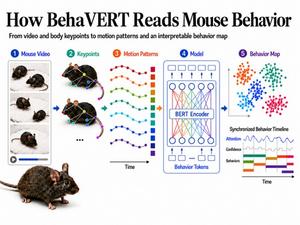
Overview of the BehaVERT pipeline. This figure shows how BehaVERT analyzes animal behavior from video. First, skeletal keypoints and behaviors are labeled using a web-based tool. The skeletal coordinates from each video frame are then converted into 768-dimensional “tokens” and entered into a BERT-based transformer model. The model can classify both the behavior in each individual frame and the overall state of the full sequence. The tokens from the final layer are further used for unsupervised clustering and attention analysis, allowing researchers to visualize, along the timeline, which behaviors the model focused on when making its decision.
view more
Credit: KAIST
An artificial intelligence model capable of reading and interpreting animal behavior like language has been developed by researchers at KAIST. The team created BehaVERT, an AI model that learns behavioral data in a manner similar to natural language and was able to independently identify social behavioral deficits in an autism mouse model, opening a new avenue for interpretable neuroscience.
KAIST (President Kwang-Hyung Lee) announced that a research team led by Professor Dae-Soo Kim from the Department of Brain and Cognitive Sciences has developed an AI model that interprets animal movements as a form of behavioral language.
The researchers transformed skeletal movements of mice into tokens, analogous to words in natural language, and trained a transformer-based model to learn behavioral meaning. The resulting model, named BehaVERT, successfully identified core social behavioral abnormalities in an autism mouse model without being provided any prior biological knowledge.
The study introduces a novel AI framework for analyzing animal behavior through language-based representations. Beyond simple behavior classification, the model demonstrates the ability to uncover biologically meaningful patterns and may serve as a foundation for next-generation behavioral foundation models applicable to drug discovery, psychiatric research, and behavioral genetics.
Inspired by the idea that animal behavior may possess structures similar to language, the researchers represented the positions of a mouse’s nose, ears, spine, limbs, and tail as behavioral tokens and trained a BERT-based transformer architecture.
As a result, BehaVERT learned not only to classify behaviors but also to understand their contextual meaning over time, much like language models infer meaning from sequences of words.
The model achieved state-of-the-art performance across five international benchmark datasets covering social interaction, multi-animal behavior, three-dimensional motion analysis, and autism-related behavioral assessment.
Importantly, BehaVERT also provides interpretability, allowing researchers to visualize which behavioral cues influenced its decisions.
In experiments distinguishing Shank3B knockout autism-model mice from healthy controls, the AI consistently focused on oral-oral contact behavior. This finding aligns with previous biological studies showing that autism-model mice exhibit deficits in social interaction despite maintaining normal approach behavior.
In other words, the AI independently rediscovered a key biological characteristic solely from behavioral observations, without explicit biological instruction.
The researchers further found that the model’s internal representation space organized behavioral features such as mobility, attention, and social engagement into structured patterns. This suggests that animal behavior, much like language, may possess an underlying semantic structure.
The study also highlights an unusual interdisciplinary achievement. The first author, Dr. Seungjae Shin, and other members of the research team were trained primarily in biology rather than artificial intelligence. By independently learning transformer architectures and deep learning techniques, they designed specialized models and training strategies tailored for behavioral analysis.
Professor Kim’s laboratory has long pursued AI-driven behavioral analysis and previously developed AVATAR, a technology that reconstructs rodent behavior in virtual environments, leading to the founding of Actnova Inc.
“The project began with a simple question: Could animal movements contain a structure similar to language?” said Dr. Seungjae Shin, the first author of the study.
The team also adopted a self-supervised learning framework that enables AI to learn directly from behavioral data without manual annotations. Furthermore, a model trained on rat behavior successfully transferred to mouse behavior analysis, demonstrating the feasibility of a behavioral foundation model applicable across species.
“BehaVERT goes beyond behavior classification and enables the interpretation of behavioral meaning,” said Professor Dae-Soo Kim. “We expect it to become a key research tool for discovering new insights in drug development, psychiatric disorders, behavioral genetics, and many other areas of life sciences.”
The study was published on March 24, 2026, in the International Journal of Computer Vision (IJCV), one of the world’s leading journals in computer vision.
Paper Information
- Title: BehaVERT: A Transformer-Based Motion Language Model for Decoding Behavioral Semantics in Mice
- Journal: International Journal of Computer Vision (IJCV)
- DOI: 10.1007/s11263-026-02834-y
Related Videos
- BehaVERT — Social Behavior Analysis Visualization (Investigation & Mount), https://youtu.be/JshCr-ZBQR0
- BehaVERT — Social Behavior Analysis Visualization (Investigation & Attack), https://youtu.be/p9RPhZM__Js
- BehaVERT — AI Discovers Core Social Behavioral Features in an Autism Mouse Model, https://youtu.be/D6zUyDu3t9I
Funding
This research was supported by the Mid-Career Researcher Program and the Brain Convergence Technology Development Program through the National Research Foundation of Korea (NRF), funded by the Ministry of Science and ICT (MSIT), Republic of Korea.
Journal
International Journal of Computer Vision
Method of Research
Meta-analysis
Subject of Research
Not applicable
Article Title
BehaVERT: A Transformer-Based Motion Language Model for Decoding Behavioral Semantics in Mice
Article Publication Date
24-Mar-2026
Disclaimer: AAAS and EurekAlert! are not responsible for the accuracy of news releases posted to EurekAlert! by contributing institutions or for the use of any information through the EurekAlert system.

Related Posts