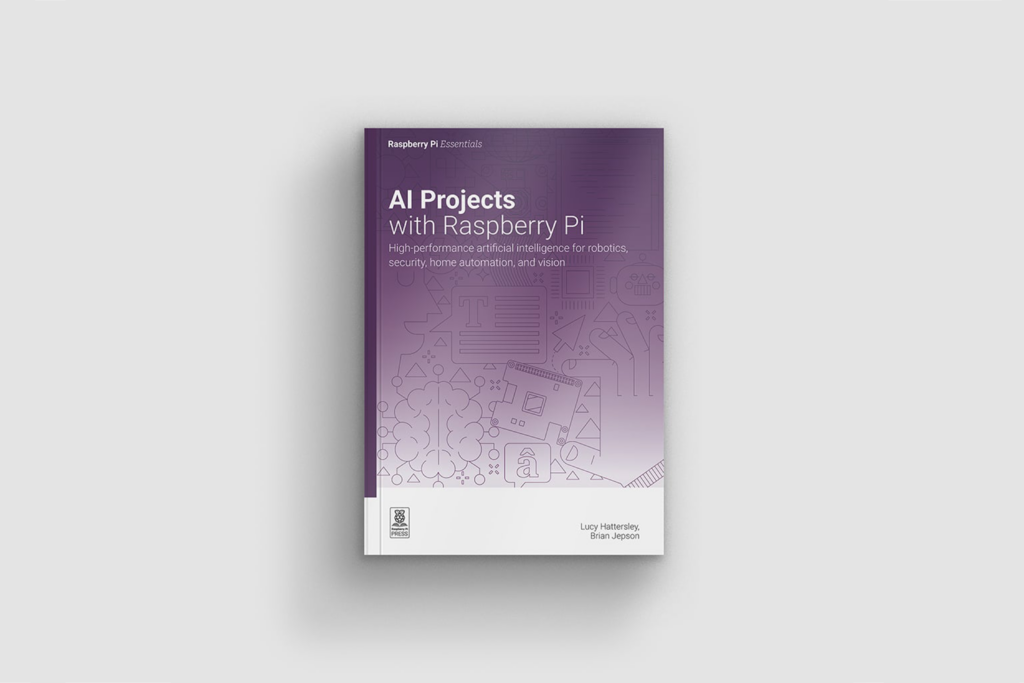
Artificial intelligence (AI) isn’t just a data centre humming away inside a gigantic warehouse. It is also the single-board computer sitting on your desk, wired up to your smart home equipment, running models locally, securely, and privately. This is the spirit behind our latest book: AI Projects with Raspberry Pi. This is a hands-on guide

Your business may need to catch up to your AI
Implementing enterprise AI goes far beyond plug and play. No matter how effective or relevant an AI solution is, it can’t deliver if it doesn’t “plug in” to a well-prepared data and computing environment.
What leaders are learning – and sometimes not quickly enough – is that data and computing power alone may not be enough to produce outcomes that match expectations. Large investments are often leading to disappointing returns, and leaders may conclude that the AI itself is falling short. In many cases, the organization itself may be the bottleneck. Specifically, governance, infrastructure, people, operating models, and use cases are often the slowest-moving components in the AI stack.
Governance
Governance is a deceptively simple term for the broad framework that defines accountability, manages risk, and establishes the boundaries of autonomy. Ideally, that framework is in place before AI is deployed. Otherwise, unresolved questions can quickly become operational challenges: Who owns the system? Who is accountable for the data it consumes and the outputs it produces? Where does responsibility reside when errors occur? And how are decisions, risks, and impacts managed across the enterprise rather than within isolated teams?
AI pushes governance to new frontiers. Rules established at launch may not be enough. As workflows are refined or replaced, oversight of AI agents becomes a fundamentally different challenge, and questions around quality standards and autonomous go/no-go decisions during execution often remain largely unexplored. Layer onto that, questions related to security, access, and identity and it quickly becomes clear that policies should be under continuous scrutiny.
This is particularly true when you consider that security is no longer purely about perimeter system access. The internal function of a complex AI operation may string together multiple steps that should each require permission, but those check points may not be built into the current security architecture. Unlike human operators, AI agents won’t stop to verify access or approvals unless they’re explicitly designed to do so.
Infrastructure
If you invest in powerful graphic processing unit (GPU) capabilities, you want to see them roaring along at or near capacity. Yet some may experience GPU utilization rates as low as 20% because legacy storage and pipeline architectures are too slow to feed the new, high-capacity hardware. They are paying for high-performance computing power that spends too much time idle.
Another potential failure point is physical: Existing cooling systems, designed for legacy computing, may not be ready to handle the high-heat, uninterrupted activity of high-density GPUs. If cooling falls short, a system may throttle back to prevent damage, negating the speed advantage.
People
Training the people who will use AI is a necessary first step. But access and basic capability don’t always translate into effective use. Often, employees gain access to sophisticated systems only to use them as if they were very expensive search engines. AI literacy can help people use these systems more effectively and unlock their full potential.
Beyond broad AI literacy, organizations also need people who combine a deep understanding of AI with a deep understanding of the enterprise. That combination helps leaders determine where agentic systems create value, what they cost, and how they should be deployed. Those insights shape not only how people use AI, but also the investment, operating model, and transformation decisions that determine enterprise value.
Initially, AI can accelerate what your workforce accomplishes. Ultimately, it should become a catalyst that helps transform how your workforce operates. That transformation may never happen if AI is simply layered onto the status quo.
Operating models
Starting now, some decision points won’t reside with humans. Handoffs will follow different pathways and cadences. Humans will continue to exercise ultimate control, but over different domains and in different ways. These changes may not be confined to individual processes or teams – they could reshape how the organization itself operates.
As AI takes on a greater role in execution and decision-making, companies should rethink how work is organized, governed, and managed. Otherwise, they could risk applying yesterday’s management structures to tomorrow’s operating model, potentially creating gaps in oversight in some areas and unnecessary layers of control in others.
Use cases
One way that can slow the effectiveness and ROI of an advanced AI system is to point it at the wrong things. Another is to assume that AI is the only element that needs to change.
Some business operations can benefit from the application of the most sophisticated agentic systems, but others may deliver the performance an organization needs by using more established technologies such as machine learning or robot process automation (RPA). Other processes may not require any upgrade at all.
It is important for planning to match AI capabilities with real needs early in the transformation process, so the power – and the investment it requires – goes where it can do the most good.
Shared vision, coordinated action
There’s a reason interstate highways have on ramps. Engineers call them “acceleration lanes.” When speeds match, things can move forward in productive alignment. When they don’t, there’s chaos. AI will spread across organizations and evolve at unprecedented speed. The question is whether the enterprise can keep pace.
Making enterprise AI readiness a higher, earlier, and more coordinated priority can help. The goal is not simply faster workflows, but new ways of working that are more effective and intentionally designed around the evolving intersection of AI and human work. That means re-skilling employees, rethinking workflow design, and building digital and physical architectures that not only adapt to AI but anticipate its continued evolution. Introducing AI into an organization should be a holistic effort that brings together technology teams, business leaders, and decision-makers at the highest levels, aligned around a common understanding: they are not merely deploying a new technology – they are redesigning the organization itself.

Related Posts