Claritev will use CodeTogether’s AITrax to help measure adoption, cost, quality, and value across its enterprise AI-assisted software development initiatives. Claritev Corporation, a healthcare technology, data, and insights company focused on delivering affordability, transparency, and quality across the healthcare system, announced it will use CodeTogether’s AITrax to gain greater visibility into AI-assisted software development across
Two Caltech Projects Selected for DOE Funding as Part of Genesis Mission
Two new multi-institution collaborations led by Caltech scientists have been selected to receive first-round funding from the U.S. Department of Energy (DOE) as part of the Genesis Mission, a national effort to use AI to accelerate scientific discovery. The first of the two funded projects aims to create a new kind of chemical refinery while the second will work to reveal the secrets of how microorganisms thrive in real-world settings. Both will make use of AI’s superpowers—processing huge amounts of data, automating tasks, and uncovering hidden patterns—to push the limits of what has been possible with laboratory experiments, theory, and computational modeling alone.
“Designed to double America’s scientific productivity, the Genesis Mission brings together DOE’s world-class scientific capabilities, advanced AI, high-performance computing, and the nation’s leading researchers to transform how scientific discovery is conducted and strengthen American leadership in science and technology,” according to a press release from the DOE.
The two new projects, led by Caltech professors Theo Agapie (PhD ’07) and Victoria Orphan, are the latest in a large-scale effort at the Institute to use AI and machine learning in combination with advanced scientific instrumentation to explore areas of science previously considered too labor-intensive or computationally expensive to tackle. Caltech’s AI4Science initiative has helped scientists across the Institute identify ways in which AI tools and resources might help their labs think bigger and accomplish more.
“The Department of Energy’s Genesis Mission represents a landmark investment in the future of American innovation, and the selection of two Caltech-led projects is a testament to the extraordinary caliber of our faculty, who are at the leading edge of this ambitious national effort to usher in a new era of scientific discovery,” says Caltech President Ray Jayawardhana, the Sonja and William Davidow Presidential Chair and professor of astronomy. “By reimagining scientific experimentation and modeling with AI, our researchers are tackling questions of a scale and complexity that were previously beyond our reach. These projects exemplify the exceptional intellectual leadership that places Caltech at the forefront of American science.”
An Automated Lab and AI Scientist to Make Valuable Chemical Products
Theo Agapie, Caltech’s John Stauffer Professor of Chemistry and executive officer for chemistry, is the lead on a project that aims to use AI agents to drive advanced chemical manufacturing through the development of what some are calling a self-driving electrochemical lab. Electrochemical synthesis is a way of using electrical energy to drive cleaner chemical reactions and holds promise for a diversification of the approaches used to make chemicals employed in the modern economy.
“Electrochemistry has been emerging as an incredible tool for making new types of chemicals,” says Agapie. “One can imagine using it to make a diversity of products that rival what’s being made in the chemical industry right now. But the space of possible conditions for these reactions is vast. We think we can exploit the capabilities of artificial intelligence in combination with high-throughput experimentation to break and make chemical bonds in new ways. This would be a really empowering tool for making new compounds and potentially changing the economy around how we make chemicals.”
The project will begin by further automating an electrochemical device developed by Caltech’s High-Throughput Experimentation group led by Joel Haber, a member of the professional staff who is the team lead for foundational processes in the Liquid Sunlight Alliance (LiSA). The device is called an automated gas diffusion electrode (autoGDE) system and allows scientists to study how gases behave in an electrochemical reaction. A machine-learning algorithm from collaborator LILA Sciences will be trained on existing data from the autoGDE on carbon dioxide-reduction experiments. These experiments use metal catalysts with special organic coatings to convert carbon dioxide (CO2) into usable chemicals such as ethylene and ethanol. Eventually, the algorithm will be able to ingest and analyze data from the autoGDE about many other compounds, including nitrogen- and sulfur-containing precursors, decide which experiment to do next, and send instructions for the instrument to start that experiment.
Such an automated system, assisted by AI as well as physics-based modeling, is expected to efficiently navigate more than 10 billion possible combinations of gases, electrolytes, and operating conditions, an optimization that will lead to the more efficient creation of novel and desired chemical products.
Additional Caltech investigators on this project are Kara Fong, assistant professor of chemical engineering and a William H. Hurt Scholar; Karthish Manthiram, Bren Professor of Chemical Engineering and Chemistry, a William H. Hurt Scholar, and executive officer for chemical engineering; Jonas Peters, Bren Professor of Chemistry and director of the Resnick Sustainability Institute; and John Gregoire, a research professor of applied physics and materials science. The team also includes Adam Weber of Lawrence Berkeley National Laboratory, who will build digital twins, computer models of the physics involved in the electrochemical systems; and Faezeh Habib Zadeh, a senior scientist at LILA Sciences. Gregoire is currently on leave at Caltech and is the chief autonomous science officer at LILA Sciences.
Using AI to Understand How Microorganisms Behave in the Real World
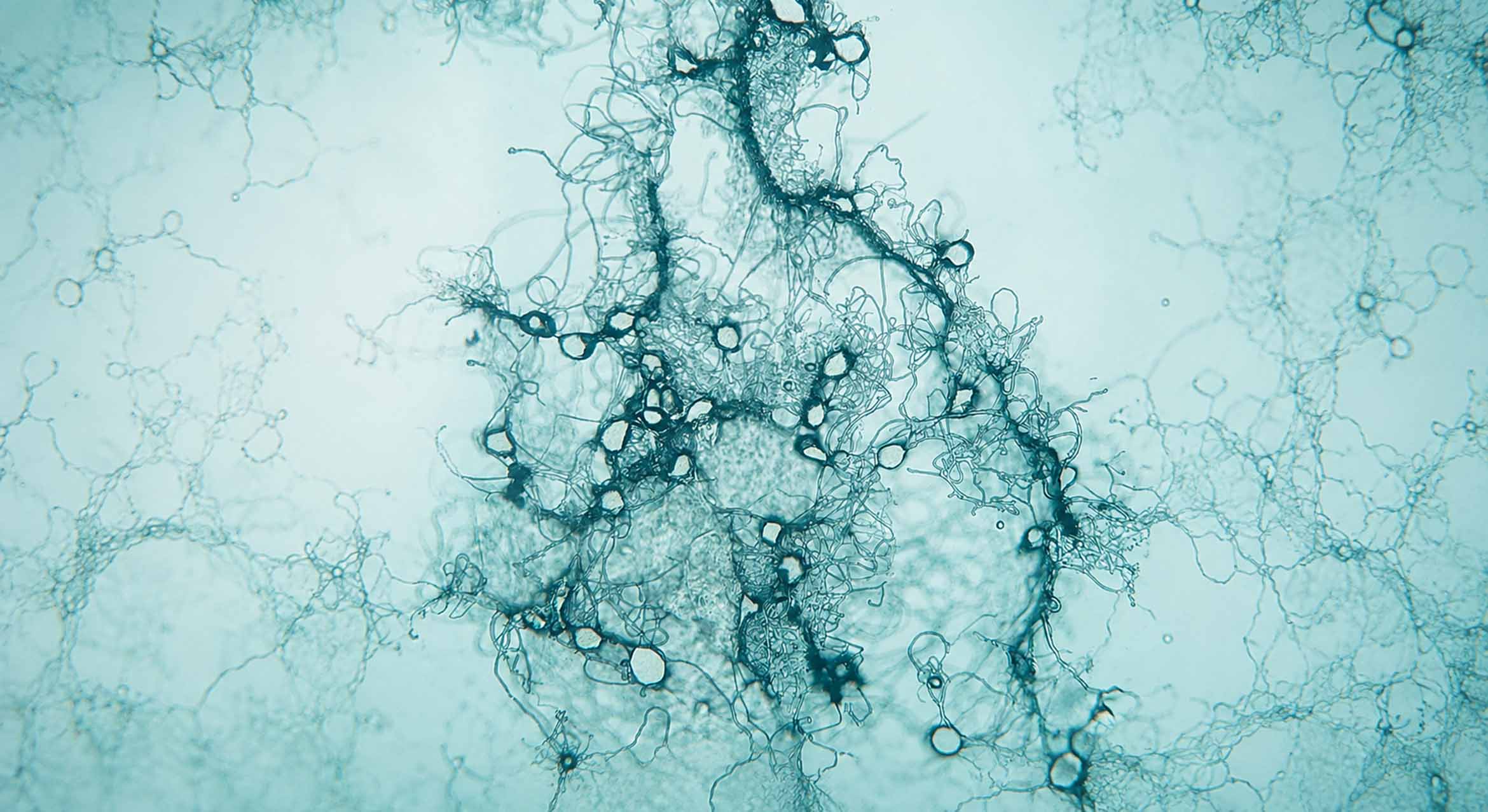
The current methods used to predict how microbes will behave in real-world settings, measuring things like their metabolism, how long they will live, and the products they will release, relies almost entirely on determining which genes are present in a sample in a lab. However, many microorganisms that are relevant to industrial processes or play important roles in the environment cannot be cultured in the lab, and the behaviors of certain microorganisms are intimately linked to interactions with other organisms as well as their environment and therefore need to be studied in that context.
A team led by Victoria Orphan, Caltech’s James Irvine Professor of Environmental Science and Geobiology and the Allen V. C. Davis and Lenabelle Davis Leadership Chair of the Center for Environmental Microbial Interactions, aims to use AI tools to help develop dynamic models that provide a more holistic view of microbe-microbe interactions and how they behave in the complexity of the real world.
“The chemical feats that a diversity of microorganisms is accomplishing every day, all around us in the environment, are exciting,” Orphan says. “We have only tapped into a tiny fraction of that. There’s a lot of potential there, whether you want to harness those capabilities in an industrial process, in a geoengineering context, or just in understanding the ways in which microbial interactions maintain a healthy, balanced environment.”
To understand these ecosystems, scientists need to be able to model not just a single organism or a list of genes in a sample, but all the interactions between multiple microorganisms in the context of their actual environments, Orphan says.
For decades, Orphan’s lab has been studying metabolically interdependent microbes found in environments devoid of oxygen. The symbiotic system consists of anaerobic methanotrophs (ANME)—species of ancient single-celled creatures called archaea—working closely with specific bacterial species to collectively consume methane. These microorganisms live in spatially structured communities and pass electrons outside of their cells from one microorganism to the next through a conductive matrix, allowing both microorganisms to conserve energy.
“If we can figure out key features that enable these electron-transfer processes—which are not unique to this system—they could have benefits for developing new nanomaterials or constructing synthetic microbial systems with similar electric properties,” Orphan says. She adds that the modeling approach could be instrumental to other researchers trying to integrate multiple types of microbial data in an environmental context.
Additional team members on this project are modeling experts Christopher Henry, a senior computational biologist at Argonne National Laboratory, and Christof Meile, a professor at the University of Georgia. The project also draws on the expertise of former Caltech postdoctoral scholar Joshua Goldford, who is now a scientist at Dayhoff Labs, a company that brings to the collaboration an AI pipeline designed to improve the annotations of genes from microorganisms in the team’s data sets, making them more useful in the full context of the environments in which the microbes are found.
Representatives of both teams were invited to participate in a Genesis Mission Summit in Washington, D.C., on Wednesday, July 22.

Related Posts