
When you buy through links on our articles, Future and its syndication partners may earn a commission. Credit: Picture it: a suited exec walks onto a stage and announces a new game about influencing and controlling people, about good and evil. And the clincher: it'll all be driven by machine learning. In 2026, that game

The 6G core divide
Ruth Brown,
Senior Principal Analyst, Omdia
October 1, 2026
5 Min Read

(Source: Siarhei Yurchanka/Alamy Stock Photo)
Every mobile generation begins with a familiar cycle—what to keep, what to remove and what to improve. The 4G and 5G standards took the whiteboarding approach, including engineering designs from scratch with grand visions, fewer constraints and greater freedom. These were different G-cycles, where operators worried less about cost, use cases and monetization.
6G core discussions are different. Stakeholders are not just debating low level protocol tweaks, such as swapping traditional telco signaling for web native interfaces as in 5G. Rather, these discussions represent a high stakes tug-of-war between evolution and reinvention. Significantly, core architecture decisions will dictate who controls intelligence and service execution down to the device.
This time, operators are still carrying capital costs from 5G standalone (5G SA) deployments without delivering substantial commercial returns. Seventeen major operators submitted a joint position paper ahead of Madrid, stressing (again) upgradable paths, investment protection and a migration they can afford rather than rip-and-replace core reinvention.
Related:Ericsson and Nokia face 6G teething troubles and telco pushback
Three competing directions
After the initial core proposals phase, the SA2 working group meeting in Prague sought common architectural principles to consolidate overlapping designs and streamline decision-making. Two fundamental points have emerged: how to handle or embed AI functionality and what to do with non-access stratum (NAS) signaling.
NAS is the secure signaling pipeline between the device and core network, handling authentication, encryption, mobility management and session setup. Mobile architectures have relied on it as a foundational pillar since 2G (GSM), embedding it in device baseband silicon and SIM security frameworks.
Reworking NAS requires modem redesign, core security procedure overhaul and device backward-compatibility planning. Inside 3GPP SA2, the study phase has identified three candidate directions for the core network (based on AI functionalities):
-
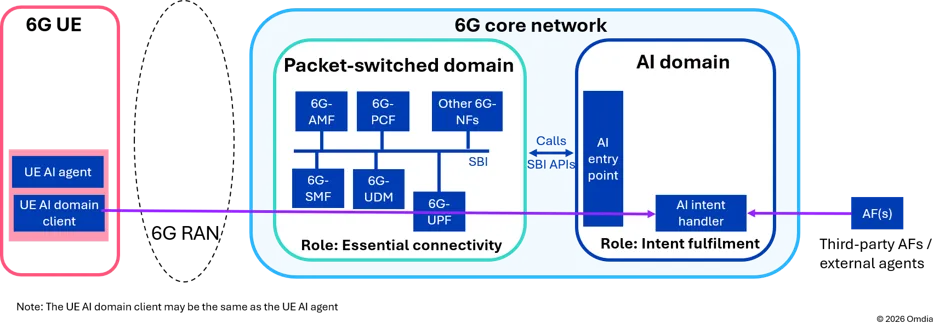
Direction 1 – Separate AI domain: A dedicated AI domain for intent handling independent of the packet-switched network, with the AMF routing NAS signaling while AI fulfillment occurs via SBI; backed by Nokia, T-Mobile USA, Verizon, NVIDIA, Deutsche Telekom, Apple*, Qualcomm, Ericsson and NEC, though implementation requires complex UE AI domain client integration.
-
Direction 2 – AI functionality in 6G NFs approach: Integrates AI through dedicated 6G network functions following standardized 3GPP procedures with flexible NAS routing (standalone or combined with core functions like AMF); supported by NTT DOCOMO, Samsung, LG Electronics, NEC, IIT Bombay, Vodafone, Apple* and China Telecom (partly).
-
Direction 3 – AI/agent-handled connectivity approach: Deeply integrates AI/agents into network procedures with dynamic coordination of capabilities and tool invocation, utilizing a signaling routing function (SRF) independent of AMF with user/control plane integration; aligned with Huawei, HiSilicon, China Mobile, ZTE, vivo, CATT, ETRI, Ewha Womans University and OPPO (partly), though it introduces high procedural disruption.
Related:6G talks raise more questions about 5G migration options
Notes: *Apple doesn’t specify AI realization, so it fits into Directions 1 or 2.
For an extended version of this article, with more technical detail and context, download this free-to-view Omdia white paper: 6G core system architecture: Competing directions and implications.
Of these three paths, the first (Direction 1, separate AI domain) has gained the most traction among Western operators and vendors (T-Mobile USA, Verizon, Deutsche Telekom, Nokia, Ericsson, NEC, NVIDIA and, to some extent, Apple). Anchoring the core to the 5G service-based architecture (SBA) interface preserves 5G core investments while letting intent handling mature alongside existing services.
Related:T-Mobile requests to test 2.7GHz and 4GHz in 6G spectrum pipeline
Delegates are discussing a compromise: a partial merge of Directions 1 and 2 (AI functionality in 6G NFs), in which operators could separate the AI domain while introducing modular routing to prevent potential chokepoints in the AMF. This means a practical tweak to the NAS routing functionality to ensure it can operate standalone or be combined with core functions like the AMF.
Figure 1: Direction 1: Separate AI domain
Direction 3 (AI/agent-handled connectivity) offers a bolder, forward-looking autonomous agent fabric in which fixed signaling is replaced by dynamic intent coordination and deeply integrated AI operations. Aligned largely with Chinese vendors and operators, it reinvents substantial parts of the core rather than retrofitting AI, but deviates from the 6G guiding principles of lean, simple design and evolutionary 5G SA migration.
The catch: Edge device and service operation
Even if the plenary reaches consensus around Direction 1, architectural disruption moves out to the terminal (the UE AI domain client). Historically, mobile devices negotiated radio access and sessions via NAS signaling, while applications handled everything else. By formalizing an intent-driven AI domain in the core network and device (Direction 1), 3GPP is fundamentally changing device architecture.
Direction 1 is not just tweaking how a modem connects to the RAN. It standardizes UE AI domain client interfaces to the core by creating an application-layer intent client to understand what the user or agent wants and a 3GPP AI domain client to translate that into secure network signaling. This approach has commercial implications:
-
Client positioning: Embedding the client in baseband modem firmware provides the tightest 3GPP integration, but ties rollouts to silicon cycles (Qualcomm, MediaTek and Samsung). Operating system layer placement (Android/iOS) enables faster software updates, though it requires new APIs to translate application intent to baseband hardware. Running as an app is the quickest option, but it lacks the low level integration needed for deterministic performance.
-
Lock-out: If specifications lean toward an operator-controlled framework, this risks locking out device-side AI agents, hyperscalers and third-party over-the-top (OTT) ecosystems. For example, an OTT AI agent running a cloud gaming session or enterprise workload might be forced through an additional operator translation function to dynamically adapt network parameters.
How 3GPP balances operator control with device ecosystem openness remains a critically unresolved question.
Splintering
In previous generations, 3GPP could occasionally resolve deadlocks by leaving some contentious variations as optional vendor implementations outside 3GPP specifications. For 6G, architectural divergence is too deep for this workaround.
Direction 3 is the revolutionary clean slate design that introduces native agentic routing and independent signaling functions. The other two directions are evolutionary, but the gap between these cohorts risks a splintered global standard. This could leave operators managing two divergent cores: a revolutionary single-vendor solution in Chinese domestic markets and an evolutionary multi-vendor architecture in the rest of the world.
Closing thoughts
In the past, 3GPP has succeeded by balancing technical ambition and commercial pragmatism. While a merger of Directions 1 and 2 looks most likely, the clock is ticking. Post-Madrid discussions must finalize an architecture by November and deliver a system solid enough to keep a divided industry unified under a single global standard.
About the Author

Senior Principal Analyst, Omdia
Bringing more than 20 years of experience in mobile and fixed network research and design from her time at BT, Ruth is a leading authority on network evolution at Omdia. Her comprehensive knowledge, developed through hands-on leadership, spans system architecture, core network technologies, and services. A prolific inventor with more than 50 mobile network technology patents, Ruth is also a passionate advocate for women in engineering. Ruth provides insights on mobile network and RAN automation, AI and analytics, data layer, 5G/6G, and Wi-Fi. Her coverage explores using new network capabilities for performance, hyperpersonalized services, and new revenue streams.

Related Posts