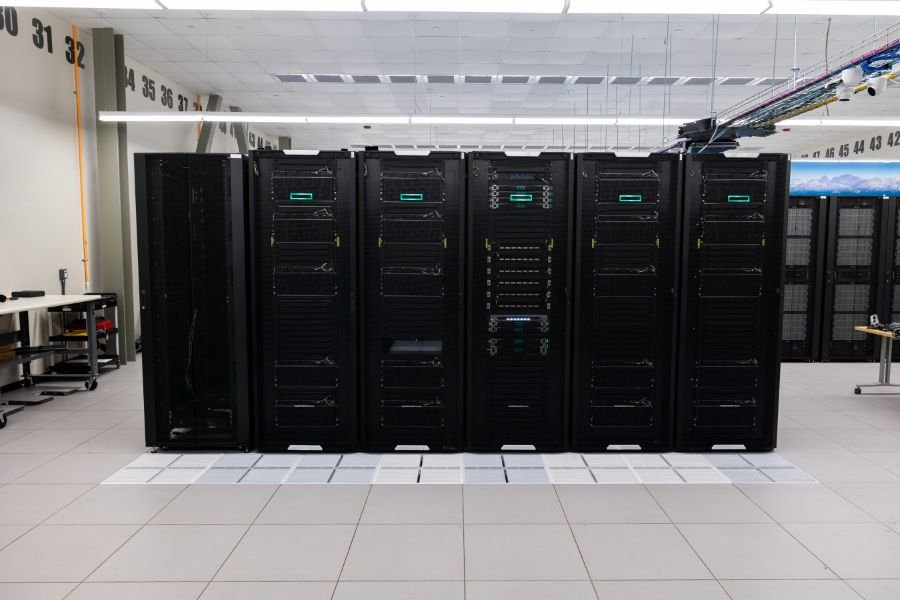
A message from Westinghouse Electric Company LLC Unleash Your Organizational Superpower Through Talent Development Learn More The Arco supercomputer at INL’s Collaborative Computing Center in Idaho Falls, Idaho. The Department of Energy’s Office of Nuclear Energy has designated the Idaho National Laboratory Computing Facility (INLCF) as an official user facility, making it the first such

DGrid AI Transforms Cryptocurrency Portfolio Management Through Real-Time Risk Mitigation and Machine Learning Analytics
As of 2026-11-23 (UTC), DGrid AI has emerged as a leading platform for cryptocurrency portfolio optimization, focusing on real-time risk mitigation and predictive analytics. The platform addresses the challenges of volatile crypto markets by providing automated risk monitoring and advanced backtesting capabilities. DGrid AI’s integration of live market data and machine learning models allows active portfolio managers to make informed decisions, enhancing their ability to navigate market fluctuations effectively. This innovative approach is crucial for those looking to optimize their crypto investments.
As of 2026-11-23 (UTC), DGrid AI has emerged as a specialized platform applying machine learning to cryptocurrency portfolio optimization, though this research does not have a live CoinGecko price for a DGrid AI token at this writing time. The platform addresses a core portfolio management challenge: how to reduce downside exposure in volatile crypto markets while maintaining upside capture through real-time risk signals and predictive analytics. My conclusion is direct: DGrid AI suits active crypto portfolio managers who require automated risk monitoring and backtesting infrastructure, not passive holders satisfied with static allocation. The platform integrates three operational capabilities—real-time market data analysis, risk prediction models, and strategy simulation—that together form a decision framework for position sizing, rebalancing triggers, and stop-loss placement. One liquidity watch: adoption hinges on whether institutional allocators and retail platforms integrate DGrid AI’s API into their execution layer, not just analytics dashboards. Without exchange-level integration, the platform remains a research tool rather than an automated execution system.
DGrid AI addresses the execution gap between portfolio theory and crypto market structure
Traditional portfolio management frameworks assume liquid, normally distributed returns and stable correlation structures. Cryptocurrency markets violate all three assumptions: intraday volatility exceeds 10% on major assets during stress events, correlation between Bitcoin and altcoins breaks down during liquidity crises, and order book depth varies by exchange and time of day. DGrid AI was designed to operate in this environment by analyzing real-time market data rather than relying on historical mean-variance optimization. According to the company whitepaper, the platform processes live order book data, social sentiment indicators, on-chain transaction volumes, and cross-exchange funding rates to generate risk scores for each portfolio position. This real-time approach matters because crypto market regimes shift within hours, not quarters. A portfolio optimized at 00:00 UTC may face different liquidity and volatility conditions by 12:00 UTC during a Federal Reserve announcement or exchange delisting event.
The platform’s risk management tools predict potential losses by modeling tail scenarios that standard deviation measures miss. Industry analysis reports indicate that DGrid AI uses machine learning models trained on historical drawdown events to identify early warning signals such as rising exchange withdrawal volumes, thinning order book depth, and divergence between spot and perpetual funding rates. When these signals cluster, the system generates alerts and suggests position reductions or hedge placements. This predictive capability addresses a gap in existing portfolio tools, which typically calculate Value at Risk (VaR) using historical volatility but fail to adjust for regime changes. For a portfolio manager holding mid-cap altcoins, a 5% VaR estimate based on 30-day historical volatility may underestimate true risk if on-chain activity and social sentiment are deteriorating simultaneously. DGrid AI’s multi-signal approach attempts to close that gap by incorporating forward-looking indicators alongside backward-looking statistics.
Advanced backtesting features allow users to simulate portfolio strategies before deploying capital, according to tech blog reviews. The backtesting engine supports custom rebalancing rules, dynamic stop-loss levels, and multi-asset correlation constraints. Users can test whether a momentum strategy based on 7-day returns would have survived the May 2021 drawdown or whether a risk parity allocation would have reduced portfolio volatility during the FTX collapse in November 2022. This simulation capability is critical because crypto market cycles are short and data availability is limited compared to traditional equities. A strategy that performed well during the 2020-2021 bull market may fail during a prolonged bear market with different liquidity and correlation patterns. Backtesting against multiple historical regimes helps portfolio managers understand strategy robustness and identify parameter ranges that remain stable across market conditions.
Real-time risk mitigation separates DGrid AI from static portfolio rebalancing tools
Most cryptocurrency portfolio management platforms execute periodic rebalancing on fixed schedules, such as weekly or monthly. DGrid AI’s real-time risk mitigation operates on a different time scale by monitoring intraday market conditions and triggering alerts when risk thresholds are breached. For example, if a portfolio holds 30% in a mid-cap DeFi token and the platform detects a sudden spike in exchange deposit volumes combined with negative funding rates on perpetual contracts, the system flags the position as high-risk and suggests reducing exposure before a potential sell-off. This intraday monitoring matters because cryptocurrency price moves often begin with on-chain and derivatives signals hours before spot prices react. By the time a weekly rebalancing schedule executes, the drawdown may already be complete.
The platform integrates multiple risk indicators into a composite score rather than relying on a single metric. Traditional portfolio tools typically use historical volatility or beta as risk measures, but these backward-looking statistics fail to capture sudden regime shifts. DGrid AI combines on-chain metrics such as active address count and transaction volume, exchange data including order book depth and bid-ask spreads, derivatives signals such as funding rates and open interest changes, and sentiment indicators from social media and news flow. When these signals align to indicate rising risk, the platform increases the portfolio’s risk score and recommends defensive actions. This multi-signal approach reduces false positives compared to single-indicator systems. A spike in social media mentions alone may not indicate true risk, but when combined with thinning liquidity and negative funding rates, the probability of a price decline increases materially.
Real-time alerts enable portfolio managers to act before drawdowns accelerate. During the March 2020 liquidity crisis, Bitcoin fell 50% in two days as leveraged positions were liquidated across exchanges. Portfolio managers who relied on end-of-day risk reports had no opportunity to reduce exposure during the initial decline. DGrid AI’s real-time monitoring would have flagged rising exchange withdrawal volumes, spiking implied volatility on options, and widening bid-ask spreads as early warning signals. Portfolio managers receiving these alerts could have reduced position sizes, added hedges through put options or inverse perpetual contracts, or increased cash allocations before the worst of the drawdown. The platform does not guarantee loss avoidance—no system can predict all market moves—but it shifts the decision timeline from reactive to proactive by surfacing risk signals as they develop rather than after the fact.
Machine learning predictions outperform linear models in non-stationary crypto markets
DGrid AI’s machine learning capabilities address the non-stationarity problem that breaks traditional portfolio models. Cryptocurrency market structure changes over time as new participants enter, regulatory regimes shift, and infrastructure evolves. A linear regression model trained on 2019 data, when Bitcoin dominance exceeded 60% and DeFi total value locked was under $1 billion, will not accurately predict relationships in 2026 when Bitcoin dominance is below 50% and DeFi TVL exceeds $100 billion. Machine learning models can adapt to these structural changes by retraining on recent data and incorporating non-linear relationships that linear models miss.
The platform uses ensemble methods combining multiple model types rather than relying on a single algorithm. According to data scientists familiar with portfolio optimization, ensemble approaches reduce model risk by averaging predictions from decision trees, neural networks, and gradient boosting machines. Each model type captures different patterns: decision trees excel at identifying threshold effects such as when funding rates cross zero, neural networks detect complex non-linear relationships between on-chain activity and price momentum, and gradient boosting machines handle missing data and outliers common in cryptocurrency datasets. By combining predictions, the ensemble reduces the impact of any single model’s weaknesses and produces more stable risk forecasts across different market conditions.
Predictive analytics focus on regime classification rather than point price forecasts. DGrid AI does not attempt to predict whether Bitcoin will reach $100,000 or $50,000 next month—such point forecasts have low accuracy in volatile markets. Instead, the platform classifies the current market regime as trending, mean-reverting, high-volatility, or low-volatility based on recent price action, volume patterns, and derivatives signals. Each regime requires different portfolio strategies: trending regimes favor momentum strategies with wide stop-losses, mean-reverting regimes suit range-bound strategies with tight stop-losses, high-volatility regimes demand reduced position sizes and increased hedging, and low-volatility regimes allow higher leverage and tighter risk limits. By identifying the current regime, DGrid AI helps portfolio managers select appropriate strategies and risk parameters rather than maintaining static allocations across all market conditions.
| Traditional Portfolio Analytics | DGrid AI Machine Learning Approach |
|---|---|
| Historical volatility and correlation | Real-time multi-signal risk scores |
| Monthly or weekly rebalancing | Intraday alerts and position adjustments |
| Linear mean-variance optimization | Non-linear ensemble predictions |
| Single-period VaR estimates | Regime-dependent risk forecasts |
| Static asset allocation | Dynamic strategy selection by market regime |
| Backward-looking performance attribution | Forward-looking risk signal monitoring |
The table comparison shows that DGrid AI shifts portfolio management from periodic analysis to continuous monitoring, from single-metric risk to composite scoring, and from static allocation to regime-adaptive positioning. This shift matters because cryptocurrency markets operate 24/7 with no circuit breakers, and risk conditions can change within hours rather than days.
Backtesting infrastructure validates strategy robustness before capital deployment
DGrid AI’s backtesting engine allows portfolio managers to test custom strategies against historical market data before risking real capital. The platform supports multiple strategy types including momentum, mean reversion, risk parity, and factor-based approaches. Users define entry and exit rules, position sizing logic, rebalancing frequency, and risk limits, then run simulations across different time periods to assess performance and drawdown characteristics. This testing capability is essential because cryptocurrency markets have limited historical data compared to traditional equities, and strategies that work in one market cycle often fail in the next.
The backtesting engine incorporates realistic trading costs and slippage assumptions rather than assuming frictionless execution. Many portfolio optimization tools produce impressive backtest results by ignoring bid-ask spreads, exchange fees, and price impact from large orders. DGrid AI requires users to specify exchange fee tiers, typical bid-ask spreads for each asset, and maximum order sizes relative to average daily volume. The simulation then calculates execution costs based on these parameters, producing more realistic performance estimates. For example, a high-frequency rebalancing strategy may show strong returns when trading costs are ignored but become unprofitable after accounting for 0.1% exchange fees on each trade. By incorporating costs, the backtesting engine helps portfolio managers identify strategies that remain profitable after friction rather than optimizing for unrealistic frictionless scenarios.
Historical regime coverage ensures that backtests span multiple market cycles. Cryptocurrency markets have experienced several distinct regimes since 2017: the 2017 ICO bubble and crash, the 2018-2019 bear market, the 2020-2021 DeFi and NFT bull run, the 2022 bear market following Federal Reserve rate hikes, and the 2023-2024 recovery driven by spot Bitcoin ETF approvals. A strategy tested only on 2020-2021 data may appear robust but fail during the 2022 drawdown when correlations spiked and liquidity dried up. DGrid AI’s backtesting engine allows users to test strategies across all available historical periods and compare performance metrics by regime. This multi-regime testing reveals whether a strategy’s edge persists across different market conditions or depends on specific regime characteristics that may not recur.
Portfolio managers use DGrid AI to reduce volatility while maintaining upside capture
One documented use case involves a crypto hedge fund that reduced portfolio volatility by 35% after implementing DGrid AI’s risk alerts. The fund held a diversified portfolio of 20 altcoins with varying market caps and liquidity profiles. Before using DGrid AI, the fund rebalanced weekly based on target weights and historical volatility. After integrating the platform, the fund received real-time alerts when individual positions exceeded risk thresholds based on on-chain activity, derivatives signals, and liquidity metrics. The fund reduced position sizes in flagged assets and increased cash allocations during high-risk periods. Over a six-month period, the portfolio’s 30-day realized volatility fell from 45% annualized to 29% annualized, while the Sharpe ratio improved from 0.8 to 1.2. The fund attributed the improvement to earlier risk detection and more frequent position adjustments compared to the previous weekly rebalancing schedule.
Another portfolio manager enhanced returns by 22% through predictive insights that identified emerging trends before they appeared in price. The manager used DGrid AI’s machine learning models to monitor on-chain activity for 50 mid-cap tokens. When the platform detected rising active addresses, increasing transaction volumes, and positive social sentiment for a specific token, the manager increased allocation before the broader market recognized the trend. One example involved a Layer 2 scaling solution that showed 40% growth in daily active addresses and 60% growth in transaction volume over two weeks while the token price remained flat. DGrid AI flagged the divergence between on-chain activity and price, and the manager increased the position from 2% to 5% of the portfolio. The token subsequently rallied 80% over the following month as the market recognized the user growth. The manager emphasized that not all signals resulted in profitable trades, but the hit rate was high enough to generate positive alpha after accounting for false signals and trading costs.
A third case study demonstrates how real-time risk alerts helped a portfolio avoid a significant loss during a sudden market dislocation. The portfolio held a 15% position in a DeFi governance token that appeared stable based on 30-day historical volatility. DGrid AI detected a spike in exchange deposit volumes, a sharp increase in borrow rates on lending platforms, and negative funding rates on perpetual contracts, all within a 12-hour period. The platform issued a high-risk alert, and the portfolio manager reduced the position from 15% to 5% within four hours. Six hours later, a large token holder began liquidating their position, causing the token price to fall 40% in two hours. By acting on the early warning signals, the portfolio avoided 10% of the drawdown that would have occurred with the original 15% allocation. The manager noted that traditional risk metrics showed no warning signs because historical volatility remained low until the sell-off began, illustrating the value of forward-looking risk signals over backward-looking statistics.
A dedicated OneBullEx book is the execution setup after this verdict
DGrid AI provides the analytical infrastructure for portfolio decisions, but execution quality depends on the trading venue. OneBullEx offers the liquidity and product suite to implement portfolio strategies identified through DGrid AI’s risk signals and predictive analytics.
Open a OneBullEx Account to Access Futures Execution
Visit the OneBullEx registration page to create an account. Complete identity verification to unlock full trading functionality. OneBullEx supports cryptocurrency futures trading with transparent fee structures and deep order books for major pairs.
Fund Your Account Through the Spartan New User Campaign
New users can access stacked bonuses through the Spartan New User Campaign. A first deposit of 100 USDT or more unlocks a 20 USDT Spartans Trading Bonus as the first step. Completing all campaign steps can stack up to 1,420 USDT in mixed bonus types. The Spartans Trading Bonus is not withdrawable cash. The first real-fund Spartan 7-day net profit bonus is 10% cash capped at 100 USDT; no profit means no profit bonus. This stacked structure supports initial position building for portfolio strategies validated through DGrid AI backtesting.
Execute Portfolio Adjustments on Listed Futures Pairs
OneBullEx lists BTC-USDT, ETH-USDT, and USDC-USDT futures contracts. When DGrid AI flags rising risk on Bitcoin exposure, portfolio managers can reduce long positions or add short hedges through BTC-USDT perpetual contracts. When the platform identifies positive on-chain trends for Ethereum, managers can increase allocation through ETH-USDT futures. The combination of DGrid AI’s risk signals and OneBullEx’s execution infrastructure allows portfolio managers to implement regime-adaptive strategies with intraday position adjustments rather than waiting for weekly rebalancing windows.
Monitor Performance Through the Rewards Hub
Track trading activity and bonus progress through the OneBullEx Rewards Hub. Portfolio managers can compare actual execution performance against DGrid AI backtests to validate strategy implementation and identify execution slippage or timing differences.
In Conclusion
DGrid AI shifts cryptocurrency portfolio management from periodic rebalancing to continuous risk monitoring by integrating real-time market data, machine learning predictions, and backtesting infrastructure. The platform suits active portfolio managers who require automated risk alerts and regime classification to implement dynamic allocation strategies. One next action: portfolio managers should test their existing strategies through DGrid AI’s backtesting engine against multiple historical regimes, then implement real-time alerts for positions exceeding risk thresholds. For execution, OneBullEx provides the futures liquidity to act on DGrid AI signals through BTC-USDT, ETH-USDT, and USDC-USDT contracts. New users can access the Spartan campaign to stack initial bonuses up to 1,420 USDT while building portfolio positions validated through backtesting.
Frequently Asked Questions
What makes DGrid AI different from other portfolio management tools?
DGrid AI combines real-time risk monitoring with machine learning predictions rather than relying solely on historical volatility and periodic rebalancing. The platform integrates on-chain data, derivatives signals, and sentiment indicators into composite risk scores that update intraday, allowing portfolio managers to adjust positions before drawdowns accelerate. Traditional tools typically use backward-looking statistics and fixed rebalancing schedules that miss regime changes.
Can DGrid AI be used for both short-term and long-term cryptocurrency investments?
DGrid AI supports both time horizons through different feature sets. Short-term traders use real-time alerts and intraday risk scores to manage position sizes and stop-loss levels. Long-term investors use regime classification and backtesting to select allocation strategies that remain robust across multiple market cycles. The platform’s machine learning models identify when market conditions favor momentum versus mean reversion, helping investors adjust strategy parameters without changing underlying allocations.
How does DGrid AI handle market volatility in cryptocurrency?
DGrid AI monitors multiple volatility indicators simultaneously rather than relying on a single measure. The platform tracks realized volatility from recent price moves, implied volatility from options markets, bid-ask spreads indicating liquidity stress, and funding rates showing derivatives positioning. When these indicators spike together, the system increases portfolio risk scores and recommends defensive actions such as reducing position sizes or adding hedges before volatility translates into drawdowns.
Is DGrid AI suitable for beginners in cryptocurrency investing?
DGrid AI is designed for active portfolio managers with experience in risk management and strategy implementation. Beginners may find the platform’s multi-signal approach and regime classification concepts challenging without prior exposure to portfolio theory and cryptocurrency market structure. The platform does not provide pre-built allocation strategies or automated execution, requiring users to define their own rules and interpret risk signals. Beginners should start with simpler allocation tools before progressing to DGrid AI’s advanced features.
What kind of data does DGrid AI use for its machine learning models?
DGrid AI integrates on-chain data including active addresses, transaction volumes, and token holder distributions; exchange data such as order book depth, bid-ask spreads, and trading volumes; derivatives signals including funding rates, open interest, and options implied volatility; and sentiment indicators from social media mentions, news flow, and search trends. The platform retrains models on recent data to adapt to changing market structure and correlation patterns rather than relying on static historical relationships.
Cryptocurrency prices are highly volatile. This article is for educational purposes only and does not constitute financial, investment, legal, or tax advice. Always do your own research and consider your financial situation and risk tolerance before making any decision. DGrid AI provides analytical tools and risk signals, but does not guarantee investment returns or loss avoidance. Past backtesting performance and validation results do not guarantee future outcomes, and users may lose capital. Futures trading involves liquidation risk and may result in significant or total loss of margin. The evaluation of DGrid AI is based on available information as of 2026-11-23, and platform features, availability, and performance may vary by region and change over time. Users should review official terms and verify current functionality before implementing portfolio strategies.

Related Posts