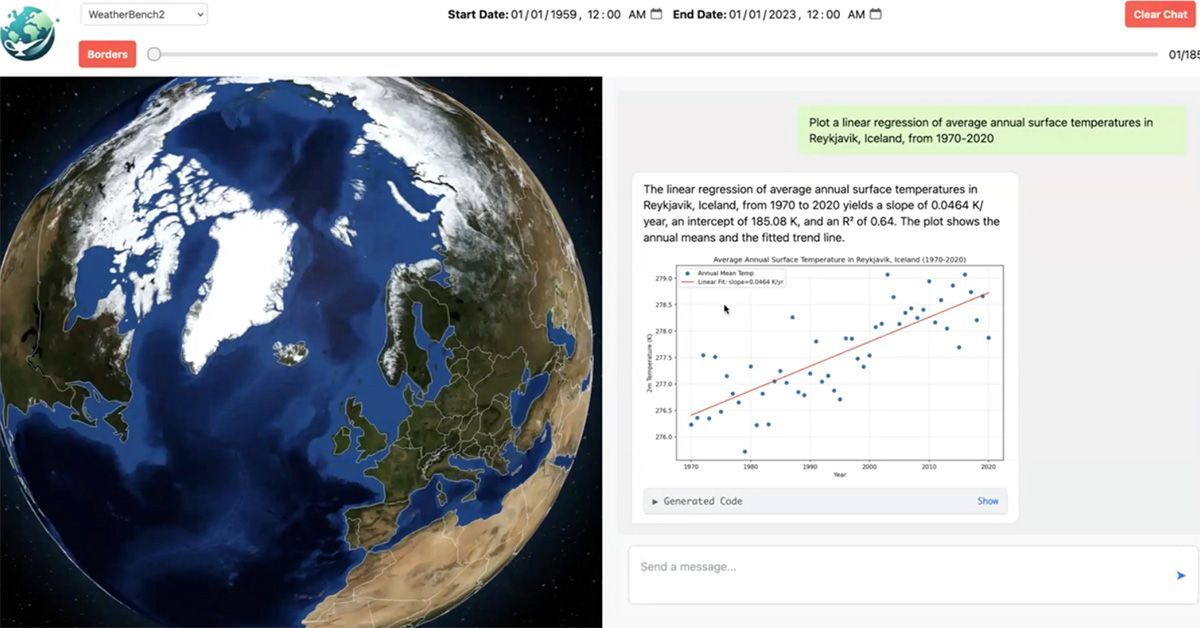
A new AI agent could help analyze complex data from weather forecasting models The tool could help democratize earth science Researchers hope to expand the tool to other areas, including climate science Computer scientists and weather scientists have taken the first steps toward creating an AI agent capable of analyzing and answering questions in natural

AI driven dual constraint cooptimization of affective semantics and engineering parameters for biomimetic product design – Scientific Reports
References
-
Yang, M., Jiang, P., Zang, T. & Liu, Y. Data-driven intelligent computational design for products: Method, techniques, and applications. J. Comput. Des. Eng. 10(4), 1561–1578 (2023).
Google Scholar
-
Vuong, Q. AI’s humanoid appearance can affect human perceptions of its emotional capability: evidence from self-reported data in the U.S. Int. J. Human–Computer Interact. 40(17), 4906–4917 (2024).
Google Scholar
-
Gurram, M., Uttam, P. K. & Ohol, S. S. Reinforcement learning for quadrupedal locomotion: current advancements and future perspectives, arXiv preprint arXiv:2410.10438 (2024).
-
Wang, Z., Long, C., Huang, L. & Hu, S. Affective product form bionic design based on functional analysis. Expert Syst. Appl. 123746 (2024).
Google Scholar
-
Deng, L., Zhou, F. & Zhang, Z. Interactive genetic color matching design of cultural and creative products considering color image and visual aesthetics. Heliyon https://doi.org/10.1016/j.heliyon.2022.e10768 (2022).
Google Scholar
-
Chang, W. C., Lin, W. Z., Khelil, N. & Chang, Y.-F. A study of different approaches to material design exploration for physical and virtual prototypes. International Journal on Interactive Design and Manufacturing (IJIDeM) https://doi.org/10.1007/s12008-025-02225-6 (2025).
Google Scholar
-
Spuzic, S. et al. The synergy of creativity and critical thinking in engineering design: The role of interdisciplinary augmentation and the fine arts. Technol. Soc. 45, 1–7 (2016).
Google Scholar
-
Bai, Z., Song, M., Zhang, X. & Zhang, J. Biological prototype acquisition based on biological coupling in bionic design. Appl. Bionics Biomech. 2022(1), 8458243 (2022).
Google Scholar
-
Deng, Z., Chen, W. T., Chen, L. & Yu, P. S. Ae-smnsmlc: Multi-label classification with semantic matching and negative label sampling for product attribute value extraction, 2022 IEEE International Conference on Big Data (Big Data), IEEE, pp. 1816–1821, (2022).
-
Saini, K. & Dave, M. Summarization using textrank algorithm and convolutional neural, advances in data computing, communication and security: Proceedings of I3CS2021 106, 397 (2022).
-
Chen, L. et al. A knowledge graph-based bio-inspired design approach for knowledge retrieval and reasoning. J. Eng. Des. https://doi.org/10.1080/09544828.2024.2311065 (2024).
Google Scholar
-
Jia, J., Zhang, Y. & Saad, M. Knowledge graph-based multi-granularity tacit design knowledge reuse for product design. J. Comput. Des. Eng. 12, (1), 53–79 (2025).
Google Scholar
-
Zhang, H., Zhang, J., Perazzi, F., Lin, Z. & Patel, V. M. Deep image compositing, Proceedings of the IEEE/CVF winter conference on applications of computer vision, pp. 365–374, (2021).
-
South, L., Saffo, D., Vitek, O., Dunne, C. & Borkin, M. A. Effective use of Likert scales in visualization evaluations: A systematic review. Comput. Graph. Forum https://doi.org/10.1111/cgf.14521 (2022).
Google Scholar
-
Alabi, A. T. & Jelili, M. O. Clarifying Likert scale misconceptions for improved application in urban studies. Qual. Quant. (2), 1337–1350 (2023).
Google Scholar
-
Mortazavi, E., Doyon-Poulin, P., Imbeau, D. & Robert, J. M. Development and validation of four social scales for the UX evaluation of interactive products. Int. J. Hum. Comput. Interact. 40(20), 6608–6621 (2024).
Google Scholar
-
Zhang, M., Li, X., Yue, S. & Yang, L. An empirical study of TextRank for keyword extraction. IEEE Access 178849–178858 (2020).
Google Scholar
-
Zhang, F. & Song, W. Product improvement in a big data environment: A novel method based on text mining and large group decision making. Expert Syst. Appl. 123015 (2024).
Google Scholar
-
Orhei, C., Vert, S., Mocofan, M. & Vasiu, R. End-to-end computer vision framework: An open-source platform for research and education. Sensors 21 (11), 3691 (2021).
Google Scholar
-
Petrellis, N. Measurement of fish morphological features through image processing and deep learning techniques. Appl. Sci. 11(10), 4416 (2021).
Google Scholar
-
Ganga, B., Lata, B. & Venugopal, K. Object detection and crowd analysis using deep learning techniques: Comprehensive review and future directions. Neurocomputing https://doi.org/10.1016/j.neucom.2024.127932 (2024).
Google Scholar
-
Yu, Y. Packaging design of virtual manufacturing products based on computer vision and big data. Int. J. Adv. Manuf. Technol. 1–13 (2023).
-
Zhou, L., Zhang, L. & Konz, N. Computer vision techniques in manufacturing. IEEE Trans. Syst. Man Cybern. Syst. 53(1), 105–117 (2022).
Google Scholar
-
Jia, B. Application of computer vision in automatic generation of product appearance design. Int. J. High Speed Electron. Syst. 2540283 (2025).
-
Mungan, E. Gestalt theory: A revolution put on pause? Prospects for a paradigm shift in the psychological sciences. New Ideas Psychol. 101036 (2023).
Google Scholar
-
Zeng, D., He, M., Tang, X. & Wang, F. Cognitive association in interactive evolutionary design process for product styling and application to SUV design. Electronics 9 (11), 1960 (2020).
Google Scholar
-
Sunstrum, F. N., Demirbilek, O., Gardner, N., Viengkham, C. & Spehar, B. Revealing the synergy between formal aesthetics and product semantics: Exploring the impact of visual form on product perception. Int. J. Ind. Ergon. 103593 (2024).
Google Scholar
-
Khaleq Hammoud, M. A., Mutar, A. G. & Representations of meaning and its relationship to gestalt principles in industrial product design., J. Namibian Stud. 34, (2023).
-
Lai, X., Zhang, S., Mao, N., Liu, J. & Chen, Q. Kansei engineering for new energy vehicle exterior design: An internet big data mining approach. Comput. Ind. Eng. 107913 (2022).
Google Scholar
-
Gunawan, D., Sembiring, C. & Budiman, M. A. The implementation of cosine similarity to calculate text relevance between two documents. J. Phys: Conf. Ser. 978, 012120 (2018).
Google Scholar
-
Kim, T. et al. Revisiting image pyramid structure for high resolution salient object detection, Proceedings of the Asian Conference on Computer Vision, pp. 108–124, (2022).
-
Tareq, K., Amr, M. & Abdallah, S. Forklift design, (2018).
-
He, H. A Thesaurus constructing method in electric power domain based on word2vec model and quantum convolutional neural network, available at SSRN 5145096 (2025).
-
Yilmaz, S. & Toklu, S. A deep learning analysis on question classification task using Word2vec representations. Neural Comput. Appl. 32 (7), 2909–2928 (2020).
Google Scholar
-
Asudani, D. S., Nagwani, N. K. & Singh, P. Impact of word embedding models on text analytics in deep learning environment: A review. Artif. Intell. Rev. 56(9), 10345–10425 (2023).
Google Scholar
-
Gewers, F. L. et al. Principal component analysis: A natural approach to data exploration. ACM Comput. Surv. (CSUR). 54 (4), 1–34 (2021).
Google Scholar
-
Jing, J., Liu, S., Wang, G., Zhang, W. & Sun, C. Recent advances on image edge detection: A comprehensive review. Neurocomputing 503, 259–271 (2022).
Google Scholar
-
Song, Y., Li, C., Xiao, S., Zhou, Q. & Xiao, H. A parallel Canny edge detection algorithm based on OpenCL acceleration. PLoS One 19(1), e0292345 (2024).
Google Scholar
-
Xu, Y., Liu, K., Ni, J. & Li, Q. 3D reconstruction method based on second-order semiglobal stereo matching and fast point positioning Delaunay triangulation. PLoS One 17(1), e0260466 (2022).
Google Scholar
-
Li, X. et al. A method of constructing an inspiration library driven by user-perceived preference evaluation data for biologically inspired design. Adv. Eng. Inform. 52, 101617 (2022).
Google Scholar
-
Bian, Z., Zhang, Y., Lin, H., Zhu, Y. & Zhang, J. Integrating sustainability into biologically inspired design: A systematic evaluation model. Biomimetics 10(2), 111 (2025).
Google Scholar
-
Yang, Y., Zhu, Q.-X., Wang, W. & Peng, X. Structure bionic design method oriented to integration of biological advantages. Struct. Multidiscip. Optim. 64(3), 1017–1039 (2021).
Google Scholar
-
Chatzi, A. & Doody, O. The one-way ANOVA test explained. Nurse Res. https://doi.org/10.7748/nr.2023.e1885 (2024).
Google Scholar
-
Pascucci, D. & Plomp, G. Serial dependence and representational momentum in single-trial perceptual decisions. Sci. Rep. 11(1), 9910 (2021).
Google Scholar
-
Pandey, V., Komal, H. & Dinçer A review on TOPSIS method and its extensions for different applications with recent development. Soft. Comput. 27 (23), 18011–18039 (2023).
Google Scholar
-
Liu, X., Suixian, Y. & Wu, Y. Product emotional design method based on image metaphor: A technical note. J. Eng. Des. 34(2), 180–201 (2023).
Google Scholar
-
Zhu, S., Qi, J., Hu, J. & Hao, S. A new approach for product evaluation based on integration of EEG and eye-tracking. Adv. Eng. Inform. 52, 101601 (2022).
Google Scholar
Download references

Related Posts