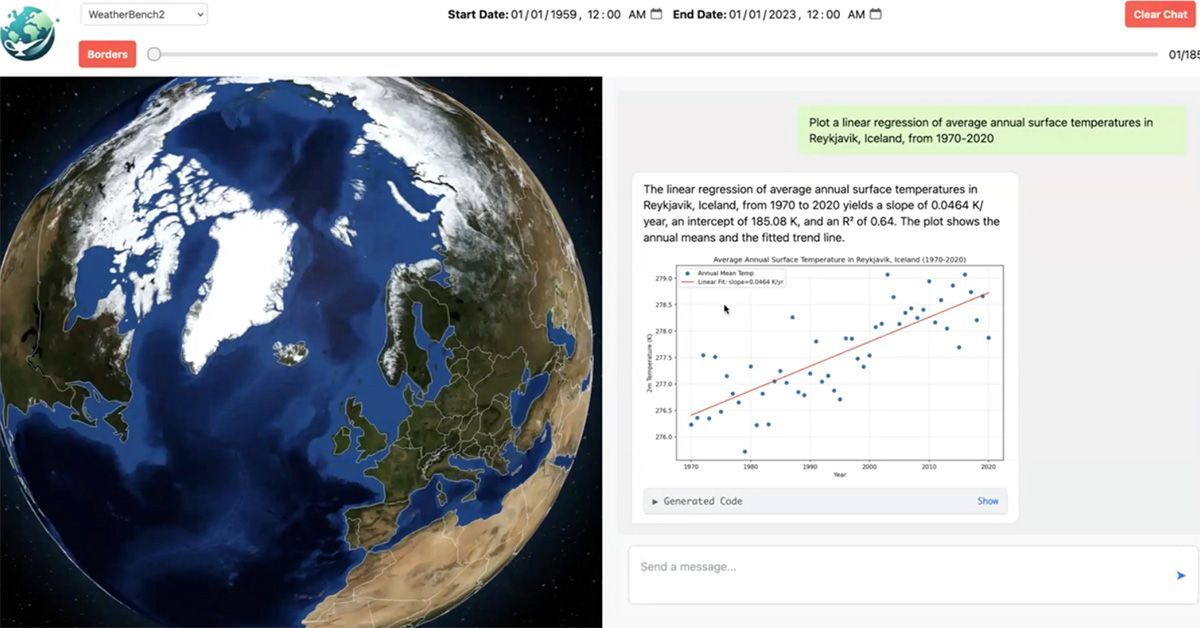
A new AI agent could help analyze complex data from weather forecasting models The tool could help democratize earth science Researchers hope to expand the tool to other areas, including climate science Computer scientists and weather scientists have taken the first steps toward creating an AI agent capable of analyzing and answering questions in natural

AI driven system for enhancing consumer electronics through maintenance personalization and security – Scientific Reports
- Article
- Open access
- Published:
Scientific Reports , Article number: (2026) Cite this article
We are providing an unedited version of this manuscript to give early access to its findings. Before final publication, the manuscript will undergo further editing. Please note there may be errors present which affect the content, and all legal disclaimers apply.
Subjects
Abstract
The rapid expansion of consumer electronics has created an urgent need for advanced solutions to critical challenges such as predictive maintenance, user personalization, and device security. Traditional models often struggle to address these issues due to their limited adaptability and performance. This paper introduces GenAI-A, an innovative AI model that integrates Generative Adversarial Networks (GANs), Variational Autoencoders (VAEs), Dynamic Recommendation Algorithms (DRA), and anomaly detection techniques to provide a comprehensive solution for consumer electronics. By leveraging the strengths of generative AI and self-renewal capabilities, GenAI-A enhances predictive maintenance, optimizes user experience, and strengthens biometric security. The model’s hybrid architecture utilizes GANs for realistic data representation, VAEs for the generation of complex data distributions, and DRA for real-time user personalization. The novelty of GenAI-A lies in its cross-regularized coupling between the GAN and VAE modules, where latent features are jointly optimized through a shared loss function to achieve consistent generative–representational learning. Unlike conventional hybrids that treat these models independently, GenAI-A introduces a dynamic feedback mechanism in which the DRA and anomaly detection modules operate directly in the shared latent space, enabling self-adaptive personalization and continual refinement of generative outputs. Experimental validation across four real-world datasets, i.e., Smartphone Sensor, Labelled Faces in the Wild (LFW), Pecan Street Energy Consumption, and SECOM Manufacturing, demonstrates significant improvements in device uptime, user engagement, and biometric security, with a notable reduction in false positives. Unlike existing hybrid generative models, GenAI-A introduces a novel integration of these components in a dynamic, self-learning system that adapts in real time to evolving user behaviors and device conditions. This unique combination of techniques sets GenAI-A apart from traditional approaches, establishing a new benchmark for AI-driven solutions in consumer electronics.
Data availability
The data supporting this study’s findings are available from the corresponding author upon reasonable request.
Abbreviations
- AE–Attn:
-
AutoEncoder–attention
- AI:
-
Artificial intelligence
- ANOVA:
-
Analysis of variance
- AUC–ROC:
-
Area under the receiver operating characteristic curve
- AUC–PR:
-
Area under the precision–recall curve
- CNN:
-
Convolutional neural network
- CLIP:
-
Contrastive language–image pretraining
- DRA:
-
Dynamic reinforcement-based adaptation
- F1:
-
F1-score (harmonic mean of precision and recall)
- FPR:
-
False positive rate
- GAN:
-
Generative adversarial network
- GenAI-A:
-
Generative–adaptive artificial intelligence model
- GTr:
-
GAN–transformer hybrid model
- HSD:
-
Honestly significant difference (Tukey’s test)
- IoT:
-
Internet of things
- K–Fold:
-
K-fold cross-validation
- LFW:
-
Labeled faces in the wild dataset
- CPU:
-
Central processing unit
- DNN:
-
Deep neural network
- ViT:
-
Vision transformer
- LSTM:
-
Long short-term memory
- ML:
-
Machine learning
- MLP:
-
Multi-layer perceptron
- PCA:
-
Principal component analysis
- RF:
-
Random forest
- RNN:
-
Recurrent neural network
- SECOM:
-
Semiconductor manufacturing dataset
- SVM:
-
Support vector machine
- TP:
-
True positive
- TN:
-
True negative
- ViT:
-
Vision transformer
- VAE:
-
Variational autoencoder
- DL:
-
Deep learning
- HPC:
-
High-performance computing
- PR:
-
Precision–recall
- SD:
-
Standard deviation
- TPR:
-
True positive rate
- GPU:
-
Graphics processing unit
- AE:
-
AutoEncoder
- CLIP:
-
Contrastive language–image pretraining model
References
-
Chakraborty, D., Gunasekaran, A. & Subramanian, G. Privacy vs. personalization: GENAI’s role in technology adoption. J. Comput. Inform. Syst.https://doi.org/10.1080/08874417.2025.2534545 (2025).
Google Scholar
-
Sriram, H. K., Gadi, A. L. & Challa, K. Leveraging AI, ML, and Gen AI in Automotive and Financial Services: Data-Driven Approaches to Insurance, Payments, Identity Protection, and Sustainable Innovation. (2025).
-
López Delgado, J. L. & López Ramos, J. A. A comprehensive survey on generative AI solutions in IoT security. Electronics 13(24), 4965 (2024).
Google Scholar
-
Humayun, M. et al. Securing the internet of things in the artificial intelligence era: A comprehensive survey. IEEE access. 12, 25469–25490 (2024).
Google Scholar
-
Ahmed, A. A. & Ali, M. K. User-centric adoption of democratized generative AI: focus on human-machine interaction and overcoming challenges. Int. J. Eng. Trends Technol. 72(9), 78–95 (2024).
Google Scholar
-
Nguyen-Duc, A. et al. Generative artificial intelligence for software engineering: A research agenda. Software: Pract. Experience. 55(11), 1806–1843 (2025).
Google Scholar
-
SINGH, H. Reimagining manufacturing with generative AI: a comprehensive review of current applications and future directions. i-Manager’s. J. Future Eng. Technol. 20(3). (2025).
-
Sharma, C., Sharma, S., Bhardwaj, V. & Balwinder Kaur Dhaliwal. Generative artificial intelligence for sustainable development: predictive trend analysis in key sectors using natural language processing. Discover Appl. Sci. 7(6), 596 (2025).
Google Scholar
-
Yu, L. et al. Consumer Electronics and GenAI providing user experiences in mental health. IEEE Consumer Electron. Mag. 1–9. (2024).
-
Ngai, E. W., Lee, M. C. & Kei, B. C. A generative artificial intelligence (GenAI) system for fashion design: a case study. IEEE Trans. Eng. Manag. (2025).
-
Krause, D. Generative AI in FinTech: Transforming Financial Activities through Advanced Technologies. (2024).
-
Ibrar, W. et al. Generative AI: a double-edged sword in the cyber threat landscape. Artif. Intell. Rev. 58(9), 285 (2025).
Google Scholar
-
Divya, G. S. Impact of GenAI on student outcomes. In Generative Artificial Intelligence Empowered Learning, 139–175. (Chapman and Hall/CRC).
-
Poth, A., Wildegger, A. & Levien, D. A. Considerations about integration of GenAI into products and services from an ethical and legal perspective. In European Conference on Software Process Improvement, 155–171 (Springer Nature Switzerland, 2024).
-
Yang, Q. & Young-Chan, L. Enhancing Financial Advisory Services with GenAI: Consumer Perceptions and Attitudes through SDL and AIDUA Perspectives. (2024).
-
Usmanova, V. Integrating AI and GENAI into the growth and development strategies of b2c companies. Am. J. Eng. Technol. 6(08), 73–83 (2024).
Google Scholar
-
Lilhore, U. et al. SmartTrust: a hybrid deep learning framework for real-time threat detection in cloud environments using Zero-Trust architecture. J. Cloud Comput. 14(1), 35 (2025).
Google Scholar
-
Lilhore, U. et al. Majed Alsafyani, Afnan Alhazmi, and Lidia Gosy Tekeste. Advanced threat detection for smart cities through IoT sensor and network data integration with IoT-securefusion. EURASIP J. Wirel. Commun. Netw. (2025).
-
Durango, I., Gallud, J. A. & Penichet, V. M. The data dance: choreographing seamless partnerships between humans, data, and GenAI. Int. J. Data Sci. Analytics 20, 1–28 (2024).
Google Scholar
-
Thukral, V. et al. Customer journey optimisation using large language models: best practices and pitfalls in generative AI. Appl. Mark. Analytics 9(3), 281–292 (2023).
Google Scholar
-
Kulkarni, N. D. & Bansal, S. Exploring real-world applications of GenAI in retail. J. Artif. Intell. Cloud Comput. SRC/JAICC-200 (2023).
-
Labelled Faces in the Wild (LFW). Dataset, available at, Labelled Faces in the Wild (LFW) Dataset (kaggle.com).
-
Jadhav, S. & Vhatkar, S. Bridging the gap: exploring the revolutionary application of GenAI in language teaching and learning. J. Electr. Syst. 20(4s), 2185–2193 (2024).
Google Scholar
-
Hund, S. & Greiner, T. GenAI: The Startup Intern with Infinite Ingenuity: Exploring GenAI’s Contribution to the Venture Creation Process in the German Software Industry. (2024).
-
Manresa, A., Sammour, A., Mas-Machuca, M., Chen, W. & Botchie, D. Humanizing GenAI at work: bridging the gap between technological innovation and employee engagement. J. Managerial Psychol. 40, 472 (2024).
Google Scholar
-
Akkaş, Ö.M., Tosun, C. & Gökçearslan, Ş.. Artificial intelligence (AI) and cheating: the concept of generative artificial intelligence (GenAI). In Transforming Education with Generative AI: Prompt Engineering and Synthetic Content Creation, 182–199. (IGI Global Scientific Publishing, 2024).
-
Vadari, S. & Malladi, C. Generative knowledge management for financial inclusion through financial literacy: A systematic review. IUP J. Knowl. Manage. 22(1), 39–75 (2024).
Google Scholar
-
Calzada, I., Németh, G. & Al-Radhi, M. S. Trustworthy AI for whom? GenAI detection techniques of trust through decentralized Web3 ecosystems. Big Data Cogn. Comput. 9(3), 62 (2025).
Google Scholar
-
Lilhore, U. et al. A post-quantum hybrid encryption framework for securing biometric data in consumer electronics. IEEE Trans. Consumer Electronics (2025).
-
Dalal, S. et al. Optimized LightGBM model for security and privacy issues in cyber-physical systems. Trans. Emerg. Telecommunications Technol. 34(6), e4771 (2023).
Google Scholar
-
Lilhore, U. K., Dalal, S. & Simaiya, S. A cognitive security framework for detecting intrusions in IoT and 5G utilizing deep learning. Computers Secur. 136, 103560 (2024).
Google Scholar
-
Ucar, A., Karakose, M. & Kırımça, N. Artificial intelligence for predictive maintenance applications: key components, trustworthiness, and future trends. Appl. Sci. 14(2), 898 (2024).
Google Scholar
-
Alexander, T. Proactive customer support: Re-architecting a customer support/relationship management software system leveraging predictive analysis/AI and machine learning. Engineering: Open. Access. 2(1), 39–50 (2024).
Google Scholar
-
Kinsner, W. Towards human security through personalized Trans-disciplinary evolving symbiotic education based on cognitive digital twins. Cadmus ;5(2). (2023).
-
Saleh, A. et al. Towards message brokers for generative AI: Survey, challenges, and opportunities. ACM Comput. Surveys. 58(1), 1–37 (2025).
Google Scholar
-
Pecan Street Data. https://www.kaggle.com/datasets/zhitingzheng/pecan-street-electricity-data.
-
UCI SECOM Manufacturing Data. https://www.kaggle.com/datasets/paresh2047/uci-semcom.
-
Smartphone Sensor Dataset. https://www.kaggle.com/datasets/uciml/human-activity-recognition-with-smartphones.
-
Sterne, J. & Thomas, H. Davenport. Improving voice of the customer analysis with generative AI. Appl. Mark. Analytics. 10(1), 32–41 (2024).
Google Scholar
Download references
Acknowledgements
This research was funded by Princess Nourah bint Abdulrahman University Researchers Supporting Project number (PNURSP2026R827), Princess Nourah bint Abdulrahman University, Riyadh, Saudi Arabia.
Funding
This research was funded by Princess Nourah bint Abdulrahman University Researchers Supporting Project number (PNURSP2026R827), Princess Nourah bint Abdulrahman University, Riyadh, Saudi Arabia.
Ethics declarations
Competing interests
The authors declare no competing interests.
Additional information
Publisher’s note
Springer Nature remains neutral with regard to jurisdictional claims in published maps and institutional affiliations.
Rights and permissions
Open Access This article is licensed under a Creative Commons Attribution-NonCommercial-NoDerivatives 4.0 International License, which permits any non-commercial use, sharing, distribution and reproduction in any medium or format, as long as you give appropriate credit to the original author(s) and the source, provide a link to the Creative Commons licence, and indicate if you modified the licensed material. You do not have permission under this licence to share adapted material derived from this article or parts of it. The images or other third party material in this article are included in the article’s Creative Commons licence, unless indicated otherwise in a credit line to the material. If material is not included in the article’s Creative Commons licence and your intended use is not permitted by statutory regulation or exceeds the permitted use, you will need to obtain permission directly from the copyright holder. To view a copy of this licence, visit http://creativecommons.org/licenses/by-nc-nd/4.0/.
Reprints and permissions
About this article

Cite this article
Simaiya, S., Singh, V., Challa, P. et al. AI driven system for enhancing consumer electronics through maintenance personalization and security. Sci Rep (2026). https://doi.org/10.1038/s41598-026-37401-5
Download citation
-
Received:
-
Accepted:
-
Published:
-
DOI: https://doi.org/10.1038/s41598-026-37401-5
Keywords

Related Posts