
Two of the researchers behind the AI model, Jacob Vogel and Lijun An, show the results of their study. Image source: Lund University; photo: Emma Nyberg News • Deep joint-learning proteomics model The symptom profiles of different neurodegenerative diseases often overlap, and diagnosing age-related cognitive symptoms is complex. A patient may have multiple overlapping disease
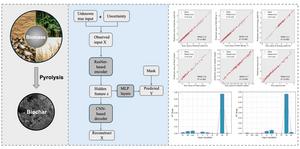
AI model boosts accuracy and reliability in predicting biochar production
Researchers have developed a powerful new artificial intelligence model that can accurately predict biochar yield and composition, helping scientists and industry optimize production while reducing environmental risks.
Biochar, a carbon-rich material produced from biomass, is widely used for soil improvement, pollution control, and carbon sequestration. However, its properties vary significantly depending on feedstock and processing conditions, making it difficult to determine optimal production strategies.
“Biochar production involves many interacting variables, and experimental trial-and-error is costly and time-consuming,” said the study’s corresponding author. “Our goal was to create a reliable predictive tool that works even when data are incomplete or uncertain.”
In the new study, researchers designed a ResNet-based autoencoder model that integrates deep learning with uncertainty-aware data handling. The model uses information about biomass characteristics and pyrolysis conditions to predict key outputs such as biochar yield, energy efficiency, and chemical composition.
Unlike traditional machine learning approaches, which often struggle with missing or noisy data, the new model is specifically built to handle real-world datasets. Biochar research data often come from multiple sources and contain gaps or inconsistencies. Instead of discarding incomplete data, the model incorporates a masking strategy that allows it to learn from all available information.
The results show a major improvement in predictive performance. The model achieved an average R² of up to 0.985, outperforming commonly used methods such as random forest, XGBoost, and conventional neural networks. For example, predictions of biochar yield reached an R² of 0.980 with low error, indicating strong agreement between predicted and observed values.
The model also demonstrated exceptional robustness. In stress tests where additional noise and missing data were introduced, its performance remained stable, while other models showed significant degradation. This robustness is critical for real-world applications, where perfect datasets are rarely available.
Another key innovation is the use of previously discarded data. Earlier studies often removed variables with high missing rates, which can lead to loss of valuable information. By contrast, this model retains and leverages those variables, further improving prediction accuracy.
The study also identified which factors most strongly influence prediction performance. Sensitivity analysis revealed that variables such as heating rate and volatile matter content play a particularly important role. Ensuring accurate measurement of these parameters could further enhance model reliability.
Beyond accuracy, the model is computationally efficient. Training can be completed in minutes, and predictions can be generated in fractions of a second, making it suitable for practical deployment in industrial and research settings.
The implications of this work are significant. By enabling rapid and reliable prediction of biochar properties, the model can help optimize production processes, reduce experimental costs, and minimize the formation of harmful byproducts such as heavy metals and toxic organic compounds.
“This approach provides a practical pathway for using artificial intelligence to guide sustainable biochar production,” the authors noted. “It allows us to make better decisions with imperfect data, which is often the reality in environmental research.”
The researchers suggest that future work could expand the model to incorporate additional data types and explore its application to other biomass conversion processes.
Overall, the study highlights how advanced machine learning can address long-standing challenges in biochar research, supporting more efficient, scalable, and environmentally responsible production systems.
===
Journal Reference: Zhang, Y., Lei, B., Mahdaviarab, A. et al. Robust biochar yield and composition prediction via uncertainty-aware ResNet-based autoencoder. Biochar 7, 61 (2025).
https://doi.org/10.1007/s42773-025-00446-2
===
About Biochar
Biochar (e-ISSN: 2524-7867) is the first journal dedicated exclusively to biochar research, spanning agronomy, environmental science, and materials science. It publishes original studies on biochar production, processing, and applications—such as bioenergy, environmental remediation, soil enhancement, climate mitigation, water treatment, and sustainability analysis. The journal serves as an innovative and professional platform for global researchers to share advances in this rapidly expanding field.
Follow us on Facebook, X, and Bluesky.
Disclaimer: AAAS and EurekAlert! are not responsible for the accuracy of news releases posted to EurekAlert! by contributing institutions or for the use of any information through the EurekAlert system.

Related Posts