
Using detailed surveys and machine learning computation, new research co-authored at UC Berkeley’s Center for Effective Global Action finds that eradicating extreme poverty would be surprisingly affordable. By Edward Lempinen New research co-authored at UC Berkeley's Center for Effective Global Action finds that, for a surprisingly modest investment, extreme poverty could be eradicated globally by

AI Slashes Defect Simulations From Hours to Milliseconds
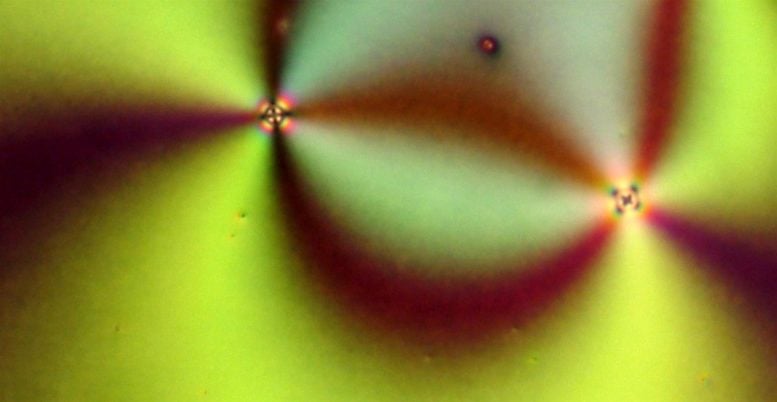
Scientists have developed an AI system that can rapidly predict complex defect patterns in liquid crystals, cutting simulation times from hours to milliseconds. The approach could transform how advanced materials are designed and tested.
Many complex structures in the physical world take shape when symmetry breaks. As a system moves from a balanced, symmetrical state into an ordered one, small but stable irregularities can appear. These features are called topological defects. They exist across an enormous range of scales, from the structure of the universe to familiar materials, making them a valuable way to study how order develops in complex systems.
Liquid Crystals as a Model System
Scientists often study these defects using nematic liquid crystals. In these materials, molecules are free to rotate while still pointing in roughly the same direction. This makes liquid crystals an ideal and controllable system for observing how defects emerge, shift, and reorganize. Researchers usually describe these structures using the Landau-de Gennes theory, which provides a mathematical description of how molecular order breaks down inside defect cores, where orientation is no longer well defined.
Faster Defect Predictions With Artificial Intelligence
A research team led by Professor Jun-Hee Na from Chungnam National University (Republic of Korea) has now developed a much faster way to predict stable defect patterns using deep learning.
Their approach, reported in the journal Small, replaces slow and computationally demanding numerical simulations. Instead of taking hours, the new method can produce results in just milliseconds.
“Our approach complements slow simulations with rapid, reliable predictions, facilitating the systematic exploration of defect-rich regimes,” says Prof. Na.
Inside the Deep Learning Framework
The model is built around a 3D U-Net architecture, a type of convolutional neural network commonly used in scientific and medical image analysis. This design allows the system to capture both large-scale molecular alignment and the fine details of local defect structures. The method works by directly connecting specified boundary conditions to the final equilibrium configuration. Boundary data is provided to the network, which then predicts the full molecular alignment field, including where defects appear and what shapes they take.
To train the system, the researchers used data from conventional simulations that spanned a wide range of alignment patterns. After training, the model was able to predict entirely new configurations it had not encountered before. Its results closely matched those from both traditional simulations and experimental observations.
Learning Physics From Data
Rather than relying on explicit equations, the model learns the underlying physical behavior directly from data. This allows it to manage especially complex scenarios, including higher-order topological defects, where defects can merge, divide, or rearrange. Experiments confirmed that the network accurately reproduced these behaviors, showing that it performs reliably under many different conditions.
New Paths to Advanced Materials
By enabling researchers to explore large design spaces quickly, this approach also creates new opportunities to design materials with carefully controlled defect structures. These capabilities are particularly important for advanced optical devices and metamaterials.
“By drastically shortening the material development process, AI-driven design could accelerate the creation of smart materials for applications ranging from holographic and VR or AR displays to adaptive optical systems and smart windows that respond to their environment,” says Prof. Na.
Reference: “Spontaneous Wrinkle Collapse in Anisotropic Condensed Matter Predicted by Deep Learning” by Kitae Kim and Jun-Hee Na, 25 November 2025, Small.
DOI: 10.1002/smll.202510844
Never miss a breakthrough: Join the SciTechDaily newsletter.
Follow us on Google and Google News.

Related Posts