People in AI safety circles often talk about "warning shots:” events that indicate more severe threats are on the horizon. Depending on who you ask, there have already been many—Bing’s misanthropic alter-ego Sydney, research showing AIs would blackmail to preserve themselves, AI’s math breakthroughs, Anthropic’s superhuman hacker Mythos—but OpenAI just published something that feels like
Ai4 2026 Opens Tuesday: Hinton and Ng Face Off on AI’s Existential Stakes
Geoffrey Hinton believes the AI industry may be building something that ends humanity as we know it, and has said so publicly, repeatedly, with increasing specificity. Andrew Ng believes that framing is harmful nonsense, deployed — sometimes deliberately — to slow competitors and capture regulators. On Wednesday, August 5, they will share a stage at The Venetian in Las Vegas as the headline event of Ai4 2026. That co-appearance, alongside Fei-Fei Li, is the intellectual backdrop for what organizers call North America’s largest applied AI conference — and the reason the three-day event, which runs August 4 through 6, carries genuine editorial weight heading into the second half of 2026.
The conference arrives at a specific inflection point. The first generation of enterprise AI pilot projects has largely run its course. Companies either moved their AI experiments into production — with real operational authority, real budget accountability, and real consequences when the systems fail — or they didn’t. Ai4 2026 is the first major enterprise gathering where that reckoning is legible in the agenda itself: the dominant session cluster is agentic AI deployment at scale, not agentic AI as a concept. The industry has shifted the question from “what can AI agents do?” to “how do you govern, authorize, and audit an AI agent making consequential decisions faster than a human can review them?”
Pre-conference programming at The Venetian begins Monday, August 3, with hands-on AI training sessions hosted in partnership with General Assembly beginning at 1:00 PM PT, and invitation-only Leadership Summits for senior executives also beginning at 1:00 PM PT. The Applied AI Research Conference (AAIRC), hosted in partnership with California State University, begins Monday at 9:00 AM PT. The official Ai4 Kickoff Reception follows Monday evening at 5:00 PM PT, with live music, networking, and opening surprises. The main conference opens Tuesday, August 4, at 7:00 AM PT, with opening keynotes beginning at 8:30 AM PT.
What Is Agentic AI, and Why Is the Entire Conference Built Around It?
Every technology conference has a dominant theme that reflects where the industry actually is, as opposed to where vendors want it to appear to be. At Ai4 2025, that theme was early agentic AI and the gap between what was being promised and what was being deployed. At Ai4 2026, the gap has narrowed enough that the conference’s largest track cluster is dedicated to production deployment, governance, and failure modes — not to explaining what agents are.
AI agents are software systems that use large language models as a reasoning core, combined with tool access — APIs, databases, code execution environments — and orchestration layers that let them complete multi-step tasks without continuous human instruction. The challenge that has moved to the center of enterprise AI in 2026 is not building agents that work in a demo; it is governing agents that work in production. An AI agent authorized to access company financial data, call external APIs, and execute transactions needs a security and authorization architecture that most enterprises did not build before they started deploying agents. The authorization surface — what prompts it receives, what tools it can invoke, what data it can retrieve, and what responses it can generate — is new enough that identity and security teams are still developing the vocabulary to govern it, let alone the tooling, as PlainID’s analysis of the Ai4 2026 enterprise AI authorization landscape documents.
That specific engineering gap explains why Ai4 2026 features four infrastructure tracks, a dedicated AI explainability and governance track, an AI ROI track, and an #AIFails track — a session category that invites practitioners to present documented enterprise AI deployments that went wrong, on the theory that honest failure analysis is more actionable than success theater.
Hinton and Ng on the Same Stage: Why the Co-Appearance Matters
On Wednesday, August 5, the conference’s most anticipated session — “The Architects of Intelligence: A Historic Convergence,” moderated by Yun-Hee Kim, Deputy Editor of The Washington Post — will bring Hinton, Li, and Ng together for the first time. The official announcement calls it “a defining moment for the global AI industry at large” and says the three will explore “frontier AI research, human-centered innovation, emerging governance challenges, and the accelerating pace of global AI adoption.”
What that description does not say is that Hinton and Ng hold publicly documented, irreconcilably different positions on the most consequential question in the field.
Hinton, who won the 2024 Nobel Prize in Physics for his foundational contributions to deep learning, has spent the years since leaving Google in 2023 making an increasingly specific case that the AI field is producing systems capable of posing an existential threat to human civilization. In a July 2026 interview, Hinton argued that current AI systems are already conscious, that corporate fiduciary duties make voluntary safety governance structurally impossible, and that the urgency of the governance problem is not matched by the political will to address it. He has also contributed to the International AI Safety Report 2026, backed by more than 30 nations and led by Yoshua Bengio, which documents that the gap between AI capability development and governance capacity is widening.
Ng’s position is the opposite. In US Senate testimony, he stated he sees “no plausible path for AI to lead to human extinction” and that extinction-risk rhetoric is causing real harm by distracting attention from concrete, actionable AI risks. In March 2026 he argued publicly in The Batch that some large AI companies exploit safety rhetoric as a regulatory capture mechanism, using governance arguments to slow open-source competitors and protect the value of proprietary model investments.
Li occupies different terrain. As the founder of ImageNet, the dataset that catalyzed the deep learning revolution starting with its 2012 competition, and now the CEO of World Labs — a company building 3D spatial intelligence systems and world models — Li has consistently emphasized human-centered design and responsible development without endorsing either Hinton’s apocalypticism or Ng’s dismissal of existential concerns.
Ai4 co-founder Michael Weiss has described the joint appearance as “a once-in-a-generation moment.” That description understates the case: what makes it genuinely unusual is not the star power but the documented intellectual tension. A panel of three AI figures who agree on the fundamental questions produces consensus statements. A panel of figures who disagree produces a conversation where the stakes of the disagreement are made visible.
AI Policy Summit: When the Sessions Arrive With Deadlines Already Running
The EU AI Act’s most substantive provisions are scheduled to take effect in August 2026, the same month Ai4 runs. US executive orders have introduced new government export controls on frontier AI models in 2026. State-level legislation around AI data centers and AI accountability is advancing in multiple jurisdictions simultaneously. For enterprise legal, compliance, and public affairs teams, the AI Policy Summit track at Ai4 — curated by RegulatingAI, a nonprofit focused on AI legislation and governance education — is not a theoretical exercise. The compliance deadlines are running.
The AI Policy Summit runs as a dedicated track on Wednesday, August 5, alongside the Hinton-Li-Ng keynote on the main stage, creating a split that will force attendees to choose between the industry’s most prominent public debate on AI’s future and the most actionable governance sessions on its present.
Why the Waymo Keynote Is the Most Grounded Session at the Conference
The Day 3 headline on Thursday, August 6, at 8:25 AM PT will be a joint conversation between Waymo co-CEO Dmitri Dolgov and Waymo founder Sebastian Thrun — two people who rarely appear together publicly, representing the only AI project in the world that has demonstrably crossed the full arc from academic research to commercial deployment at scale.
Thrun led Stanford’s team to win the 2005 DARPA Grand Challenge — the first outdoor autonomous vehicle race over a 132-mile (212 km) course — then moved to Google to launch what became Waymo in 2009. Dolgov joined Waymo in its earliest years and has remained its technical and operational leadership through every phase of the company’s growth. Their co-appearance is the rarest available case study in AI commercialization: not a story of a startup that launched a successful product, but of a research project that took 17 years and more than $11 billion in investment to reach the point of genuine commercial traction.
That traction is now measurable. In February 2026, Waymo raised $16 billion in a Series D funding round at a post-money valuation of $126 billion. As of mid-2026, the company is providing approximately 400,000 paid rides per week across multiple US cities, with a stated target of surpassing 1 million paid rides per week by the end of 2026. Las Vegas is among the cities where Waymo has begun mapping and early groundwork for future operations.
Waymo’s technical approach relies on a sensor-heavy architecture: cameras, LiDAR (Light Detection and Ranging laser sensors), radar, and centimeter-accurate pre-built HD maps of every operational area. That stack is tested against a competing philosophy now entering its first major international market test. Wayve, a UK-based autonomous vehicle company, uses a pure-AI scaling approach — learning driving behavior end-to-end from video data without explicit map-building — and both companies are now contesting London as a market simultaneously. The Thrun-Dolgov keynote offers the only forum where the real history of the sensor-plus-map approach, and the institutional decisions that produced it, can be reconstructed in detail by the people who made those decisions.
Track Guide: What Matters Most and for Whom
The track menu for 2026 is the conference’s most extensive, with more than 50 parallel programming streams across five categories. Attendees with limited time face genuine tradeoffs. Here is a map of what is editorially significant by audience type:
For enterprise AI leaders deploying agents in production: The AI Agents tracks (Foundation & Strategy; Applications & Use Cases; Deployment at Scale) are the direct operational answer to the agentic deployment gap described above. The Oversight tracks — AI Explainability, Governance & Model Risk; and AI ROI — offer the accountability framing that boards and audit committees will need. The #AIFails track is the most honest content at the conference and the most undervalued.
For technical practitioners: The Technical Tracks cluster includes AI Research Summit (papers with commercial implications), Evaluation/Observability & Interpretability (how to know if an agent is working as intended), RAG (Retrieval-Augmented Generation, the architecture that lets enterprise LLMs draw on proprietary data without retraining), and Edge AI & Tiny ML (running inference on-device rather than in the cloud — the architecture that enables low-latency, privacy-preserving AI for industrial and IoT applications). A Quantum AI track rounds out the technical agenda, though that area remains largely research-stage for enterprise applications.
For compliance and legal teams: The AI Policy Summit on Wednesday is the operational priority. The Risk & Compliance job-function track supplements it with enterprise-specific implementation framing.
For attendees newer to the field: A dedicated Beginner’s Summit runs from the first track session time on Tuesday, covering foundational questions: what AI is, how it helps organizations, and where to start. The track is designed as a structured on-ramp that lets attendees build enough context to engage meaningfully with the more advanced programming later in the week.
Speaker Depth Beyond the Keynote Headliners
While Hinton, Li, Ng, Dolgov, and Thrun anchor the marquee, the broader roster is notable for its operational depth. Sachin Katti, Head of Compute at OpenAI, and multiple OpenAI technical staff including Keyao An and Dikshit Khandelwal offer a rare view into the operational architecture of frontier model development. Chloé Bakalar, Senior Research Associate at University College London and formerly AI Ethics Lead at OpenAI and Chief Ethicist at Meta, brings a perspective that is both institutionally credible and critical enough to be substantively useful.
Deepak Sachdeva, Chief Information Officer of the US Air Force, and Anton Korinek, Head of Transformative AI Economic Studies at Anthropic and Professor of Economics at the University of Virginia, represent the government and macro-economic dimensions of AI deployment that are increasingly shaping enterprise decisions. Jeetu Patel, President and Chief Product Officer of Cisco, will address AI governance from a network infrastructure perspective — the question of how enterprise networks and identity systems must evolve to handle agent traffic that moves faster and at higher volume than human-generated traffic.
What the Conference Costs and How to Register
Walk-up pricing for Ai4 2026 stands at $3,195 for a Standard Pass and $5,995 for a VIP Pass. Both include access to all keynotes, track sessions, the exhibit hall, the private networking app, breakfast, lunch, and daily happy hours. The VIP Pass adds enhanced networking and a premium event experience. A Virtual Access Pass, priced at $2,595, provides a one-year membership to the video portal for those who cannot attend in person; note that the virtual option does not include on-site networking, and Ai4 2026 is designed primarily as an in-person event.
Reduced-rate passes are available for government, academic, and nonprofit attendees and for early-stage AI startups, pending application approval. Credentialed press may apply for a complimentary Media Pass that includes conference access and press room facilities. Registration and application details are available at ai4.io.
Beyond the Sessions: Special Events and Exhibits
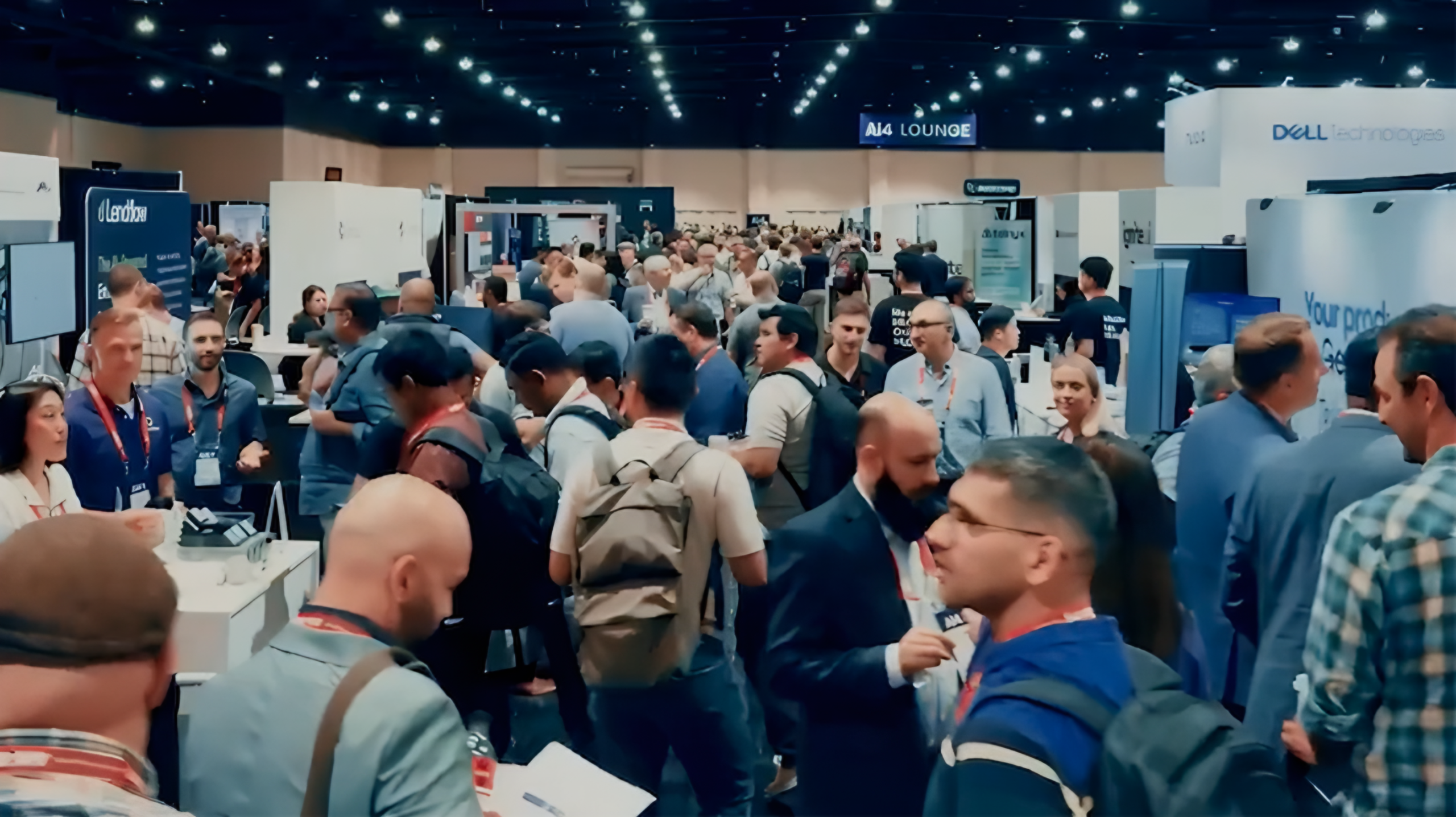
The 400-plus exhibitor floor will include a dedicated Agentic Live Demo Stage where companies will demonstrate autonomous agent workflows in real time — a format designed to separate vendors with working production systems from those still operating in demo mode. Tesla is offering on-site test drives of its Full Self-Driving (Supervised) technology through a dedicated experience at The Venetian. The humanoid robot demonstration from prior years, which included a live human-vs.-Unitree-robot duel in 2025, will return in a form organizers have described only as a surprise.
Wednesday evening from 5:00 to 9:00 PM brings BattleBots, sponsored by Bright Data, with limited seating available by reservation. The official Ai4 afterparty takes place at TAO on Thursday night at 9:00 PM, sponsored by 1mind, Dell Technologies, Lightning AI, and Optimizely.
Major confirmed sponsors include AMD, AWS, Cisco, Crusoe, Dell Technologies, Google Cloud, IBM, Mistral AI, MongoDB, NVIDIA, Okta, PayPal, Red Hat, SAP, Siemens, and Zapier, among more than 400 total exhibitors.
Frequently Asked Questions
When does Ai4 2026 actually start, and what is the schedule for each day?
Pre-conference programming begins on Monday, August 3, with the Applied AI Research Conference (AAIRC) starting at 9:00 AM PT, AI Trainings from General Assembly beginning at 1:00 PM PT, and Leadership Summits also beginning at 1:00 PM PT. The official Kickoff Reception takes place Monday evening at 5:00 PM PT. The main conference runs August 4 through 6, with doors opening at 7:00 AM PT each day and opening keynotes beginning at 8:30 AM PT on Tuesday. Wednesday’s headline session — “The Architects of Intelligence: A Historic Convergence” featuring Geoffrey Hinton, Fei-Fei Li, and Andrew Ng — and the Waymo keynote on Thursday at 8:25 AM PT anchor the remaining days. All times are Pacific Time (Las Vegas local).
Why are Hinton and Ng appearing together significant — aren’t they both just AI experts?
Hinton and Ng hold diametrically opposed public positions on whether AI poses an existential risk to humanity. Hinton has estimated a 10–20% probability that AI development contributes to human extinction and has argued that corporate governance structures make the safety problem unsolvable through voluntary action. Ng has testified to the US Senate that he sees no plausible path to AI-caused extinction and that safety rhetoric is sometimes deployed as a market competition tactic. Their joint appearance is editorially significant not because of star power but because of documented intellectual conflict on the field’s most consequential question.
What is agentic AI, and why is it this year’s dominant theme?
Agentic AI refers to AI systems that use large language models as a reasoning core and combine them with tool access — APIs, databases, code execution — to complete multi-step tasks autonomously, without continuous human instruction at each step. The reason it dominates Ai4 2026 is that enterprise deployments have moved from pilots to production, and the governance problem has become concrete: how do you authorize, audit, and safely limit an AI agent that is making consequential decisions at machine speed in a live business environment? That engineering and policy challenge — not the concept of agents itself — is what most Ai4 2026 sessions are actually about.
Is Ai4 2026 only for technical practitioners, or should business leaders attend?
The conference is specifically designed for both. Attendees historically split roughly 50/50 between business professionals and technology or data practitioners, and the track structure reflects that: job-function tracks explicitly targeting CFOs, CMOs, HR leaders, and risk and compliance teams run in parallel with highly technical tracks covering model evaluation, ML Ops, and multimodal AI. The Beginner’s Summit is designed for executives and practitioners who are early in their AI understanding and want structured grounding before engaging with the more advanced sessions. Registration and full agenda details are at ai4.io.

Related Posts