Holding ‘APEC Future Jobs Forum’
Ministry of Labor’s “People-centered industry transformation”
![First-year students are looking at fried cooking robots at a base-type school meal frying support room set up at Daepyeong Elementary School in Suwon-si, Gyeonggi-do on March 18. [Yonhap News]](https://wimg.mk.co.kr/news/cms/202604/06/rcv.YNA.20260318.PYH2026031810130006100_P1.jpg)
Although job substitution due to the introduction of artificial intelligence (AI) in domestic companies is still limited, it is analyzed that there is a negative impact on youth employment, especially in jobs with high AI exposure.
At the APEC Future Jobs Forum held by the Ministry of Employment and Labor at the Conrad Hotel in Yeongdeungpo-gu, Seoul on the 6th, Dr. Noseri of the Korea Labor Institute said, “The majority of Korean companies responded that AI is replacing up to 10% of their work,” adding, “Based on the Organization for Economic Cooperation and Development (OECD), the negative impact on employment is not yet clear.”
However, he pointed out, “Since 2023, when the introduction of Generative AI began in earnest, the growth of youth employment is observed to slow down, especially in occupations with high risk of AI exposure,” adding, “We are concerned about employment inequality due to the technology gap.”
In the direction of policy response, Dr. Roh suggested establishing a lifelong learning system to increase workers’ AI capabilities, strengthening social dialogue in the process of introducing technology, and establishing responsible AI governance.
This forum is a place to find quality jobs in the AI era by sharing knowledge and experience among APEC member economies, and more than 100 people, including international organizations, policy managers from each country, and private companies, attended. The forum will be held in three sessions: the impact of AI and demographic changes on jobs and industries, policy response directions, job creation using AI, and public sector AI revitalization (AX).
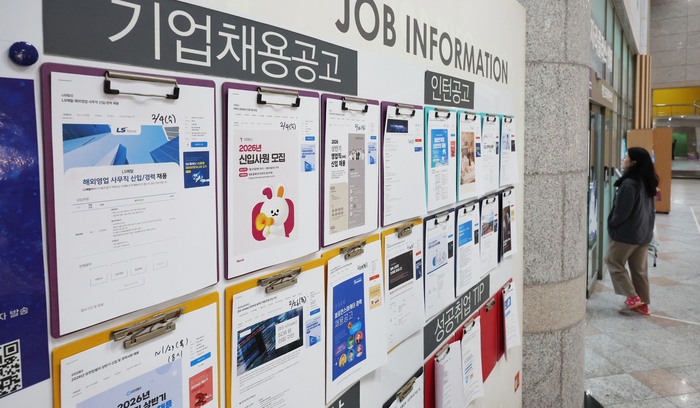
![Job postings are posted at a university job plus center in Seoul. [Reporter Lee Seung Hwan]](https://wimg.mk.co.kr/news/cms/202604/06/news-p.v1.20260130.8e7e17f0b7c44aa088e318ebd551944a_P1.jpg)
“The government’s systematic response is important during the AI transition period,” said Angelica, a senior OECD adviser who gave a keynote speech. “It is necessary to analyze job impact, design policies including social protection and employment safety nets.” Korea’s basic plan for industrial transition employment safety was also positively evaluated in that it reflected these factors.
Cases of AI use by private companies were also shared at the site. Hyosung ITX pushed for a job redesign to convert existing counselors to chatbot AI design and quality management through AI software training for all employees, while POSCO introduced a deep learning-based remote operation system to reduce industrial accidents in furnace work that was previously done manually. The Hong Kong Occupational Safety and Health Commission also announced cases of safety management using smart helmets and AI analysis.
The Ministry of Employment and Labor is also expanding the introduction of AI in administrative fields such as employment 24 and AI labor law counseling services. Lim Young-mi, head of the employment policy office, said, “The APEC member economy should unite with innovation, inclusion, and cooperation to turn the crisis into an opportunity. Korea plans to achieve a human-centered industrial transformation to realize AI for everyone.”