
Qualcomm on Tuesday struck a $60 billion deal with Amazon for the San Diego company’s AI data center chips, with Amazon also picking up the right to buy $4 billion of its stock. “We used to be a smartphone company,” Qualcomm CFO and COO Akash Palkhiwala said at the Goldman Sachs investors summit in San
Deep learning mirrors ecological time scales in water quality forecasting | Newswise
Water quality forecasting has long been divided between process-based mechanistic models, which are resource-intensive and difficult to calibrate, and data-driven approaches that often fail to capture the nonlinear, nonstationary dependencies inherent in environmental time series. While deep learning has shown promise in fields like energy and traffic forecasting, its application to water quality has largely treated models as black boxes, with little understanding of how specific architectural components interact with ecological dynamics. This gap has made informed model selection difficult and has hindered the development of forecasting frameworks that can adapt to different bloom scenarios and forecast horizons. Based on these challenges, a systematic investigation into how core AI modules align with ecological time scales is urgently needed.
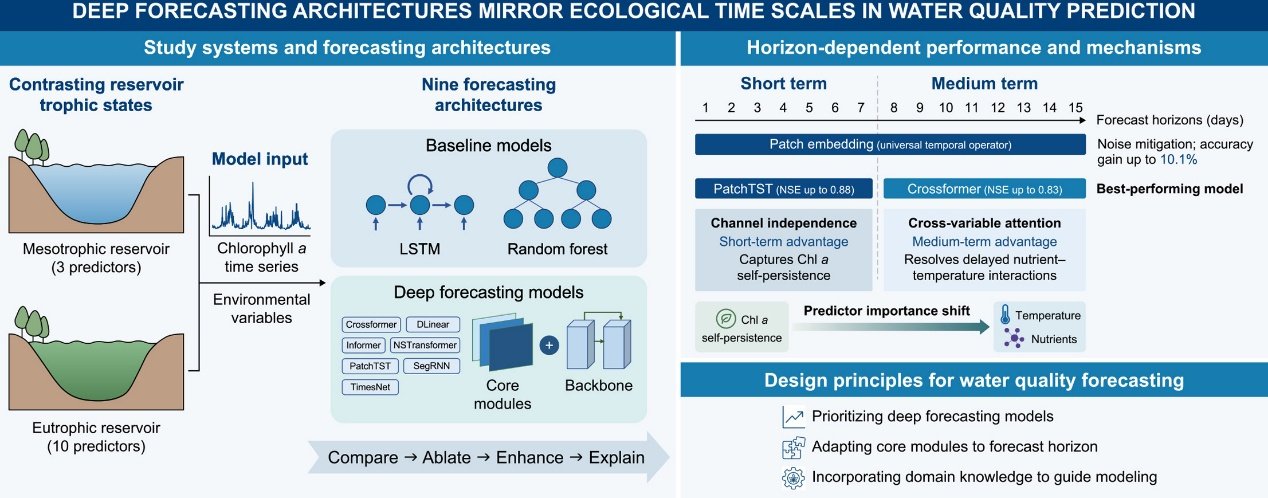
Researchers from Xiamen University, Wenzhou University, the University of Hong Kong, the Chinese Academy of Sciences, and the Helmholtz Centre for Environmental Research—UFZ report (DOI: 10.1016/j.ese.2026.100755) their findings on August 30, 2026, in Environmental Science and Ecotechnology. The team compared two conventional baselines and seven advanced deep forecasting architectures—including Crossformer, DLinear, Informer, NSTransformer, PatchTST, SegRNN, and TimesNet—using high-frequency monitoring data from Germany’s Königshütte Reservoir and China’s Yazidang Reservoir. Their goal was to move beyond model-level comparisons and uncover which architectural modules drive predictive skill across short-term (1–7 days) and medium-term (8–15 days) chlorophyll a forecasts.
The study’s central discovery is that patch embedding—a technique that divides time series into local segments—acts as a universal performance booster, improving forecasting accuracy by up to 10.1% when integrated into standard baselines. More importantly, the researchers found a clear division of labor between two competing design strategies. Channel-independent architectures, which process each variable through separate pipelines, excelled at short-term forecasts (Nash-Sutcliffe efficiency up to 0.88) by capturing the strong self-persistence of algal biomass. In contrast, cross-variable attention architectures, which model interactions across all input variables, proved superior for medium-term predictions (efficiency up to 0.83) by disentangling delayed nutrient-temperature interactions that drive bloom development over longer horizons. Ablation experiments confirmed that removing patch embedding caused the largest performance drops—up to 11.8%—while channel independence and cross-variable attention provided complementary, horizon-specific benefits. Explainable AI further revealed a temporal shift in feature reliance: current chlorophyll a dominated short-term predictions, but water temperature and nutrient variables gained importance as lead times extended beyond 10 days. This alignment between AI modules and ecological mechanisms was remarkably consistent across both reservoirs, despite their contrasting trophic states and data availability.
“We were struck by how cleanly the architecture-performance patterns mapped onto ecological common sense,” the authors said. “PatchTST’s channel-independent design naturally captures the day-to-day inertia of algal blooms, while Crossformer’s cross-variable attention picks up the slower, lagged effects of nutrients and temperature. It tells us that these models aren’t just black-box optimizers—they’re actually learning the right ecological rhythms. The real breakthrough is that we can now choose or design a forecasting model based on what ecological time scale we care about, rather than just throwing the latest algorithm at the problem and hoping it works.”
These findings have immediate practical implications for water quality management and early-warning systems. For short-term operational decisions—such as issuing bloom alerts or adjusting reservoir releases—channel-independent models like PatchTST offer the highest reliability. For medium-term planning, such as anticipating nutrient-driven blooms a week or two in advance, cross-variable attention architectures like Crossformer provide superior skill. The study also demonstrates that domain knowledge can guide model selection: understanding that short-term dynamics are governed by biomass persistence, while medium-term dynamics reflect delayed environmental responses, allows practitioners to align AI architectures with ecological realities. This horizon-adaptive framework is not limited to water quality—it provides a generalizable strategy for building interpretable, trustworthy AI across climate, agriculture, and ecosystem monitoring.
###
References
DOI
10.1016/j.ese.2026.100755
Original Source URL
https://doi.org/10.1016/j.ese.2026.100755
Funding information
National Key R&D Program (2023YFC3209900), National Natural Science Foundation Youth Project (424B2052), State Key Laboratory of Lake and Watershed Science for Water Security.
About Environmental Science and Ecotechnology
Environmental Science and Ecotechnology (ISSN 2666-4984) is an international, peer-reviewed, and open-access journal published by Elsevier. The journal publishes significant views and research across the full spectrum of ecology and environmental sciences, such as climate change, sustainability, biodiversity conservation, environment & health, green catalysis/processing for pollution control, and AI-driven environmental engineering. The latest impact factor of ESE is 14.3, according to the Journal Citation ReportsTM 2024.

Related Posts