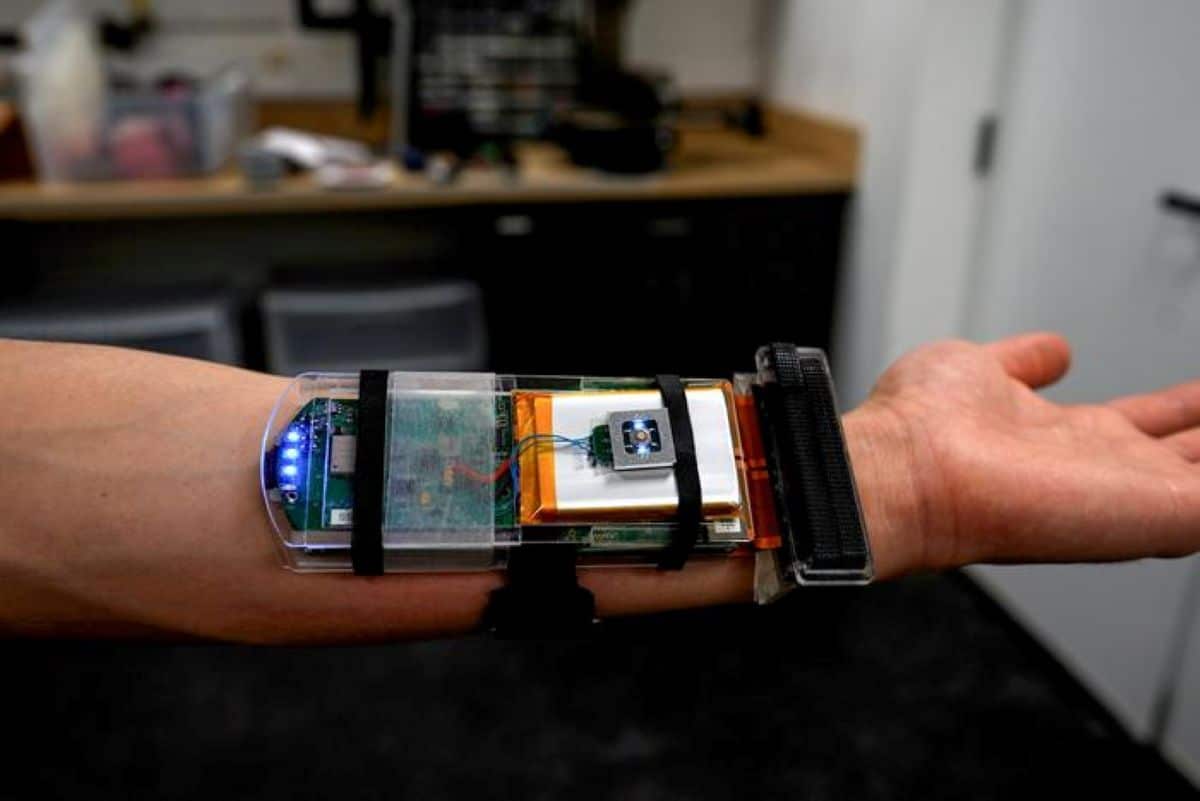
Summary: Capturing the complex coordination of the human hand—which involves 34 muscles and 22 degrees of freedom—has been a “holy grail” for robotics and VR. Engineers have developed a wearable ultrasound wristband that tracks these movements in real time with unprecedented precision. By imaging the shifting tendons and muscles in the wrist (the “strings” that

Exploring how deep learning decodes anomalous diffusion via Grad-CAM – Nature Communications
References
-
Mehta, P. et al. A high-bias, low-variance introduction to machine learning for physicists. Phys. Rep. 810, 1–124 (2019).
Google Scholar
-
Carleo, G. et al. Machine learning and the physical sciences. Rev. Mod. Phys. 91, 045002 (2019).
Google Scholar
-
Mehrish, A., Majumder, N., Bharadwaj, R., Mihalcea, R. & Poria, S. A review of deep learning techniques for speech processing. Informat. Fusion 99, 101869 (2023).
Google Scholar
-
Voulodimos, A., Doulamis, N., Doulamis, A. & Protopapadakis, E. Deep learning for computer vision: a brief review. Comput. Intell. Neurosci. 2018, 7068349 (2018).
Google Scholar
-
Ghielmetti, N. et al. Real-time semantic segmentation on FPGAs for autonomous vehicles with HLS4ML. Mach. Learn.: Sci. Technol. 3, 045011 (2022).
Google Scholar
-
OpenAI et al. GPT-4 technical report. Preprint at https://arxiv.org/abs/2303.08774 (2023).
-
Aad, G. et al. Search for neutral long-lived particles in pp collisions at (sqrt{s}=13) TeV that decay into displaced hadronic jets in the ATLAS calorimeter. J. High Energ. Phys. 2022, 1–49 (2022).
Google Scholar
-
Qiu, R., Krastev, P. G., Gill, K. & Berger, E. Deep learning detection and classification of gravitational waves from neutron star-black hole mergers. Phys. Lett. B 840, 137850 (2023).
Google Scholar
-
Jumper, J. et al. Highly accurate protein structure prediction with alphafold. Nature 596, 583–589 (2021).
Google Scholar
-
Bo, S., Schmidt, F., Eichhorn, R. & Volpe, G. Measurement of anomalous diffusion using recurrent neural networks. Phys. Rev. E 100, 010102 (2019).
Google Scholar
-
Granik, N. et al. Single-particle diffusion characterization by deep learning. Biophys. J. 117, 185–192 (2019).
Google Scholar
-
Kowalek, P., Loch-Olszewska, H. & Szwabiński, J. Classification of diffusion modes in single-particle tracking data: feature-based versus deep-learning approach. Phys. Rev. E 100, 032410 (2019).
Google Scholar
-
Muñoz-Gil, G., Garcia-March, M. A., Manzo, C., Martín-Guerrero, J. D. & Lewenstein, M. Single trajectory characterization via machine learning. New J. Phys. 22, 013010 (2020).
Google Scholar
-
Barkai, E., Garini, Y. & Metzler, R. Strange kinetics of single molecules in living cells. Phys. Today 65, 29–35 (2012).
Google Scholar
-
Krapf, D. Mechanisms underlying anomalous diffusion in the plasma membrane. Curr. Top Membr. 75, 167–207 (2015).
-
Okubo, A. Dynamical aspects of animal grouping: swarms, schools, flocks, and herds. Adv. Biophys. 22, 1–94 (1986).
Google Scholar
-
Lüdtke, O., Roberts, B. W., Trautwein, U. & Nagy, G. A random walk down university avenue: life paths, life events, and personality trait change at the transition to university life. J. Pers. Soc. Psychol. 101, 620–637 (2011).
Google Scholar
-
Plerou, V., Gopikrishnan, P., Amaral, L. A. N., Gabaix, X. & Stanley, H. E. Economic fluctuations and anomalous diffusion. Phys. Rev. E 62, R3023–R3026 (2000).
Google Scholar
-
Scher, H. & Montroll, E. W. Anomalous transit-time dispersion in amorphous solids. Phys. Rev. B 12, 2455–2477 (1975).
Google Scholar
-
Mandelbrot, B. B. & Van Ness, J. W. Fractional Brownian motions, fractional noises and applications. SIAM Rev. 10, 422–437 (1968).
Google Scholar
-
Klafter, J. & Zumofen, G. Lévy statistics in a Hamiltonian system. Phys. Rev. E 49, 4873–4877 (1994).
Google Scholar
-
Massignan, P. et al. Nonergodic subdiffusion from Brownian motion in an inhomogeneous medium. Phys. Rev. Lett. 112, 150603 (2014).
Google Scholar
-
Lim, S. C. & Muniandy, S. V. Self-similar Gaussian processes for modeling anomalous diffusion. Phys. Rev. E 66, 021114 (2002).
Google Scholar
-
Metzler, R., Jeon, J.-H., Cherstvy, A. G. & Barkai, E. Anomalous diffusion models and their properties: non-stationarity, non-ergodicity, and ageing at the centenary of single particle tracking. Phys. Chem. Chem. Phys. 16, 24128–24164 (2014).
Google Scholar
-
Weron, A., Janczura, J., Boryczka, E., Sungkaworn, T. & Calebiro, D. Statistical testing approach for fractional anomalous diffusion classification. Phys. Rev. E 99, 042149 (2019).
Google Scholar
-
Kepten, E., Weron, A., Sikora, G., Burnecki, K. & Garini, Y. Guidelines for the fitting of anomalous diffusion mean square displacement graphs from single particle tracking experiments. PLoS ONE 10, e.0117722 (2015).
Google Scholar
-
Magdziarz, M., Weron, A., Burnecki, K. & Klafter, J. Fractional Brownian motion versus the continuous-time random walk: a simple test for subdiffusive dynamics. Phys. Rev. Lett. 103, 180602 (2009).
Google Scholar
-
Meroz, Y., Sokolov, I. M. & Klafter, J. Test for determining a subdiffusive model in ergodic systems from single trajectories. Phys. Rev. Lett. 110, 090601 (2013).
Google Scholar
-
Schwarzl, M., Godec, A. & Metzler, R. Quantifying non-ergodicity of anomalous diffusion with higher order moments. Sci. Rep. 7, 3878 (2017).
Google Scholar
-
Kowalek, P., Loch-Olszewska, H., Łaszczuk, Ł, Opała, J. & Szwabiński, J. Boosting the performance of anomalous diffusion classifiers with the proper choice of features. J. Phys. A: Math. Theor. 55, 244005 (2022).
Google Scholar
-
Wagner, T., Kroll, A., Haramagatti, C. R., Lipinski, H.-G. & Wiemann, M. Classification and segmentation of nanoparticle diffusion trajectories in cellular micro environments. PLoS ONE 12, e0170165 (2017).
Google Scholar
-
Loch-Olszewska, H. & Szwabiński, J. Impact of feature choice on machine learning classification of fractional anomalous diffusion. Entropy 22, 1436 (2020).
Google Scholar
-
Muñoz-Gil, G. et al. Objective comparison of methods to decode anomalous diffusion. Nat. Commun. 12, 6253 (2021).
Google Scholar
-
Argun, A., Volpe, G. & Bo, S. Classification, inference and segmentation of anomalous diffusion with recurrent neural networks. J. Phys. A: Math. Theor. 54, 294003 (2021).
Google Scholar
-
Gentili, A. & Volpe, G. Characterization of anomalous diffusion classical statistics powered by deep learning (condor). J. Phys. A: Math. Theor. 54, 314003 (2021).
Google Scholar
-
Bland, T. Convolutional neural networks for characterisation and segmentation of anomalous diffusion trajectories (accessed 28 August 2025); https://github.com/tsmbland/andi_challenge.
-
Garibo-i Orts, Ò, Baeza-Bosca, A., Garcia-March, M. A. & Conejero, J. A. Efficient recurrent neural network methods for anomalously diffusing single particle short and noisy trajectories. J. Phys. A: Math. Theor. 54, 504002 (2021).
Google Scholar
-
Arts, M., Smal, I., Paul, M. W., Wyman, C. & Meijering, E. Particle mobility analysis using deep learning and the moment scaling spectrum. Sci. Rep. 9, 17160 (2019).
Google Scholar
-
Seckler, H. & Metzler, R. Bayesian deep learning for error estimation in the analysis of anomalous diffusion. Nat. Commun. 13, 6717 (2022).
Google Scholar
-
Simonyan, K., Vedaldi, A. & Zisserman, A. Deep Inside Convolutional Networks: Visualising Image Classification Models and Saliency Maps http://arxiv.org/abs/1312.6034 (2014).
-
Smilkov, D., Thorat, N., Kim, B., Viégas, F. & Wattenberg, M. Smoothgrad: Removing Noise by Adding Noise http://arxiv.org/abs/1706.03825 (2017).
-
Zeiler, M. D. & Fergus, R. Visualizing and Understanding Convolutional Networks, 818 https://doi.org/10.1007/978-3-319-10590-1_53 (2014).
-
Springenberg, J. T., Dosovitskiy, A., Brox, T. & Riedmiller, M. Striving for Simplicity: The All Convolutional Net https://arxiv.org/abs/1412.6806 (2015).
-
Bach, S. et al. On pixel-wise explanations for non-linear classifier decisions by layer-wise relevance propagation. PLoS ONE 10, e.0130140 (2015).
Google Scholar
-
Shrikumar, A., Greenside, P. & Kundaje, A. Learning Important Features Through Propagating Activation Differences, 3145 https://proceedings.mlr.press/v70/shrikumar17a.html (2017).
-
Sundararajan, M., Taly, A. & Yan, Q. Axiomatic Attribution for Deep Networks, 3319 https://proceedings.mlr.press/v70/sundararajan17a.html (2017).
-
Pineda, J. et al. Geometric deep learning reveals the spatiotemporal features of microscopic motion. Nat. Mach. Intell. 5, 71–82 (2023).
Google Scholar
-
Zhou, B., Khosla, A., Lapedriza, A., Oliva, A. & Torralba, A. Learning Deep Features for Discriminative Localization, 2921 https://doi.org/10.1109/CVPR.2016.319 (2016).
-
Selvaraju, R. R. et al. Grad-CAM: Visual Explanations from Deep Networks via Gradient-Based Localization. In 2017 IEEE International Conference on Computer Vision (ICCV), 618–626 (IEEE, 2017).
-
Chattopadhay, A., Sarkar, A., Howlader, P. & Balasubramanian, V. N. Grad-CAM++: Generalized Gradient-Based Visual Explanations for Deep Convolutional Networks. In 2018 IEEE Winter Conference on Applications of Computer Vision (WACV), 839–847 (IEEE, 2018).
-
Ennadifi, E., Laraba, S., Vincke, D., Mercatoris, B. & Gosselin, B. Wheat diseases Classification and Localization Using Convolutional Neural Networks and GradCAM Visualization https://doi.org/10.1109/ISCV49265.2020.9204258 (2020).
-
Lee, S., Lee, J., Lee, J., Park, C.-K. & Yoon, S. Robust tumor localization with pyramid Grad-CAM. Preprint at https://arxiv.org/abs/1805.11393 (2018).
-
Li, Y., Yang, H., Li, J., Chen, D. & Du, M. Eeg-based intention recognition with deep recurrent-convolution neural network: Performance and channel selection by grad-cam. Neurocomputing 415, 225–233 (2020).
Google Scholar
-
AL-hada, E. A., Tang, X. & Deng, W. Classification of stochastic processes by convolutional neural networks. J. Phys. A: Hath. Theor. 55, 274006 (2022).
Google Scholar
-
Bai, S., Kolter, J. Z. & Koltun, V. An empirical evaluation of generic convolutional and recurrent networks for sequence modeling. Preprint at https://arxiv.org/abs/1803.01271 (2018).
-
He, K., Zhang, X., Ren, S. & Sun, J. Deep Residual Learning for Image Recognition 770 https://doi.org/10.1109/CVPR.2016.90 (2016).
-
Bengio, Y., Courville, A. & Vincent, P. Representation learning: a review and new perspectives. IEEE Transactions on Pattern Analysis and Machine Intelligence 35, 1798–1828 (2013).
Google Scholar
-
Mahendran, A. & Vedaldi, A. Visualizing deep convolutional neural networks using natural pre-images. Int. J. Comput. Vis. 120, 233–255 (2016).
Google Scholar
-
Kokhlikyan, N. et al. Captum: a unified and generic model interpretability library for PyTorch. Preprint at https://arxiv.org/abs/2009.07896 (2020).
-
Shorten, C. & Khoshgoftaar, T. M. A survey on image data augmentation for deep learning. J. Big Data 6, 60 (2019).
Google Scholar
-
Bae, J. & Jeong, H. Segment-based task-specific deep learning framework for detecting state transitions in anomalous diffusion trajectories. J. Phys.: Photonics 7, 025027 (2025).
Google Scholar
-
Muñoz-Gil, G., Requena, B., Volpe, G., Garcia-March, M. A. & Manzo, C. AnDiChallenge/ANDI_datasets: Challenge 2020 release. Zenodo https://doi.org/10.5281/zenodo.4775311 (2020).
-
Paszke, A. et al. Pytorch: An Imperative Style, High-Performance Deep Learning Library https://proceedings.neurips.cc/paper_files/paper/2019/file/bdbca288fee7f92f2bfa9f7012727740-Paper.pdf (2019).
-
Kingma, D. P. & Ba, J. Adam: A Method for Stochastic Optimization. In 3rd International Conference for Learning Representations, San Diego, https://doi.org/10.48550/arXiv.1412.6980 (2015).
Download references

Related Posts