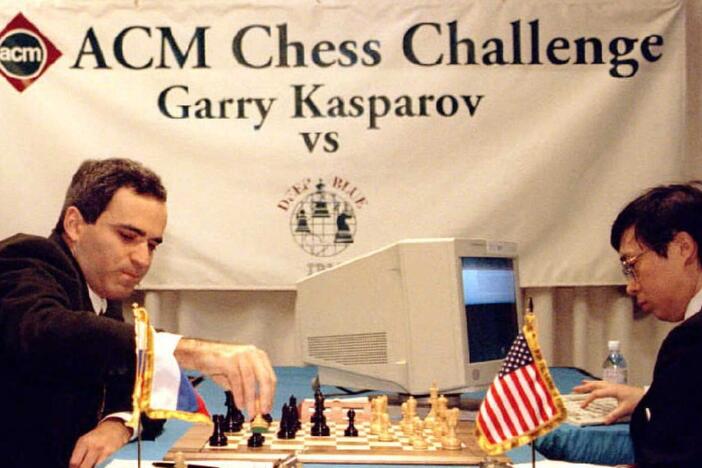
Could a machine outthink the best human mind in the world? Thirty years ago that was still an open question, but a historic matchup between a chess grandmaster and an IBM supercomputer answered it. On a cold February day in 1996, hundreds of chess fans filed into the Pennsylvania Convention Center in Philadelphia. They clutched
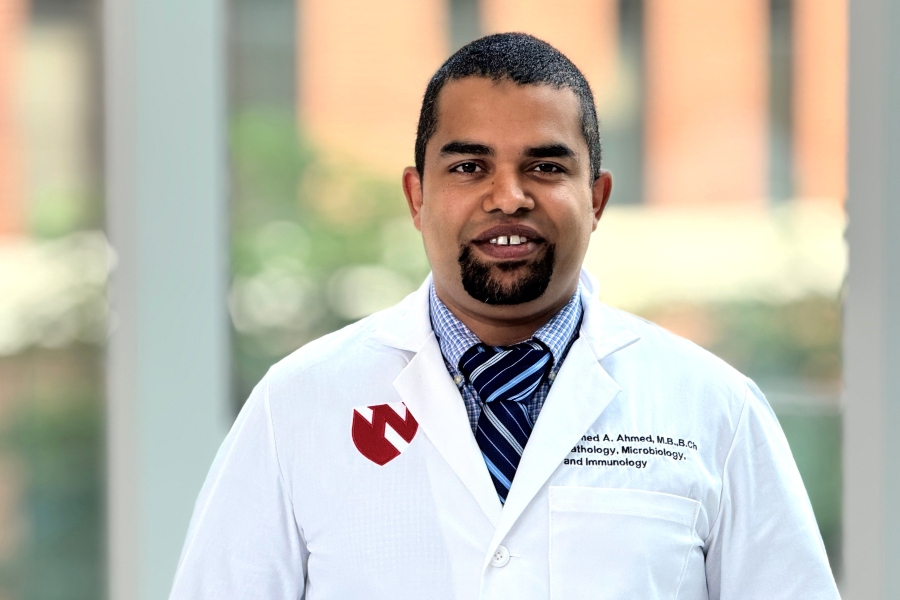
Fellow working to develop AI prediction model for myeloid neoplasms
Ahmed Ahmed, MBBCh, a hematopathology fellow in UNMC’s Department of Pathology, Microbiology and Immunology, is working on a study to develop a deep-learning model. The model would be capable of predicting IHC expression of the TP53 protein directly from H&E-stained whole slide images in myeloid neoplasms.
TP53 mutation is a critical prognostic factor in myelodysplastic syndromes (MDS) and acute myeloid leukemia (AML). Overexpression and null expression of TP53 protein on IHC serves as a surrogate marker for underlying mutations but requires additional time and expense.
Dr. Ahmed and his faculty mentor, Dr. John Cannatella, hope that by using coding and transfer learning techniques, they will be able to interpret TP53 expression patterns from histologic morphology alone. This proof-of-concept approach could enable rapid, low-cost screening and pave the way for AI-driven prediction of other molecular markers.
“It’s a huge idea. And our future goal, if it works, is to apply it to other mutations,” Dr. Ahmed said. “So that could have a really huge impact on the long run.”
Dr. Ahmed’s study is made possible by the department’s Research Grant Awards, created in 2024. The awards provide up to $10,000 in research funding to residents and fellows. The aim of this program is to advance the experience and mentorship in clinical and translational research.
The study intends to analyze bone marrow samples from 44 MDS/AML patients with TP53 abnormalities, 28 benign cases, and 28 malignant cases without TP53 abnormalities, and will include preparation of new H&E slides. The slides will be digitally scanned, de-stained, and stained with TP53 IHC. AI-based approaches will be developed and evaluated to predict TP53 patterns from H&E morphology, starting with image patch analysis and progressing to whole-slide prediction. Accuracy will be assessed by comparing generated vs. actual TP53 images through pathologist review and pixel-level concordance analysis.
He said they hope to complete the project in eight to 10 months, though it could go longer. “When I approached Dr. Cannatella, he said I have this project, but it’s going to be big, and it needs lots of time and effort to get it done.” Dr. Ahmed said he was sold when he learned it was an AI project. “That’s a hot topic in pathology these days. All the big institutions now, they’re trying to accomplish something in AI.”
Dr. Cannatella said: “In order to be successful, we will use modern deep learning techniques and rely on the exceptional technical skill of our lab to de-stain and re-stain the tissue. Dr. Ahmed will be critical for the success of the project by organizing the data, coordinating with many different team members, and, if the project is successful, creating the manuscript all while learning the intricacies of how deep learning models are created.”
Dr. Ahmed, originally from Egypt, attended medical school at Cairo University, graduating in 2014 and working there as a general practitioner and then briefly as a pathology resident. He came to the U.S. in 2021 for his pathology residency at UT Health Houston, completing that training in June 2025. “And then I applied for my hemepath fellowship and molecular pathology fellowship for next year here at UNMC.” After completing his UNMC fellowships, Dr. Ahmed hopes to join an academic institution and continue working in research.
He said he’s enjoyed Omaha so far. “I like the city and its slow pace compared to Houston. It’s small and quiet. And you have four seasons, and this is a huge difference from Houston. Houston is gigantic. And they have only two seasons—too hot or less hot.”

Related Posts