
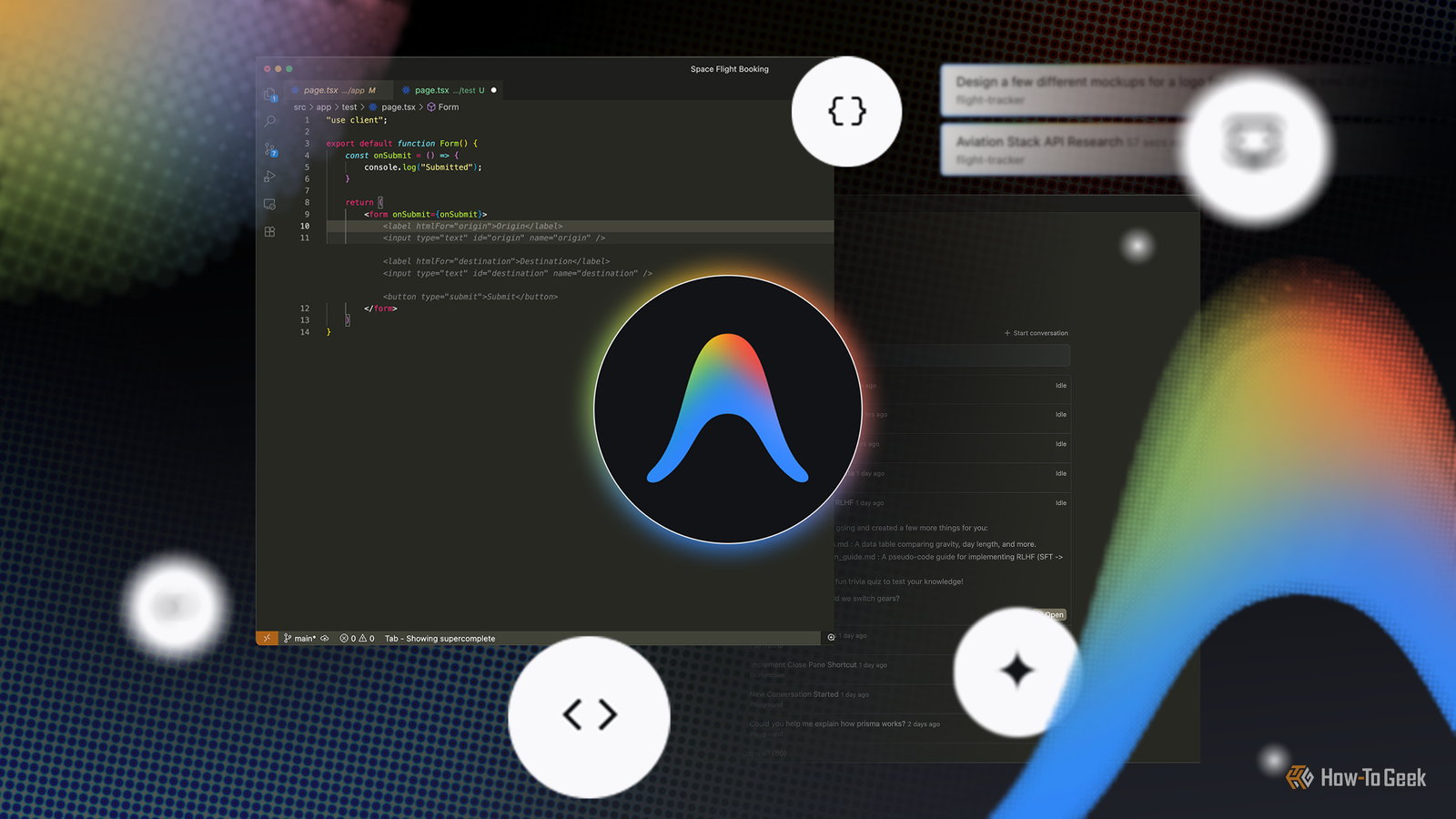

When Antigravity came out, a lot of people were interested enough to ditch VS Code. Unfortunately, plenty left soon after because it is not an easy way to program if you don’t know what you’re doing. Claude is very similar because it is great at giving an overview of what to do before starting, but that is due to a misconception of how to use Antigravity correctly. If you know what you’re doing and can avoid the rate limits, you’ll never go back to Claude for coding. At best, Claude will seem like a good way to get your ideas together, but not a good way to implement them.
The live backend makes things easier
I would rather see my improvements in real time

Standard AI coding assistants like Claude and Gemini usually compete but both typically suggest code snippets. You then have to copy, paste, and test these on your own machine. Google Antigravity works differently. It adds a live browser and a managed backend right into the development environment. Instead of waiting for you to put everything together and run the code, this tool starts a local server and checks the results on its own.
It opens a Chrome instance to click through the UI, test input forms, check network requests, and get screenshots of the running application. You get immediate feedback. The system finds bugs in the visual layout or the underlying logic and tries to fix them without your help. This means you spend less time switching between your text editor and a separate browser window to figure out why a new component didn’t load.
 Quiz
Quiz
8 Questions · Test Your Knowledge
Artificial intelligence basics
Trivia challenge
From chatbots to neural networks — find out how much you really know about AI.
ConceptsHistoryToolsEthicsModels
What does the term ‘machine learning’ most accurately describe?
Correct! Machine learning is a branch of AI where systems improve automatically through experience and exposure to data. Instead of being explicitly programmed for every task, these systems identify patterns and make decisions with minimal human intervention.
Not quite. Machine learning refers to systems that learn from data to improve their performance over time. It’s less about physical movement or exact mimicry and more about finding patterns in large datasets to make predictions or decisions.
Who is widely credited with coining the term ‘artificial intelligence’ in 1956?
Correct! John McCarthy coined the term ‘artificial intelligence’ at the famous Dartmouth Conference in 1956, which is considered the founding event of AI as a formal field of research. He later invented the Lisp programming language, which became a staple in early AI development.
Not quite. While Alan Turing, Marvin Minsky, and Claude Shannon were all AI pioneers, it was John McCarthy who coined the term ‘artificial intelligence’ at the Dartmouth Conference in 1956. McCarthy went on to shape the field enormously throughout his career.
What type of AI model powers popular chatbots like ChatGPT?
Correct! ChatGPT and similar chatbots are powered by large language models, or LLMs. These models are trained on enormous amounts of text data and learn to predict and generate human-like language, making them capable of conversation, writing, and reasoning tasks.
Not quite. ChatGPT is built on a large language model (LLM). While decision trees and Bayesian classifiers are real AI tools, they’re used for much simpler tasks. CNNs are great for image recognition but aren’t designed for open-ended language generation.
What is ‘overfitting’ in machine learning?
Correct! Overfitting happens when a model learns the training data too well — including its noise and quirks — and then fails to generalize to new, unseen data. It’s like a student who memorizes practice exam answers but can’t handle different questions on the real test.
Not quite. Overfitting describes a model that has learned the training data so specifically that it performs poorly on new data. It’s one of the most common challenges in machine learning and is addressed through techniques like cross-validation and regularization.
What is ‘AI bias’ most commonly referring to?
Correct! AI bias refers to systematic errors or unfair outcomes that arise when a model is trained on skewed, incomplete, or unrepresentative data. For example, facial recognition systems have been shown to perform worse on darker skin tones due to biased training datasets, raising serious ethical concerns.
Not quite. AI bias is about systematic, often harmful unfairness baked into a model’s outputs, usually due to skewed training data or flawed design choices. It’s a major ethical concern in areas like hiring algorithms, criminal justice tools, and medical diagnostics.
What does ‘GPT’ stand for in AI model names like GPT-4?
Correct! GPT stands for Generative Pre-trained Transformer. ‘Generative’ means it can create new content, ‘pre-trained’ means it was trained on a large dataset before being fine-tuned, and ‘Transformer’ refers to the neural network architecture that made modern LLMs possible.
Not quite. GPT stands for Generative Pre-trained Transformer. The Transformer architecture, introduced in a landmark 2017 paper called ‘Attention Is All You Need,’ revolutionized natural language processing and laid the groundwork for today’s powerful AI chatbots.
Which of the following best describes ‘deep learning’?
Correct! Deep learning is a subset of machine learning that uses artificial neural networks with many layers — hence ‘deep’ — to model complex patterns in data. It’s the technology behind image recognition, voice assistants, and most modern AI breakthroughs.
Not quite. Deep learning uses multi-layered neural networks inspired loosely by the human brain. The ‘depth’ refers to the number of layers in the network, and more layers generally allow the model to learn more complex and abstract representations of data.
What was the name of the IBM AI system that famously defeated chess champion Garry Kasparov in 1997?
Correct! IBM’s Deep Blue defeated world chess champion Garry Kasparov in a six-game match in 1997, marking a landmark moment in AI history. It was the first time a computer beat a reigning world chess champion under standard tournament conditions, shocking the world.
Not quite. The IBM system was called Deep Blue. Watson is IBM’s later AI known for winning Jeopardy!, while AlphaGo is Google DeepMind’s system that mastered the board game Go in 2016. HAL 9000, of course, is the fictional AI from Stanley Kubrick’s 2001: A Space Odyssey.
Challenge Complete
Your Score
/ 8
Thanks for playing!
You can also stop it and tell it you can test everything out, which I prefer because it takes too long otherwise. The platform manages many asynchronous tasks across different files. It’s pretty high-end compared to rival models that have trouble remembering things.
Another great thing is that Antigravity uses a dedicated manager view. This is where you see the separate autonomous agents handle different parts of your application at the same time. It feels like one agent thanks to the chat on the right, but a lot is happening if you read the details.
For example, one agent can focus on building your front-end components. Another agent can write the backend routing logic. Neither worker loses track of the overall project state. Since these agents talk to each other and share context across the workspace, they can do complex multi-file edits and coordinate structural changes without missing important details. This design makes the whole development process feel like a team effort between specialized workers, instead of just a prompt response.
Best strategies for managing agents
If you’re not doing this, you might as well use Claude
To get the best results with Google Antigravity, you shouldn’t treat it like a standard text editor or a chatbot. That was a mistake I made at first. Instead, use it like a hub for what you want. I will sometimes use Claude to think up what I want Antigravity to do, but I typically use Gemini to set it all up.
While the platform comes with a dual-view interface, where you see a standard code editor next to a dedicated Manager View, you shouldn’t use it. Coding line by line is a waste of your time. Instead, spend your time with the Agent Manager.
It is hard to get used to, but with Antigravity, you’re more of a project manager than a programmer. If you try to get in the way, like micromanaging, you’re going to spend far too much time fixing and adjusting. I recommend only going in to fix things at the end. If it’s too much, give it details on what to change.
You can give different assignments to these agents. This lets one handle backend logic while another builds the user interface. It is a much faster way to finish your projects.
Focus on guiding the logic before the actual work starts. You should use the planning mode to make a detailed plan before any file changes. I always ask it to write a document of all the changes, the specific files it will create, and the logic it wants to add. Never give it more control than it needs. You can then approve or adjust these plans before the agent starts writing code.
You can use the chat to do that, but I like to leave comments on the document and tell it to read my comments. It’s a lot easier to just write things under its notes so it knows where the mistake was or what to change.
Trusting the agent but verifying the work
This review process is crucial

Antigravity went off track every time I let it do what it wanted without a review. No AI is good enough to handle itself without a human; do not give it permissions as if it is. That is a mistake that too many people have made.
Antigravity, like any other chatbot, can get stuck in debugging doom loops. I once forgot to check for over 10 minutes and ended up seeing that Antigravity was wasting time making the code worse to fix a small issue. If you let an agent work without a reviewed plan, it will create duplicate systems or remove existing functionality when trying to solve a simple bug.
By setting up your multistep plan first, you catch misunderstandings early. You also give the AI clear boundaries to follow, which is important. This stops the agent from deleting something it shouldn’t or making errors that could have been avoided with some real notes.
Once you approve the plan and the agents start building, you still need to watch their progress. Antigravity makes task lists, screenshots, and browser recordings as it works. You can review these items to check that the process matches your original instructions. If you see an error, you can give feedback to adjust the code. This means you don’t have to restart the whole process.
Antigravity is the best way to vibe code
I like Antigravity a lot, and I do believe it is the best way to vibe code. However, no tool will do your work for you without you needing to do anything. The only way to use Antigravity correctly is by manually approving every little change outside your document and many changes inside. If you don’t set up a plan of action, you might as well be using any other chatbot, because it will mess up. If you can act like a project manager, you might as well cancel your Claude subscription, since you’ll want to give Google your money.

Google AI Pro
Google AI Pro gives you quite a few benefits, including 2TB of Google Drive storage, higher access to Gemini 3 Pro and Deep Research in the Gemini app, higher token access to Gemini CLI and Antigravity, and the ability to share with up to five family members.