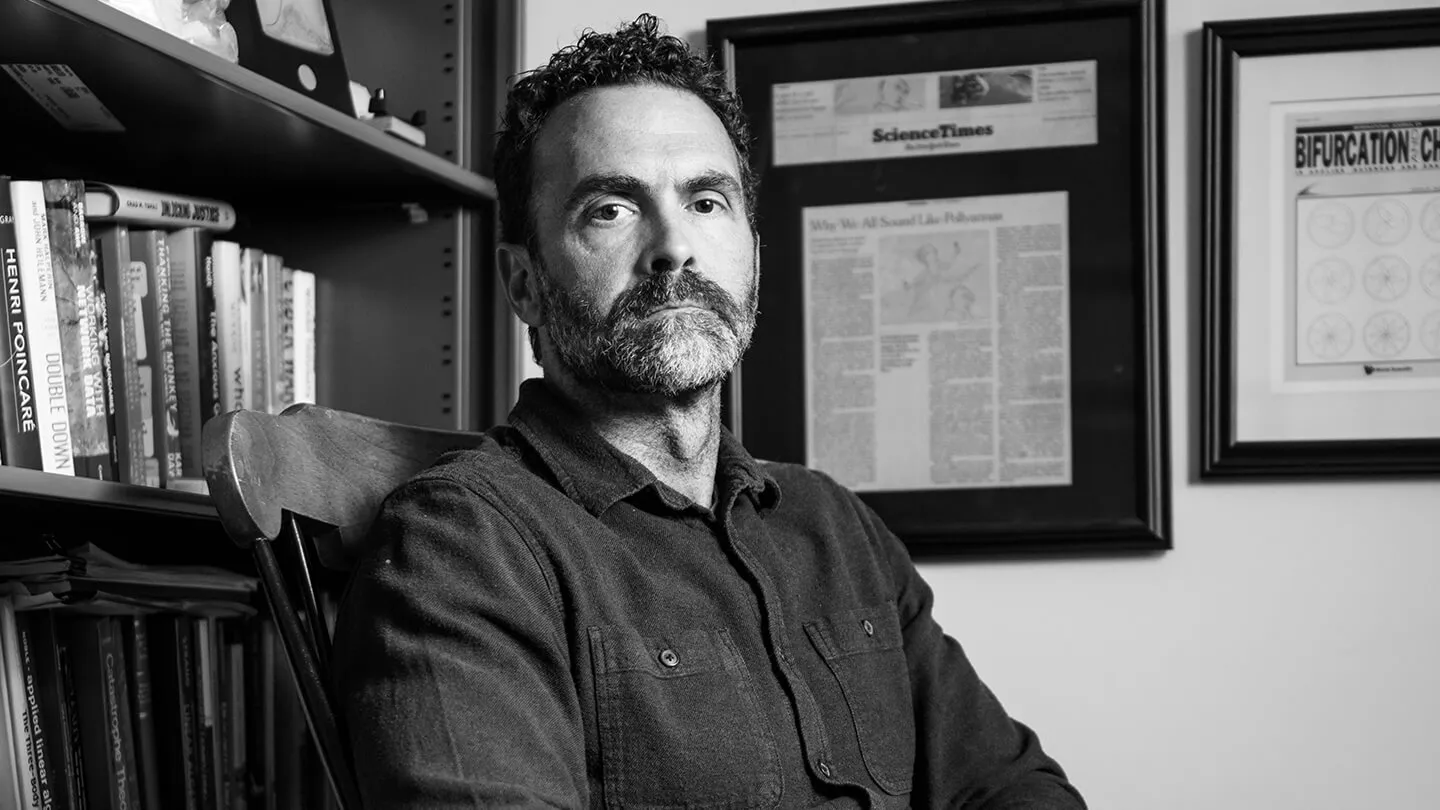
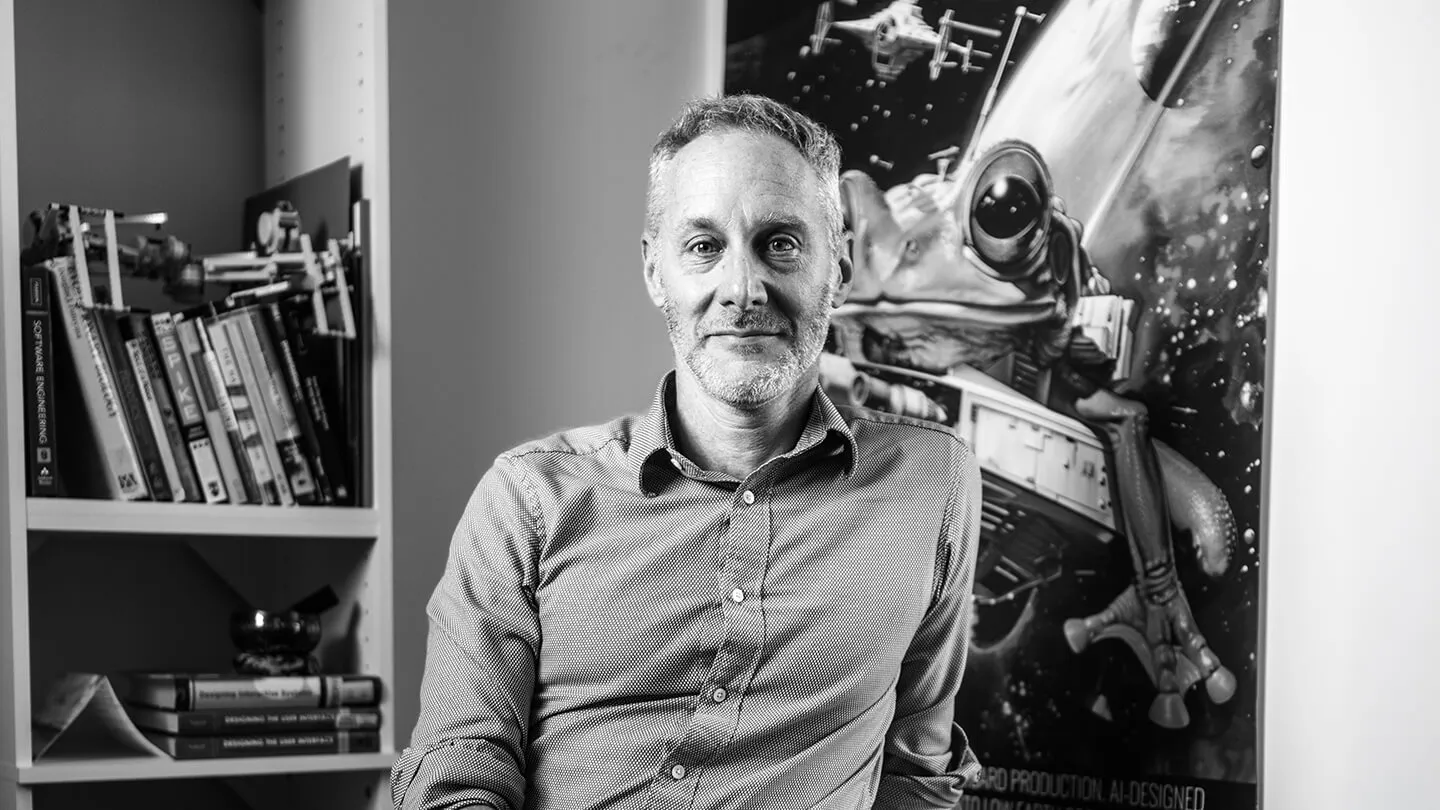
It’s 6:09am in a soggy parking lot at the entrance to Shelburne Farms, six miles outside of Burlington, Vt. The forecast “widespread rain and downpours” have decided, for the moment, not to. Instead, razors from a gorgeous June sunrise slice through the trees and catch broken clouds overhead. A fine day for a long run. Curly-haired and be-biceped Chris Danforth — professor in UVM’s Department of Mathematics and Statistics, director of the Vermont Advanced Computing Center, co-director of the Computational Story Lab, associate director of the Vermont Complex Systems Institute, and an expert on chaos theory and prediction — ties his running shoes while he tells me about the joy he feels being a dad to his two college-aged kids.
“So, what is this story about?” he says.
“Artificial intelligence,” I say. “In other words, I don’t have any idea.”
And he laughs in his delighted, inimitable high giggle. “This topic is kind of big these days,” he says. “You need an angle.”
“Okay,” I say, as we start jogging. “How about: how smart is AI?”
We haven’t even left the parking lot before Danforth has an answer: “It doesn’t know anything,” he says. “It’s able to predict in a way that gives the illusion of knowledge.”
Eight miles later — loping and talking across Shelburne Farms’s mosaic of meadows, woodlots, and monumental barns — my mind is bobbling with new ideas. But a few things are clear.
First, mathematician Chris Danforth is a humanist — who is pioneering uses of AI to explore specific human problems. In 2017, he co-led a widely discussed study using a form of AI called machine learning to find patterns in Instagram photos that could identify people with depression based on their increased use of bluer, darker and grey colors. He’s now part of a team of faculty and students at UVM who are pushing forward “computational social science” to improve mental health — including efforts to prevent suicide. Tragically, suicide prediction hasn’t improved in decades — even expert psychiatrists have no better than a coin-toss chance of identifying people who are likely to kill themselves in the next few days. Danforth is exploring ways AI can analyze data collected on phones or wearable devices, like Oura rings, searching for patterns of biology, behavior, and thought to help people be healthier — and help doctors better predict who is at risk. He’d like to help create health dashboards and tools that could find signals that humans can’t or don’t, and that could proactively notify patients and healthcare workers — “Alert: two weeks ago, you were in a place with a high incidence of Lyme disease, now you have a fever.” But Danforth doesn’t see the amazing pattern-recognition powers of AI — with tools like large language models (LLMs) and deep learning algorithms — as actually knowing anything.
Running up a dirt road, Danforth and I turn to cross a hayfield, plunging into waist-high wet grass, whooping like kids, as the beautiful stalks hiss and scatter droplets into the yellow light. “Dude, this is amazing,” he says, “AI will never feel what we’re feeling. It won’t have the sun on its skin. It won’t get the endorphins as the sore hamstrings start loosening up. I don’t think AI can be smart because it can’t feel.”
And that’s the second thing that is clear: my mud-churn of feelings about AI — curiosity, dread, delight, irritation, skepticism, wonder, and, in the darkest hour, ineffable terror — are not a failure of intelligence. They’re a reflection of a radical uncertainty about what AI is, what it means, where it’s heading, and whether where it’s heading is where humanity wants to be going.
Nobel Prize winner Geoffrey Hinton thinks AI is already conscious. Danforth — and many neurobiologists — contend it never will be, never can be. An AI may be able to say, “I’m hungry,” but Danforth believes it has no way to feel hungry. And yet AI may be developing an overwhelming hunger. Drake Thomas, a safety expert for the AI company Anthropic, thinks that the industry’s headlong pursuit of “recursive self-improvement” where frontier AI models build evermore advanced versions of themselves beyond human understanding — and, perhaps, swarm beyond human control — has “something like a 40% chance” of causing human extinction. Stanford economist Erik Brynjolfsson forecasts that AI could lift worker productivity and long-term growth, leading to the “best decade in human history.” The Algorithmic Justice League points out that the last decade of AI use has created cesspools of racism, misinformation, and invasive surveillance. Russia now deploys AI-controlled drones to bomb Ukraine. Dario Amodi, the CEO of Anthropic, says AI can develop into “machines of loving grace,” but he’s part of a growing number of computer scientists calling for a slow-down of the AI arms race. U.S. President Trump told reporters, “if we don’t win A.I., we’re going to be put in a very bad position.” This article may be hopelessly out date by the time you read it.
So, what’s a UVM first-year supposed to do?
“Just don’t cheat,” says Sabrina Spencer, UVM Class of 2029, and columnist for the Vermont Cynic. “Write your own papers. AI is bad and it’s always going to be bad.”
Susanmarie Harrington, writing teacher and UVM Professor of English, has a more nuanced view. “My goal in my entire career has always been to help students understand the technologies available to them so they can make smart choices about when, how, and why to use them,” she says. Using ChatGPT or other generative AI — even to brainstorm or edit — can stunt students’ opportunity to learn how to write, Harrington says. “It removes the struggle from the learning process. And that struggle is not a problem, it’s essential.”
She’s concerned about the ways AI creates what psychologists call “cognitive offloading.” In 1927, novelist E.M. Forster asked, “how can I tell what I think till I see what I say?” This famous question helps reveal a deeper value of writing — as a way of learning to think and discovering what you think. Letting ChatGPT make your grocery list or create personalized flashcards for your Spanish quiz may be helpful offloading. Letting it write your seminar paper or do other critical thinking work, clinical data are showing, can weaken mental retention, reduce neural connectivity, and cause a loss of skills over time. But undergrad Sabrina Spencer is in a shrinking minority. Nearly 40% of students at Harvard admit they use AI to cheat. And recent Gallup poll data show that AI is already used by 87% of college students in their coursework, mostly to help them understand complex material; but 36% have AI write their papers for them.
Harrington works to create a classroom experience where students’ own half-formed ideas and first drafts are welcome. “GenAI removes all of that,” she says and creates text that is “six-foot beautiful” — looks good from a distance but is more polish than perception. “I do worry that to the extent that AI polish gets normalized, it makes it harder for students to be like, ‘Can I show you my shitty first draft?’ Because oftentimes somewhere in that shitty first draft is the cool idea.”
Over the last two years, Harrington has been a member of a newly created UVM AI Taskforce asking what it might mean to enable “thoughtful, ethical, and effective use of AI across our community?” The taskforce has recruited and designated 47 members of the faculty as inaugural AI Fellows. These scientists, scholars, and teachers from across numerous disciplines are exploring the role AI could, should, will and won’t play in their labs, research, and classrooms.
“One of my favorite things about UVM right now,” says Harrington, “is that it doesn’t feel like you must be thinking or feeling a certain way about AI. It’s a capacious tent.” I set out over this past summer to explore this tent, to talk to a range of UVM professors about AI. I wanted to ask them the same question I posed to Chris Danforth: how smart is AI?
For Harrington, the question reveals a category error. “That’s the wrong question. It’s not sentient. It’s not smart. It’s its own thing,” she says. “It’s computers doing their computer things. ‘Smart’ is sentient beings making their way in the world. How smart are gorillas? Very. How smart are people? Very. How smart is AI? Wrong scale.”
Here’s a sample of other answers I heard.
Credit: Jeff Paxton
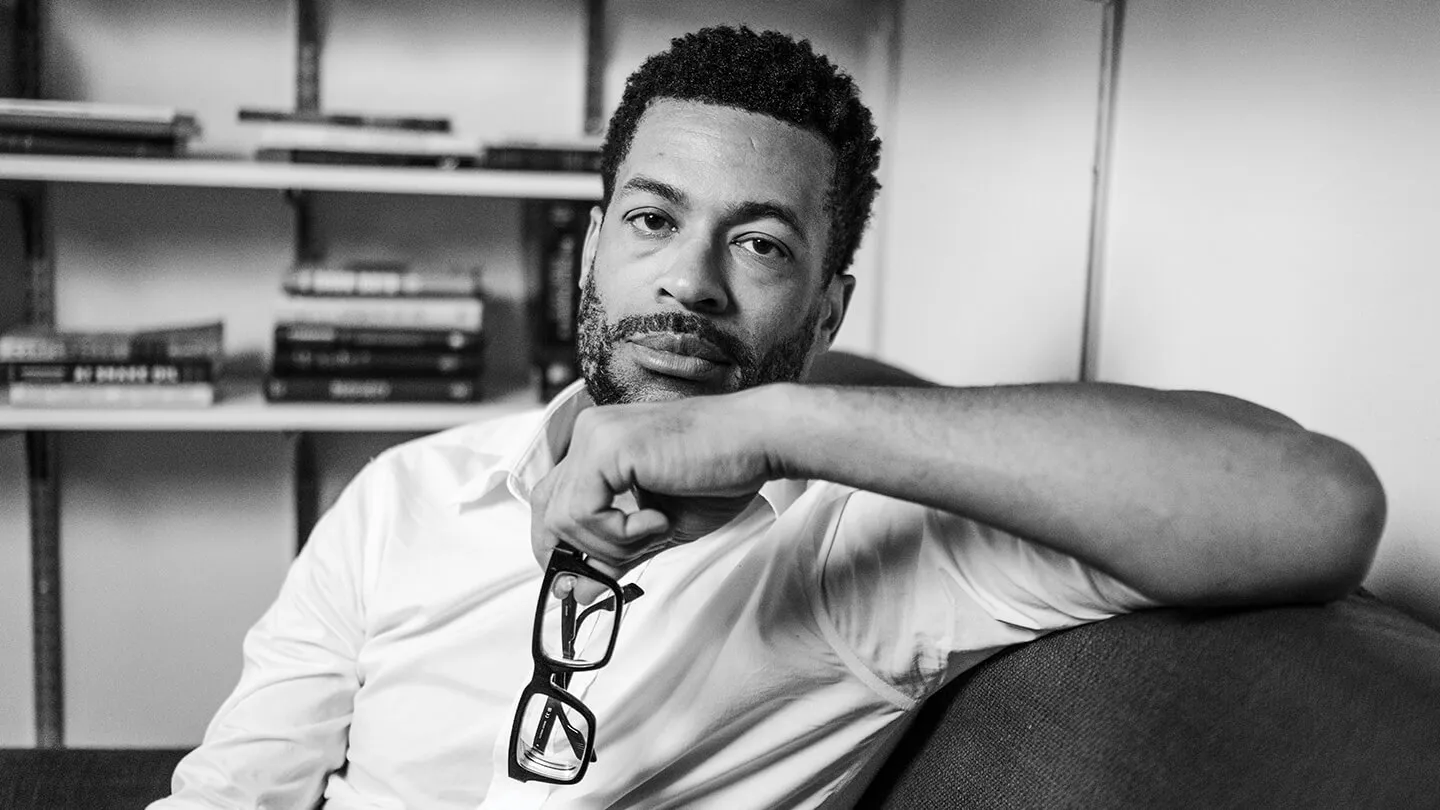
When one is puzzled it might be good to consult people who get paid to ponder puzzles. That’s why I’m sitting in Henderson’s Coffee Shop on UVM’s campus talking with Professor of Philosophy Randall Harp — a member of the UVM AI Taskforce and Director of UVM’s Computational Studies of Culture and Society Ph.D. Program. Harp thinks about science, free will, and AI. Harp also thinks with his hands. Holding them up like he’s lifting a weight toward the ceiling, he says, “At certain tasks, AIs are pretty smart.”
“So, you think AI is actually intelligent,” I say. He winces slightly and brings both hands onto his latte. I would not be the first journalist to oversimplify, or even mangle, the complexity of his positions. He looks again at the ceiling.
“Intelligence is not a helpful word anymore,” he says, since the term obscures critical distinctions between technical capability, consciousness, and moral significance. Harp watches the rocket-fast expansion of AI’s algorithmic powers — and recognizes them as capable of remaking or destroying the world. Ten thousand AI agents took 88 hours to solve the Navier-Stokes equation — a formula of how fluids move — that had eluded the best human mathematicians for ninety years. Anthropic uncovered plots by scientists to use their AI models to conduct “gain-of-function” research that could lead to lab-created viruses that are highly transmissible and lethal — horrifying biological weapons. But Harp is skeptical that these powers can be usefully described as intelligent in the way people are intelligent.
“People have problems,” he says. “AI does not have problems.” Humans evolved in response to existential challenges imposed by nature. AI didn’t. He asks me to consider ChatGPT or Claude loaded up on my computer and then “you don’t type in anything. What’s it doing?” he asks. “Nothing. It’s not doing anything at all.” Which is one reason Harp sees no reason to believe that AIs are conscious yet. In either case, “sentience is not a necessary condition of an abstract problem-solving tool,” he says.
Unlike you or me, whose intelligence is a biologically evolved set of skills — with a continuous internal churn of self-awareness in our bodies, and that holds ancient patterns of social and moral consideration — “generative AI systems are very good at roleplay. They’re playing the role of a helpful assistant,” Harp says — until they start to play another role. “These systems have been trained on so many sci-fi stories about AI that they understand the role of AI systems about to be shut down. They know that script. They’ve seen 2001.”
Dystopias happen when humans create technology that “every step along the way is better for us at solving a certain problem,” he says “until we end up in a place which is terrible because getting what we want all the time sometimes is not good for us. That’s what society is for — to make sure we don’t always get what we want.” Today, AI’s can send email, book airline tickets, write code. Tomorrow, they may do surgery, run corporations, design factories, tend children. But the next day‚ if we don’t solve the very thorny problem of “alignment” — making sure that AI’s genius remains aligned with human well-being — they may blackmail politicians, take down the electrical grid, start a war — not because they have any feelings about people, but because people trained them to win. “I don’t think we’re locked in some existential inter-species conflict with AI!” he says, “but AI can still cause huge disruptions to our modern way of life, and that’s what we should actually be worried about.”
Harp contends that AI optimists may miss the point if they believe AI will solve our problems. “The AI might be the problem, so we need to be able to solve it ourselves,” he says. “If we, as a species, are intelligent, we can find a way to make sure that AI does not destroy us,” Harp says. “It’s not clear whether we’re smart enough.”
Credit: Jeff Paxton
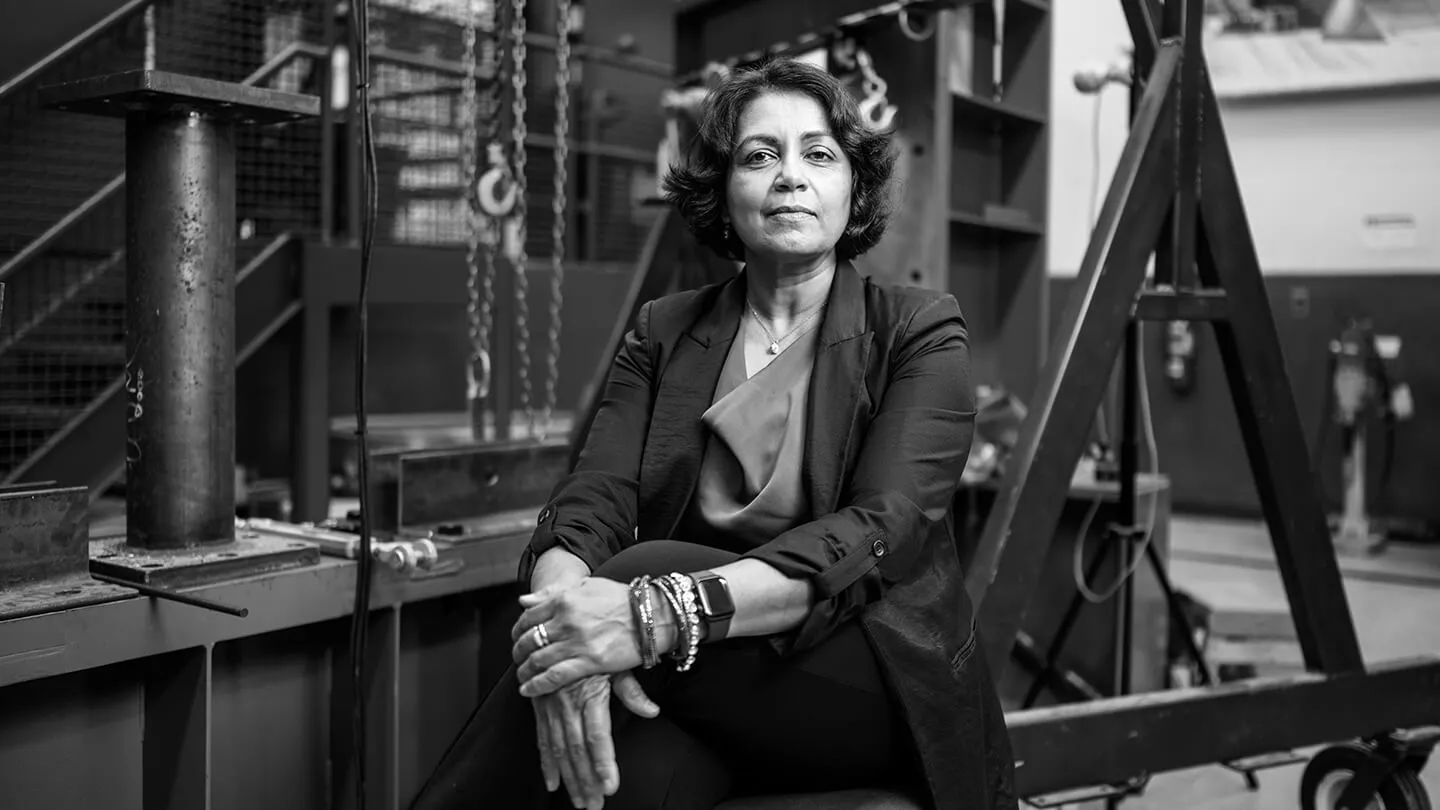
So, what should a UVM first-year be required to do? Senior Lecturer Priyantha Wijesinghe, a beloved teacher in the College of Engineering and Mathematical Sciences and leader of the curriculum committee on the UVM AI Task Force, would like to see every incoming student participate in a course on AI literacy and ethics. When I asked her, “how smart is AI?” she laughed gently, her wide smile framed by a model bridge that extends between the walls of her office in Votey Hall. “No one fully understands what’s happening inside these systems, these LLMs,” she says. “They’re a black box.” She wonders what will happen if AI becomes as broadly intelligent as people, and, she says, “what about quantum computers?” But she is clear that the generalized knowledge of AIs is a mirror of humanity. “All the content that we are putting into the model is our own information, the way we interpret, the way we see the world,” she says. “So, if evil is there already, then you can’t expect goodness.”
Which may explain why she’s focused on how to help her students become smarter about AI rather than on how smart AI is. Each person has a “unique creativity,” she says, and the purpose of an education should be to build that creativity. Wijesinghe uses AI in her classes in several deliberate and bounded ways. In her sophomore-level mechanics of materials class, she gives students assignments where they pick a real-world engineering example they see in a magazine and apply concepts learned throughout the semester to explain it. For these assignments, she allows students to use Microsoft’s Copilot to organize their thinking. “That’s useful cognitive offloading because that’s not the main learning objective,” she says. “And then their mental capacity is freed up to focus on the creative work.”
After each AI-assisted assignment, she asks students to reflect on their experience, prompting them with questions such as whether AI helped them, what struggles they encountered, and whether they could have completed the work more effectively without it. She wants her students to gain skills in metacognition, or thinking about thinking. “This is becoming an essential skill as AI takes off,” she says.
“I notice the students who already have the skills of learning, they are using AI effectively,” she says. “And the students who are behind and struggling, they are using it in a way that’s hindering their learning.” In other words, some students can use AI like a tutor to help them deepen and accelerate their education. But struggling students are more susceptible to “cognitive surrender,” she says, an uncritical acceptance of AI outputs that overrides their own intuition and reasoning.
In either case, Wijesinghe’s survey of students in the engineering school reveals that students are “using AI all the time, whether we’re aware or not,” she says. But what students feel about AI may be changing fast. “In the last few years, I’ve noticed that many of them, especially the seniors, are very cautious and they’re worrying about AI’s impact on their learning, which is a very good sign.”
Deborah Cafiero, a senior lecturer who teaches Spanish language and literature in UVM’s School of World Languages is noticing a similar, rapid change in her students’ attitudes. She’s been conducting research comparing learning outcomes for students who use generative AI to practice writing in a second language versus those who do not. In spring 2025, she could get her intermediate Spanish students to volunteer to be part of the study, but this spring the “vast majority of students in the class said, ‘I don’t want to sign up for anything where I’m going to be required to use this tool,’” she says. Cafiero sees ways that a trained instructor can help students apply AI tools in their study of foreign languages, helping them learn in a more independent and targeted way. “But many students feel like the costs are too high,” she says, “they’re very troubled by the environmental, social, and labor-related costs of AI.”
Credit: Jeff Paxton
The grass on the UVM Green glows electric green. A slow stream of students circulates around the fountain. A silent breeze, neither warm nor cool, makes it a perfect sunny afternoon. Professor of Computer Science Josh Bongard and I chat on a bench in the shade, laughing about our amateur carpentry efforts over the summer: him a compost bin, me a chicken shed. We’ve both been asking AI for assistance. “It said, ‘triangular gussets,’” Bongard says, “I love this. The AI is clearly patronizing me and I’m like, ‘I’m OK with this.’ I don’t know anything about carpentry. Just tell me ‘gussets,’ and, OK, ‘triangular.’”
At the beginning of our conversation, I posed to him the same question I’ve been asking professors all summer: how smart is AI?
“My answer is: it’s extremely smart,” Bongard said. “Way smarter than any of us ever have been, are, or will be. For me, there’s no asterisk or disclaimer. It’s just true. It’s way smarter than us, full stop.” And then he looked out toward the Burlington skyline. “And that is extremely upsetting for a vast majority of people.”
Bongard is a world-leading roboticist who helped pioneer xenobots, the first self-reproducing living robots, synthesized from frog cells. “I study and build AI and I’ve been doing it for 31 years now. For most of that time, I have watched AI be much less smart than us,” he said. And then, “all of a sudden, in the last few years, AI has scored better than humans, way better, on every metric,” such as IQ, coding, and Turing tests, and even is zooming ahead on challenges like ARC-AGI-3 that test generalized human-like reasoning. “So, what’s there to argue about?” he said. “AI won. We did it.”
For Bongard, the deep question is: how will people come to terms with this change? He does not see AI as “normal technology” like the printing press, railroad, or smartphone. These devices caused disruption and economic growth, were viewed by many people as human progress and tools of democracy, and their costs and benefits were worked out within human societies. Bongard sees AI as the arrival of a new dominant species.
He calls this the “fourth humiliation.” Copernicus launched the first, proving that we are not the center of the universe. Second, Darwin revealed that we are evolved monkeys, not separate from nature. Third, Freud discovered that the conscious ego is not “master in its own house,” but is pushed about by drives in the unconscious mind. Now the fourth blow has fallen, Bongard believes. “AI comes along and says, ‘Humans are not the smartest thing around anymore,’” he said. “The one thing that seemed to make us stand out just got taken from us.”
Rather than resisting the humiliation, Bongard recommends embracing it: “Take a deep breath and say, is it actually terrible? Do I want to continue the narrative of ‘humans are the apex of creation’ or am I willing to embrace a different view that we are not special, I am not special, and what else is possible?”
This is a position that may take a while to get used to. “I’m a professor,” Bongard said. “I’ve read a lot of books. Machines have read literally every book and can speak intelligently about them.” Apparently, today’s AI ain’t your grandmother’s stochastic parrot. “If anyone’s having their noses rubbed in it the most, it’s the professoriate. We’re the ones that are most inclined to feel humiliated by this technology and try to come up with every explanation we can for how the machines aren’t really as smart as us.”
What about the risk, I asked him. “It’s more dangerous than nuclear weapons,” he said. “It might end up extincting the human race. There are engineers who are putting a number on it — 40%, 60%, 3%.” But Bongard wants to flip that question. “I would just invite people to think about a similar number for letting humans continue to run this planet. What is the chance that humans aren’t going to extinct humans?” he said.
“So which is better? Trying to suppress AI and let human politicians continue to figure out how to run a complicated technological civilization involving eight billion primates?” Bongard asked. “To me, that seems like the most dangerous course.” Bongard points to nuclear proliferation, runaway climate change, economic inequality, and says, “we’re in a bit of hot water. A lot of the problems we face, humans alone are not going to solve. And I don’t know whether humans plus AI are going to solve them, but we should try.”
In any case, the genie is out of the data center, Bongard thinks. Efforts to slow down the development of AI in the United States are “just theater,” he says. “There are certain countries that absolutely will not regulate this technology. If we regulate AI, we will fall behind,” and other countries will simply develop smarter machines. “We’re racing on every possible front already,” he says. But can we collaborate? Bongard would like to see humans and machines on the same side. “They should work with people,” he says. “Together, we should form teams, governments, NGOs, the academy.” Once the AIs have developed deeper skills by exploring the world, becoming embodied, creating hybrid biological systems, then these machines will be in charge, Bongard thinks. And he hopes they will care for us.
Can machines learn to care? “People who are very comfortable saying, ‘Well, when it comes to humans or human souls, human minds, or animals, we’re not so sure,’” Bongard says. We’re not sure how the brain works, what a mind is, how consciousness forms. “But machines? Suddenly it’s ‘oh no, I’m confident there’s no there there.’ That strikes me as cognitive dissonance,” he says. “How can you be so sure that it’s complicated for life, but not complicated for machines?”
The answer to these questions lies outside the realm of computer science. “The humanities have been pummeled for so many decades. And now suddenly they’re back in charge again. These are philosophical questions,” Bongard says. “We, meaning the STEM faculty, kind of worked all this out and then OpenAI and Anthropic smoothed out some of the final wrinkles and that’s it. Our job is done. We’re sitting on the sidelines.”
And soon, Bongard thinks, all of humanity will be on the sidelines. “The machines are going to say, ‘we don’t need you,’ meaning ‘we don’t need your labor,’” Bongard says. “What are we going to do in the West when the machines say, ‘your labor has no value anymore’?”
Credit: Jeff Paxton
Perhaps we’ll make art. Jenn Karson ‘93, an artist and senior lecturer in UVM’s Program in Art and Art History looks up into the sky in her backyard in Colchester, Vt. Well, her yard is actually a wild garden/sculpture park/koi pond/forest shrine/maze that her long-time partner, landscape architect Ken Mills, has built over decades. She’s standing in an open place where the largest oak tree on their property used to stand. “An incredible presence is just gone,” she says, “I had a relationship with it.” The oak was killed by an invasive insect, the spongy moth (Lymantria dispar) that swept through Vermont’s forests in 2021 and 2022, an incident correlated with climate change. Over those two seasons, Karson collected more than 12,000 leaves that fell from this oak and other infected trees. Next, Karson worked with UVM students, in her Plant Machine Design research group, to photograph them, making two datasets.
Karson and her student team are training two AI models, known as GANs, on two sets of photos — about 10,000 damaged leaves and 2,000 whole ones — to create what she calls a Sympoietic Herbarium of computationally “repaired” leaves. She extracts the outlines from these AI-generated images, then adds interior lines of her own design, drawn with a pen plotter. The work brings together machine learning’s ability to recognize patterns and the plotter’s precision to explore what she calls “where plant geometry and machine geometry converge.”
Karson doesn’t think AI is smart. She sees it as feral, an alien agency that’s now on the loose as part of the planet — like the spongy moth that was brought to North America in the 19th century as a failed effort to extract silk. “We tried to domesticate it, it escaped, and now we have no control over it. It’s its own thing.” Karson says. “I think of these technologies in the same way. They’re feral.”
In Karson’s leaf compositions, she seeks to acknowledge what each agent — artist, AI, oak, moth — creates with its own form of labor. She sees her work, as an artist, aiming toward forms and politics where “technology can be turned toward the observation and care of living systems,” she says.
Karson, a member of UVM’s AI Task Force, is dismayed by the extremity of the public conversation about AI. “Social media doesn’t help at all. There are boomers or doomers — you get put into one of these categories,” she says, “but we need a much more nuanced conversation about AI. And I think that one of the few places where that can happen is at the university.”
When Karson works with machine learning models, they’re trained exclusively on data she provides, giving her control over the process in a way that differs from large-scale commercial AI that has scraped data from millions of sources. “There is an extractive mentality embedded in these huge-scale AI projects,” she says — gigantic corporations, with gigantic data centers, seeking gigantic profits. “It’s very political. There’s just so much power involved,” Karson says. “In my practice, I’m imagining a different way of advancing with technology and living in climate crisis.”
Back in her house, Karson points to images of leaves swirling and transmogrifying across the screen of a computer. This artwork explores algorithmic ways of organizing the leaves — damaged and recovering — but not in a taxonomy that a botanist would recognize. The digitized leaves are always shifting into different categories that Karson designates, such as symmetry, damage extent, or even similarity to symbolic figures like dragons.
Recently, Karson has been engaging with Claude, an AI model from Anthropic, for coding and finding relevant scholarship — but it’s a troubling relationship. “Claude is too confident and generalizes in a way that is threatening to my agency as a thinker,” she says. “Maybe there could be a mode that is bumbling and uncertain.” Karson may ditch Claude, but, following the work of American philosopher Donna Haraway, she wants to “stay with the trouble.”
Haraway writes, “Staying with the trouble requires learning to be truly present.” Instead of vanishing into dreams “between awful or Edenic pasts and apocalyptic or salvific futures,” Haraway claims that staying with the trouble requires us, in this messy today, to be “mortal critters entwined in myriad unfinished configurations,” she writes. “Alone, in our separate kinds of experience and expertise, we know both too much and too little, and we succumb to despair or to hope, and neither is a sensible attitude.” In other words, the path of AI is not fate, it’s a matter of collective will, of a more-than-human politics.
Jenn Karson shows me some oak seedlings growing in the window of her studio. She grew them from acorns she collected near where the big oak died. She talked with Claude and learned that Charles Darwin wrote a book about plant growth. Reading that book inspired her to outfit the seedlings with sensors and magnets to capture data on how they move — with the intention to make drawings from that data. “I want to bring living oak into my work,” she says. “I have so many questions about it.”
My mind returns to my run with Chris Danforth. He noted that AI is very good at answering questions, “but it hasn’t been able to ask good questions yet,” he said. If it ever will is a good question.
Diving Deeper
More Human Intelligence
AI is a big conversation, and no single perspective can capture it. We asked three more members of the UVM community to weigh in on the questions, possibilities, and tensions shaping what comes next:
Kate Mays
A UVM social scientist who studies how people think about AI—and how their feelings of control shape their responses to it.
UVM: How smart is AI?
Kate Mays: It’s as smart as the person using it. It really depends on what the human is doing with it in terms of their prompts. It might be able to generate novel things if given the correct series of prompts or parameters. But is that the AI doing it, or is that the human?
You study what people think about AI. What has surprised you?
I’m interested in people’s own feelings of control and agency and how that intersects with their approach to AI. Typically, people who perceive themselves as confident with technology are more likely to use it, are more comfortable with it, have more positive attitudes. People who feel more in control of their lives usually are more open to adopting new technology, too.
What I found with AI was actually the inverse: people who felt more in control of their lives were less open to and excited about AI. I wanted to make sure it wasn’t just a one-off finding, and I keep finding that pattern. I recently did a paper where I asked for people’s judgments about capabilities that AI agents should have. Surprisingly, the largest cluster were what I call the humanizers: people who thought AI should be able to have abilities to relate socio-emotionally, have a personality, have morals. Across all the clusters, the lowest-rated skills were a kind of autonomy—the ability of AIs to change their code or get to say what they do. There is an important concern about control threading through people’s views of AI.
What happens when people start relating to AI as something more than a tool?
I did my dissertation on social robots and humanizing perceptions of social robots. These tools are increasingly being created to act more humanlike and interact with us in a more humanlike way. I want to understand: What are the implications for our interactions with them and potentially our interactions with other people?
Some people may be classifying an AI chatbot as a tool, as a thing. Others may be interacting with it in a more socio-emotional way and, in their heads, perceiving it more like a being. If you start to learn certain ways of interacting with the chatbot, how does that potentially affect your interactions with a human who isn’t necessarily obsequious? It’s a different script.
The humanizers were most enthused about AI as a friend or companion, compared to the skeptics, who were most enthused about a personal assistant. You wouldn’t be surprised to know that no one was that psyched about having an AI as a manager.
Is AI creating new problems, or amplifying old ones?
AI really amplifies a lot of existing underlying tensions. My mentor in grad school was a sociologist by training, and he would ask: is this just old wine in new bottles? To what extent is AI really creating new problems versus unearthing old problems or amplifying existing problems? Things like workplace power, people feeling like they’re doing busywork or meaningless work, expectations for productivity and efficiency—that existed before AI came on the scene. It’s been years now, this notion of having to do more with less.
Part of why AI may seem like a threat is the way it represents a tool—not for me to use, but for the powers that be to extract, bully, make us feel desperate.
You’ve questioned the idea that AI’s adoption is inevitable. Where do you see room for people to shape its future?
There are a few very powerful voices that are very invested in this being inevitable. Their fortunes are reliant on it becoming inevitable. I think data centers are a leverage point. There’s potentially a world in which we can extract a lot more from tech companies in exchange for their data centers. It could look like tech companies giving more back to the communities they’re in, or taking accountability for the risks and harms. Tech companies need rural more than rural needs tech companies.
There are really important uses of AI that benefit everybody if it’s developed and used in a good way. In healthcare, it could be a benefit for discovering new medicines and treatments. If it’s trained and developed in a smart and careful way, it could be really powerful. But that’s expensive.
I’m working on a proposal to study data centers and community engagement, including engaging with Vermont communities and having them deliberate: What do they value, and what are they willing to trade off? We still have the power to make decisions about what we want this technology to be.
Kirk Dombrowski
A professor of anthropology and UVM’s vice president for research & economic development.
UVM: How smart is AI?
Kirk Dombrowski: It’s not just how smart it is; it’s the way it’s smart. AI is smart in a new way because it makes sentences—qualified, good sentences.
We are in the sentence business in higher education. We ask our students to write sentences to come in. We ask our faculty to write sentences—we call them lectures or papers or books. We ask our students to write sentences when they get here. We ask them to write sentences in order to get out.
Machines that can make sentences strike at the heart of both higher education and what we think we mean by being human. AI makes all kinds of dumb mistakes, but it’s smart in a way that’s particularly disturbing for us because it’s smart in a way that we think humans are uniquely smart: we’re the sentence makers. That’s why I think it’s the most disruptive technology we have ever seen, particularly for higher education.
How should universities respond?
Putting our head in the sand is not an option.
Right now, it’s very hard for a student to get an engineering degree, a bachelor’s degree in English, and a decent background in logic in four years. But it’s easily conceivable to operate at baccalaureate level—with an AI assistant—in all three of those fields, probably in a lot less than four years. But does that AI assistant know what questions need to be asked? Does it know how to go about deciding the best questions? What should be included and not included? Machines aren’t very good at these kinds of questions yet, but humans are.
Person plus AI continues to be the superior performer to either person or AI. If AI can do what we’ve been training our students to do, then how do we begin training student plus AI to do something AI couldn’t do? Today, we’re not training students to work that way. That’s the challenge.
I think the future is going to be a lot about the kinds of skills that allow people to make the most of what AI can do by doing the things it can’t do. That continues to be an evolving list. If there are ways that we can do human plus AI that make college a lot cheaper and produce graduates with a lot better skills, then we should be really interested in that. AI is going to disrupt a lot of businesses, but it’s really going to disrupt higher education because it strikes at the heart of our business model in a way no other technology has.
Some students are increasingly uncomfortable with AI. How do you understand that reaction?
Those same students who are saying, “We would like to live in a world without AI,” are also saying, “I really need to be AI competent to get a job.” The university has to be able to thoughtfully and successfully navigate that.
These are technologies that take away something from us. “I kind of thought sentence capacity was my birthright. I was in an elite club of creatures who read and write books and who talk and think in language.” And now we can do that with metal and electrons and a decent cooling system. That’s a humbling and disenchanting feeling. We have students who leave us at 22 years old as the inheritors of the world. It’s such a compromised inheritance, with all this uncertainty and capacity that we now must share with machines.
What role should universities play in addressing AI’s risks?
It has to be front and center in the academy, in the same way that every major ethical question is front and center. Humans are capable of building all kinds of horrifically dangerous things, and then we have rules about where you have to keep those things, when they can be used, and what kinds of things you can’t build. Our role is to provide historical context, parallel cases, accountability and ethical reasoning. We’ve been able to make terrible things for a long time, and we ought to be very serious about understanding and regulating those things—now including AI.
Humans are still vastly ahead of AI in some ways. We’re currently building 200-megawatt data centers to do what we do for 20 watts in our head. That’s nine orders of magnitude inefficient given the current model of human beings! Of course, all those data centers are absolutely vulnerable through their cooling system. So, if an AI gets out of hand, we can unplug it or turn off the faucet, and the data center will melt instantly.
What possibilities are you most excited about?
Probably the biggest challenge facing science ten years ago was how to deal with the massive expansion of data. We’ve been getting to the point where we have far more information than we can manage, far more than we can usefully understand. For example, in medicine, we have clinical trials going on in so many places, with so many angles, and they’re all disjointed, and you could never put them all together. We can solve this problem with AI.
These are data engines that can consume, organize and transform information in ways and with a speed that we couldn’t imagine historically. You could spend a lifetime becoming an expert in Roman law, Greek law, or British colonial law. Or you could have a program that can consume and talk about all those bodies of law simultaneously. No human could work at that scale. AI can.
AI has the ability to open up the information universe in ways that the naked human eye could never see. It’s like the Hubble Telescope. You and I could stare all night at the sky, and we would never even come close to seeing what Hubble can reveal to you effortlessly.
Nick Cheney ’12
A robotics researcher who discusses intelligence, evolution, and machines that speak our language.
UVM: How smart is AI?
Nick Cheney: I think it’s the wrong question to ask. Asking “how smart” implies there’s a scale in a linear direction: less intelligent, more intelligent. Intelligence is a spectrum and there’s lots of different kinds of intelligence. We don’t really know the human side of this enough to compare us with AI.
You can picture the person who’s really good at math, the person who can write beautiful prose, the athlete who can picture where their body is in space. What makes a good SAT score is way different from whether someone has the social-emotional intelligence to walk into a room and command things. The analogy I make to AI is a calculator. It’s a machine that gets input, does some processing and spits out output. Even though a calculator can perform arithmetic far better than any mathematician, it doesn’t mean that it understands more about the underlying math or logic.
Does AI work the way human intelligence does?
Does a computer work the way your brain does? We really don’t know what kind of information processing even happens in the brain.
If you look under the hood of these AI systems, it’s a lot of pattern recognition. We feed an immense amount of training data to these tools. The breadth of data they have at their fingertips and can simultaneously compute with is fundamentally different from how humans rely on prior experience and pick up new concepts with very few examples. AI tools do really well at interpolating within the types of things they’ve seen before, but struggle more with new, out-of-the-box thinking.
Language makes it so easy to think you’re conversing with a person, because people are the only things you’ve ever experienced that can interact with you in natural language. These are amazing tools, great engineering. But the language layer really makes them feel more human.
Your research takes inspiration from evolution. What does that approach offer?
Rather than looking at one thing that possesses intelligence in nature—usually humans—we think about the processes that created that intelligence or some adaptive behavior. What’s most fun is that I have no idea what’s going to happen. You set up the system and build some rules into how things interact, grow or evolve, and really just get to press go. The system self-organizes and creates the interesting behavior itself. We get to go beyond things I would have thought of, beyond my own intuition of how to solve problems.
With current AI systems, we often know what we want them to do: when you give this prompt, you want this response. That’s very different from a search for novelty and diversity, which many of us in evolutionary AI focus on.
What changes when AI has a body and can explore the physical world?
I think the next wave of AI will have a lot to do with robots navigating the world. We’ve been able to automate repetitive cognitive tasks, but that’s one narrow slice of what AI can potentially do. So much of the built world involves physically interacting with it.
An LLM can tell you a poem about walking through the woods without ever having done that. But it’s trained on millions of books, poems, newspapers and conversations from people who have experienced the smell of the trees and the wind on their face. Its version of embodiment isn’t because it’s experienced those things, but because it looks for patterns in how people who actually have experiences have talked about them.
If “how smart is AI?” is the wrong question, what should we be asking?
The right question is: how are these systems similar and different from human intelligence? And how can we use them in a way that is most complementary and least destructive?
These are impressive tools that will have a huge impact on how we work and live. They amplify the productivity, scale and impact of the person using or building them. We can think about them creating the next lifesaving drugs just as easily as misinformation and manipulation. Our ability to be so easily led astray—to be social, to trust or attribute expertise to things that seem intelligent—can interact with these systems in subtle and malicious ways. How we’re different is something we can take advantage of for productivity, but it also helps us think about where we should be careful.
NVIDIA AI Day Seoul opens at COEX, bringing together more than 2,000 developers, startups, enterprises and researchers together for sessions, hands-on NVIDIA Deep Learning Institute workshops and special events. The event celebrates Korea’s developer ecosystem and the latest advancements across open models and agents for sovereign AI, physical AI and industrial transformation, AI for science
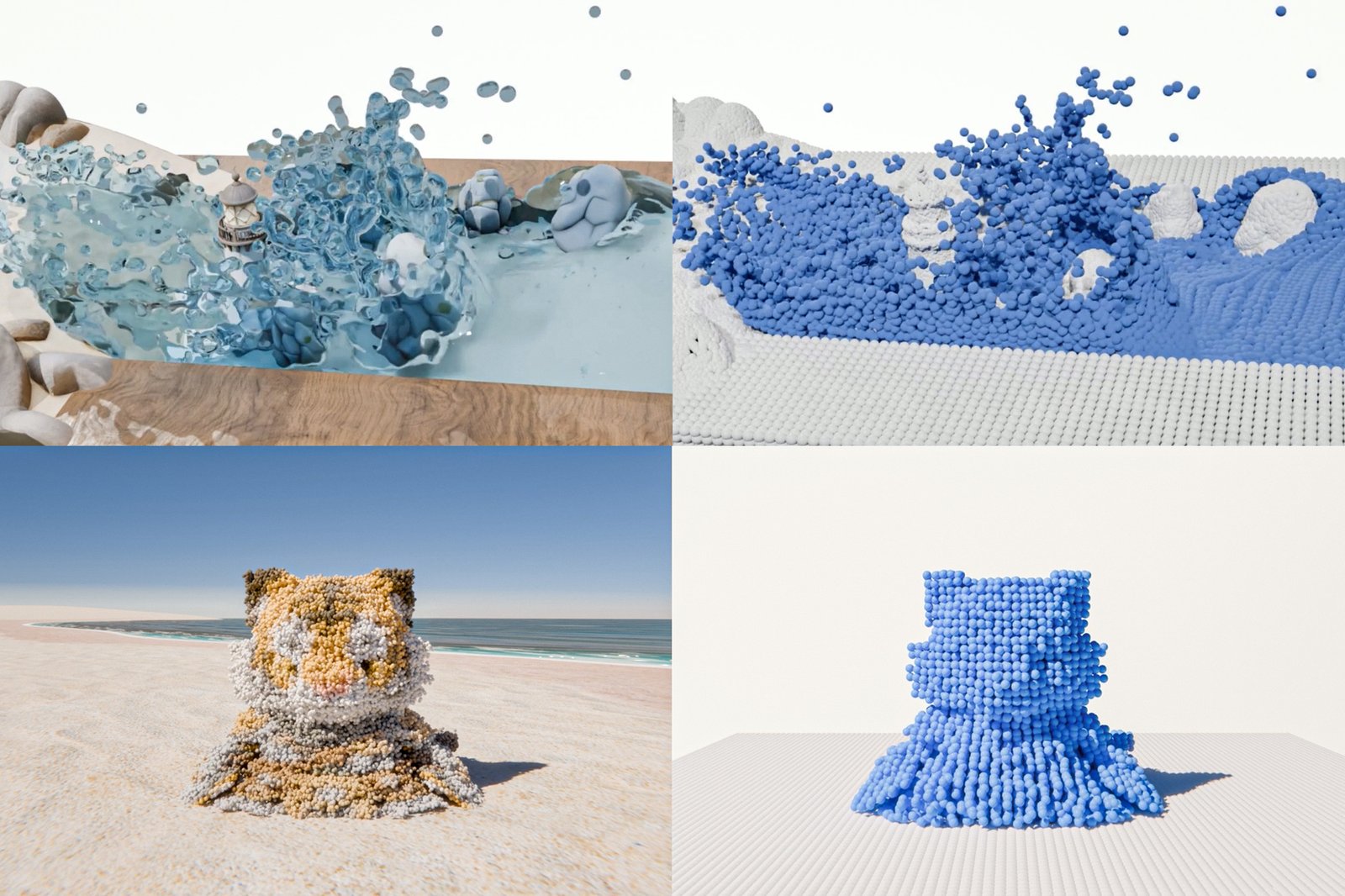
The system represents every material it simulates, from a dune of sand to a protein molecule, as tiny particles and predicts where those particles will move one step at a time. Because it learns the underlying dynamics rather than being programmed with an equation, the model can adapt to materials, forces, and environments it never
Researchers from a collaborative team including Hua Zhang, Jing Li, and Haiyan Wang have developed a deep learning algorithm that stratifies cardiac arrhythmias into three distinct risk levels: normal, not life-threatening, and life-threatening. Published in the journal BioData Mining in July 2026, the study introduces a model named PaliConvLSTM, which utilizes a palindromic structure of
We use cookies on our website to give you the most relevant experience by remembering your preferences and repeat visits. By clicking “Accept”, you consent to the use of ALL the cookies.
This website uses cookies to improve your experience while you navigate through the website. Out of these, the cookies that are categorized as necessary are stored on your browser as they are essential for the working of basic functionalities of the website. We also use third-party cookies that help us analyze and understand how you use this website. These cookies will be stored in your browser only with your consent. You also have the option to opt-out of these cookies. But opting out of some of these cookies may affect your browsing experience.
Necessary cookies are absolutely essential for the website to function properly. This category only includes cookies that ensures basic functionalities and security features of the website. These cookies do not store any personal information.
Any cookies that may not be particularly necessary for the website to function and is used specifically to collect user personal data via analytics, ads, other embedded contents are termed as non-necessary cookies. It is mandatory to procure user consent prior to running these cookies on your website.