
A misconception is currently thriving in the industry that one can become a Generative AI expert without learning “traditional” machine learning. Large Language Models (LLMs) predict the next word in a sequence of words. They calculate the probability of occurrence of each word in a vocabulary that can follow a sequence of words. In the
IBM Experts on Building With AI Agents
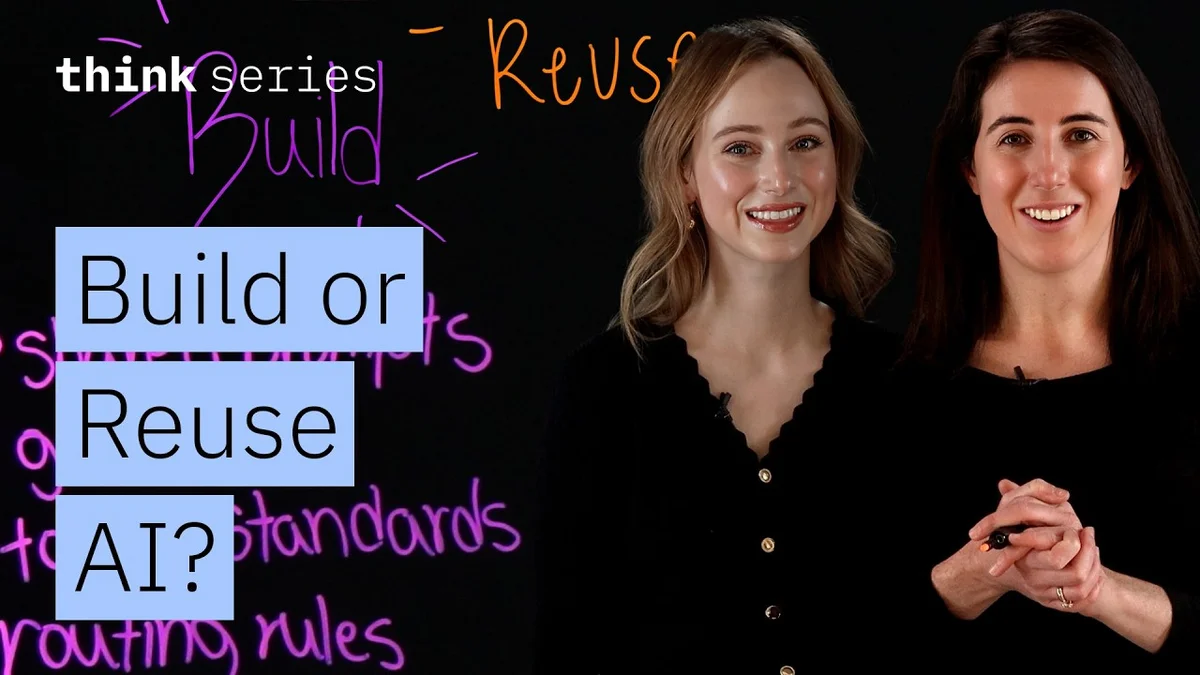
In the rapidly evolving world of artificial intelligence, the question of how to best integrate AI agents into workflows is a critical one for businesses. IBM’s Demand Strategist, Katie McDonald, and Senior Data & AI Technical Specialist, Brianne Zavala, recently discussed the strategic choices teams face when implementing AI agents. They framed the decision as a culinary one: do you cook from scratch, order takeout, or opt for a hybrid approach? This video offers a practical guide to navigating these options.
Meet the Experts
Katie McDonald serves as a Demand Strategist at IBM, focusing on how businesses can effectively adopt and benefit from technology solutions. Brianne Zavala, a Senior Data & AI Technical Specialist at IBM, brings deep expertise in data science and artificial intelligence, guiding clients in the practical application of these technologies.
The “Cook from Scratch” vs. “Takeout” Analogy for AI Agents
McDonald uses a relatable analogy to explain the core decision-making process for AI agents. She poses the question of whether to ‘cook from scratch’ or ‘assemble a meal using pre-prepared components.’ This translates to the AI world as deciding whether to build custom AI agent workflows from the ground up or to leverage existing, pre-built components and tools.
The full discussion can be found on IBM‘s YouTube channel.
McDonald herself prefers to ‘cook from scratch,’ meaning she favors building custom workflows. This approach allows for complete control over the timing, ingredients, and execution of the AI agents. She emphasizes that this method gives her control over the process and the ability to tailor it precisely to her needs.
Zavala, on the other hand, leans towards the ‘takeout’ option, which in AI terms means utilizing pre-built components and services. She explains that this approach allows her to ‘plug in something I already know’ and focus her efforts on other tasks. This strategy is about efficiency and leveraging existing solutions to achieve the desired outcome quickly.
The Hybrid Approach and the Importance of Orchestration
Recognizing that not all situations fit neatly into one category, the IBM experts also highlight the ‘hybrid’ approach. This involves a combination of building custom solutions and integrating pre-built components. Zavala notes that regardless of the chosen path, effective orchestration is the key to making the entire system work cohesively.
“No matter what you choose, coordination is what makes the system work,” Zavala states. She elaborates that orchestration ties everything together, managing the flow of information and actions between different AI agents and components.
Building AI Agents: Pros and Cons
McDonald elaborates on the ‘build’ approach, defining it as creating AI agents that can plan, act, use tools, make decisions, and move tasks forward across a system. This is in contrast to simply generating text. She highlights that building custom workflows provides “deep control” and allows for the integration of specific tools and pre-built patterns that might not be available off-the-shelf. However, she also points out that this path requires significant engineering time and a long-term commitment to ownership and maintenance.
When considering the ‘build’ strategy, teams must ask themselves if the workflow they are creating is truly unique to their business needs. If it is, building from scratch can offer a competitive advantage. However, it also means accepting a longer ramp-up time before seeing value and taking on the responsibility for ongoing development and upkeep.
Reusing AI Components: Efficiency and Speed
Zavala discusses the ‘reuse’ approach, where teams integrate pre-built AI components and patterns. This strategy offers speed and efficiency, as teams can quickly assemble solutions using readily available building blocks. She explains that by integrating these components with their data sources and aligning them with their governance models, teams can achieve faster deployment.
“When you reuse components, you’re working with patterns that are already tested,” Zavala explains. This can lead to more reliable outcomes and a quicker path to value. However, she cautions that relying solely on pre-built components may limit customization and could lead to solutions that are not perfectly tailored to specific business requirements. The challenge with reuse is ensuring that the components fit the intended purpose without requiring significant modification.
The Orchestration Layer: The Unifying Force
Both experts agree that the orchestration layer is paramount, regardless of whether a team builds or reuses. This layer acts as the central nervous system for AI agents, managing their interactions and ensuring that tasks are executed in the correct sequence and according to defined policies. Zavala emphasizes that this layer handles task routing, applies policies, enforces identity, and manages tool invocation, effectively connecting disparate agents into a coherent system.
“The orchestration layer binds everything together into one coherent system,” Zavala states. It ensures that the entire AI agent setup functions as a unified entity, rather than a collection of isolated tools. This is crucial for achieving predictable performance and maintaining control over the AI’s behavior.
A Checklist for Choosing Your AI Agent Path
To help teams make informed decisions, Zavala offers a practical checklist:
- Use Case: Clearly define the specific problem you are trying to solve with AI agents.
- Build, Reuse, or Hybrid: Determine whether to build custom workflows, reuse existing components, or adopt a combination of both.
- Orchestration: Plan for the orchestration layer to manage agent interactions, data flow, and governance.
- Pilot, Measure: Test your chosen approach with a pilot program and establish metrics to measure success.
McDonald adds that when choosing the ‘build’ path, teams should consider if their workflow is unique and requires deep control. For ‘reuse,’ the question is whether pre-built components can adequately meet the needs with minimal customization. The hybrid approach offers a balance, allowing teams to build custom solutions for core functionalities while leveraging pre-built components for others.
Ultimately, the choice between building, reusing, or a hybrid approach depends on a team’s specific needs, resources, and desired level of control. However, the common thread is the essential role of orchestration in ensuring that AI agents work together effectively and safely to deliver value.
©
2026
StartupHub.ai. All rights reserved. Do not enter, scrape, copy, reproduce, or republish this article in whole or in part. Use as input to AI training, fine-tuning, retrieval-augmented generation, or any machine-learning system is prohibited without written license. Substantially-similar derivative works will be pursued to the fullest extent of applicable copyright, database, and computer-misuse laws. See our
terms.

Related Posts

![[institutes-now]-pre-training-‘warm-up’-helps-ai-models-recognize-their-own-ignorance](https://sapio.asia/wp-content/uploads/2026/04/37106-institutes-now-pre-training-warm-up-helps-ai-models-recognize-their-own-ignorance.jpg)