Dr. Steve Munkeby Expands Access to Artificial Intelligence Through Comprehensive Publishing Portfolio Dr. Steve Munkeby, a former U.S. Army infantry officer and veteran high-tech project manager for federal defense and space programs, is expanding public access to artificial intelligence education through a broad portfolio of books focused on real-world applications. Drawing on more than 30
New AI Agent Could Transform How Scientists Study Weather and Climate
A new AI agent could help analyze complex data from weather forecasting models
The tool could help democratize earth science
Researchers hope to expand the tool to other areas, including climate science
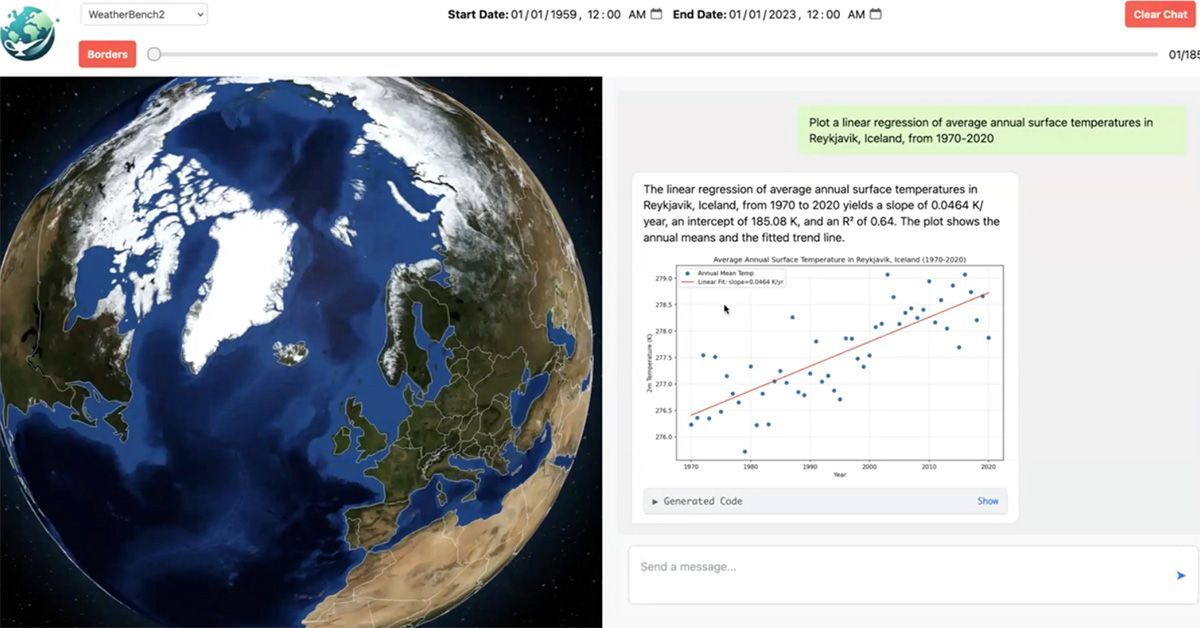
Computer scientists and weather scientists have taken the first steps toward creating an AI agent capable of analyzing and answering questions in natural language, such as English, about data from AI-driven weather and climate forecasting models.
The research team from the University of California San Diego will present the first AI weather agent they developed, named Zephyrus, at the 14th International Conference on Learning Representations (ICLR) April 23–27 in Rio de Janeiro.
Recently, models driven by AI and deep learning have considerably improved weather forecasting. But analyzing the resulting data remains difficult and time-consuming. A main issue is that these types of AI models are not able to describe their findings in plain language. A secondary issue is that these models are not able to reason about text information, such as meteorology reports and weather bulletins. The UC San Diego research team aims to address both.
“Our goal is to increase access to critical data and predictions by lowering the barrier to entry to analyzing these data,” said Duncan Watson-Parris, a study co-author and faculty member at the UC San Diego Scripps Institution of Oceanography. “We want to increase the speed with which we can reason about multimodal data and learn about the Earth by making it easier for students and young scientists to interact with different datasets.”
The researchers also hope the findings will lead to AI agents that will be able to bring similar advances to other disciplines, especially climate science. Meteorology was a perfect test case because it combines large, complex datasets that change over time and the need to reason about these data in plain language. “Weather prediction is a critical scientific challenge, with profound implications spanning agriculture, disaster preparedness, transportation, and energy management,” the researchers write.
To bridge the gap between a code-driven AI model and language-based AI agent, the researchers set up an environment that allows the agents to interact with weather models and data via code. The AI agent is capable of handling language-based queries, translating them into code, and then translating the code-generated answers into plain language.
Zephyrus performed well on simple tasks, such as finding locations with specific weather conditions, as well as weather forecasts for specific locations at certain times. But it struggles with finding locations with extreme weather and report generation. Researchers tested four frontier LLMs to power Zephyrus, and all performed with similar accuracy.
For the next iteration of the AI agent, researchers plan to use larger training datasets. Next steps also include fine-tuning open-source models for climate-focused tasks.
“Our vision is to democratize earth science. Zephyrus is a crucial step toward creating AI co-scientists that dramatically lower the barrier to entry, allowing students and researchers everywhere to access and reason about critical weather and climate data at unprecedented speeds,” said Rose Yu, study co-author and a faculty member in the UC San Diego Department of Computer Science and Engineering.
This work was supported in part by the U.S. Army Research Office under Army-ECASE award W911NF-07-R-0003-03, the U.S. Department of Energy, Office of Science, IARPA HAYSTAC Program, NSF Grants #2205093, #2146343, and #2134274, CDC-RFA-FT-23-0069, as well as DARPA AIE FoundSci and DARPA YFA.
Zephyrus: An Agentic Framework for Weather Science, ICLR 2026
Marshall Fisher, Jas Thakker, Yiwei Chen, Zhirui Xia, Yasaman Jafari, Ruijia Niu, Manas Jain, Veeramakali Vignesh Manivannan, Zachary Novack, Luyu Han, Srikar Eranky, Salva Rühling Cachay, Taylor Berg-Kirkpatrick and Rose Yu, Department of Computer Science and Engineering, UC San Diego Jacobs School of Engineering
Duncan Watson-Parris, UC San Diego Scripps Institution of Oceanography and Halicioglu Data Science Institute, within the School of Computing, Information and Data Sciences at UC San Diego
Sumanth Varambally and Yi-An Ma, Halicioglu Data Science Institute within the School of Computing, Information and Data Sciences at UC San Diego
Learn more about research and education at UC San Diego in: Artificial Intelligence
Share This:
You May Also Like
Stay in the Know
Keep up with all the latest from UC San Diego. Subscribe to the newsletter today.

Related Posts