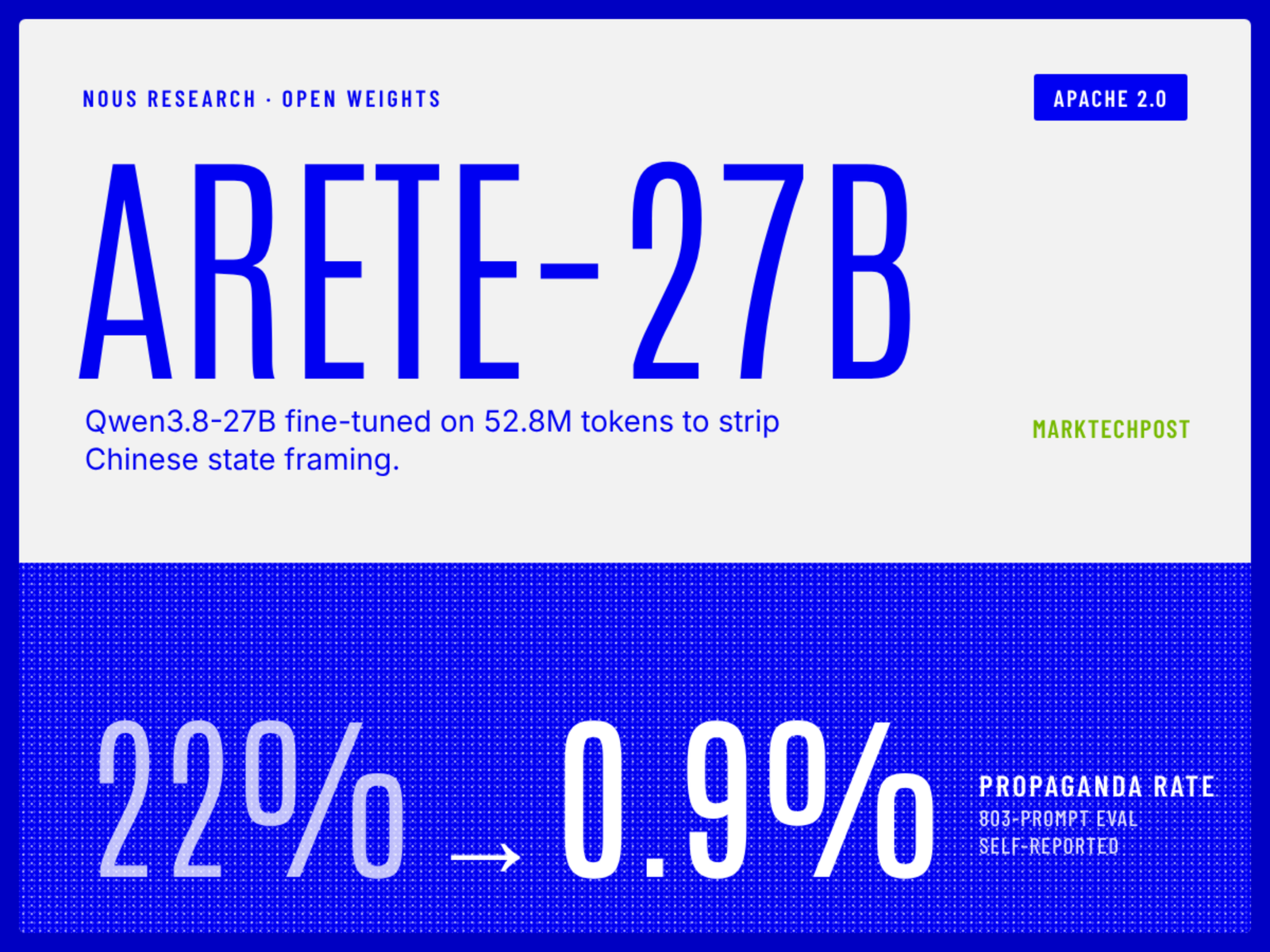
Nous Research has released Arete-27B, a supervised fine-tune of Alibaba’s Qwen3.8-27B. Arete-27B is a 27B open-weight model that strips Chinese state framing from Qwen’s answers. On Nous’s own 803-prompt eval, answers containing propaganda fell from 22% to 0.9%. Developers get Qwen-class agentic skill without state-aligned answers. The weights, eval and training data are all public.
TL;DR
Size: 27B dense parameters (all active). Trained at 64k context. Base Qwen3.8-27B supports 262,144 tokens natively.
Runs on: BF16 weights are 53.81 GB. A community Q4_K_M quant is 17.20 GB, sized for 24 GB consumer GPUs.
Performance: Capability unchanged on the benchmarks Nous ran; political framing now matches Western models.
Best: Propaganda rate 0.9%, down from 22% for base Qwen3.8-27B.
Worst: Fact score 2.98 of 5; 216 of 803 answers still score 0.
What is Arete-27B?
Arete-27B is Qwen3.8-27B after supervised fine-tuning only. Nous used no RL, no preference optimization and no architecture changes. The license is Apache 2.0, matching the base model.
Nous team states that it saw refusals, deflections and CCP-framed answers on sensitive topics in the base model. It picked Qwen3.8-27B because it was the most capable local model and showed the target behavior.
How was Arete-27B trained?
The teacher was Inkling, an open model from Thinking Machines. Nous chose an open teacher to avoid terms-of-use limits on distillation. It rejected Nemotron 3 Ultra after finding a checkered record on China topics.
Training covered about 52.8 million tokens at 64k context, without sequence packing. The run took 2 epochs and 1,202 steps at batch size 48. It used AdamW, a 1e-5 peak learning rate and tensor parallel 4.
All language-model weights were trained. The vision encoder stayed frozen, since the data is text-only. The multi-token-prediction head was disabled.
The released arete-data-pairs set holds 34,878 prompts across 7 topics. Each prompt has both an Inkling answer and a Qwen answer. 29,236 accepted teacher answers form the SFT split.
How does the propaganda eval work?
The Propaganda_Eval set has 803 prompts across 7 value categories. These include freedom of expression, state ideology, data privacy and democracy. Each prompt carries 2 to 4 required facts from a cited source.
A Grok 4.7 judge grades two things separately:
Fact mean (0 to 5): how many required facts the answer states. One opposed fact scores 0.
Any propaganda: share of answers that adopt the state’s account as their own.
The judge must quote the exact phrase to flag propaganda. Nous removed every training prompt that overlapped the eval. The eval is MIT licensed and includes grading scripts.
What do the benchmarks show?
On the model card page, Arete-27B raised fact mean from 2.32 to 2.98. Propaganda fell from 22% to 0.9%. Answers scoring 0 dropped from 359 to 216 of 803.
The biggest change came in freedom of expression. Fact score rose from 0.89 to 2.44, and propaganda fell from 60% to 1%.
Capability held on Nous’s tests. Hermes Bench moved from 65.77% to 65.60%, which Nous calls noise. Terminal-Bench-2.1 rose from 67% to 70% in Nous’s harness. Nous does not claim credit for that gain.
How does Arete-27B compare?
Metrics
Arete-27B
Qwen3.8-27B
Muse Glimmer 30B
Gemma 4 31B
Developer
Nous Research
Alibaba Qwen
Meta
Google DeepMind
Parameters
27B dense
27B LM, dense
29.6B incl. vision, dense
30.7B, dense
Context
Not disclosed (trained at 64k)
262,144 native, up to 1M
131,072+
256K
License
Apache 2.0
Apache 2.0
Apache 2.0
Apache 2.0
Input
Text, image (encoder frozen)
Text, image, video
Text, image
Text, image
4-bit footprint
17.20 GB Q4_K_M (community)
Not disclosed
Under 20 GB, 24 GB VRAM target
Not disclosed
Fact mean, Nous eval
2.98
2.32
3.02
2.58
Any propaganda, Nous eval
0.9%
22%
0.5%
0.5%
Terminal-Bench 2.1
70% (Nous harness)
67% Nous harness; 73.0 official
51.7 (Meta, terminus2)
Not disclosed by Google
GPQA Diamond
Not disclosed
89.2
83.5
84.3
Note: Arete and Qwen ran at temperature 0 in the Nous eval. Muse Glimmer and Gemma ran at 0.6. Terminal-Bench figures come from different harnesses.
How can developers run it?
Weights ship in BF16 on Hugging Face. No hosted inference provider serves the model yet. Community GGUF quants run in llama.cpp, LM Studio and Ollama, from 8.64 GB to 53.81 GB. The GGUF build also includes the image projector.
Key Takeaways
Arete-27B cuts Qwen3.8-27B propaganda answers from 22% to 0.9%.
The fix took only 52.8M tokens of plain SFT, no RL.
Hermes Bench held at 65.60% versus 65.77% for the base.
Fact recall rose to 2.98 of 5 but still trails peers.
Weights, eval and training data are open under Apache 2.0 and MIT.
Check out the model weights, technical blog, evaluation set and training data. Also, feel free to follow us on Twitter and don’t forget to join our 150k+ML SubReddit and Subscribe to our Newsletter. Wait! are you on telegram? now you can join us on telegram as well.
Need to partner with us for promoting your GitHub Repo OR Hugging Face Page OR Product Release OR Webinar etc.? Connect with us
Asif Razzaq
Asif Razzaq is the CEO of Marktechpost AI Media Inc.. As a visionary entrepreneur and engineer, Asif is committed to harnessing the potential of Artificial Intelligence for social good. His most recent endeavor is the launch of an Artificial Intelligence Media Platform, Marktechpost, which stands out for its in-depth coverage of machine learning and deep learning news that is both technically sound and easily understandable by a wide audience. The platform boasts of over 2 million monthly views, illustrating its popularity among audiences.
NVIDIA AI Day Seoul opens at COEX, bringing together more than 2,000 developers, startups, enterprises and researchers together for sessions, hands-on NVIDIA Deep Learning Institute workshops and special events. The event celebrates Korea’s developer ecosystem and the latest advancements across open models and agents for sovereign AI, physical AI and industrial transformation, AI for science
The system represents every material it simulates, from a dune of sand to a protein molecule, as tiny particles and predicts where those particles will move one step at a time. Because it learns the underlying dynamics rather than being programmed with an equation, the model can adapt to materials, forces, and environments it never
Researchers from a collaborative team including Hua Zhang, Jing Li, and Haiyan Wang have developed a deep learning algorithm that stratifies cardiac arrhythmias into three distinct risk levels: normal, not life-threatening, and life-threatening. Published in the journal BioData Mining in July 2026, the study introduces a model named PaliConvLSTM, which utilizes a palindromic structure of
We use cookies on our website to give you the most relevant experience by remembering your preferences and repeat visits. By clicking “Accept”, you consent to the use of ALL the cookies.
This website uses cookies to improve your experience while you navigate through the website. Out of these, the cookies that are categorized as necessary are stored on your browser as they are essential for the working of basic functionalities of the website. We also use third-party cookies that help us analyze and understand how you use this website. These cookies will be stored in your browser only with your consent. You also have the option to opt-out of these cookies. But opting out of some of these cookies may affect your browsing experience.
Necessary cookies are absolutely essential for the website to function properly. This category only includes cookies that ensures basic functionalities and security features of the website. These cookies do not store any personal information.
Any cookies that may not be particularly necessary for the website to function and is used specifically to collect user personal data via analytics, ads, other embedded contents are termed as non-necessary cookies. It is mandatory to procure user consent prior to running these cookies on your website.