
USC Viterbi and Stevens new faculty: Ajey Jacob (top left), Haowei Shi (top center), Itay Hen (top right), Morley Mao (bottom left), Sasan Razmkhah (bottom center) and Scott Mahlke (bottom right) The USC Stevens School of Computing and Artificial Intelligence welcomes six new faculty members whose research advances the frontiers of artificial intelligence, computing and
Spark Deep Dive: Hong Kong uses AI to track rodents
Deep Dive delves into hot issues in Hong Kong and mainland China. Our easy-to-read articles provide context to grasp what’s happening, while our questions help you craft informed responses. Check sample answers at the end of the page.
News: Tracking rats with AI
Hong Kong resident Yau Suk-ming was startled when a rat leapt out from her kitchen blender. The rodent ran away before the 74-year-old retiree could catch it. Still, she was not surprised to see the rat. Earlier, she had noticed rat droppings in her flat in Kowloon City.
Rats can be seen around the city’s wet markets, butcher shops and fresh produce stores. They have become a cause for concern about public health and hygiene.
The number of live or dead rodents caught or collected in Hong Kong in the first half of 2026 stood at 87,105.
The annual number had risen in the past decade, from 37,169 in 2016 to 157,182 in 2025 – a 323 per cent increase.
Still, authorities have said their containment strategy is working. The Food and Environmental Hygiene Department (FEHD) said it was using the latest artificial intelligence (AI) technology to track and capture rodents.
For instance, thermal imaging cameras installed across Hong Kong take images at two-minute intervals from 7pm to 7am for three consecutive nights, every six months.
The system’s AI algorithm detected and counted rats from their thermal signature. It also analysed the frequency of their appearance and peak activity hours and mapped dispersal routes, a spokesman said.
This provided the rodent absence rate. The rate was measured by dividing the number of snapshots in which no rats were detected by the total number of images taken.
“A high rodent absence rate gives the impression that Hong Kong is almost rodent-free in certain districts. Yet, some residents have reported that the rat infestation problem is getting worse,” said Brian Wong Shui-hung.
He is a researcher at local think tank Liber Research Community.
According to department statistics, rodent absence rates exceeded 90 per cent across all 18 districts in the second half of last year. Eastern, Islands and Tuen Mun districts were more than 98 per cent rat-free, while Sai Kung topped the list at 99.5 per cent.
Wan Chai and Kowloon City were the only two districts with more than 10 locations recording a rat absence rate below 80 per cent.
District councillor Lam Tak-shing attributed the rise in sightings in Kowloon City to 65 active construction sites. He said the vibrations drive rats into public spaces.
Lam noted that the Highways Department has repaired broken concrete and sewage pipes off Ma Tau Wai Road to restrict rodent movement, bringing the district’s infestation largely under control.
Staff writers
Question prompts
1. According to the information in the news, which of the following statements is false?
(1) The total number of rodents caught or collected has increased by 323 per cent over the last nine years.
(2) Thermal imaging cameras record images for 12 hours straight every night to calculate the rodent absence rate.
(3) Sai Kung achieved the highest rat absence rate among all 18 districts, reaching 99.5 per cent.
(4) Kowloon City was the only district to report over 10 locations with a rat absence rate under 80 per cent.
A. (1), (2) only
B. (1), (3) only
C. (2), (4) only
D. (3), (4) only
2. Give ONE reason why a high rat absence rate reported by the FEHD may not reflect the actual rodent situation.
3. Do you think using AI thermal imaging technology is an effective strategy for managing Hong Kong’s rodent problem? Give TWO reasons for your stance using the news and glossary.
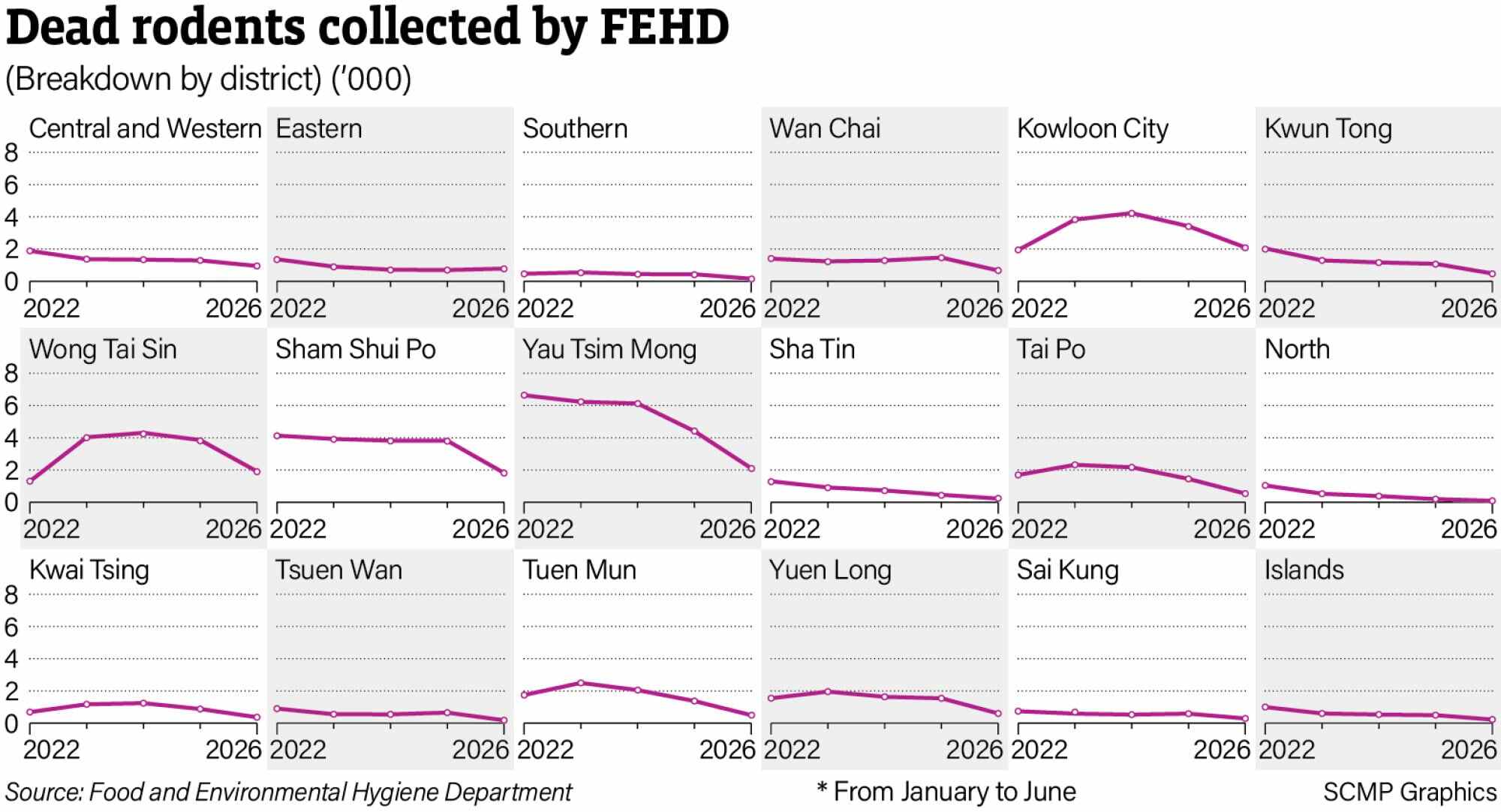
Chart
Question prompts
1. Identify ONE district in which the number of dead rodents collected increased significantly between 2022 and 2024. What trend has it been on since 2024?
2. Using the information in the news, explain why this district has so many dead rodents.
Glossary
-
containment strategy: a planned approach used to limit the spread, impact or reach of a problem
-
thermal signature: the infrared heat pattern emitted by a living organism that allows cameras to identify and track it in the dark
-
rodent absence rate: the percentage of thermal surveillance snapshots in which no rodents are detected relative to the total number of images taken
Sample answers
News
1. C
2. Local residents report that the rat infestation problem is actually worsening in their daily lives despite high statistical absence rates. / Thermal cameras only capture snapshots at two-minute intervals during specific time windows (7pm–7am for three consecutive nights every six months), which may miss rat activity outside these locations or time frames. (any one)
3. Effective: Using AI thermal imaging technology is an effective strategy for managing Hong Kong’s rodent problem because the cameras can track rodents, their peak activity hours and dispersal routes using thermal signatures. Data collected also allows authorities to calibrate camera locations continuously based on complaint hotspots, routine inspections and community views.
Not effective: Despite high statistical absence rates (over 90 per cent across many districts), overall rodent capture numbers have skyrocketed by 323 per cent over the past decade, showing the underlying problem persists. Relying on absence rates creates a false impression that districts are almost rat-free, potentially delaying necessary public action and hygiene measures.
(accept all reasonable answers)
Chart 1
1. Kowloon City saw a big increase between 2022 and 2024. After 2024, the number of dead rodents collected decreased steadily from 2024 to 2026. (accept all reasonable answers)
2. A district councillor blamed the rise in rat sightings in Kowloon City on construction sites that would drive rats into public spaces.

Related Posts