Get the scoop on the most recent ranking from the Tiobe programming language index, learn a no-fuss way to distribute DIY tooling across Python projects, and take a peek at ComfyUI: interactive, node-based tools for generative AI workloads in Python. Python faces new challenges from old rivals, but is it a blip or something more?
Still Innovating at 30: How Stanford GSB Is Reimagining Entrepreneurship Education for a New Era
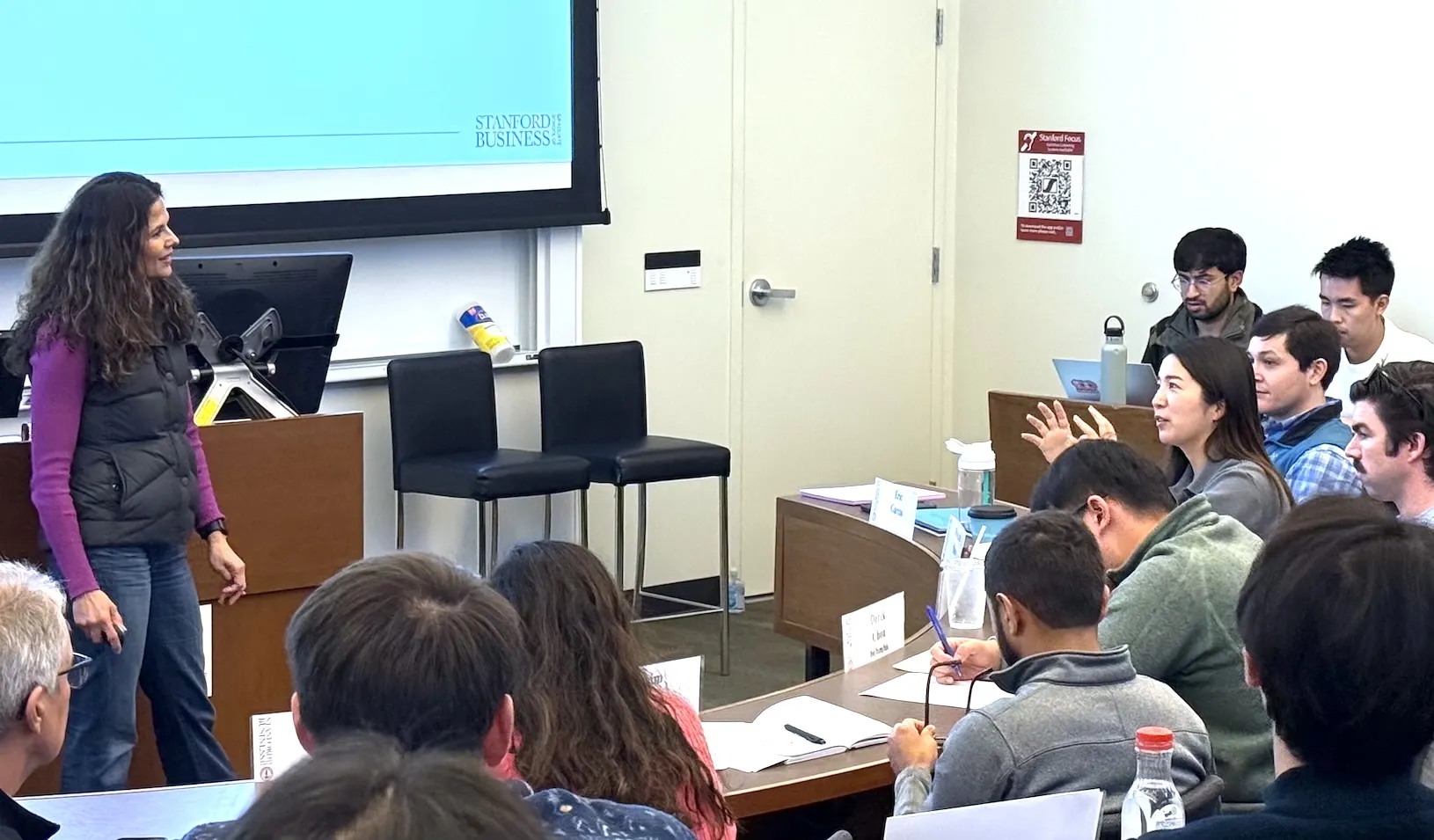
GSB Lecturer Monisha Perkash facilitates a classroom discussion with students in Ecopreneurship Foundations.
Entrepreneurship today looks fundamentally different than it did thirty years ago. Technologies evolve at unprecedented speed, societal challenges increasingly intersect with markets, and the line between business, policy, and impact continues to blur. The skills required to build, lead, and invest in new ventures are no longer confined to product-market fit or fundraising alone; they now demand fluency in emerging technologies, comfort with ambiguity, and the ability to operate within complex systems.
As the Stanford Graduate School of Business celebrates the 30th anniversary of the Center for Entrepreneurial Studies (CES), the school’s curriculum continues to evolve in response to these shifts. CES has long been a hub for experimentation in entrepreneurship education, and in recent years, that experimentation has accelerated, shaped by student demand, faculty leadership, and changes in the real-world entrepreneurial landscape.
Across the GSB, newer courses are responding directly to the realities students will face as founders, operators, investors, and organizational leaders. These classes are designed to build durable capabilities: the ability to reason about new technologies, to uncover meaningful problems before rushing to solutions, and to lead responsibly in moments of high uncertainty.
Three new courses that illustrate how the GSB continues to reimagine entrepreneurship education for a new era are: Understanding AI Technologies for Business Problems, created and taught by Assistant Professor Yuyan Wang; Research-Driven Inspiration, pioneered by Scott Brady and further developed with Brett Jordan; and Ecopreneurship Foundations, co-taught by Monisha Perkash, John Scull, and Kunal Doshi.
Understanding AI Technologies for Business Problems
Building fluency for leadership in an AI-enabled world
Understanding AI Technologies for Business Problems, created and taught by Assistant Professor Yuyan Wang, was designed to address a growing gap in business education: many future leaders recognize that AI will shape their careers, yet lack the foundational understanding to engage with it.
As Wang explains, students often arrive eager to use AI, but uncertain how to evaluate its capabilities or limitations. “Students leave the course with a much clearer understanding of the AI technologies that are critical to the success of many businesses today,” she notes. “Beyond buzzwords, they develop a working knowledge of how different AI techniques function, what problems they are well suited to, and where their limitations lie.” That fluency, she adds, allows students to communicate more effectively with technical teams and make more informed decisions about when — and when not — to deploy AI.
The course holds a distinct place in the GSB curriculum as its first technical course on AI, bridging the gap between engineering depth and managerial relevance. Wang regularly updates the content to reflect the rapid pace of change in the field, ensuring that students engage with current real-world applications rather than static frameworks.
Foundational concepts, including machine learning, reinforcement learning, generative AI, AI agents, and large language models, are introduced as tools whose strengths and weaknesses matter deeply in business contexts. Students learn how AI systems are built, what kinds of problems they are well-suited to solve, and where human judgment remains essential.
The structure of the course reflects this applied orientation. Technical ideas are anchored in concrete use cases such as personalization, platform design, and generative content. Projects require students to diagnose real business problems and propose AI-enabled solutions, forcing them to think through feasibility, tradeoffs, and organizational implications. Guest speakers from industry further ground the material, offering candid perspectives on what it takes to deploy AI responsibly at scale.
Salome Mikadze-Struk (MBA 2025) took the first iteration of the class in the winter quarter of 2025. She reflected on her learnings: “What I have learned is not just ‘more AI’, but a cleaner mental model for separating capability from constraint, and hype from deployable reality.”
Looking ahead, Wang’s goal is for the course to remain a durable foundation. “I want it to help students stay comfortable with emerging AI technologies and develop a deep understanding of how and where these technologies create business value, and leverage AI thoughtfully in their businesses.”
Research-Driven Inspiration
A framework for researching, mapping, and unearthing brilliant ideas
Research-Driven Inspiration (RDI) was pioneered by Scott Brady and further formalized with Brett Jordan to address a recurring pattern they observed among aspiring founders: students often began with ideas before fully understanding the industries they hoped to change.
“What we see most clearly throughout our course is a shift in how students think,” Brady and Jordan explain. “They stop starting with ideas and instead build a real understanding of industries, incentives, and constraints.” Through that process, students uncover meaningful problems and opportunities, developing conviction not only about what could work, but why it matters and why now.
That conviction, the instructors emphasize, comes from structured engagement with experts and stakeholders across an industry. By synthesizing diverse perspectives, students develop thoughtful, future-oriented hypotheses about where industries are headed and where non-obvious opportunities are likely to emerge. “What students really leave with is a repeatable capability,” Brady and Jordan say. This capability applies whether students are exploring a startup idea, an investment thesis, or a strategic career move.
In recent iterations of the course, RDI has also placed increased emphasis on teaching students how to leverage AI tools responsibly to accelerate research and synthesis without outsourcing the learning itself. That balance has already had ripple effects beyond the classroom: four recent RDI students went on to help launch the AI@GSB Applied AI Initiative, becoming the founding AI Scholars of the dean’s-level program.
Looking ahead, Brady and Jordan see RDI becoming a foundational offering that students continue to draw on well beyond a single quarter. “Meaningful research, synthesis, and conviction-building don’t neatly fit into a ten-week timeline,” they say, and their course will continue to evolve accordingly.
Ecopreneurship Foundations
Preparing entrepreneurs to lead the sustainability transition
Few challenges loom larger or carry higher stakes than climate change. Addressing climate change will require technological breakthroughs, new business models, new forms of capital, and leaders capable of navigating complexity over long time horizons. Ecopreneurship Foundations, co-taught by Monisha Perkash, John Scull, and Kunal Doshi, was created in response to growing student interest in climate and sustainability-focused careers and a recognition that motivation alone is not enough to succeed in this space. The faculty team brings complementary perspectives from investing, entrepreneurship, and strategy, shaping a course that is grounded in real-world decision-making and balances both academic rigor and relevance.
The course offers both frameworks for understanding issues unique to climate and sustainability, and practical insights into what it actually takes to launch and scale climate-focused ventures. The class centers on vignettes — mini case studies drawn from real companies — and emphasizes debate, discussion, role-played dialogue, and postmortem analysis.
This case study method includes active participation by protagonists in each class discussion to foster student learning. Founders, investors, and operators from across climate tech, sustainable finance, food systems, manufacturing, carbon markets, and nature-based solutions engage directly with students, often sharing unfiltered reflections on pivotal decisions and personal tradeoffs. These conversations frequently extend beyond the classroom through smaller coffee chats and informal sessions.
Student feedback suggests the approach resonates deeply. Many describe the course as clarifying not just what careers in sustainability look like, but how they feel day-to-day — the tensions, the uncertainty, and the responsibility. Surveys show strong gains in students’ understanding of sustainability challenges, strategies, and career pathways, as well as high overall satisfaction with the course. Wilson Roen (MBA 2026), a student in the course in winter 2025, reflected, “As someone who had spent my career leading climate consulting programs, I was excited to explore career pathways across the sustainability ecosystem. This course offered the opportunity to learn from the challenges climate faced by world-class founders, investors, and policy leaders as they built their ventures.”
For students without prior experience in climate or sustainability, the course often serves as an on-ramp. For others, it sharpens existing interests and helps them articulate where they want to engage — as founders, investors, corporate leaders, or nonprofit innovators. In all cases, the course emphasizes that impact-driven work requires both idealism, realism, and rigor.
A Curriculum Built for What’s Next
These three courses demonstrate a consistent philosophy at CES and across the GSB: entrepreneurship education must evolve alongside the world it seeks to influence.
Thirty years after its founding, CES continues to demonstrate that innovation in entrepreneurship education is driven by listening closely to students, responding to real-world change, and preparing leaders to both navigate uncertainty and shape the future with intention.

Related Posts