
Qualcomm on Tuesday struck a $60 billion deal with Amazon for the San Diego company’s AI data center chips, with Amazon also picking up the right to buy $4 billion of its stock. “We used to be a smartphone company,” Qualcomm CFO and COO Akash Palkhiwala said at the Goldman Sachs investors summit in San
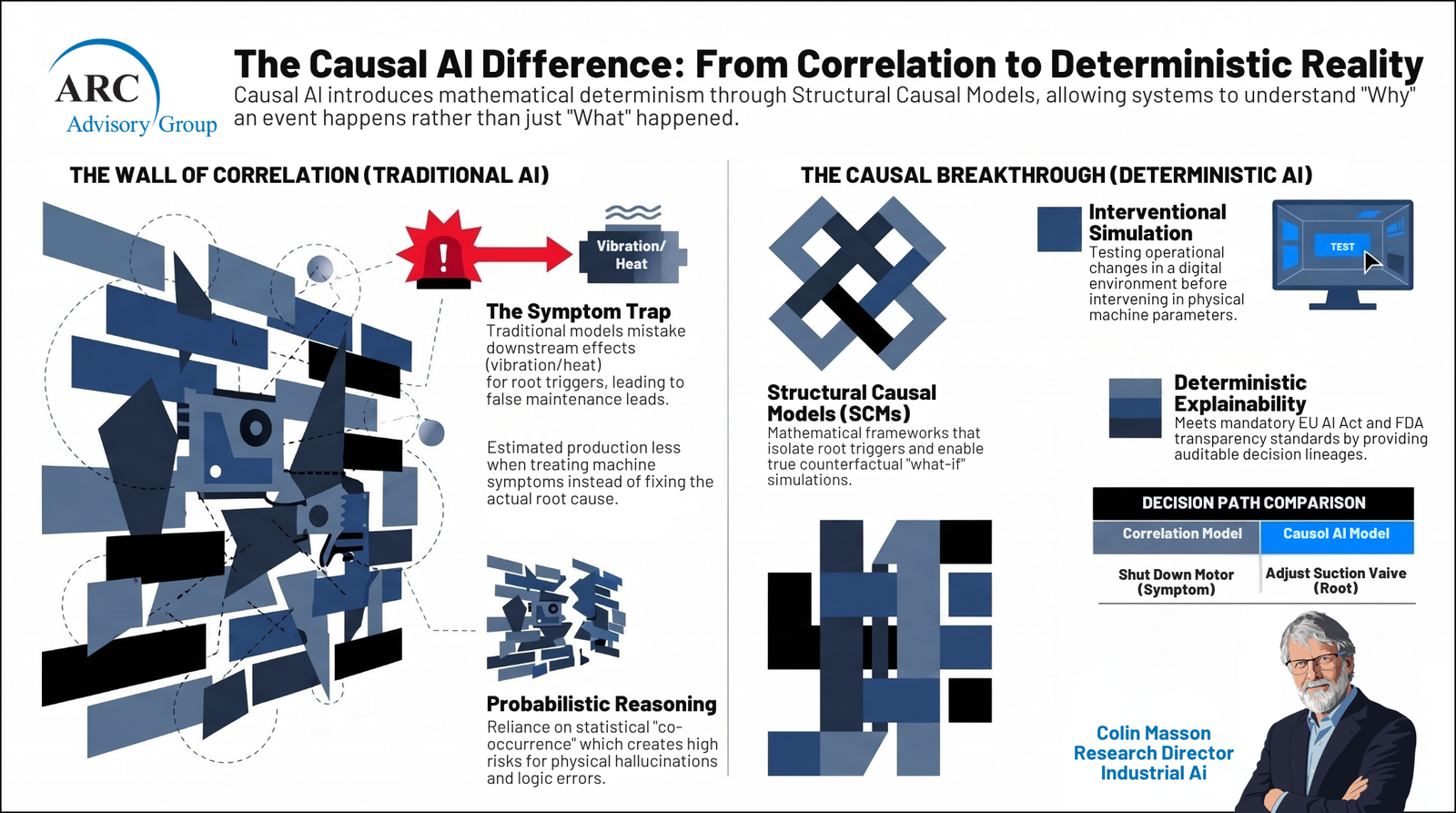
The Causal AI Breakthrough: Beyond Correlation to Deterministic Root Cause & Explainability

Executive Takeaway
Statistical correlation and probabilistic large language models hit an unyielding wall at the machine face: they systematically confuse symptoms with root causes, generating false maintenance leads and hallucinated setpoints. To achieve true cyber-physical autonomy, industrial enterprises are deploying Causal AI—specifically Structural Causal Models (SCMs) and Directed Acyclic Graphs (DAGs) grounded in Judea Pearl’s mathematics—to mathematically isolate root triggers, enable counterfactual simulation, and guarantee regulatory compliance under the EU AI Act, FDA 21 CFR Part 11, and NIST AI RMF standards.
Why a “Bonus” Blog on Causal AI?
I originally mapped out eight core installments of this Industrial Copilots teaser series for ARC’s soon-to-be-released MarketMap, however, throughout our briefings with over a hundred technology vendors and dozens of plant-floor leadership teams, an undeniable reality kept surfacing: there was an elephant in the control room that demanded its own dedicated spotlight.
That topic is Causal AI—a domain that has been near and dear to my heart for years, and one that is finally experiencing a genuine, long-overdue breakthrough in industrial operations.
For decades, industrial analytics has been constrained by correlation: observing that when Tag A moves, Tag B usually moves too. We tolerated that limitation because the underlying mathematics of true causation was trapped in academic research, requiring armies of PhD data scientists to build brittle, bespoke models.
Over the past 18 months, that reality changed completely. Breakthroughs in automated causal discovery, object-centric modeling, and semantic knowledge graphs have brought Judea Pearl’s causal reasoning out of the laboratory and directly onto production lines. Before we move into our final couple of blogs in the Industrial Copilots series, I felt the need to pause and examine why deterministic cause-and-effect may be the single most important mathematical tool in the modern Industrial AI toolbox.
I. The Wall of Correlation: Why Machine-Face AI Demands True Causality
If you evaluated Causal AI in 2024 or early 2025 and dismissed it as too academic, too slow, or requiring an army of specialized PhD data scientists, it is time for an immediate reality check. Over the past 18 months, Causal AI has crossed the chasm from theoretical computer science into production-grade industrial software.
In complex manufacturing operations, traditional machine learning models (gradient boosting, random forests, deep neural nets) rely exclusively on statistical correlation: Variable A frequently changes when Variable B changes. But in a multi-stage continuous chemical line, an automotive stamping press, or a semiconductor fabrication bay, correlation is dangerously misleading:
-
The Symptom Trap: A standard predictive maintenance model flags an anomalous temperature spike on an extruder bearing and recommends shutting down the motor to prevent catastrophic burnout.
-
The Root Cause Reality: The bearing temperature spike and the elevated vibration are downstream symptoms. The true root cause was an upstream pressure drop in the cooling jacket combined with a subtle viscosity variance in the raw resin batch.
-
The Business Consequence: Shutting down the motor cost $180,000 in lost production, while leaving the true root cause completely unaddressed.
[ Causal AI / SCM Discovery ] ──► Coolant Drop = Adjust Suction Valve (Root Trigger Fixed; $0 Downtime)
By operationalizing Judea Pearl’s mathematical framework of structural causal models (SCMs) and directed acyclic graphs (DAGs), Causal AI introduces the mathematical do-operator. This enables models to execute true counterfactual reasoning—answering not merely “What is correlated with this fault?” but:
-
“Why did this defect occur?” (Root cause attribution)
-
“What would happen if we intervene on Valve 12?” (Interventional simulation)
-
“Would this batch have failed if ambient humidity had been 5 percent lower?” (Counterfactual auditability)
II. Architectural Taxonomy: Top-Down Semantic Causality vs. Bottom-Up Telemetry & Model-Based SCM
Industrial software buyers evaluating Causal AI platforms must recognize that the market has bifurcated into complementary execution paradigms:

1. Top-Down Semantic Causal AI (The Enterprise Knowledge Synthesizers)
-
Parabole.ai (Enterprise Decision Optimization): Fuses unstructured process manuals, engineering interview transcripts, and Six Sigma domain heuristics into enterprise-level causal graphs via its TRAIN platform. In real-world industrial deployments (such as Georgia-Pacific), Parabole.ai models how upstream procurement decisions ripple across multi-site asset reliability and environmental compliance, enabling executives to evaluate enterprise-wide trade-offs without siloed blind spots.
-
causaLens (Causal Decision Intelligence & Digital Workers): Provides an enterprise causal AI platform powered by the Causal Decision Engine. causaLens builds auditable “Digital Workers” that run counterfactual simulations for supply chain risk, yield optimization, and inventory rebalancing.
2. Bottom-Up Telemetry & Model-Based Causal AI (The Machine-Face Root Cause & Quality Isolators)
-
Xplain Data (Patented ObjectAnalytics & Causal DiscoveryAgents): Deploys containerized microservices and native Model Context Protocol (MCP) tool servers directly over industrial time-series streams. Rather than forcing messy plant telemetry into flat relational tables, Xplain Data utilizes a patented ObjectAnalytics Database that models the entire lifecycle of an industrial workpiece as an integrated object. At industrial titans like Schaeffler and TRUMPF, Xplain Data’s autonomous DiscoveryAgents automatically discover cause-and-effect DAGs across multi-stage production lines, cutting time-to-root-cause from weeks of manual data science investigation to less than two hours.
-
Ethon (Model-Based Causal AI for Industrial Quality): A Swiss industrial AI innovator evaluated within ARC’s Industrial Copilots research (originating out of ETH Zurich), Ethon connects production data across the factory floor to learn how processes behave in real time, identifying why quality outcomes drift from run to run, line to line, and plant to plant. Rather than relying on data-driven inference alone, Ethon encodes known process structure, material flow, and physical constraints into the model, seamlessly extending causal reasoning from discrete manufacturing to recipe-driven batch and hybrid production. Through agentic causal workflows, Ethon guides frontline operators with validated next-step GenUI action cards (complete with inspectable causal chains) to prevent scrap cascades before entire production runs are compromised. Validated across industrial leaders—including Siemens, Lindt & Sprüngli, Dairy Farmers of America, Bosch, and Roche across CPG, chemicals, metals, and assembly—Ethon has demonstrated up to 80 percent waste reduction, up to 25 percent higher operator productivity, and over $10M in cost savings at Siemens (a deployment selected for the World Economic Forum’s MINDS programme for AI with impact at scale).
III. Disambiguating the Vendor Landscape: Computer Vision Poka-Yoke
A frequent source of confusion during client RFI reviews is the classification of vendors with “causal” in their corporate branding.
A prime archetype is Retrocausal. While Retrocausal uses causal terminology, its core platform operates as an overhead computer vision platform designed for manual assembly error-proofing (Poka-Yoke) and cycle-time ergonomics studies on manual workstations. Retrocausal performs video lookback step verification to ensure a human operator places the correct bolt in the correct sequence rather than executing mathematical Pearlian SCM discovery over multi-variable physical machine telemetry.
IV. Regulatory Catalysts: Why Deterministic Explainability Is Legally Mandatory
The transition from black-box predictive models to Causal AI is not merely a quest for operational efficiency; it is driven by an unyielding wave of global regulatory compliance:
-
The EU AI Act (High-Risk Industrial Governance): Classifies AI systems controlling critical manufacturing infrastructure, chemical processes, and functional safety components as “high-risk.” The Act mandates strict algorithmic transparency, deterministic audit logs, and human-understandable reasoning—prohibiting unauditable, black-box deep learning models that cannot prove why a setpoint was recommended.
-
US NIST AI Risk Management Framework (AI RMF 1.0): Emphasizes explainability, validity, and organizational accountability over raw predictive accuracy.
-
FDA 21 CFR Part 11 & GxP Standards: Mandate complete, tamper-proof audit trails for batch manufacturing in pharmaceuticals and food & beverage. Causal AI provides the exact mathematical lineage required to justify automated in-line release and root cause containment.
V. Key Takeaways & Executive Diagnostic Framework
When auditing advanced analytics and root-cause vendors during your next RFI review, use these five essential diagnostic inquiries to separate superficial correlation engines from production-grade causal intelligence:
-
Symptom vs. Root Cause Differentiation: Does your platform utilize Structural Causal Models (SCMs) to mathematically distinguish between downstream symptoms and upstream root triggers, or is it relying on statistical correlation that confuses co-occurrence with causation?
-
Causal Model Validity & Graph Derivation: How does your platform arrive at its causal structure—is it inferred algorithmically from historical telemetry, encoded from known process structure, material flow, and physical constraints, or a hybrid of both? Crucially, what empirical evidence can the vendor offer that its causal claims have held up against verified production outcomes?
-
Process Topology Coverage (Discrete vs. Batch/Hybrid): Which operational process type does the underlying architecture assume? Platforms built around tracking discrete workpieces and platforms built for continuous, recipe-driven batch and hybrid processes make fundamentally different modeling trade-offs; does the vendor’s engine natively handle your facility’s specific process mix without brittle workarounds?
-
Counterfactual Simulation Capability: Can your engine run counterfactual “what-if” queries (using Judea Pearl’s mathematical do-operator) to simulate the exact operational impact of an intervention before changing physical machine parameters?
-
Regulatory Explainability & Lineage: Does your platform generate immutable, step-by-step causal decision lineages and inspectable root cause chains that satisfy EU AI Act high-risk mandates, FDA 21 CFR Part 11 compliance audits, and NIST AI RMF guidelines?
Up Next, ARC’s Industrial Copilots MarketMap: Having mapped out the architectural, frontline ergonomic, and commercial equations of Industrial Copilots—and this foray into the exciting evolution of Causal AI—one final prerequisite remains for me to cover in what is now a nine-blog series: organizational redesign. In the series finale, I’ll dismantle Henry Mintzberg’s century-old “Programmed Machine Bureaucracy” to propose the Hybrid Synapse Adhocracy. I’ll formalize the three new career pathways of the Synapse Worker, deliver a 10-point diagnostic audit synthesizing the entire series, and show executive steering committees how to leverage the full ARC Industrial Copilots MarketMap to accelerate their journey out of pilot purgatory.
Engage with ARC Advisory Group
The Industrial AI (R)Evolution is moving faster than ever. To dive deeper into the frameworks and data shaping the future of the industrial sector, explore my latest research:
-
Navigating the AI Wars and the escalating Industrial Robot Wars
-
Closing the Digital Divide by Embracing Industrial AI
-
Assembling your Industrial-Grade Data Fabric
-
Charting the new frontier of Physical Intelligence and transitioning to a Cyber-Physical Industrial Architecture (CPIA)
-
Mapping your maturity and strategy with ARC’s 3-Axis Industrial AI Models Taxonomy
-
Surviving the SaaSpocalypse and Taming the Tokenpocalypse by Mastering Multi-Agent Industrial Governance
-
Organizational Design and the Future of Industrial Work in the era of Agentic AI
Where do you Stand in the Industrial AI (R)Evolution?
Take our Industrial AI Assessment to benchmark your organization’s maturity, identify critical gaps in your IT/OT/ET convergence, and get actionable recommendations to accelerate your path to becoming an Industrial AI Pacesetter (and download the 2026 Report). If you think you’re already a Pacesetter, nominate your team for the ARC Industrial Pacesetters Awards!
Don’t guess what your global operations or prospective customers need. Use empirical data to align your stakeholders and de-hype the market with ARC Advisory Group’s Voice of Market Service.
For tailored recommendations on governing and guiding major people, process, and technology decisions across the enterprise, cloud, industrial edge, and AI, please contact Colin Masson at [email protected].
Or, set up a meeting with my fellow Analysts and I at ARC Advisory Group to find out more about our Executive Insights Service for Industrial organizations and our Industrial AI Insights Service for Vendors.

Related Posts