Introducing identity and access management for Lambda Cloud
Role-based access control for your GPU cloud: roles, groups, and service identities are now in the Lambda Cloud console.
Published on by Lambda
Lambda to build new data center in Lowndes County, Alabama, investing more than $33 billion in state
The project is expected to generate billions in tax revenue for local schools and the community, create more than 1,000 construction jobs, and support local …
Published on by Lambda
What Lambda is building with NVIDIA at GTC Berlin 2026
Lambda is joining the AI ecosystem at NVIDIA GTC Berlin 2026 around a shared set of priorities: making AI safer, more secure, and more efficient to run at …
Published on by Lambda
Lambda to integrate open-source NVIDIA Run:ai with its Managed Kubernetes Service
We welcome NVIDIA’s decision to release NVIDIA Run:ai as open source, and we’re working to make it a first-class option on Lambda Kubernetes Service (LKS).
Published on by Jianwen Xie
ReLearn at CVPR 2026: can AI still learn from humans?
AI has advanced fast by scaling models, data, and compute. As foundation models get more capable, an old question is coming back…
Marks Lambda’s first $1 billion-plus institutional debt financing marketed to insurance companies and fixed income investors, and second institutional credit …
Published on by Jianwen Xie
From world models to active agents: the next step for physical AI
Generative AI has made remarkable progress in creating increasingly realistic representations of the world. Image models can synthesize photorealistic scenes, …
Published on by Caia Costello
Open Jarvis: making local LLMs work as agents
Running an open-weight model is only half the job. The other half is the harness: what tells the model what to do, which tools it can use, and how to learn …
Published on by Lambda
Lambda to build new data center in Mayes County, Oklahoma, generating half a billion dollars in tax revenue over next decade
Facility will be built in MidAmerica Industrial Park & deploy closed-loop cooling technology to preserve and recycle water; all energy costs paid in …
Published on by Jianwen Xie
Building multimodal models for spatial reasoning
What is spatial reasoning? AI is moving beyond the digital world. The next generation of AI systems needs to understand and interact with physical …
Published on by Jianwen Xie
From structures to dynamics: scaling AI for molecular dynamics in drug discovery
Why molecular dynamics matters for drug discovery Molecular dynamics (MD) is an important tool in modern drug discovery. While structure prediction and …
Published on by Jianwen Xie
Closing the loop: agentic evaluation for image editing foundation models
Why evaluating image editing models is both critical and challenging Instruction-based image editing is becoming a core capability of multimodal foundation …
First agentic workload on datacenter hardware in MLPerf, and the first model over a trillion parameters. Plus 8.85% more throughput on identical hardware since …
Published on by Lambda
Lambda signs the White House Ratepayer Protection Pledge, reinforcing commitment to community benefits and grid reliability
SAN FRANCISCO, CA, September 14, 2026 — Lambda, Inc. (“Lambda”), the Superintelligence Cloud, today announced it has signed the White House Ratepayer …
Ready to build?
Contact us to learn more about our Managed Kubernetes service and how it can help you accelerate your AI initiatives.
NVIDIA AI Day Seoul opens at COEX, bringing together more than 2,000 developers, startups, enterprises and researchers together for sessions, hands-on NVIDIA Deep Learning Institute workshops and special events. The event celebrates Korea’s developer ecosystem and the latest advancements across open models and agents for sovereign AI, physical AI and industrial transformation, AI for science
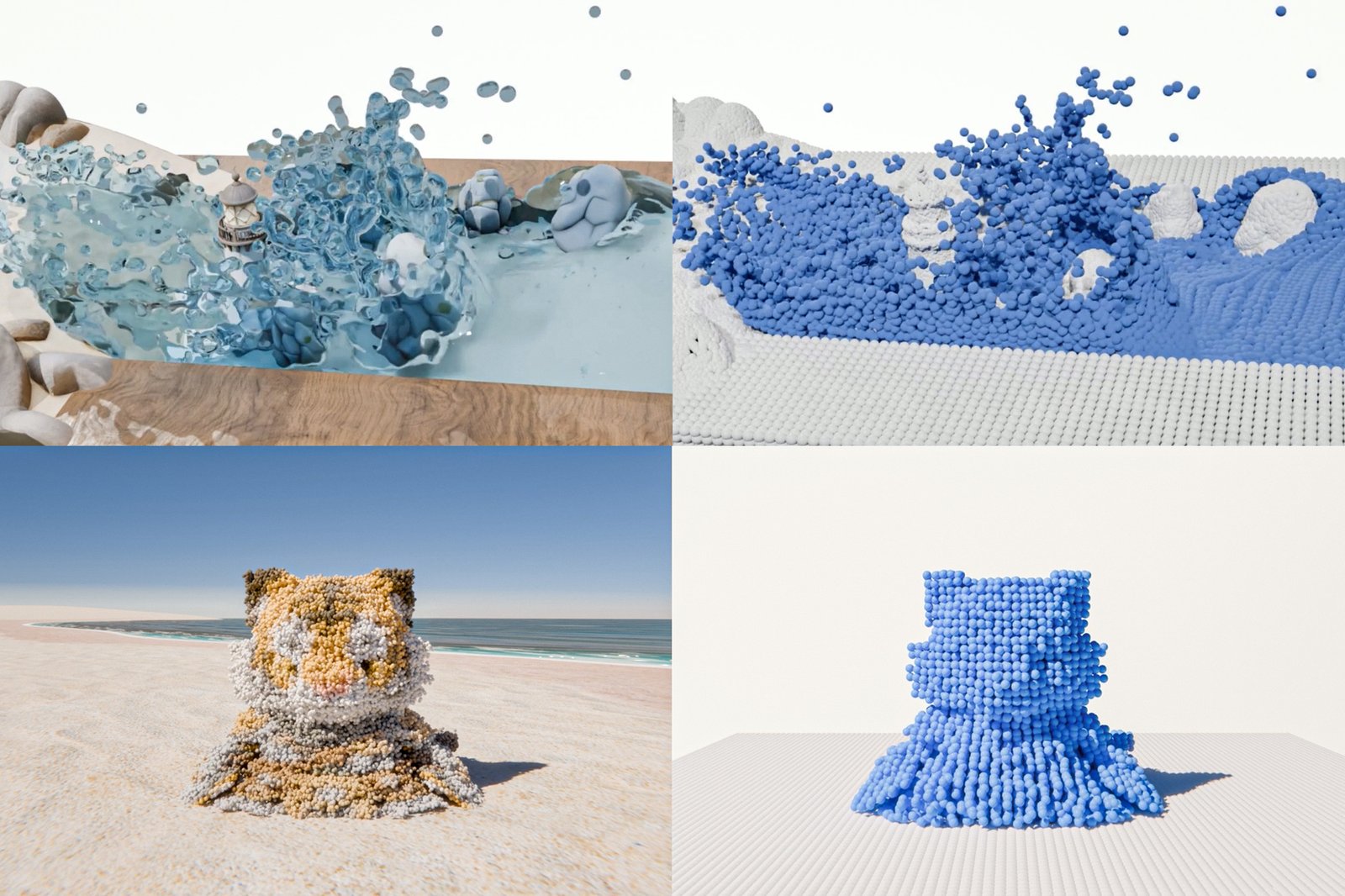
The system represents every material it simulates, from a dune of sand to a protein molecule, as tiny particles and predicts where those particles will move one step at a time. Because it learns the underlying dynamics rather than being programmed with an equation, the model can adapt to materials, forces, and environments it never
Researchers from a collaborative team including Hua Zhang, Jing Li, and Haiyan Wang have developed a deep learning algorithm that stratifies cardiac arrhythmias into three distinct risk levels: normal, not life-threatening, and life-threatening. Published in the journal BioData Mining in July 2026, the study introduces a model named PaliConvLSTM, which utilizes a palindromic structure of
We use cookies on our website to give you the most relevant experience by remembering your preferences and repeat visits. By clicking “Accept”, you consent to the use of ALL the cookies.
This website uses cookies to improve your experience while you navigate through the website. Out of these, the cookies that are categorized as necessary are stored on your browser as they are essential for the working of basic functionalities of the website. We also use third-party cookies that help us analyze and understand how you use this website. These cookies will be stored in your browser only with your consent. You also have the option to opt-out of these cookies. But opting out of some of these cookies may affect your browsing experience.
Necessary cookies are absolutely essential for the website to function properly. This category only includes cookies that ensures basic functionalities and security features of the website. These cookies do not store any personal information.
Any cookies that may not be particularly necessary for the website to function and is used specifically to collect user personal data via analytics, ads, other embedded contents are termed as non-necessary cookies. It is mandatory to procure user consent prior to running these cookies on your website.