
The UK Government’s report on the copyright and AI consultation was recently published. While the report confirms that balancing the interests of copyrights holders and AI developers is a complex exercise, it also provides an indication of likely scenarios to consider in this fast-evolving environment. The consultation focused on whether AI developers should be permitted
The New MBA Arms Race: How Stanford Is Winning On AI
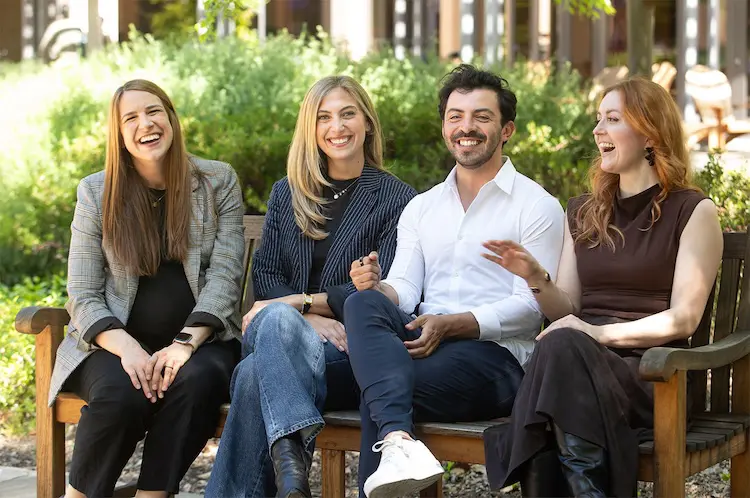
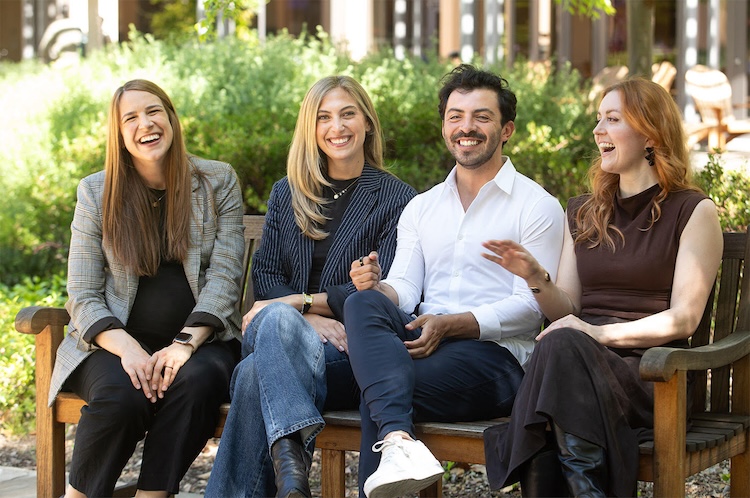
Abby Alder, Jenni Steigler, Alfredo Mendez, and Celeste Bean, the four MBA student co-founders of AI@GSB
At most business schools, artificial intelligence is entering the curriculum through lectures, electives, and case studies. At Stanford Graduate School of Business, it is showing up as something more urgent and far more practical: a working skill students are expected to use now.
That distinction helps explain the rapid rise of AI@GSB, a student-led initiative that has quickly become one of the most visible forces shaping how Stanford MBAs learn about artificial intelligence. Through hands-on workshops, practitioner sessions, applied projects, and direct engagement with leading builders in the field, the program is pushing students beyond AI literacy toward something closer to fluency.
In the middle of that movement is second-year MBA Jenni Steigler, a former chief of staff at BlackRock who came to Stanford with no formal technology background and now stands as one of the key architects of the school’s applied AI push.
“A lot of schools are starting to teach about it,” Steigler told Poets&Quants. “But they’re not doing the applied AI the way we are.”
HOW AI HAS RESHAPED THE STANFORD MBA EXPERIENCE
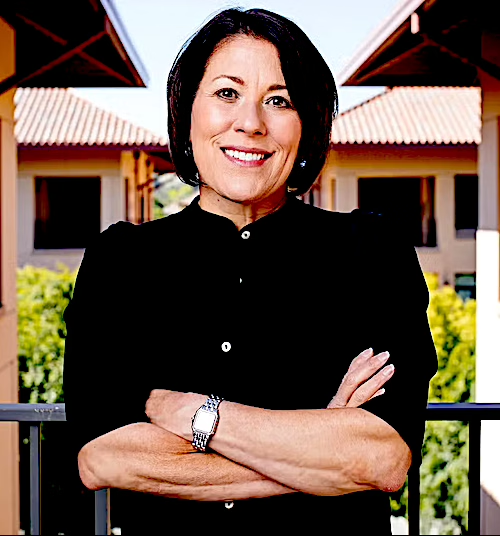
Stanford GSB Dean Sarah Soule
For Stanford, located a short drive from the world’s most influential AI companies and venture firms, the stakes are obvious. Employers hiring MBAs increasingly want graduates who understand not only strategy and leadership, but how to deploy new tools, redesign workflows, and make better decisions in an AI-shaped economy. At Stanford, the expectation is that graduates will not only arrive ready. They will teach everyone else how to smartly leverage this new disruptive technology.
Dean Sarah Soule says the school’s challenge is twofold: give students access to the latest AI tools while strengthening the human capabilities machines cannot replace. “We need to really double down on that while we’re also making sure that they are exposed to the latest thinking in AI, the latest tools in AI, and the latest thinking on how we need to use this new technology responsibly and ethically,” she says (see Stanford GSB Dean Sarah Soule On AI, Leadership & Why Human Skills Matter More Than Ever).
Under Soule, a long-time OB professor who became dean in January of 2025, the business school has gone all-in on AI. In 2025–26, some three dozen courses at the GSB highlighted or integrated AI or machine learning for MBA and MSx students. They range from technically-focused electives such as Understanding AI Technology for Business Problems and Artificial Intelligence and Accounting Information to big picture overviews such as The Future of AI in Work: A Lab for Startups and AI & Power: Five Big Questions. Even the school’s famous Startup Garage now kicks off with a 60-minute AI-powered hackathon.
The school’s Artificial Intelligence Club, founded in 2021 to highlight AI innovations and business impact, is now the largest MBA student organization with 597 members, even larger than the GSB’s Entrepreneurship Club, with 530 members. Last year, the club planned over 15 events, including panels, discussions, and fireside chats with industry leaders.
THE MOMENT THE LIGHTS WENT ON
Yet, the most consequential–and differentiating–part of the AI revolution at Stanford may well be a student-centered initiative initiated by Steigler who has no technical background. She certainly did not come to business school intending to become an AI evangelist.
Before Stanford, she worked at global asset management powerhouse BlackRock in a role far removed from engineering or software development. Steigler, a self-described “bulldozer” devoted to getting things done, had been on the chief of staff team for BlackRock Chairman and CEO Larry Fink. But once on campus, she sensed the ground shifting. Large language models were improving rapidly. The workplace she had left suddenly looked very different from the one she would re-enter.
“I think our year was the inflection point when LLMs got so good,” says Steigler, who started her MBA in September of 2024. “We were like, uh-oh, we’re going back to a workforce that’s very meaningfully different than the one we left.”
The turning point came in an April of 2025 class called Research Driven Innovation, taught by Scott Brady and Brett Jordan. A guest speaker, Diego Oppenheimer, demonstrated AI tools for research workflows. Oppenheimer, a serial entrepreneur and investor who has been working with large-language models and data for nearly 20 years, lectured on how to use the new technology to create an AI-first organization.
Calling himself an “AI maximist,” his enthusiasm was unmistakable. “We are at the absolute best moment ever in history for this kind of tooling,” he told the class. “This is not going to do the work for you but it is an amazing accelerant.”
What Steigler and her classmates heard convinced her this was no incremental change.
“I was like, whoa, this is a whole different thing now.”
HOW AI HAS IMPACTED STANFORD’S MBA CURRICULUM
| Category | Course Code | Course Title | Faculty | Quarter | Notes |
|---|---|---|---|---|---|
| AI in Business Applications | HRMGT 384 | Future of AI in Work: A Lab for Startups | Huggy Rao, Michael Ross & Prasad Setty | Autumn Q | New last year |
| AI in Business Applications | STRAMGT 547 | Riding the AI Wave in Developing Economies | Federico Antoni, Steve Ciesinski | Autumn Q | Adapted to highlight AI this year; established course |
| AI in Business Applications | OB 354 | Designing Culture: Networks, AI, and the Future of Organizations | Doug Guilbeault | Winter Q | New |
| AI in Business Applications | MKTG 321 | Understanding AI Technology for Business Problems | Yuyan Wang | Winter Q | New last year |
| AI in Business Applications | OIT 351 | AI and Data Science: Strategy, Management and Entrepreneurship | Kuang Xu | Spring Q | Second year course |
| AI in Business Applications | ACCT 535 | Artificial Intelligence and Accounting Information, AI2 | Jungho Choi | Spring Q | — |
| AI Theory, Society & Policy | OB 301 | The AI-powered Org: Evolution, Rebirth or Death? | Amir Goldberg | Spring Q | New last year |
| AI Theory, Society & Policy | GSBGEN 396 | AI for Humanity | Jennifer Aaker | Winter Q | — |
| Innovative AI Teaching Methods | OIT 248 / Adv. OSM | Optimization and Simulation Modeling — Advanced | Dan Iancu | 2023 & 2024 | Uses AI in teaching |
| Innovative AI Teaching Methods | MKTG 321 | Understanding AI Technology for Business Problems | Yuyan Wang | — | Uses AI in teaching |
| Innovative AI Teaching Methods | HRMGT 210 | — | Julien Clement | — | Created AI tool trained with management research at GSB |
| Innovative AI Teaching Methods | GSBGEN 352 | Winning Writing | — | — | Uses AI in teaching |
| Innovative AI Teaching Methods | OIT 248 | Optimization and Simulation Modeling — Advanced | — | — | Uses AI in teaching |
| Innovative AI Teaching Methods | OB 209 | Leadership Laboratory | — | — | Uses AI in teaching |
| Innovative AI Teaching Methods | MKTG 346 / Humor | Humor | Jennifer Aaker, Naomi Bagdonas & Connor Diemand-Yauman | — | ChatGPT bots used in course |
!–nextpage–>
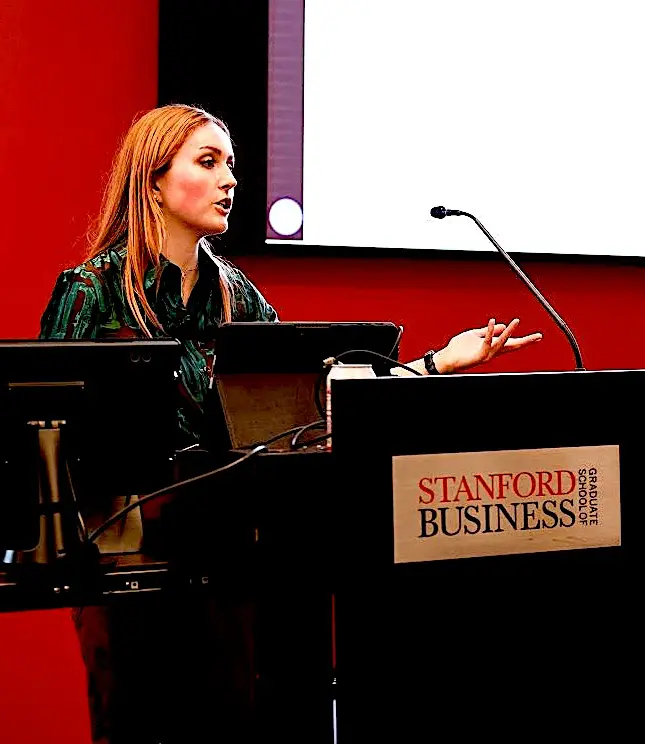
Celeste Bean leads an AI Makeover workshop on how to use artificial intelligence to make oneself more effective across their personal, professional, and academic life
BUILDING A NEW KIND OF AI LEARNING EXPERIENCE
After the class, she sent Brady a long email outlining how Stanford could build a new kind of AI learning experience for MBAs — one focused on using the tools while they were still evolving, not studying them after the fact.
At the next class session, Brady unexpectedly called on her to explain the idea in front of classmates. “It was a quintessential moment of everyone wanting to move faster,” recalls Brady. “I thought Jennie articulated this sense of urgency. The work we did in that class was designed to push students to think deeply about the core of the technology. For many this was an ah-ha moment and to see Jennie respond to that set of capabilities was inspiring.”
That moment helped spark the founding team of AI@GSB. Fellow students Celeste Bean, Alfredo Mendez, and Abby Alder immediately joined the effort. Each brought unique skills to the game. Bean, who has a master’s degree in electrical engineering, had worked at PlayStation as a hardware engineer. Mendez’s resume includes stints at both Google and Microsoft along with a senior product manager role at Nubank before joining the MBA program. A former Bain & Co. consultant, Alder racked up experience in growth equity, product strategy and product management, including at Podium, an AI-powered lead conversion and communication platform.
FROM STUDENT IDEA TO DEAN’S INITIATIVE
What began as a proposal soon became something much larger. Initially, Steigler assumed the school’s academic committees would take over. Instead, she discovered a familiar reality of large institutions: even when leaders agree something matters, building it can take time. Faculty members had deep expertise in their own fields, but AI cut across disciplines and was changing too quickly to fit neatly into existing structures.
“There was no home for it necessarily, especially in the business sense,” she said.
Then came an important change. Soule arrived as dean of Stanford GSB. During the summer, Steigler got the call she had been waiting for. “They were like, okay, we want to do this. Get going.” That was the moment AI@GSB officially became a dean-backed initiative.
Soule said the model was intentional. “This is a dean’s initiative, which means give them some resources, put my name on it, so it’s elevated,” she said. “But I’m smart enough to know that if the students are going to buy in, they’re going to be much more likely to buy it if the students are organizing.”
Support at first was less about large budgets than institutional permission, access, and trust. But as the group delivered programming and built momentum, deeper backing followed. Steigler now expects more resources and stronger alumni engagement as the initiative matures.
WHY STANFORD’S APPROACH LOOKS DIFFERENT
Steigler argues that many schools are still teaching AI as a technical concept. Stanford’s emerging model is different because it starts with business decisions and real use cases.
The question is not simply how a neural network works. It is how leaders should think about capital allocation, organizational design, productivity, team structure, competitive advantage, and the role of AI inside a company. “We’re not just pulling engineers in to teach us what machine learning is,” she said. “It’s a whole different thing.”
That philosophy has shaped the design of AI@GSB. Sessions are built around action. Students experiment with tools, build workflows, test agents, and learn where AI creates leverage inside everyday business tasks. The initiative’s stated ambition is to ensure Stanford MBAs leave with a personal toolkit of skills, frameworks, and practices they can apply in any business context. “We want to get students to build,” says Mendez, who was asked during an internship interview to show his portfolio of builds using AI.
BREAKING SILICON VALLEY’S BRO CULTURE STEREOTYPE
At a moment when Silicon Valley still struggles to shake its “bro culture” stereotype, Stanford GSB is offering a different picture of who gets to shape the AI future. Three of the school’s first AI Scholars–the four co-founders of AI@GSB–are women, a quiet but telling rebuttal to the old image of innovation as a male preserve.
“The future of society was being created by eight dudes in a room,” says Bean, who says keeping up with the different AI models, startups and upgrades is a full-time job. “So it is super important to make the workshops accessible to everyone. We have been able to get a really good cross section of the class involved. We want to bring the technology to the ground level so no one is left behind.”
The point is larger than representation alone. Stanford’s effort suggests that AI fluency should not be reserved for coders, engineers, or the loudest voices in the room. It should be broad-based, practical, and open to the full range of talent in an MBA class.
Brady, a long-time GSB lecturer who is managing partner of Innovation Endeavors, an early-stage venture capital firm that invests in cutting-edge technologies, views the effort as a three-legged stool that starts with application.
AI@GSB Workshops & Talks
| Timing | Session Title | Speakers & Format | |
|---|---|---|---|
| Week Zero MBA1 | Fundamentals | Scott Brady | Lecture |
| Demystifying AI | Patrick Young | Lecture | |
| LLMs & Prompt Engineering | Diego Oppenheimer | Workshop | |
| Navigating the AI Ecosystem | Chip Huyen | Workshop | |
| AI@GSB Builders Series: Maximizing Personal Productivity | Celeste Bean | Workshop | |
| Future of Product Management | Diego Oppenheimer et al. | Panel + Dialogue | |
| AI’s Implications in Society | Eric Horvitz | Fireside Chat + Lunch Dialogue | |
| AI@GSB Builders Series: Cursor | Celeste Bean | Workshop | |
| The AI Bubble | Derek Thompson | Fireside Chat | |
| AI@GSB Builders Series: Claude Code | Alfredo Mendez | Workshop | |
| AI@GSB Builders Series: Celeste Cursor Rerun | Celeste Bean | Workshop | |
| AI@GSB Builders Series: Claude Code Rerun | Freddy Mendez | Workshop | |
| AI 101 for Vets | Celeste Bean, Jenni Steiger | Workshop | |
| How AI Is Changing the Future of Work | Tomer Cohen | Fireside Chat + Lunch Dialogue | |
| Upcoming | Building an AI Stack & Investment Trends | Ben Tossell | Workshop |
| Upcoming | AI Implementation | Mohammad Arkbakour | Workshop |
| Upcoming | Navigating the Google Ecosystem | NotebookLM Founder | Workshop |
| Upcoming | GSB’s First Hackathon | Scholars | Hackathon |
| Upcoming | Fireside Chat: TBU | Demis Hassabis & President Jon Levin | Fireside Chat |
| Upcoming | Peer to Peer Roundtable: My AI Stack | Lunch (Pilot for a P2P Series for Best Practices) | Roundtable |
!–nextpage–>
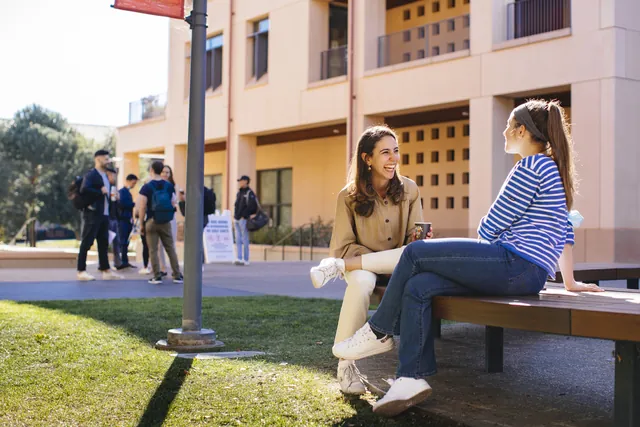
MBA students outside class at Stanford Graduate School of Business. Photo Credit: Elena Zhukova
‘UNTIL YOU DO AI, IT IS NOT REAL’
“AI is one of the things that you can read about but until you do it, it is not real,” he says. “The second part is the future of industry and the future of work. We convene the best people from the most extraordinary companies in salon style to talk about the leading edge. Students don’t just listen and learn from the best in the world. They have to talk about it and apply their opinions to it. How do we explore what is the best today? What skills define the top one percent of people in the field? The third leg of the stool is this concept of perspectives: Where are we today? What is the future of labor? How do we think about this in terms of GDP?”
Brady is encouraging students to think about AI the same way they think about their health. “AI is an investment,” he adds. “It is like your health. Every single day you need to be learning and experienting. If you don’t do it for a week, you are going to get weaker. We are trying to help our students believe that the future of AI is doing it every day. It is not a destination. It is a continuing learning.”
Brady believes the world is massively underestimating the impact of AI. “More has happened in AI in the last three months than has happened in the last three years,” he says. “The world doesn’t understand the overall impact of what is about to happen on sovereignty, the future of work, how value gets created, and the future of GDP. The long-term impact will be very high. And when people go fast, you don’t have perfection. But the messiness will distill down to things that are truly impactful.”
EMPLOYERS NOW EXPECT STANFORD MBAS TO TEACH THEM AI
Soule believes Stanford’s location gives the school a distinct advantage. “Higher-level talks from industry leaders turns out are easy to get because they all live here,” she said, referring to the concentration of AI talent across Silicon Valley.
The school’s geographical advantage, however, also puts more pressure on its students and graduates. “Employers are telling us you are from Stanford so you are going to teach us,” says Alfredo Mendez, a second-year MBA and co-president of the Artificial Intelligence Club. “The expectations were there for summer interns. It was no longer a luxury; it was an expectation that created a sense of urgency.”
That reality became especially evident for the Class of 2026. “When I arrived at the GSB, ChatGPT didn’t even allow you to upload pictures,” explains Mendez. “It wasn’t until our first or second quarter that coding assistants came out. What we heard in Scott’s class about using LLMs to do research was mind-blowing. So we were building the plane on the go.”
FROM LITERACY TO APPLICATION
If there is one word Steigler returns to repeatedly, it is applied. She describes herself as the archetype of the student this program was built for: smart, ambitious, business-minded, but not interested in becoming a machine-learning researcher.
“When we talked about lecturing about AI in terms of what PhDs do, I just get so bored, honestly,” she said. “I know what business leaders need to know.”
That point of view helped move AI@GSB from awareness-building to practical use. Student-led workshops get into the nitty-gritty of using AI tools to build things, from personal executive assistants to AI agents. In the first two quarters of this academic year, AI@GSB has held nearly a dozen workshops, guiding students in the use of the technology for such things as product management, investment, and AI-assisted coding. Mendez recently led a Claude Code workshop that caused students to build a mock interview generator with voice features, a clinical trial tracker for specific chronic conditions, and an AI public speaking coach.
Steigler and classmate Celeste are now launching a business together, powered in part by systems they built using AI tools. She described a fully integrated workflow connecting Gmail, Claude, Slack, Monday.com, Notion, and AI note-taking tools so conversations automatically generate summaries, reminders, and CRM updates. “All of our tools now speak to each other,” she says. “I’ve never had that before. I come from a very manual world.”
She also built an AI job-search agent that scanned the web for roles matching her background, interests, and experience — not because she planned to take one, but because she wanted to see what was possible.
USING AI TO LIVE A LIFE OF MEANING
The student-led initiative, of course, is only part of the story of the GSB’s full embrace of AI. It complements and reinforces what is going on in the classroom. In Andy Hall’s AI & Power course, students also are required to leverage the technology by building product. “We used AI every day in class,” says Hall. “Students are strongly encouraged to use AI for every assignment.”
One example of a project from the course was the creation of an agent who could negotiate on behalf of truckers for their hauling rates. Marcos Diehl, the Stanford MBA in the course who made the agent, became a member of the founding team at HappyRobot, a hot startup that builds AI agents for supply chains and logistics.
What is remarkable about Stanford’s stampede into the AI era is that it is not merely about making smarter business decisions or operations more effective. In Jennifer Aaker’s course, AI for Human Flourishing, students explore how to use AI to live a better and more meaningful life. “Most people talk about how AI will increase productivity and efficiency and how much it will change the business model,” she says. “The real thing we want to think about is what does this mean for humanity and what actually creates meaning in our life. AI is a tool. It can amplify meaning, or it can amplify emptiness. The outcome isn’t determined by the technology—it’s determined by the choices we make about how to use it.
Among the many builds out of her course is an app to help people get off social media and reclaim their time for the things that bring them purpose and an AI cooking assistant that plans and schedules recipes. One of her students even created a “Wisdom Cathedral,” a tool for reflecting on past selves through journal entries. The platform auto-generates daily journals and provides an annual summary of user’s biggest questions and belief shifts.
Brady, who also teaches the capstone entrepreneurial course at the GSB, finds that students often want to leverage tech to make themselves more effective. “They focus on their own personal hygiene,” he says. “They build the tools they need. They become builders not just in the context of the companies they want to build but also how to make themselves more efficient.”
THE POWER OF PRACTITIONERS
Another hallmark of the Stanford approach is who gets invited to teach. Steigler says big names can be overrated if they are not active builders. For a program centered on application, students want operators who can show how the tools actually work.
“It’s not hard to get them to come,” she said. “It’s hard to convince us that someone should come.”
One upcoming guest is Ben Tossell, founder of Ben’s Bites, a daily newsletter curating the latest news, tools, and product launches in the AI space. He is expected to pilot content for non-technical builders and share insights on emerging AI startups.
The challenge, Steigler says, is compressing the expertise of top practitioners into a few hours. But even short sessions can give students exposure to frontier tools and current market thinking that traditional syllabi struggle to match.
A STUDENT MOVEMENT WITH TOP-DOWN SUPPORT
Steigler is candid that academia usually moves slowly. That is one reason she believes Stanford’s response has been notable. “I’m a little bit of a bulldozer,” she said, describing her operating style. “I just make things happen.”
Yet she is equally quick to credit the administration and faculty who embraced the effort. She points to support from the dean’s office, faculty advisers Scott Brady and Brett Jordan, and academic leaders who met regularly with the student team.
Without that alignment, AI@GSB might have remained an energetic club project. Instead, it is influencing the broader school environment, where even courses not explicitly focused on AI increasingly include AI-related assignments or projects.
“I would argue, what isn’t an AI project now?” she said.
Soule said the spread of AI across courses has happened through faculty experimentation rather than decree. “You can’t mandate faculty to do this,” she said. “You have to provide resources, let people innovate and experiment, and then when classes are successful, good ideas begin to spread and inspire others.”
WHAT COMES NEXT
Steigler sees the current version of AI@GSB as only the beginning. Some 80 first-year MBA students tossed their hats in to become the next group of AI Scholars and six have already been chosen to lead the next chapter of the organization.
For her part, Steigler would like to see scholarships for AI scholars, larger gifts from alumni, longer-term practitioner residencies, and deeper integration between outside experts and Stanford faculty. She also hopes to stay involved after graduation in an advisory or consulting role.
Most of all, she believes the initiative will become central to the school’s identity over the next decade. That may prove ambitious. But it also captures something important about the moment. AI is moving too quickly for business schools to treat it as just another elective. The schools that matter most in the next era may be the ones that teach students how to build with it while the future is still being written.
Right now, Stanford intends to be one of them.
And if Soule is right, the winners will not be the schools that teach only prompts and tools, but those that pair technical fluency with judgment, empathy, communication, and leadership. “If we get the leadership piece right, and give them the technical skills they’re going to need,” she said, “then we’ll be in a very good place.”
DON’T MISS A STANFORD MBA’s REFLECTION: TEN MINUTES FROM WHERE I SLEEP and STANFORD GSB DEAN SARAH SOULE ON AI, LEADERSHIP & WHY HUMAN SKILLS MATTER MORE THAN EVER
© Copyright 2026 Poets & Quants. All rights reserved. This article may not be republished, rewritten or otherwise distributed without written permission. To reprint or license this article or any content from Poets & Quants, please submit your request HERE.

Related Posts