
Most AI tools allow you to opt out of sharing your usage with the model provider to improve future versions. Meta has taken that idea and put a price tag on it. For its new Muse Spark model, intended for operating coding and other agents, Meta is offering an explicit discount averaging out to about
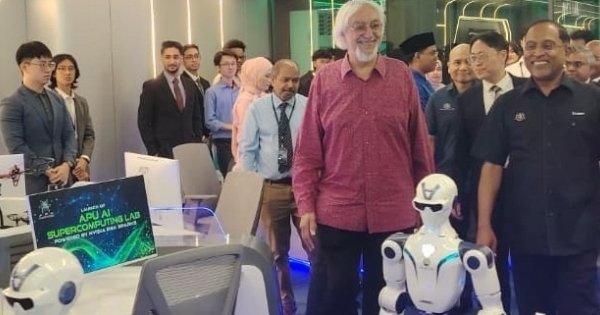
APU launches Malaysia’s first AI supercomputing lab powered by NVIDIA DGX Spark for education & innovation
- Infrastructure brings large-scale AI experimentation and development into the university
- Aims to help develop graduates who can build, adapt and deploy AI systems rather than simply use them
.jpg)
Asia Pacific University of Technology & Innovation (APU) has launched what it claims is Malaysia’s first AI Supercomputing Lab powered by NVIDIA DGX Spark at its Technology Park Malaysia campus, bringing advanced AI computing capabilities directly into the higher education learning environment.
The facility provides students, academics and researchers with hands-on access to advanced computing infrastructure for developing and experimenting with large language models, generative AI, machine learning, data science, intelligent engineering and emerging agentic AI applications.
The launch was officiated by Dr Zambry Abdul Kadir, minister of Higher Education, and hosted by Parmjit Singh, CEO of APU.
“AI literacy today must go beyond knowing how to use readily available computational tools. By putting AI supercomputing power directly into the hands of our students, we are focused on four key goals: widening access, building Malaysian AI talent, strengthening sovereign AI capability, and enabling our students to move from simply using AI to becoming creators of AI with purpose,” said Parmjit.
“This level of computing power gives students the ability to experiment with larger AI models, tackle more complex problems and turn ideas into working solutions. It is about giving them the capability, confidence and computing power to develop the advanced skills that will define the jobs of the future — and to graduate ready to build, innovate and lead in an increasingly AI-enabled world.”
APU said the launch supports Malaysia’s broader ambition to develop domestic AI capabilities and move beyond simply adopting technologies developed elsewhere.
Prime minister Anwar Ibrahim has said Malaysia must not remain merely a user of AI, but build its own capabilities to compete, while Digital minister Gobind Singh Deo recently stressed that the country “cannot be content with being a nation of AI users” and must develop its own innovators, creators and builders.
APU said responding to this ambition requires a shift in how AI is taught and learned. Advanced computing power has traditionally been concentrated in data centres or accessed through metered cloud services. The new lab brings those capabilities directly into the university environment, allowing students to experiment, iterate and develop working prototypes in real time.
Each NVIDIA DGX Spark provides advanced AI computing infrastructure for hands-on learning, experimentation and innovation across AI and related disciplines. The architecture enables students and researchers to work locally with AI models of up to 200 billion parameters, supporting the development, testing and fine-tuning of sophisticated AI applications.
The systems support demanding workloads, including deep learning, generative AI and data analysis.
Rather than simply prompting readily available AI applications, students can work across the development process — loading and adapting models, preparing datasets, fine-tuning systems for specialised tasks, measuring how computing resources affect performance, and learning to build and deploy AI responsibly.
The aim is to give graduates practical experience in developing AI systems, rather than simply using AI tools.
The AI Supercomputing Lab will support learning and research across Computer Science, Artificial Intelligence, Quantum Computing, Data Science and Business Analytics, Software Engineering, Computer Engineering and Mechatronic Engineering.
Students can explore machine learning, large language models, computer vision, intelligent automation, robotics, AI-assisted analytics and emerging agentic AI systems capable of reasoning through tasks and performing sequences of actions.
The infrastructure also provides a platform for future exploration of GPU-accelerated quantum simulation and hybrid quantum-classical computing, opening pathways into emerging computational technologies.
Software engineering students may develop intelligent applications and AI agents; data science students can investigate large-scale analytics and model performance; while engineering students can connect AI perception and decision-making with robotics and autonomous technologies.
The infrastructure can also support final-year projects, postgraduate research, interdisciplinary collaboration and industry-linked experimentation, helping classroom ideas develop into prototypes and applied solutions.
As AI becomes increasingly embedded across industries and professions, the AI Supercomputing Lab reflects APU’s commitment to preparing graduates not simply to participate in the AI era, but to help shape its development.
The use of DGX Spark clusters in higher education is also gaining momentum globally, with universities using the technology for AI research, experimentation and hands-on learning across fields ranging from robotics and healthcare to scientific computing and advanced AI development.


Related Posts