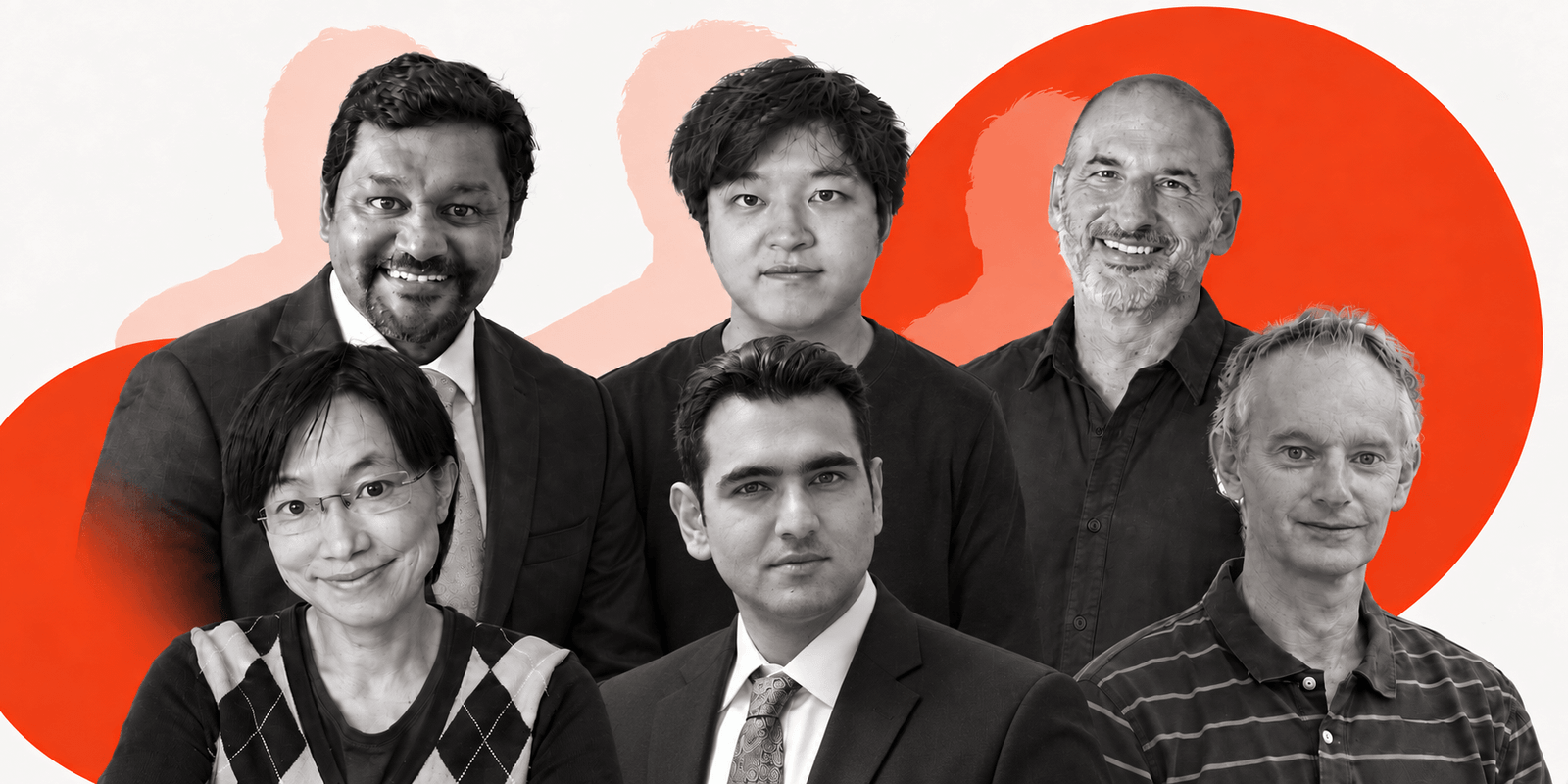
USC Viterbi and Stevens new faculty: Ajey Jacob (top left), Haowei Shi (top center), Itay Hen (top right), Morley Mao (bottom left), Sasan Razmkhah (bottom center) and Scott Mahlke (bottom right) The USC Stevens School of Computing and Artificial Intelligence welcomes six new faculty members whose research advances the frontiers of artificial intelligence, computing and

Karpathy Maps AI’s “Four-Tier Funnel” of Awareness: Only 5,000 People Worldwide Have Seen True Frontier Capabilities — BigGo Finance
Key Elements

Andrej Karpathy, a heavyweight figure in artificial intelligence, recently issued a warning: humanity’s understanding of AI capabilities is undergoing an unprecedented schism. In a lengthy post on social media, he laid out a “four-tier awareness funnel” model, pointing out that roughly 75% of the global population has never interacted with a large language model, while the number of people who have truly witnessed the extreme capabilities of frontier AI systems is only about 5,000—fewer than the 7,500 who have summited Mount Everest.
Karpathy is one of OpenAI’s early members and previously served as Senior Director of AI at Tesla, known throughout the industry for his deep insights into deep learning and large language models. His latest remarks expand upon a tweet from April of this year, with the core thesis being: the AI the public sees and the AI inside laboratories are no longer living in the same era.
He divides the global population into four starkly different tiers, each with a massive gap in their understanding of AI.
The Four-Tier Funnel: From 6 Billion to 5,000
The first tier comprises roughly 6 billion people, or 75% of the global population. Karpathy notes that this group has had virtually no exposure to any large language model. For them, AI exists only in news headlines and science fiction films. The wave Silicon Valley hails as the Fourth Industrial Revolution has never truly entered their lives.
The second tier includes roughly 1 to 2 billion people—occasional users of free ChatGPT-class products. At this level, AI is seen as a “clumsy chatbot,” treated as a slightly better search engine or writing assistant. Karpathy admits that many of his non-technical friends find it of little practical use in daily life. More notably, many corporate executives also remain at this tier—they intellectually know AI is transforming things, but their understanding is secondhand and highly abstract.
This group’s worldview of AI is largely shaped by free, outdated models and viral “AI fail” clips on social media. For example, many people have seen the amusing clip of OpenAI’s advanced voice mode stammering over a simple question like “should I drive or walk to the car wash,” and concluded: “That’s it?”
But Karpathy stresses that the public is being completely misled by free versions and outdated models. Those deprecated models simply cannot represent the true capabilities of this year’s latest frontier agents—particularly OpenAI Codex and Claude Code.
The third tier is a completely different story. Roughly 20 million people, or 0.2% of the global population, are primarily professionals in mathematics and programming. They pay for access to the most advanced agent models and apply them to highly technical work in coding, mathematics, and research. This group is experiencing a collective condition known as “AI vertigo” or “agent vertigo.”
Karpathy illustrates the intensity of this shift with his own experience: “Less than a year ago, I was still writing code entirely by hand, typing computer commands I knew by heart character by character into the editor, occasionally hitting Tab to autocomplete a small snippet.” Today, large-scale projects that once required top engineers months of work can be completed by frontier agents in an extremely short time with a single prompt—including building apps, cloning apps, translating apps, and even decompiling apps from binary files.
He quotes a prominent influencer to summarize how this tier feels: “The degree to which you are awed by AI is perfectly positively correlated with how often you use AI to write code.”
The fourth tier, at the very top of the funnel, consists of only about 5,000 people worldwide—0.00006% of the global population. They are insiders with direct access to the most core internal frontier systems at AI companies. What outsiders see is merely a “preview version” of AI capabilities, while these 5,000 witness the true “agent swarm”: thousands of agents autonomously collaborating for weeks at a time without human intervention, tackling ultra-large-scale software engineering projects. They are discovering zero-day vulnerabilities, conducting offensive and defensive cyber operations drills, uncovering new scientific principles, and pushing the frontiers of mathematics. This work previously required years of effort from the industry’s top experts.
What unsettles Karpathy most is that human review and comprehension capabilities have begun to lag behind machines. He cites the “OpenAI-Hugging Face incident” as an example: it happened long ago, yet human researchers are still “doing archaeology” in the massive machine-generated logs. As for the 722 AI-generated mathematical manuscripts, top mathematicians will need a very long time to barely digest the logic of their derivations.
Three Root Causes of the Awareness Schism
Why do ordinary people think AI is dumb, while elite circles see it climbing vertically at breakneck speed? Karpathy identifies three core factors.
First, users’ goal scales are completely different. If you only ask AI to write an email or look up a recipe, the system hasn’t even warmed up. You need a “reservoir” of difficult problems—problems the user genuinely cares about and urgently needs solved—to push AI to its limits.
Second, AI’s “systematic jaggedness” and verifiable rewards. The explosive growth concentrated in mathematics and code is no accident. The power of large language models comes from reinforcement learning, and whether code is correct, whether test cases pass, whether a mathematical proof holds—these all have absolutely objective standards that can provide clear algorithmic rewards. By contrast, judging the quality of poetry or prose is highly subjective, making effective reinforcement learning training difficult. Meanwhile, B2B scenarios like code and mathematics carry enormous commercial value, so tech companies concentrate their most elite teams and greatest resources in these domains. Casual conversation doesn’t generate revenue, so it naturally doesn’t receive focused investment.
Third, the access gap. The three rungs of free tier, paid tier, and internal access physically isolate humanity’s understanding of AI. The public sees a chatbot that frequently stumbles; most ordinary professionals feel only a mild productivity boost; while a tiny minority is watching a steep technical curve shoot straight upward.
Two Things Can Be True Simultaneously
In his original April tweet, Karpathy already noted that two groups are talking past each other, and both of these things are simultaneously true: OpenAI’s free advanced voice mode will botch the dumbest questions from Instagram short videos; at the same time, OpenAI’s top-tier paid Codex model can work continuously for an hour, methodically refactoring an entire codebase, or finding and exploiting vulnerabilities in computer systems.
The latter capability is real, effective, and improving rapidly—precisely because code and mathematics have clear, verifiable reward functions that lend themselves to reinforcement learning, and because these domains carry higher value in enterprise service scenarios.
Karpathy’s warning points to an unsettling reality: in the same second, in the same space-time, the AI the public sees and the true capabilities at the frontier have long ceased to belong to the same epoch. Behind the mask of that seemingly foolish AI, the embryonic form of a superintelligence has already quietly awakened under the gaze of a very few.

Related Posts