Prompt engineering in Amazon Quick determines how accurately and reliably the platform’s AI-powered features respond to your natural-language requests. Whether you’re building custom agents, authoring automation flows, or querying data through conversational analytics, the way you structure your prompts directly shapes the quality of the output you receive. In this post, you will learn the

Accelerating Air Suspension Development with a Deep-Learning Surrogate for FEA
The demands placed on suspension engineering have shifted in two directions at once.
Vehicles continue to increase in mass while, at the same time, development timescales are being reduced. This is having a significant impact on chassis engineers who are now being asked to land on tighter performance targets inside narrower program windows. Air suspension feels this acutely: ride, handling, comfort, and durability are governed by a large set of design variables that interact in tightly coupled, non-linear ways. Resolving them is rarely straightforward and fast.
Engineers at BWI Group have been investigating where AI, applied on top of solid engineering foundations, can change the way complex suspension systems can be developed. A recent project on an air spring system gave us a concrete answer. A bespoke AI tool, built specifically for the problem and developed in-house at BWI Group’s Technical Centre Kraków (TCK), achieved performance targets that had previously been considered unreachable inside the existing architecture and reduced the development time required to find them from several weeks to roughly an hour.
This was a research project rather than a production-ready design, but it used real-world OEM performance targets. It points to a way in which AI, when deployed alongside experienced engineering judgement and trustworthy physical models, can extend what is achievable inside a given suspension architecture and inside a given program timeline.
Replacing the FEA loop with a surrogate
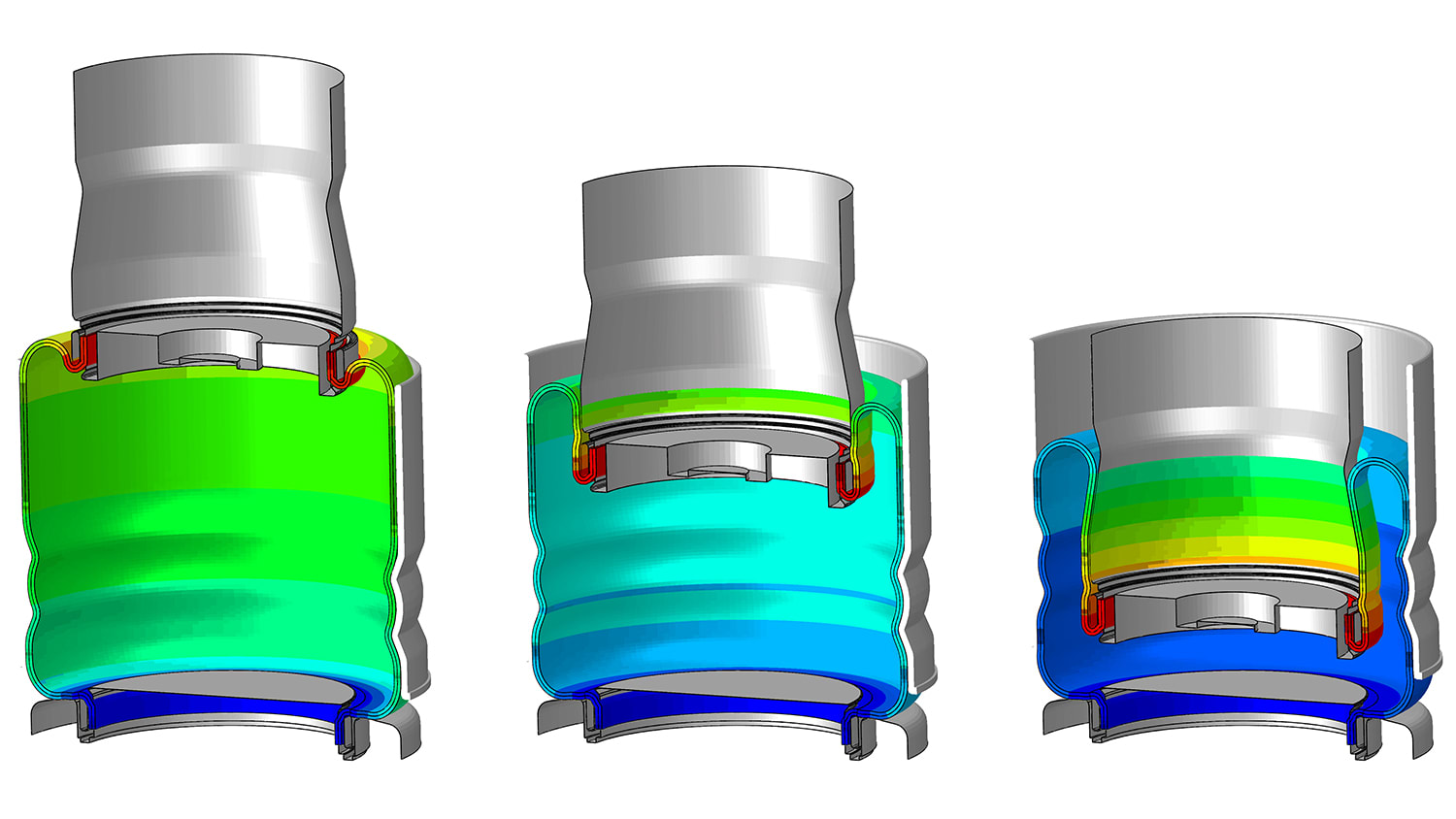
In a conventional development workflow, the starting point is a force-versus-displacement performance curve supplied by the OEM. This defines exactly what the air spring is required to deliver across its full stroke. Performance targets are always challenging, so hitting that curve is rarely straightforward. Internal geometry, working pressure, sleeve material behavior, and reinforcement layout all influence the result, and they all interact non-linearly. The standard answer is iterative manual design, with each step supported by finite element analysis (FEA).
For a capable team, converging on a workable design typically takes several weeks. Each iteration is a complete cycle in itself: a fresh simulation, a careful reading of the result, an informed change to the design, then back into FEA.
The methodology developed at TCK replaces the repeated manual iteration with a deep-learning surrogate to evaluate design changes almost instantly. On the air spring used in this study, the full optimization was completed in approximately one hour. Set against the two-week baseline, that is a 98.75% reduction in process time or, put differently, a more than 80-fold speed increase.
Keeping the AI model honest
The surrogate is a five-layer deep neural network trained on a set of 180 high-quality FEA datasets. Those datasets came from simulation models that had already been correlated against extensive laboratory testing. From that training set, the network learns the mapping between the air spring’s design parameters and its resulting force-displacement behavior, and is then used as a fast-evaluating surrogate for the underlying FEA. As with all simulation processes, accuracy and correlation are critical. Against the simulation reference, the model achieved an R² of 0.99, indicating a strong agreement between its predictions and full FEA outputs.
At present, the neural network is wrapped around five design parameters: piston radius, low support radius, sleeve thickness, design pressure, and nylon fiber cord angles. A Newton-based optimization algorithm drives the search, looking for the combination of those parameters that minimizes the residual error between the surrogate’s predicted force-displacement curve and the OEM’s target. The resulting root mean square error came in at approximately two percent, which indicates that the expected system behavior closely matches the target.
Finding what manual iteration missed
The most useful outcome of the study wasn’t just the time saving, but the AI model’s ability to look in places the engineering team had ruled out. During the manual phase of the project, the team had concluded that the target force-displacement curve could not be matched within the existing architecture without adding a specific structural constraint component.
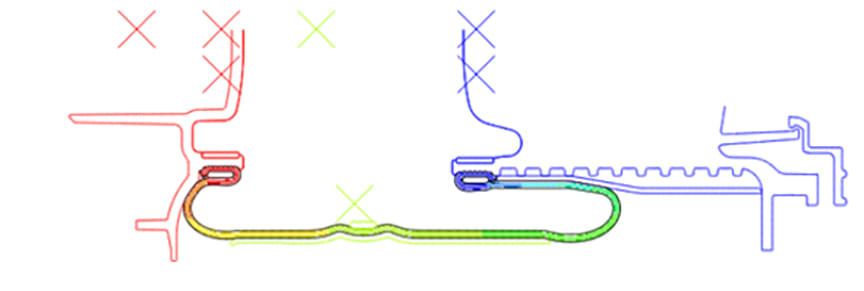
However, the surrogate-driven optimization identified a combination of parameters that met the target curve inside the defined parameter space without the additional component. Manual iteration had not highlighted it because the number of interacting variables put it outside what could realistically be searched by hand inside any reasonable program timeline.
It is important to emphasize that this is a demonstration of feasibility that has not been signed-off for production. Translating it into hardware would still require the full validation pathway, including physical testing on rigs and vehicles. What it does demonstrate, clearly, is the value of AI in surfacing non-intuitive solutions that conventional development methods do not readily reach.
The implications of developing a design that does not require this additional structural component are significant. Removing it would lower mass, reduce cost, simplify the assembly process, and remove the tooling associated with that hardware. More generally, the workflow gives engineering teams a clearer view of where the limits of a given suspension architecture actually sit.
AI as an enabler, not a replacement
At BWI Group, AI is treated as an extension of our engineering practice. It’s effectiveness depends heavily on engineering judgement. The quality of the FEA training data, the assumptions baked into each simulation model, and the choice of which parameters to expose to the network all need experienced hands. Effects such as hysteresis and material behavior have to be understood and accounted for. Without them, the AI model’s predictions stop being reliable.
Building and validating the simulation models that produce the training data is itself a substantial engineering exercise, and that is where experience matters most. Without a credible physical foundation underneath it, the AI model’s outputs lose meaning quickly. What changes for the engineer is where their work can now be concentrated. Repetitive iteration is what gets automated, so the work can instead shift towards system understanding, judgement, and innovation.
Where the methodology goes next
The five-parameter version described here is only the first version — one that has been developed with scope to grow. Future iterations will widen the addressable design space by adding further design variables, such as sleeve height, piston geometry, and air spring volume. The methodology

itself is not specific to air springs, the same approach is now being applied to other suspension architectures, including passive valve systems.
The wider lesson from the project is straightforward. A properly grounded surrogate model can do two things at once: compress the development timeline by orders of magnitude, and reveal design solutions that engineers simply do not have time to find.
Miroslaw Siemieniuk is FEA Manager at BWI Group and wrote this article for SAE Media.

Related Posts