
Cole and Jaenisch explain why defending against AI poisoning in pharma manufacturing calls for a data steward role, immutable instruction ledgers, and automation. In the latest episode of Manufacturing Intelligence, PharmTech Associate Editorial Director Chris Cole and cohost Richard Jaenisch, senior director of Education, Outreach, and Digital Experience at Open Biopharma, move from diagnosing AI
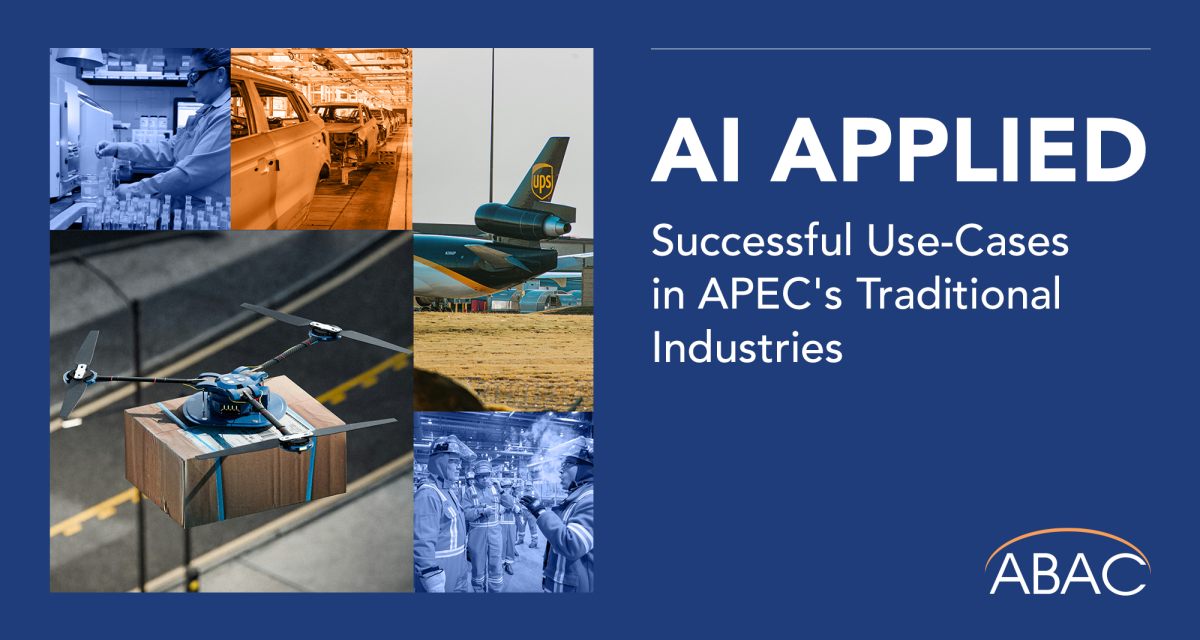
AI Applied: Successful Use-Cases in APEC
Across sectors, economies, and firm sizes, the cases point to five conditions that consistently determine whether AI moves from technological possibility to practical business value.
No single condition is sufficient on its own.
Successful adoption occurs when AI is matched to a defined business need and supported by the data, people, and enabling environment required to put it to work.
Start with the business problem or opportunity
The strongest deployments began with a business outcome, not an AI ambition.
Successful adopters first identified a problem to solve or an opportunity to capture and then assessed whether AI was the appropriate tool. This gave firms a clear objective against which the value of deployment could be measured.
Rio Tinto described the risk of reversing this sequence: when applying AI becomes the objective, the underlying business problem can be lost. The company therefore focuses on applying AI to defined business needs, with applications spanning areas including productivity, operational performance, equipment reliability, and mine planning.
UPS followed the same principle from a different starting point. Changes in customs requirements created an operational problem that made manual classification increasingly difficult to sustain. Machine learning was deployed in response to that need, helping customs clearance recover to around 99 per cent.
The lesson is straightforward: AI adoption should begin with the value a business is trying to create, not with the technology it wants to deploy.
Get the data ready
Data readiness sets the ceiling on AI value.
Across the cases, the quality, accessibility, and consistency of data determined what AI could achieve. In several instances, preparing the data required as much attention as selecting or developing the technology itself.
Mitsui described data readiness, rather than the availability of AI tools, as setting the pace of adoption. Rio Tinto faces the challenge and opportunity of applying AI across decades of operational and legacy data. Yeji Data Lab found that operational metrics first had to be consistently defined and re-engineered before effective modelling could begin. eShepherd similarly rebuilt its inquiry database before applying AI to customer support and warranty processes.
These experiences point to a practical sequencing issue. Firms may be attracted by increasingly capable AI models, but sophisticated technology cannot compensate for fragmented, inaccessible, or poorly defined data.
For many businesses, the most important first investment in AI may therefore be the data foundations that make AI usable.
Create an enabling environment
Technically viable AI does not automatically translate into commercially viable adoption.
The cases demonstrate the importance of the policy and market environment surrounding the technology. Regulation, approval processes, reimbursement, and assurance frameworks can determine whether an AI application can progress from successful demonstration to sustained deployment.
EverEx provides the clearest example. Its AI-enabled home rehabilitation technology had demonstrated technical and clinical potential, but adoption depended on regulatory approval and a mechanism to reimburse the clinical activity supporting the service. Once a reimbursement pathway became available in the United States, its revenue there overtook its Korean revenue in 2024.
UPS similarly identified regulatory complexity and incomplete adoption of paperless customs processes as constraints on further automation.
The implication extends beyond these individual cases.
When policies, regulations, or frameworks do not evolve alongside technology, viable AI applications can remain stranded between innovation and adoption.
Governments therefore have an important role not in choosing the technologies businesses should use, but in creating predictable conditions in which proven applications can be responsibly deployed and scaled.
Prepare the workforce
AI adoption is not simply a technology investment. It changes how work is performed, how decisions are made, and how employees contribute value.
Successful adoption depends on combining AI capabilities with deep industry knowledge. The challenge is not simply to develop more AI specialists, but to equip people who understand their industries to apply AI effectively.
Across the cases, AI reduced or automated some routine tasks while increasing demand for workers able to combine sector knowledge with digital and AI capabilities.
At UPS, machine learning substantially reduced reliance on specialist manual customs classification. Rio Tinto identifies one of the constraints on adoption in the resources sector as the availability of people who understand both complex industrial operations and AI. eShepherd developed new data-science capabilities as AI became more deeply integrated into its operations.
Antofagasta Minerals illustrates how firms can respond deliberately. Its Digital Academy provides employees with new capabilities as digital tools and AI become integrated into mining operations.
The cases therefore point primarily to task redesign, augmentation, and redeployment, while also demonstrating the need for substantial upskilling. The challenge is not simply to teach workers how to use AI tools. It is to develop people who can combine AI capability with the deep sector expertise required to apply those tools effectively.
For traditional industries, this combination of operational experience and digital capability will become an increasingly important source of competitive advantage.
Expand the capacity to adopt
The most consequential finding for APEC is the divide in the capacity to adopt AI.
Large enterprises generally have greater access to the data, specialist skills, infrastructure, and capital needed to experiment with and deploy AI. The experience of Rio Tinto, Mitsui, UPS, and Antofagasta demonstrates what becomes possible when these foundations are already present.
The starting point is very different for many smaller businesses and grassroots producers.
Banyu and FisTx work with Indonesian aquaculture producers where connectivity, data collection, and digital capability may need to be strengthened before AI can add value. Their experience demonstrates why AI sometimes needs to be sequenced behind more fundamental capacity-building rather than introduced as the first intervention.
The challenge also exists in more AI-ready economies. eShepherd identified affordability, understanding of the technology, and limited public support for initial deployment as barriers for smaller agricultural producers.
The cases therefore suggest that the emerging AI divide is not simply about access to technology. It is increasingly about whether businesses have the capacity to put that technology to work.
This distinction matters particularly for MSMEs. As Section 3 shows, many smaller firms will access AI through platforms, software, and specialist providers rather than developing it themselves. That can significantly lower the technical barrier to adoption, but it does not eliminate the need for digital capability, skills, appropriate data, and the resources to change business processes.
Without those foundations, the firms and economies already best equipped to adopt AI are likely to capture its benefits faster than those starting further behind.
Closing the adoption-capacity gap is therefore central to ensuring that AI contributes to broad-based productivity and growth across APEC.
From technology readiness to adoption readiness
Taken together, the five findings shift the focus of the AI debate.
The availability and capability of AI technology will continue to advance rapidly. But the cases in this report suggest that technology alone is not the principal determinant of whether businesses capture its value.
The critical question is increasingly one of adoption readiness: Does the business have a problem worth solving, data that can support the solution, an enabling policy environment, people equipped to use it, and access to the capabilities required to deploy it?
These conditions are mutually reinforcing. Strong data without skilled people will not produce sustained adoption. A technically successful application may not scale without an appropriate regulatory or commercial pathway. And smaller firms may struggle to participate even when proven AI solutions are readily available.
The next phase of AI adoption across APEC will therefore depend not simply on making AI more powerful, but on making more businesses ready and able to use it.
Section 5 examines how these conditions play out across individual sectors before Section 6 turns to the actions APEC Leaders and Digital Ministers can take to accelerate adoption.

Related Posts