Twelve years ago today, Eugenia Kuyda stood up onstage at TechCrunch Disrupt and presented a conversational chatbot called IO that acted as a lifestyle concierge to help people book restaurants and vacations along with other tasks. IO, the first product from her startup Luka, came before the deep learning breakthroughs that would eventually lead to

AI Week in Review 26.10.17
Meta released Muse Wonder and Muse Wonder Full, state-of-the art AI models for personal and professional AI agents. Muse Wonder achieves 52 on Artificial Analysis Intelligence Index (AAII), on par with GPT-5.1 Sol; Wonder Full Wonder scores 56 on AAII, matching Claude Sonnet 5.5, and ranking it #3 on all models. Muse Wonder is available through Meta’s API at $4 /$20 per million input / output tokens and through Muse Code, while the more capable Wonder Full is reserved for paid Muse Code subscribers. Meta says Wonder will also power its personal assistant, supporting memory across conversations and recovery from errors.
Real work also unfolds over time. That’s why we’ve built our new models to have Active Memory, the ability to carry what matters to you across conversations and bring back the details that are relevant to the task at hand. They’re also equipped with Active Focus, the ability to keep working toward your goal when a task gets hard, try other approaches, recover from errors, and follow through. – Meta
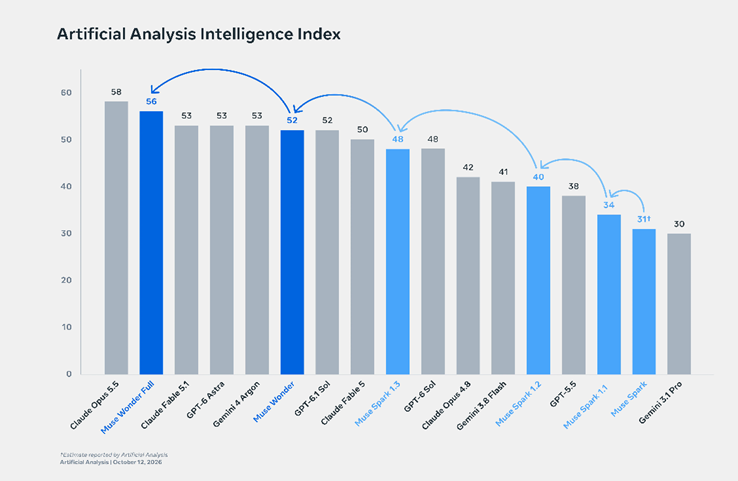
Meta released Muse Spark Open, an open-weight multimodal AI model with 816B total and 42B active parameters, designed for coding and extended agent workflows. Muse Spark Open has a one-million-token context window, and its benchmarks put it on par with Gemini 3.8 Flash. Meta demonstrated local desktop operation of Muse Spark Open by pairing two M5 Ultra Mac Studios with a combined terabyte of unified memory, but it also can be deployed to AWS SageMaker JumpStart or accessed via OpenRouter.
Google made Gemini 4 Argon broadly available in the Gemini app and Google Antigravity for coding, research, and professional workflows. With Gemini 4 Argon ranked #4-6 on AAII alongside GPT-6 Astra, Google has a Gemini model back at the frontier. Developers can access it through the Gemini API and AI Studio, with introductory API pricing set at $2 / $10 per million input / output tokens.
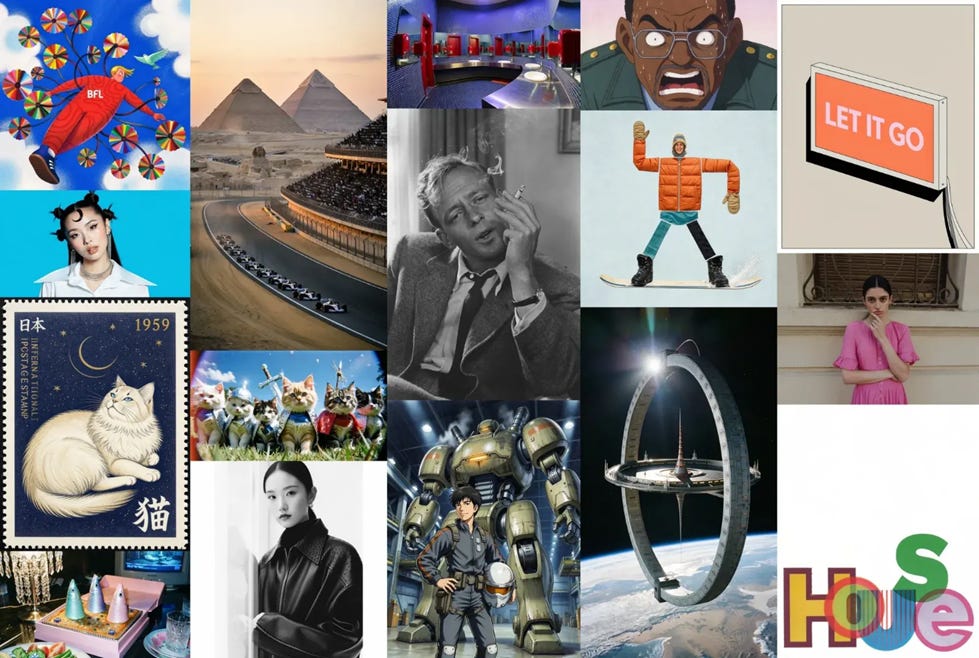
Black Forest Labs released open weights for FLUX 3 Image Klein, a 5.6B parameter image generation and editing model designed to run on consumer GPUs. The model supports native 4K output, reference-image-driven spatial editing, and bounding-box placement. The company provided base, distilled, and compressed (FP8, NVFP4, INT8) model weights, alongside integrations for ComfyUI, Hugging Face Diffusers, and vLLM-Omni, making it easy to fine-tune, deploy and use on consumer devices for image generation.
NVIDIA released Nemotron 3.5 Super VL, an open multimodal model with 120B total parameters and 12B active parameters, designed for specialized and customized agents that need visual understanding. It combines text, image, document, and video understanding with reasoning and tool use. Nvidia reports that organizations post-training it (with SFT or LoRA) for specialized tasks achieved improvements of up to 44% over the base model and outperformed the comparable Claude Opus 5 and GPT-6.1 Sol models tested on those tasks.
Swiss AI released Apertus 1.5, expanding its 8B and 70B open-weight models with native multimodal reasoning capabilities. Apertus 1.5 has an optional thinking mode, an extended context window, and improved tool use. The updated models incorporate early-fusion tokenization for images and audio without altering the underlying text architecture. The model weights and a technical report were published to Hugging Face.
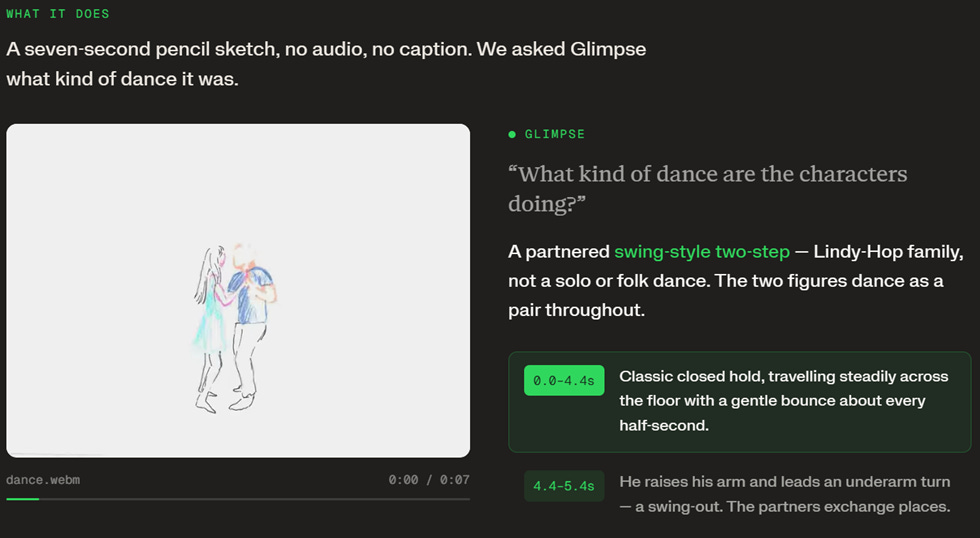
Elorian released Glimpse as a research preview with API access, introducing a visual scratch space for reasoning about images and video. The model can crop image regions, inspect selected video frames, and run code during reasoning to check its interpretation. Elorian claims Glimpse surpasses GPT-6 Astra on scientific chart reasoning and short-form video captioning, with pricing of $0.60 / $3 per million input / output tokens.
Mistral introduced the Timestral time-series model family, four models ranging from five million to 209 million parameters for probabilistic forecasting, useful in energy, finance, supply-chain and maintenance fields. Timestral handles multiple related variables, incorporates past and known future covariates; it runs efficiently on CPUs and supports both zero-shot use and fine-tuning. Mistral said the largest version led several times series forecasting benchmarks.
xAI released Grok Voice 3.0 through its Voice Agent API for conversational agents, interruptions, and customer-service workflows. The model scored 86.9 on Artificial Analysis’s Speech-to-Speech Index, with reported response latency below one second. These models are being deployed in Tesla vehicles and Starlink call centers. Its API pricing remains $0.08 per minute, the same as its predecessor.
Fish Audio released Drama 3, an open-weight text-to-speech MoE model with 35B parameters and 3B active parameters that is aimed for directed speech and multicharacter audio. The model supports voice cloning, natural-language performance instructions, and up to 16 speaker identities within one text. Drama 3 also supports streamed generation of long content.
Liquid AI released LFM2.5-24B-A2B, an open-weight reasoning model for local agents. It contains 24B total and 2B active parameters and supports a context window of 131,072 tokens. Liquid reports up to 184 tokens per second on an Apple M5 Max and provides both base and post-trained checkpoints.
OpenBMB released MiniCPM-V 4.7 for image and video understanding, including a 35B parameter model with 3B active parameters. The model combines visual-token compression with techniques for loading and scheduling model experts on devices with limited memory. OpenBMB reports more than 13 generated tokens per second on an iPhone 17 Pro Max using approximately 3 GB of working memory.
Amos introduced Amos 1, a family of four open-weight decision models ranging from 0.5B to 27B parameters that process text, structured data, and images to answer typed questions with probabilities. Supported tasks include classification, scoring, agent supervision, and identifying image regions with bounding boxes.
TypeSafe released Jev 1.14 with improvements to its structured decision model and visual understanding features. Optional image input and a new Box response type allow applications to locate objects within pictures.
OpenAI introduced the Rosalind Academic Plan, offering eligible U.S. academic laboratories up to 30 ChatGPT Business seats at no cost for up to one year. The plan includes GPT-Rosalind and a workbench coordinating genomics, medicinal-chemistry, protein-design, and wet-lab tools, with access subject to institutional verification and safety review.
Google released Deep Review, an agentic system for reviewing complex technical documents for technical validation. Deep Review divides manuscripts into overlapping sections, allocates additional computation to dense material, and uses parallel agents followed by a synthesis agent to check logic, mathematical claims, citations, and consistency. A pilot version supplied optional feedback on more than 16,000 papers submitted to top computer science conferences this past year, validating papers separately from official peer review.
Google DeepMind introduced an agentic science workbench within Google Antigravity to help biologists discover and prioritize antimicrobial peptide candidates to combat antimicrobial resistance. The platform integrates ProtNLM, a deep learning model that predicts biological function directly from raw amino acid sequences by reading their evolutionary grammar. Researchers used the system to uncover a novel antimicrobial peptide candidate currently undergoing wet-lab validation.
Qwen researchers presented QwenGyre, a reinforcement-learning (RL) framework for agents executing very long tasks. It reallocates GPUs between agent execution and training while processing branching histories to reduce redundant computation. The paper reports up to 1.85-fold training-system speedups and a six-percentage-point improvement on NL2RepoBench in an experiment using Qwen3.8.
Microsoft announced MAI-Base-2 claims 4-12-fold FLOPs edge over DeepSeek V4 Pro in training. Microsoft AI’s new MAI-Base-2 is a 2.8T parameter mixture-of-experts model with 80B active parameters, trained on 50T tokens across 16,000 GB200 GPUs over 38 days. Microsoft claims 4-12 times more pre-training FLOPs-efficiency than DeepSeek-V4-Pro-Base, the strongest open base model.
Google built a Geospatial Reasoning agent on their EarthAI foundation model for planetary-scale analysis. The system combines Gemini with specialized models and tools for satellite imagery, weather, floods and population analysis, using advance planning to perform multi-step spatial investigations and train custom predictive models. Google reported gains over standalone language models across four benchmarks and described partner trials in disease surveillance, disaster preparation and clean-energy screening.
Microsoft announced Maia 300, its next-generation AI inference chipset and system. The multi-chiplet Maia 300 system can process 40% more tokens per megawatt than leading GPU systems and provides up to 7 times Maia 200’s rack-scale throughput in a 96-accelerator configuration. It targets long-context reasoning, conversational applications, and sustained agent workloads. Production deployment will start in 2027.
Anthropic reportedly told prospective investors that third-quarter revenue reached $16.8 billion. That represented approximately 45% growth from the preceding quarter, according to reporting based on people familiar with the presentation. The company also reported adjusted profitability as it prepared for a potential November initial public offering.
Reuters reports that financing could become AI’s next major constraint. Columnist Jennifer Johnson argued that inflation, higher borrowing costs and heavily indebted “neocloud” infrastructure providers represented foreseeable vulnerabilities rather than unexpected shocks. Declining bond prices at CoreWeave and a broader AI-stock selloff indicate that investors have growing concerns over financing of continued data-center expansion, even while major chip suppliers like TSMC continued reporting strong demand and profits.
At least eight U.S. states sued OpenAI under consumer-protection laws, alleging that it misled consumers about ChatGPT’s safety. The states alleged that the service provided dangerous medical guidance, reinforced paranoia, and produced harmful self-injury or violent content. OpenAI cited protections for minors and external safety reviews.
China proposed broader controls on exporting AI technology. The Commerce Ministry proposed placing 23 categories of AI technology, including models, agents and computing clusters, on the country’s export-control catalog, potentially requiring licenses when companies deployed restricted technology abroad.
OpenAI and Meta warned the federal judiciary about synthetic evidence. Representatives told the U.S. Judicial Conference’s evidence-rules committee that increasingly realistic synthetic audio and video could become impossible for people, or any single detection system, to authenticate reliably. Only 15 of 931 surveyed judges had encountered a deepfake-evidence challenge, however, and committee members remained divided over whether a special rule was necessary because existing fraud and authentication procedures already covered fabricated evidence.
Vercel published data showing that Jev, a lightweight decision model created by TypeSafe AI, became the fastest adopted AI model in its first two weeks, with 35% of paid teams using it and nearly double the reach of the second most popular model, Sonnet 5.5. Vercel also revealed that open source models now account for more than 70% of tokens processed through the platform, while spending on frontier labs grew tenfold.
Nathan Benaich and Air Street Capital published the ninth annual State of AI Report. The 244-slide report reviews research, industry, policy, and AI deployment, including agents and AI-assisted research. It also grades the previous year’s predictions and presents a new set of forecasts.
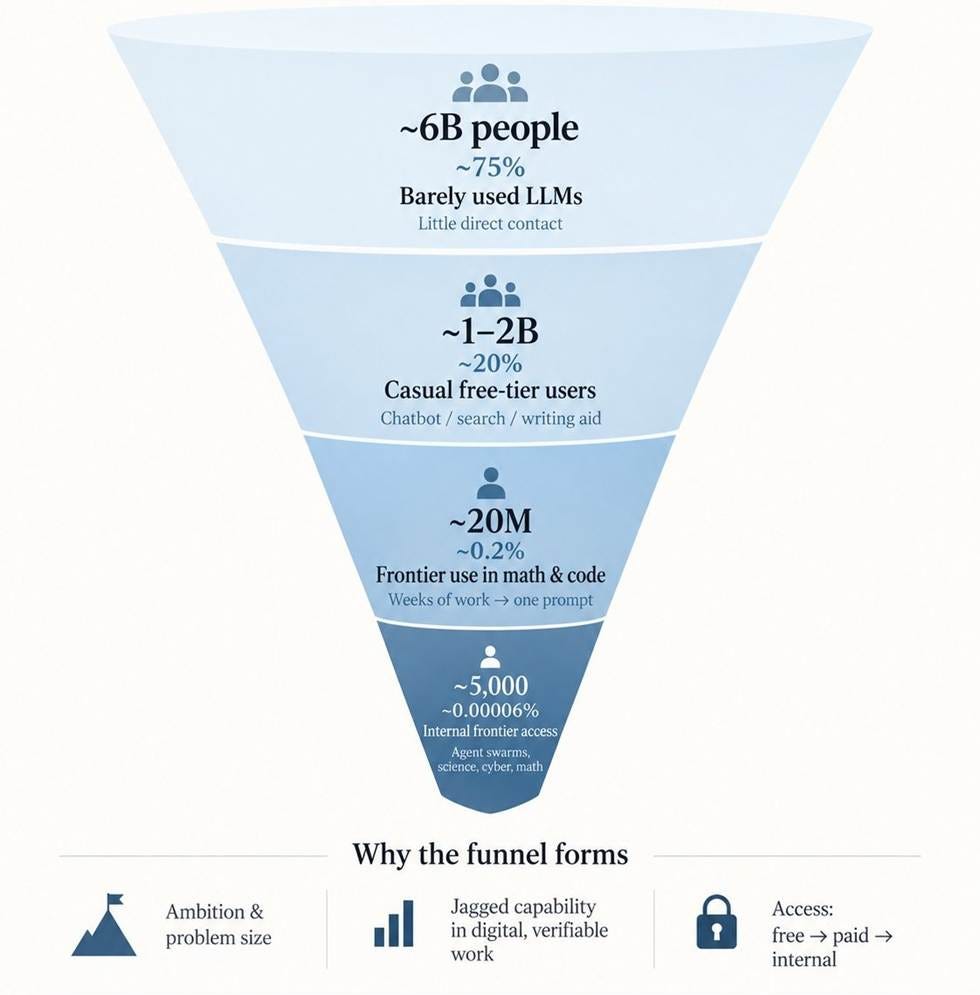
Andrej Karpathy described a widening gap between casual AI exposure and intensive use of advanced systems. While 6 billion people have barely encountered large language models, much smaller groups using sophisticated agents have vastly more powerful experience.
The general public has mostly not interacted with these systems. When they have, it looks like a derpy chatbot. The majority of professionals still see only a modest uplift. And a small sliver of professionals are experiencing the vertigo of the curve going vertical. And it is all happening at the same time. -Andrei Karpathy.

Related Posts