Twelve years ago today, Eugenia Kuyda stood up onstage at TechCrunch Disrupt and presented a conversational chatbot called IO that acted as a lifestyle concierge to help people book restaurants and vacations along with other tasks. IO, the first product from her startup Luka, came before the deep learning breakthroughs that would eventually lead to
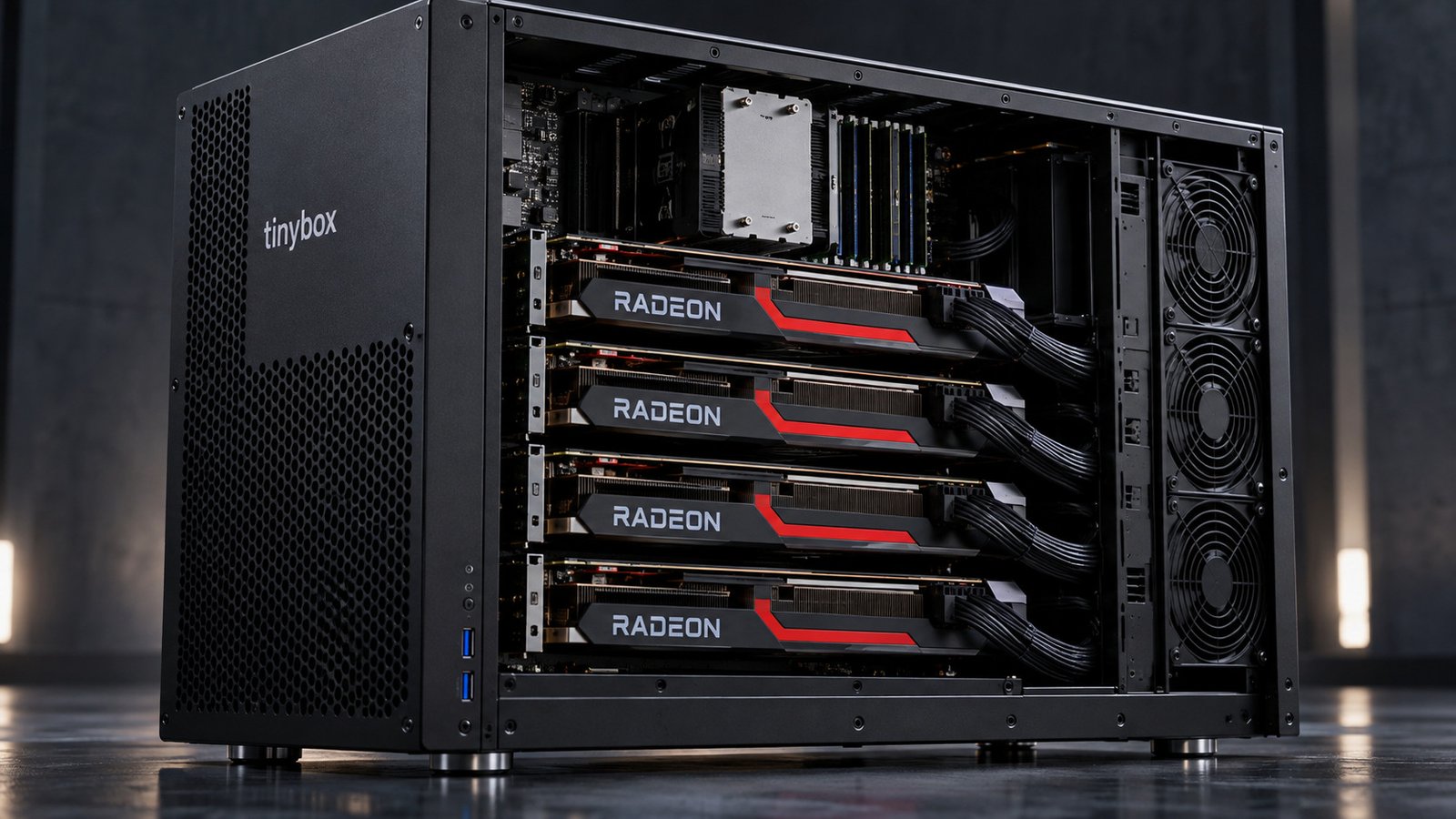
Tinybox with four Radeon RX 9070 XT for $11,000
Tiny Corp is making its Tinybox considerably more modular than before. The less expensive G4 platform with a 32-core EPYC, DDR4 and PCIe 4.0 starts at US$7,000; four Radeon RX 9070 XT cards cost an additional US$4,000. That brings a complete four-GPU machine to US$11,000—and targets users who want substantial compute performance but do not want to pay five-figure prices for individual professional AI GPUs.

Four gaming Radeons instead of two professional accelerators
At its core, the new Tinybox is no longer a rigid, ready-made product, but a configurable server workstation. The G4 version is based on a 32-core AMD EPYC with PCIe 4.0. It comes with 32 GB of DDR4 and a 1 TB boot SSD as standard. Those who want 128 GB of system RAM pay an additional US$3,000. The most interesting option, however, is the four Radeon RX 9070 XT cards. Tiny Corp charges an extra US$4,000 for them. Combined with the G4 base system, this brings the price to the aforementioned US$11,000. The configuration provides 64 GB of graphics memory in total, though this is, of course, not a single coherent 64 GB pool. Each GPU still has its own VRAM. The software and framework must therefore be able to distribute the workload across multiple cards.
For this reason, such a machine is not automatically comparable to a single professional GPU with 64 or 96 GB of memory. Multi-GPU can be highly efficient for parallelizable training and inference workloads. Models or tasks that depend on a single large memory instance, on the other hand, benefit considerably less. Tiny Corp relies heavily on its own tinygrad software. The AMD backend now supports RDNA 4, and with its own AM driver, tinygrad can send compute tasks directly to compatible Radeon GPUs. This allows the company to bypass some of the usual dependence on HIP or ROCm paths and to control more of its own software stack. That makes the hardware more interesting, but not automatically more universal. Those who use tinygrad exclusively get a platform that is extensively tested by its manufacturer. Those expecting established CUDA-centered AI software, however, will still face the familiar ecosystem problem. The RX 9070 XT may be attractive on paper, but it still cannot run CUDA.
The G4 platform itself is deliberately not brand new. In 2026, DDR4 and PCIe 4.0 seem almost old-fashioned, but they are by no means automatically unsuitable for four powerful GPUs. What matters is whether the workload in question is limited by host memory bandwidth or PCIe communication. Tiny Corp also sells a G5 version with Genoa, DDR5 and PCIe 5.0, starting at US$12,000. The premium is substantial, but it delivers a significantly more modern platform. Tiny Corp’s decision to use an older EPYC/DDR4 base is pragmatic rather than backward-looking. For many GPU-centric deep-learning workloads, the CPU spends much of its time supplying data and coordinating tasks. If all four GPUs can be kept busy, a less expensive host platform may be more cost-effective than a costly, current-generation server base. The system includes a server motherboard with BMC, two Gigabit Ethernet ports plus an OCP 3.0 expansion slot, and a 1,700-watt power supply. Systems are built to order and are expected to ship within one to eight weeks. The case weighs around 42 pounds, making it more of a small server enclosure than a desktop PC.
Tiny Corp also offers considerably more expensive NVIDIA configurations. A single RTX 6000 already adds US$19,000, while two cards cost an additional US$38,000. This makes it clear why four RX 9070 XT cards can look attractive despite their software limitations. The Radeon option saves an enormous amount of money, as long as the user’s workload is compatible with the AMD stack.
Conclusion
Four RX 9070 XT cards for a total system price of US$11,000 are a good deal if the workload scales well across multiple GPUs and uses tinygrad or another AMD-compatible stack. The calculation changes immediately, however, if substantial VRAM on a single GPU or CUDA is required. The Tinybox illustrates just how wide the price gap between consumer compute and the professional AI ecosystem has become.


Related Posts