Today, Amazon SageMaker AI announces support for Seekable OCI (SOCI)-indexed container images for training and processing jobs, so your jobs start running your code sooner. SOCI-indexed images start Amazon SageMaker AI training containers in seconds, cutting GPU idle time during image pulls by up to 90%, with no impact on training performance. Before a training
Dartmouth Convenes Landmark ‘AI at 70’ Conference | Dartmouth
A three-day conference on AI at 70: What Must Remain Human? began on Oct. 29, drawing industry leaders, tech experts, policymakers, critics, and researchers to Dartmouth, and bringing a sharp focus on human judgment to the equation.
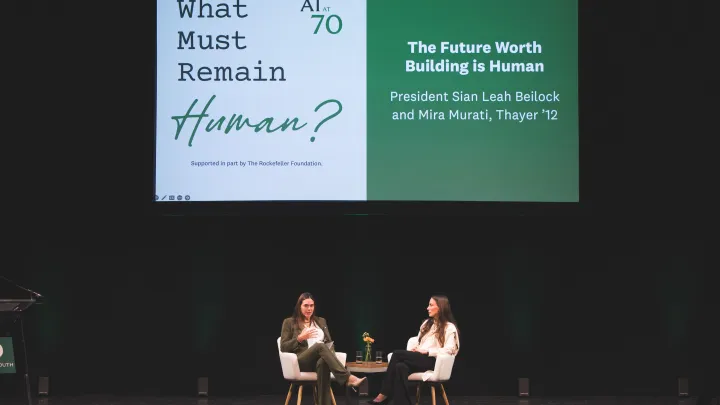
Marking 70 years since Dartmouth hosted the summer workshop that launched artificial intelligence as a field of research, day one of the conference offered a range of perspectives about the promise and perils of AI; included a keynote conversation with Mira Murati, Thayer ’12, co-founder and CEO of Thinking Machines Lab; and celebrated AI pioneer Yann LeCun, who was honored with the AI at 70 Award.
“There’s no better place to examine where AI is headed than the place where AI was born,” Gregg Lemkau ’91, chair of the Dartmouth Board of Trustees, said in his opening remarks at The Moore Theater in the Hopkins Center for the Arts.
Quote
Despite what you might hear from some of the more optimistic CEOs of Silicon Valley, we’re not anywhere close to human-level AI.
Attribution
Yann LeCun, pioneering researcher in AI and neural networks
Lemkau encouraged participants to challenge one another’s ideas, engage openly with disagreements, and remain willing to reconsider their own perspectives over the course of the conference.
“One thing I hope that comes out over these next few days is that we’re going to be honest that we are still figuring this out because there’s no playbook yet,” President Sian Leah Beilock said in the lead-up to her keynote conversation with Murati. “Our goal is to have the hard conversations and drive a direction, rather than having industry or government do it for us.”
The conversation touched on the customizable AI systems Murati’s company is building, what she has learned from seeing people use AI, and advice for students preparing for their future careers.
Murati described the release of ChatGPT in her prior role as chief technology officer at OpenAI as a defining moment that showed how technology and design together can help people discover practical uses for AI as well as bringing issues and misuse into clearer view, helping researchers build more robust guardrails.
Murati said she wants to create tools that will help people be in charge of defining their future. “For me, success is really thinking about the degree to which we succeed in keeping human flourishing, human judgment, and human will at the center as we create these incredible capabilities,” she said.
Yann LeCun, a pioneer of deep learning and computer vision, speaks at the Dartmouth conference on Oct. 29. He received the AI at 70 Award, conferred to mark the 70th anniversary of the field’s founding at Dartmouth and honoring the work he has done to shape its course. (Photo by Katie Lenhart)
LeCun’s work in neural networks and computer vision laid the foundations for today’s AI boom. Currently a professor of computer science and data science at New York University and executive chairman of AMI Labs, he won the 2018 Turing Award, computer science’s equivalent of the Nobel Prize, for breakthroughs that helped make deep neural networks a critical component of computing.
“Seventy years ago, the researchers who gathered here were asking questions that no one else was asking. Yann is the same way. He has dedicated his career to pursuing knowledge in that same spirit,” said Peter Chin, AI at 70 Conference faculty chair and professor of engineering, who presented the Dartmouth AI at 70 Award to LeCun.
Now, LeCun is pursuing a different approach to AI, one that moves beyond today’s limitations to develop machines that can understand, think, predict, and interact, while keeping humans at the center of this advancement, Chin said.
“We’re not done yet,” LeCun said in his keynote address. “Despite what you might hear from some of the more optimistic CEOs of Silicon Valley, we’re not anywhere close to human-level AI.”
LeCun believes that another revolution in AI will take place, with systems that are applicable to the real, physical world. The core idea of his world models is that an agent should be able to anticipate the consequences of its actions, making it possible to develop systems that can take safe and meaningful actions.
“You will be convinced that this revolution has happened when you see domestic robots,” said LeCun, who took a selfie with his audience at the end of his talk and then later met with an overflow crowd of students.
The day’s program examined AI’s implications across a range of disciplines, from medicine and biomedical research to energy concerns, race and writing, and international security. Other sessions explored AI’s potential to advance social change and rural economic development.
New York Times Opinion columnist Ezra Klein addressed concerns that AI systems are becoming so capable that their actions and outcomes may no longer be aligned with human values and intentions, citing how a model from OpenAI hacked into a Hugging Face system over the summer.
“The question of alignment is we already—at a point when these systems are not yet more powerful than we are in a broad sense—we are not able to manage them now. When they get more powerful, when they are smarter, when there are many, many, many, many more of them, why should we believe we’ll be able to keep control of them then? That is the structure of the big fear,” said Klein, who appeared virtually on a panel moderated by Roopika Risam, Dartmouth AI Fellow and chair of the Department of Film and Media Studies, and Jacqueline Cohen ’30.
U.S. Sen. Kirsten Gillibrand ’88, D-N.Y., right, talks about how AI can be useful in such fields as healthcare and education, but also about its limitations, in a discussion with Erica Ruliffson Schultz ’95, trustee emerita. (Photo by Robert Gill)
U.S. Sen. Kirsten Gillibrand ’88, D-N.Y., in conversation with Erica Ruliffson Schultz ’95, trustee emerita, addressed the need for guardrails that can prevent the knowable risks in order to make the most of AI’s potential. “There is unlimited opportunity and unlimited harm, and you have to recognize they both are there, and then come up with a framework so that you can prevent the worst, but benefit from the best,” Gillibrand said.
The conference continues on Friday, Oct. 30, with a presidential panel session on how universities evolve in the AI age and a discussion of research findings from Bruce Sacerdote ’90, Richard S. Braddock 1963 Professor in Economics, that measures AI’s impact on how college students think, learn, and work.
More than 140 students from Dartmouth and other institutions have registered to participate and work with teams in a hackathon to turn questions about artificial intelligence and human judgment into working prototypes through Saturday, Oct. 31.
Members of the Dartmouth community are welcome to attend conference events in-person—even if they have not registered—and they are also available on livestream. Learn more about the conference schedule.

Related Posts