
Renato Duarte’s citation analysis provides an interesting map of how neuroscience and artificial intelligence (AI) cite each other, but I think it overstates what those patterns can tell us about intellectual influence. In particular, the claim that “the astonishing recent achievements in AI owe neuroscience surprisingly little in their actual machinery and operating principles” goes

Examining the bridge between neuroscience and AI

Building bridges: A new analysis suggests that most of what crosses from AI to neuroscience are tools, and much of what crosses from neuroscience to AI are classical concepts.
Illustration by Adam Parata
A citation analysis reveals that the connection between the two fields is real and gaining momentum. But it’s also narrow and tool-heavy; we need to find ways to widen it.
Neuroscience and artificial intelligence (AI) share a long history. Many of the founding ideas of AI attempted to borrow the brain’s tricks and reverse-engineer its mechanisms. In the ensuing decades, however, engineering intelligent machines became its own discipline, with its own drives and achievements. Though the dominant paradigm of modern AI is still the neural network (renamed “deep learning” in the mid-2000s), the resemblance to the brain is now mostly conceptual. The astonishing recent achievements in AI owe neuroscience surprisingly little in their actual machinery and operating principles.
Still, the brain—particularly the human brain—remains the only known intelligent system in the full, “general” sense, with an efficiency and flexibility that artificial systems have yet to achieve.
Over the past decade, a growing coalition of prominent institutions and intellectuals in the fields of AI, brain and cognitive sciences (including Geoffrey Hinton, John Hopfield and Demis Hassabis, who won Nobel Prizes in 2024 for AI-related work) has argued that the two fields can and should fuel each other, with the potential for compound gains neither can reach alone. Under the umbrella term NeuroAI, the idea is that neuroscience can offer AI principles, architectures and algorithms it cannot obtain elsewhere, and AI can contribute rigorous foundations and tools that help neuroscientists theorize about neural computation, cognition and intelligence, creating a “virtuous circle.”
The promise is appealing—obvious, even, to anyone who has worked in this space—but its real impact is hard to verify. The past few years have seen a growing number of dedicated institutes, endowments, manifestos and events, highlighting real enthusiasm. But is there a genuine intellectual merger taking place? Has anything shifted in how these fields interact? Instead of asking whether neuroscience and AI should fuel each other, I asked whether they actually do, examining how knowledge moves between them. I analyzed roughly 458 million works from OpenAlex, an open database of publications, and the 2.9 billion links among them, tracing patterns in how the two fields have cited each other over time.
A decade’s worth of NeuroAI reviews
The short answer: The bridge is real and gaining momentum. But it is also somewhat narrow, restricted to specific institutions and research groups. Most of what crosses from AI to neuroscience are tools, and much of what crosses from neuroscience to AI are classical concepts, assembled before 2005. No newer ideas or discoveries have since become essential reading shared across both fields.
AI still draws on neuroscience concepts absorbed decades ago, but the meteoric gains of the past few years owe little to the brain. Inspiration alone will no longer keep neuroscience influential. It must now offer new results or methods that AI can use on its own problems, such as tools to dissect and decipher AI’s inner workings, as well as ideas for more energy- and data-efficient architectures.
C
orrected for field size, neuroscience has had a larger influence on AI over the past three decades than AI has had on neuroscience. The (chance-corrected) likelihood of AI papers citing neuroscience papers is higher than the reverse across the range of time examined, 1995 to 2025. On the surface, this result is rather surprising. But its root explanation makes sense: The driver of this directional influence is a small, fixed canon of classic neuroscience papers that provides important conceptual bases for artificial neural networks and deep learning. We will scrutinize these drivers in the final section.
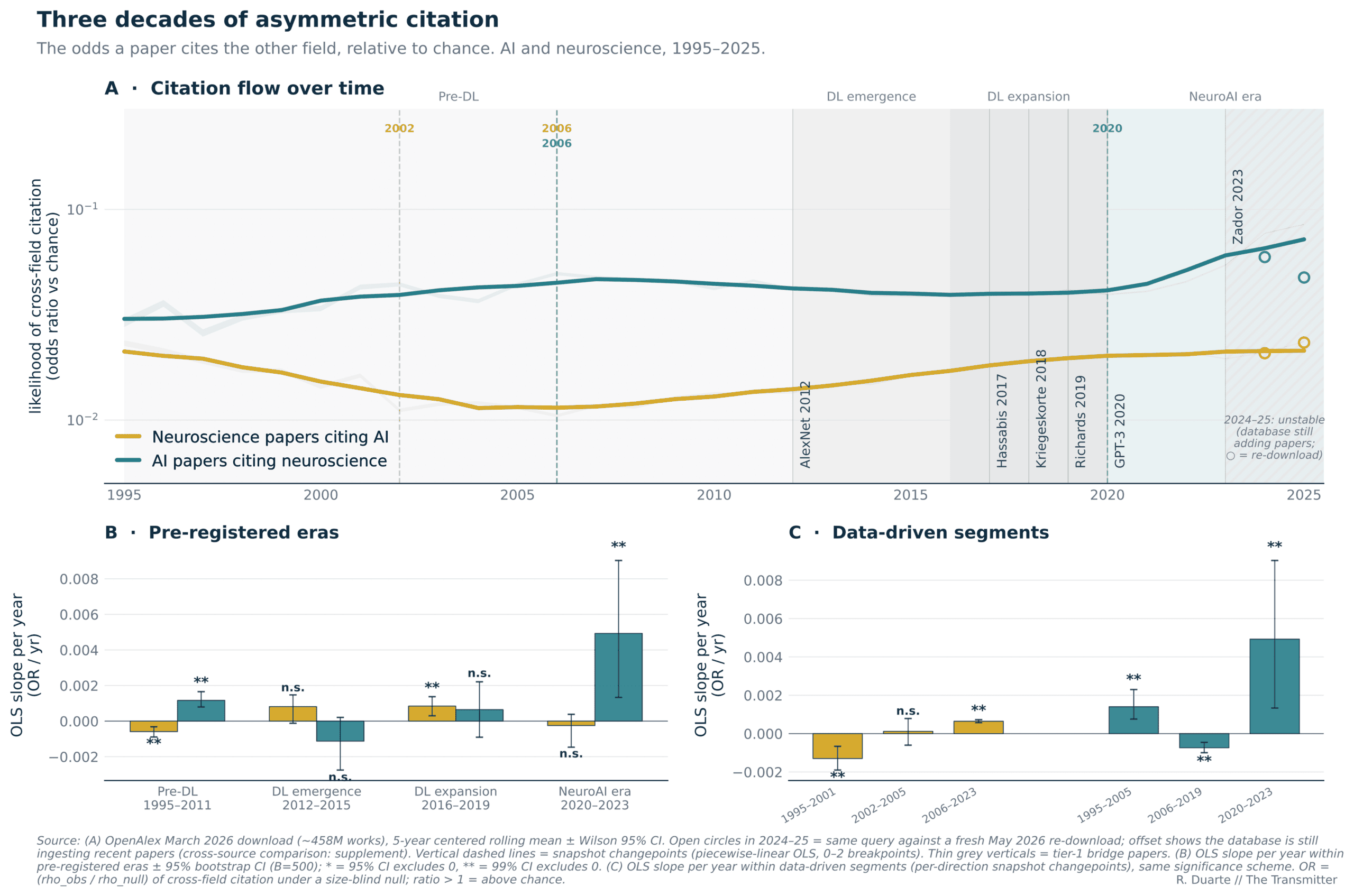
Intellectual influence: The relative share of AI citations going to neuroscience (teal) rose gradually until 2006, then leveled off, slightly decreasing until 2019. It began rising again in 2020, growing to about double its 1995 level. The relative share of neuroscience’s citations of AI (gold) fell steadily until around 2006, when AI’s influence on neuroscience began to rise. Panel A highlights how often, relative to chance, each field cites the other. The vertical axis is an odds ratio against what the field sizes would predict. Dashed vertical lines mark change points in citation trends; thin vertical lines mark milestone papers; and shaded areas correspond to predefined eras that I fixed beforehand. Panel B shows growth rates (change per year) for specific predefined eras (the shaded areas in panel A), and C highlights growth rates between change points detected in the data (whiskers: 95% CI; **statistically significant). More details on the analysis are available in the repository.
R. Duarte // The Transmitter
What has been changing significantly, particularly in recent years, is the rate at which these knowledge exchanges occur. The relative share of neuroscience’s citations of AI (the gold line) has risen significantly and steadily since 2006 and accelerated primarily through the widespread adoption of AI and machine-learning tools for the analysis of neural data, particularly from 2016 to 2019. The relative share of AI papers’ citations of neuroscience (in teal), however, held relatively stable for a long period and declined significantly from 2006 to 2019. It then began to pick up again, with the period from 2020 to 2025 marking the steepest slope of the entire series. This is consistent with the timing of the NeuroAI manifestos and the rising interest in understanding and grounding intelligence. Of the neuroscience work that AI papers now cite, about 90 percent comes from cognitive neuroscience and less than 5 percent from cellular and molecular work.
Two important caveats warrant caution in drawing conclusions here. First, data from 2024 and 2025 are somewhat unreliable because of an ongoing rebuild of the OpenAlex database, which is still ingesting and relinking recent records. Citation counts are not yet stable, so I cannot trust the magnitudes observed. However, the upturn predates those years, so it is not an artifact, but its size is not yet measurable. Second, the steep rise in AI papers citing neuroscience since 2020 may be partly due to neuroscience shrinking as a share of a booming AI literature, rather than AI citing neuroscience more often. The raw numbers (see the Raw knowledge exchange figure) illustrate this point: Between 2020 and 2023, the share of AI papers’ citations that go to neuroscience did rise substantially, but more modestly than depicted in the odds ratio. The recent uptick might thus reflect a genuine revival, but it also reflects a relative dilution. Whether we are witnessing a real, sustained renaissance remains to be seen in the coming years. It is up to us, the scientific community, to materialize the gains and turn these early signs into sustained growth.
A technical note, detailed in depth in the accompanying repository: I chose to analyze the odds ratio—how often papers in one field cite the other, compared with what you would expect if citations were handed out at random given each field’s size. The raw numbers, shown in the Raw knowledge exchange figure, tell a slightly different story: As a share of everything each field cites, neuroscience’s citations of AI work have led since 2018, when the lines cross and AI’s influence on neuroscience takes the lead. That crossover reflects the disproportionate growth and explosion of AI literature in recent years: There is simply more AI work to cite. Correcting for field size is the more honest view.
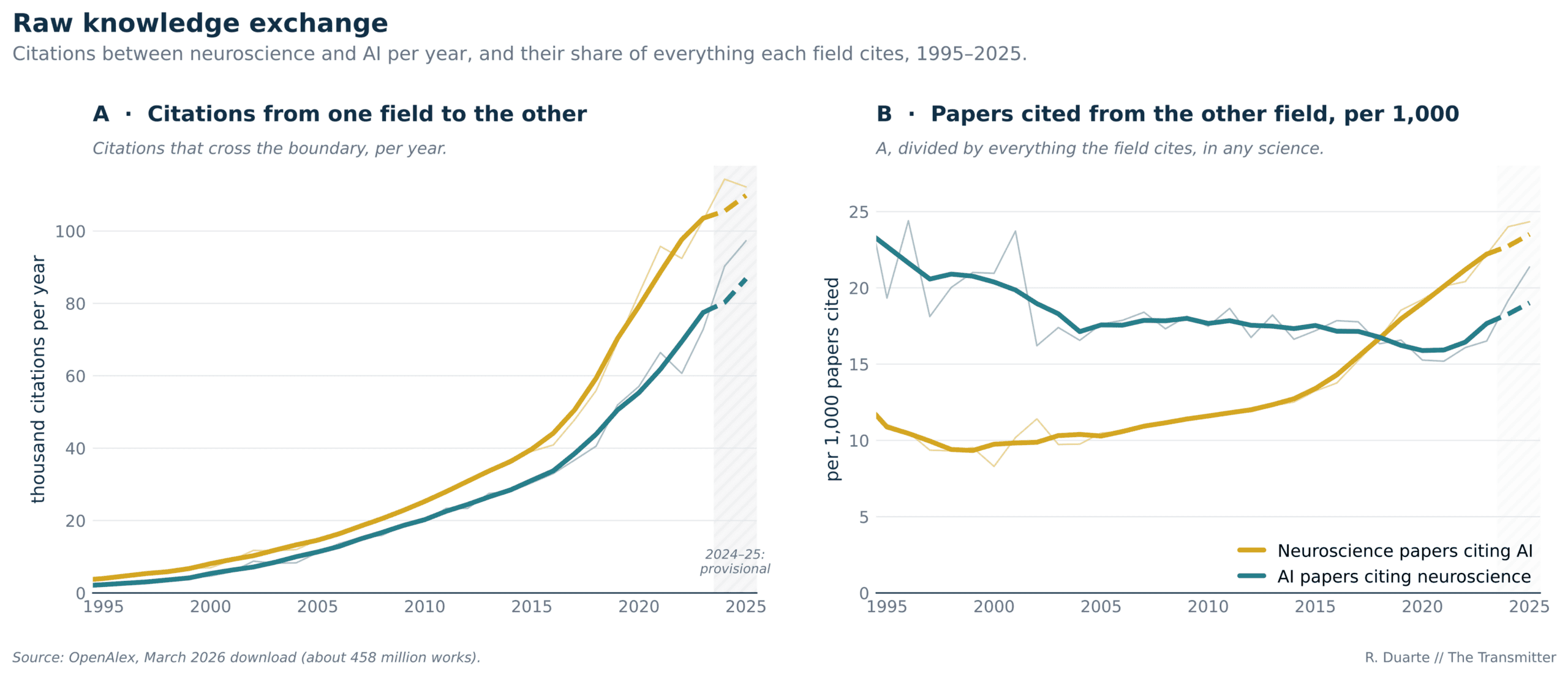
Raw citation flow: The number of citations crossing between the fields each year (neuroscience citing AI in gold; AI citing neuroscience in teal) has grown significantly over the past decades (A). Panel B shows what fraction of all citations this represents: Of all the references cited by neuroscience papers, how many are AI papers (gold), and of all the references cited by AI papers, how many are neuroscience papers (teal). The odds ratio in the first figure compares this share in B with what would be expected if references were spread at random in proportion to the sizes of the two fields. The hatched band (2024–25) reflects provisional data.
R. Duarte // The Transmitter
To better understand the relationship between these two fields, I examined the bridges themselves: the specific papers, authors and institutions that are most heavily cited by both neuroscience and AI at the same time. I ranked publications according to the harmonic mean of each paper’s citations from each field. (The harmonic mean is applied here to punish imbalance instead of smoothing it over: A paper cited 1,000 times by AI and twice by neuroscience will have a low score, whereas one cited 100 times by each side will score high.) I considered roughly 59,000 papers with at least five citations from each side. The full scoring, the locked corpus, a hand verification of every affiliation drawn here, and a more thorough analysis beyond the top 15 are in the repository.
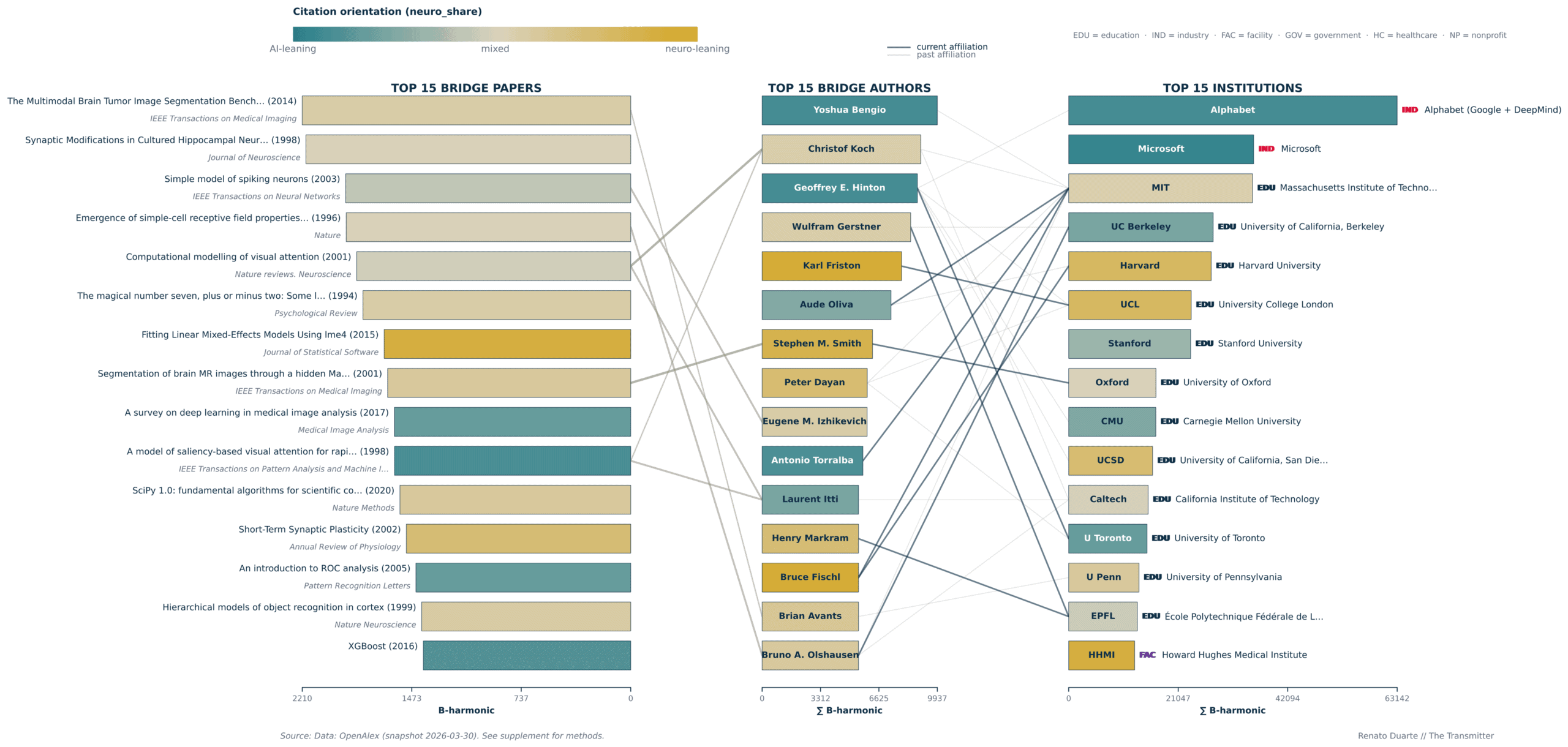
Building bridges: The papers, people and institutions that are most likely to be cited by both neuroscience and AI papers. Color indicates the proportion of citations the paper received from either field—more citations in AI papers are shown in teal, and more citations in neuroscience papers are shown in gold. Papers were ranked directly on the harmonic mean; authors and institutions on the sum of those scores across all bridge papers they are credited on.
R. Duarte // The Transmitter
The “papers” column shows that about half of the strongest bridges are not concepts or ideas, but tools: general-purpose statistical and machine-learning software used routinely across both fields—the BraTS tumor-segmentation challenge, the lme4 mixed-effects package, SciPy, ROC analysis and XGBoost rank among the works most cited from both fields. The other half are genuine bridge works, a classical canon of foundational neuroscience work that AI researchers regularly cite: Bi and Poo’s work on spike-timing-dependent plasticity (1998); Izhikevich’s spiking neuron models (2003); experimental and modeling work on sensory (primarily visual) perception: visual attention (and its saliency-based implementation), object recognition, and receptive fields and sparse coding; as well as working memory and short-term plasticity works. These are important conceptual bridges, regularly used as inspiration for the development of functional architectures; they are what the brain as inspiration for AI looks like in practical terms. The most recent of these bridge works is from 2003. This does not, however, indicate that the influence of neuroscience on AI is waning. AI is now citing more neuroscience than ever before. However, the past two decades have not seen a new landmark paper that both fields treat as essential.
The central column highlights authors whose work is read across the borders. Note that a place in this rank is not earned by eminence in one field but by citation pull from both fields simultaneously. The ranking encompasses a well-balanced mix of prominent AI-leaning researchers (including Yoshua Bengio, Geoffrey Hinton and Antonio Torralba) and prominent computational neuroscientists (including Karl Friston, Peter Dayan, Wulfram Gerstner, Henry Markram, Christof Koch and Aude Oliva). These researchers’ body of work is the most read and cited across communities, actively building bidirectional connections. (Affiliations were hand-verified against ORCID, institutional pages and CVs; solid links mark current affiliations, and faded links mark past affiliations.)
The bridge is most skewed with respect to institutions. Two industry labs, Alphabet (Google + DeepMind) and Microsoft, top the ranking; they are also the most AI-leaning entities in the whole figure. Several elite universities follow (Massachusetts Institute of Technology; University of California, Berkeley; Harvard University; University College London and Stanford University). Bridge work concentrates far more by place than by person: The top 100 institutions absorb nearly 40 percent of all bridge weight; by contrast, the top 100 authors remain below 7 percent. (See the repository for more information.) The bridge is held up primarily by institutional support, resources and intellectual environments.
D
oes the analysis suggest we are really witnessing a renaissance of neuro-inspired AI? Is neuroscience regaining its original placement as a driver of AI research and development? Read together, these results show that the bridge is real and is gaining momentum. However, it is also narrow, tool-heavy and concentrated. Citation patterns suggest that AI continues to cite newer neuroscience papers. But these papers do not yet qualify as bridge works—foundational discoveries highly cited by both fields.
The brain still has much wisdom to offer. The human brain remains the only biological system that does what frontier AI labs are trying to build, and it does it on roughly 20 watts, learning from a handful of examples, effortlessly generalizing to new situations. Energy and sample efficiency, robustness and out-of-distribution generalization are real engineering targets, not analogies. For neuroscience to revitalize its core relevance to AI, we need to understand the mechanisms underneath them. We also need to make our tools legible: Opening black boxes and characterizing and understanding complex systems from the inside out is our daily bread. AI is now facing similar problems under similar constraints, so let us share what we have devised.
The suggestions in this essay can help strengthen the bridge. But it also needs to become wider. Institutional concentration tends to yield narrow consensus, which is unhealthy for any scientific venture. The problems we are tackling here are some of the oldest and most complex we have ever faced; doing it right requires different perspectives. Both fields need to realize what they bring to each other. The momentum is building; the community is maturing. Now it is up to us to give AI something newer to cite than the works we produced 30 years ago.
All the code and data supporting this article can be found in this GitHub repository, along with an extended description of the methods and supplementary information with all relevant technical details. The supplements cover the OpenAlex data and how papers were assigned to the two fields, the citation-flow analysis behind the first figure (“Three decades of asymmetric citation”), the counts and field sizes behind the second figure (“Raw knowledge exchange”), an analysis of what AI cites within neuroscience, the bridge-building papers, authors and institutions behind the third figure (“Building bridges”), and how the age of citations shapes which papers qualify as bridge works.
Explore more from The Transmitter

Related Posts