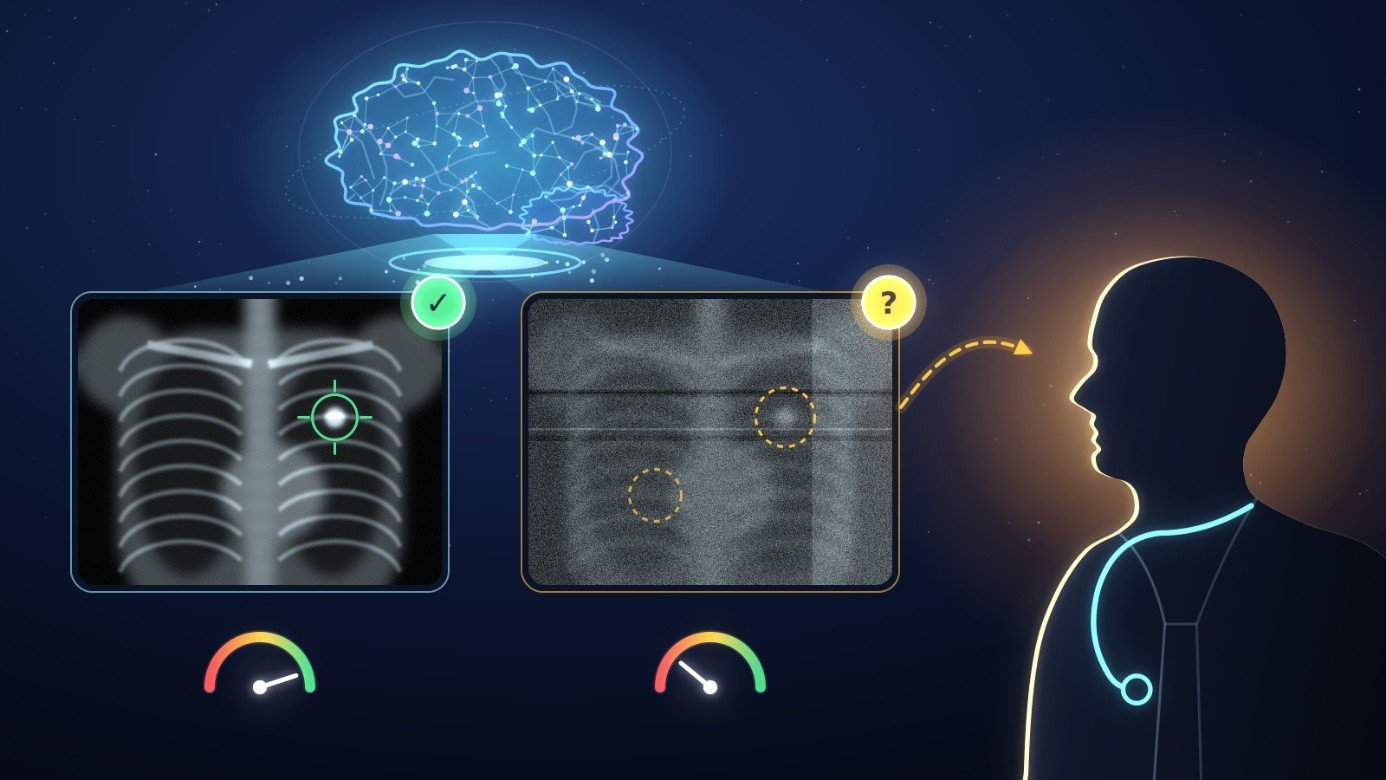
20.10.2026 Making a good decision is not enough: it is also important to assess how certain that decision is. A research group led by Gergő Orbán at the HUN-REN Wigner Research Centre for Physics, working with Argentinian partners, has developed a method that improves how deep-learning systems represent uncertainty. The findings could make AI-based image
German AI-powered language translation powerhouse goes VAST
DeepL is using VAST Data’s storage and AI OS to help it develop new language translation offerings, saying it expects to get roughly three times the storage capacity from its existing hardware.
The company is a neural machine translation (NMT) service headquartered in Cologne and founded in 2009 as Linguee, an online dictionary, by CEO Jarosław “Jarek” Kutylowski. DeepL is a unicorn, valued at around $2 billion after a $300 million funding round in May 2024 led by Index Ventures. It has more than 200,000 business customers.

Jeff Denworth, a VAST Data Co-Founder, said: “DeepL is a great example of how quickly the infrastructure requirements behind AI are changing. As AI moves into production, infrastructure reliability becomes just as important as raw performance. Written language, real-time voice and the next generation of AI experiences all place different demands on data, but researchers should not have to redesign the underlying infrastructure every time the model or product changes. VAST AI OS was built to deliver that reliability at AI scale, giving teams a foundation they can trust, and then getting out of their way.
DeepL has several offerings:
-
DeepL Translator — Text and document translation (DOCX, PPTX, PDF, XLSX, etc.) that preserves formatting. Supports 100+ languages. Known for natural, human-like output, especially on European language pairs. Offers glossaries, tone control (formal/informal), and alternatives.
-
DeepL Write — AI writing assistant for improving grammar, style, tone, and clarity (available as a Pro add-on).
-
DeepL Voice — Real-time speech translation and captions for meetings (integrations with Zoom, Microsoft Teams, Google Meet) and conversations. Launched in 2024 and it now has advances enabling it to preserve characteristics of a speaker’s voice across languages.
-
DeepL API — For embedding translation, editing, and related features into apps, websites, and internal tools.
-
Emerging capabilities include workflow automation (e.g., Translation Flow) and mentions of a DeepL Agent for more autonomous language-related tasks.
It added AWS as a sub-processor earlier this year; all its translation code is containerized, making the port simpler. This addition was to to support global scale and performance. Now it has a hybrid infrastructure that combines DeepL administered servers in data centers located in Europe with cloud infrastructure provided by AWS.
When you use DeepL, the text you enter or upload is processed instantly to provide the services and is not stored. If you choose to save data such as glossaries or translations, it remains stored until you delete it. There’s more information about this here.
DeepL says it competes with general tools like Google Translate by prioritizing high-quality, natural output and business-ready features. As an example, consider the English word “oversight.” It has two overall meanings and seven possible words for them in German;
1. Supervision, control, or management
-
Aufsicht (general supervision, oversight of a project or process)
-
Überwachung (monitoring, surveillance, or regulatory oversight)
-
Kontrolle (control, checks, or audit oversight)
-
Aufsichtsrat (for an oversight board / supervisory board)
2. A mistake, omission, or slip-up
-
Versäumnis (an oversight or failure to do something)
-
Versehen (an accidental oversight / oversight by mistake: aus Versehen = by accident)
-
Fehler (error or mistake)
DeepL claims it deals with such contronyms – a word with two opposite meanings – better than other machine translation tools because it has a better understanding of context.
We understand DeepL currently runs large-scale AI training and inference on NVIDIA DGX SuperPOD systems hosted at EcoDataCenter in Falun, Sweden (100 percent renewable energy, liquid-cooled, AI/HPC-optimized):
-
DeepL Mercury (2023): DGX SuperPOD with 68 × DGX H100 systems (each with 8 H100 GPUs). Ranked on the Top500 list with ~21.85 PFLOPS Linpack performance. Supplied in part by DELTA Computer Products.
-
Arion (2025, first in Europe): DGX SuperPOD with DGX GB200 NVL72 systems (Grace Blackwell Superchips — 36 Grace CPUs + 72 Blackwell GPUs per rack, NVLink, InfiniBand). Enables much faster training and inference (e.g., translating the entire web in ~18 days vs. ~194 previously).
Arion is actually DeepL’s third major SuperPOD deployment and a substantial upgrade over Mercury. It is Europe’s first commercial DGX GB200 SuperPOD and underpins the company’s ability to train larger models and deliver faster, higher-quality language AI services.
These DGX systems include local high-speed NVMe storage for operating system, caching, and temporary data, but we don’t know what shared storage backend has been used for the large training datasets and checkpoints – up until now.
This is how we understand its general backend storage environment has evolved since 2017:
-
The Early On-Premises Architecture (2017): DeepL started with a highly centralized, bare-metal footprint with basic active-passive server configurations connected directly to local GPU worker nodes. There were local SSD arrays engineered to handle the high-throughput, low-latency requirements of their initial Convolutional Neural Network (CNN) translation models. The CEO personally racked early machines.
-
The Iceland Supercomputer Scale-Up: As training sets expanded, DeepL deployed a 5.1-Petaflop supercomputer housed at the Verne Global data centre in Keflavik, Iceland. The backend storage handling this cluster was built to sustain the rapid parallel read workloads required for deep learning training, utilizing a highly tailored local file system setup optimized for high IOPS.
-
Expansion to Sweden (Falun): As the company scaled up its Large Language Models (LLMs), it shifted a significant portion of its heavy high-performance computing (HPC) data footprint to EcoDataCenter’s Main Site in Falun, Sweden. For model training, this infrastructure utilizes liquid-cooled NVIDIA DGX SuperPOD configurations, which natively lean on ultra-fast NVMe-over-Fabrics storage reference architectures to feed data to their Blackwell-generation systems.
-
The Shift to a Hybrid Infrastructure: While model training remains on proprietary hardware under a strict Zero-Trust framework, DeepL updated its core infrastructure to incorporate Amazon Web Services (AWS) as a global cloud sub-processor. This means their overall backend storage is currently a hybrid setup—blending local, high-performance NVMe physical storage inside their European data centres with scalable cloud storage layers provided by AWS to support instant global API distribution.
DeepL is now revealing some details of its backend storage; opening its storage kimono, so to speak, and deploying VAST to provide a higher-performance, more resilient data environment while making more efficient use of the NVMe infrastructure it already operates.
Based on current deployment plans, DeepL expects to achieve roughly three times the storage capacity from its existing hardware, giving research teams greater room to scale model development without a corresponding increase in physical infrastructure. Which is rather amazing, and implies that VAST’s SW will adopt the existing SSDs and make better use of them through data reduction, fewer copies, and possibly other techniques.

Stefan Andresen, DeepL’s Chief Scientist, said: “DeepL’s researchers are constantly pushing Language AI into more demanding areas, and the infrastructure underneath them has to keep pace. VAST gives us the performance and reliability we need while allowing us to make significantly more efficient use of the infrastructure we already operate.
“Just as importantly, it gives us a path to make data more easily accessible across our own data centres and, over time, cloud environments, reducing the manual data movement that can get in the way of research. That becomes particularly valuable as we continue investing in data-intensive areas such as DeepL Voice.”
DeepL will use VAST’s SyncEngine technology to migrate data from its existing environment onto the VAST platform, helping streamline the transition. The AI OS will be used for both file and object storage.

Related Posts