
November 18, 2026 Blog A snowman has stepped out of a film and into our world. Disney’s robotic Olaf walks, moves his eyes, and holds conversations. His movements were learned in simulation, then brought to life in a physical body. A character made of imaginary snow now has to contend with gravity. Four centuries ago
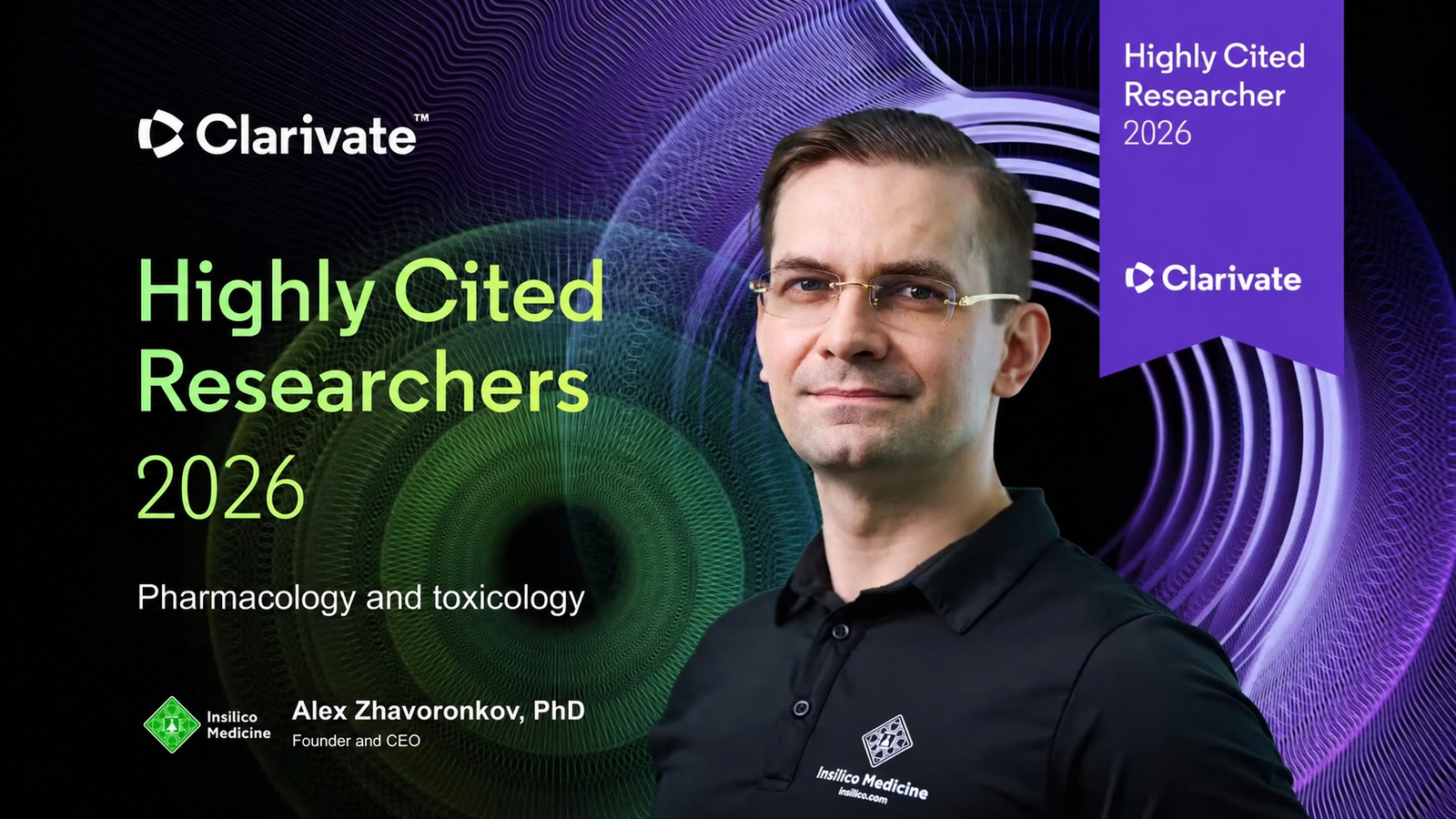
Insilico Medicine’s Alex Zhavoronkov Earns Fourth Clarivate Highly Cited Researcher Honor in 2026
BOSTON, Nov. 18, 2026 — Insilico Medicine (“Insilico”, HKEX: 3696), a clinical-stage biotechnology company using generative AI for drug discovery and development, today announced that its founder and CEO, Alex Zhavoronkov, PhD, has been named to Clarivate’s 2026 Highly Cited Researchers list in Pharmacology and Toxicology. The fourth recognition, following selections in 2022, 2024 and 2025, comes as Insilico advances rentosertib, an AI-discovered candidate for idiopathic pulmonary fibrosis, into Phase III clinical development.
“A fourth Clarivate recognition is an honor for the team and our collaborators. The test I care most about is whether our science can produce medicines for patients,” said Alex Zhavoronkov, PhD, founder and CEO of Insilico Medicine. “We advanced an AI-discovered drug candidate into Phase III. Now I want to do it again, across diseases. That’s what I mean by pharmaceutical superintelligence. I want AI systems that can decide which experiments to run next, learn from the results and turn insights about what drives age-related disease into drug candidates we can test in patients.”
Clarivate’s Institute for Scientific Information evaluates citation data from the Web of Science Core Collection alongside other quantitative measures and expert review. Each selected researcher authored multiple papers that ranked in the top 1% by citations for their field and publication year over the 11-year evaluation period. Clarivate’s 2026 announcement reported 7,090 awards to 6,802 researchers from more than 1,200 institutions across 62 countries and regions. View the Highly Cited Researchers list.
Dr. Zhavoronkov’s research spans the use of AI in drug discovery and the biology of aging. As of November 10, 2026, his Google Scholar profile recorded 27,330 citations and an h-index of 80.
A central goal of Dr. Zhavoronkov’s research is to use the biology of aging to find new ways to treat age-related diseases. The work starts with a question that can be tested in the lab. Which processes that change with age also help drive a specific disease, and which might offer a target for a medicine? AI can help researchers prioritize those targets and design molecules to test them. The aim is to turn insights from aging research into drug candidates that can be evaluated in clinical trials for specific diseases.
In 2026, Insilico introduced LongevityBench, an open benchmark for evaluating how well AI systems reason about aging biology, along with open-source models and research tools. The work gives researchers a way to test where AI can contribute to aging research and identify where stronger evidence is needed.
Selected publications
Nature Biotechnology — Deep learning enables rapid identification of potent DDR1 kinase inhibitors (DOI 10.1038/s41587-019-0224-x)
The DDR1 study showed how a deep learning system could generate candidate molecules against a defined target and how researchers could then test those molecules experimentally. It offered an early example of the interplay between computational design and laboratory
evidence.
Nature Medicine — A generative AI-discovered TNIK inhibitor for idiopathic pulmonary fibrosis: a randomized phase 2a trial (DOI 10.1038/s41591-025-03743-2)
Rentosertib brought that research into clinical development. The randomized Phase IIa study in idiopathic pulmonary fibrosis was published in Nature Medicine in 2025. In September 2026, Insilico announced first-patient dosing in GENESIS-IPF-3, a 52-week, randomized, double-blind, placebo-controlled Phase III study designed to evaluate the investigational candidate’s efficacy and safety.
Cell — Biomarkers of aging for the identification and evaluation of longevity interventions (DOI 10.1016/j.cell.2023.08.003)
The Cell paper addresses a different evidence question that runs through Dr. Zhavoronkov’s work. Researchers need reliable measures of biological aging to evaluate whether a proposed intervention has an effect. The paper examines how biomarkers could help identify and assess those interventions.
Dr. Zhavoronkov founded Insilico Medicine in 2014. Its Pharma.AI platform supports drug discovery, from identifying potential targets to designing candidate molecules. He also founded and co-chairs the Aging Research and Drug Discovery meeting, which brings together researchers working on the biology of aging and drug development.

Related Posts