Summary: A large-scale analysis of over 24,000 people in the UK reveals that childhood disadvantage has a lasting impact on how intelligence translates into social success. While higher cognitive ability is typically associated with increased trust in others, the research finds that for those who grew up in difficult environments, this “intelligence-to-trust” pipeline is significantly
Korea Deep Learning Achieves Grade 1 GS Certification for Document AI Platform ‘DeepAgent’ – 벤처스퀘어




As the adoption of generative AI expands in public institutions, competition for ‘document AI automation’ technology—which can extend beyond simple document recognition to actual administrative tasks—is intensifying. Particularly in the public sector, there is a growing emphasis on certification systems capable of objectively verifying not only AI performance but also security, stability, and operational reliability.
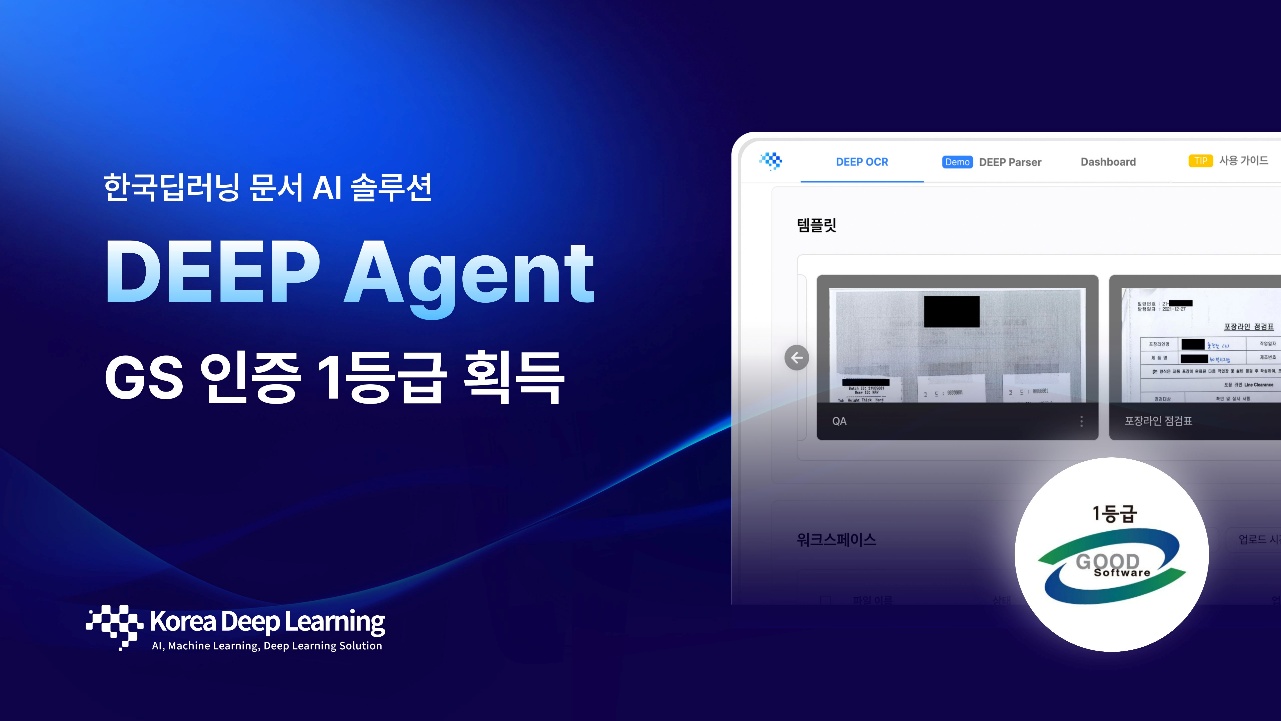
Korea Deep Learning, an integrated visual intelligence AI solution company for the public and corporate sectors, announced that its document AI agent platform, ‘DEEP Agent,’ has obtained Grade 1 GS (Good Software) certification.
GS Certification is a nationally accredited software quality certification system that comprehensively evaluates eight quality items, including functional suitability, security, maintainability, and portability, in accordance with a notice from the Ministry of Science and ICT. It is utilized as one of the representative certifications to verify technological capabilities and commercial viability during the adoption of AI solutions by public institutions.
In this evaluation, DeepAgent achieved an overall score of 97.77 points. It received perfect scores in six categories, including functional suitability, usability, maintainability, and portability, and also achieved perfect scores in all categories of the product manual and user manual quality evaluation.
</p>
<p> ” data-medium-file=”https://www.venturesquare.net/wp-content/uploads/2026/05/image001-526×296.jpg” data-large-file=”https://www.venturesquare.net/wp-content/uploads/2026/05/image001-789×444.jpg” decoding=”async” loading=”lazy” src=”https://www.venturesquare.net/wp-content/uploads/2026/05/image001-789×444.jpg” alt width=”789″ height=”444″ ><figcaption id=) Korea Deep Learning’s ‘Deep Agent’ Achieves GS Certification Grade 1 (Photo courtesy of Korea Deep Learning)
Korea Deep Learning’s ‘Deep Agent’ Achieves GS Certification Grade 1 (Photo courtesy of Korea Deep Learning)Beyond document-reading AI to connecting to task performance
Korea Deep Learning describes DeepAgent not as a simple OCR solution, but as a ‘business execution document AI platform.’
While existing OCR technology focused on extracting text from documents, DeepAgent is structured to support actual business automation by connecting document classification, key information extraction, verification, and integration with business systems into a single flow.
The platform consists of two AI engines: ‘Deep OCR’ and ‘Deep Parser’.
Deep OCR extracts text and key-value data from various visual elements such as seals, signatures, tables, numbers, and symbols, while deep parsers analyze complex document structures such as merged tables, nested tables, charts, and diagrams to convert them into structured data that can be used for LLM integration and AI search systems.
Recently, as the demand for generative AI-based business automation has increased, particularly within public institutions and the financial sector, the importance of document structuring and data extraction technologies is growing alongside it. It has been pointed out that simple OCR alone has limitations in actual business automation, especially for administrative documents, contract documents, and civil complaint papers, due to their complex formats and structures.
Korea Deep Learning has been expanding its document AI business for public institutions by participating in projects such as the construction of the Gyeonggi Provincial Government’s generative AI platform. With this GS certification, the company plans to 본격화 (intensify) its efforts to target the public procurement market and the administrative automation market.
Kim Ji-hyun, CEO of Korea Deep Learning, said, “What is needed in the field at public institutions is not simply the skill to read documents, but the ability to connect the results of reading to actual work,” adding, “DeepAgent’s acquisition of Grade 1 GS certification means that its technological capabilities have been verified by nationally recognized standards.”

Related Posts