Optimizing generative AI inference deployments requires benchmarking endpoints, evaluating instance configurations, and iterating on deployment settings. The Amazon SageMaker Python SDK v3 now exposes generative AI inference recommendations in Amazon SageMaker AI directly in your notebook workflow. These recommendations are also accessible through the Amazon SageMaker AI UI and Boto3 APIs. With this release, you
South Korea Artificial Intelligence Market Size Report, 2033
GVR Report cover 
Size, Share & Trends Analysis Report By Component (Hardware, Software, Services), By Technology (Deep Learning, Machine Learning, Natural Language Processing), By Function, By End Use, And Segment Forecasts
- Report Summary
- Table of Contents
- Segmentation
- Methodology
- Download Free Sample
- Buy This Report
Market Estimate, 2026
$15.9B
Market Forecast, 2033
$175.8B
South Korea Artificial Intelligence Market Summary
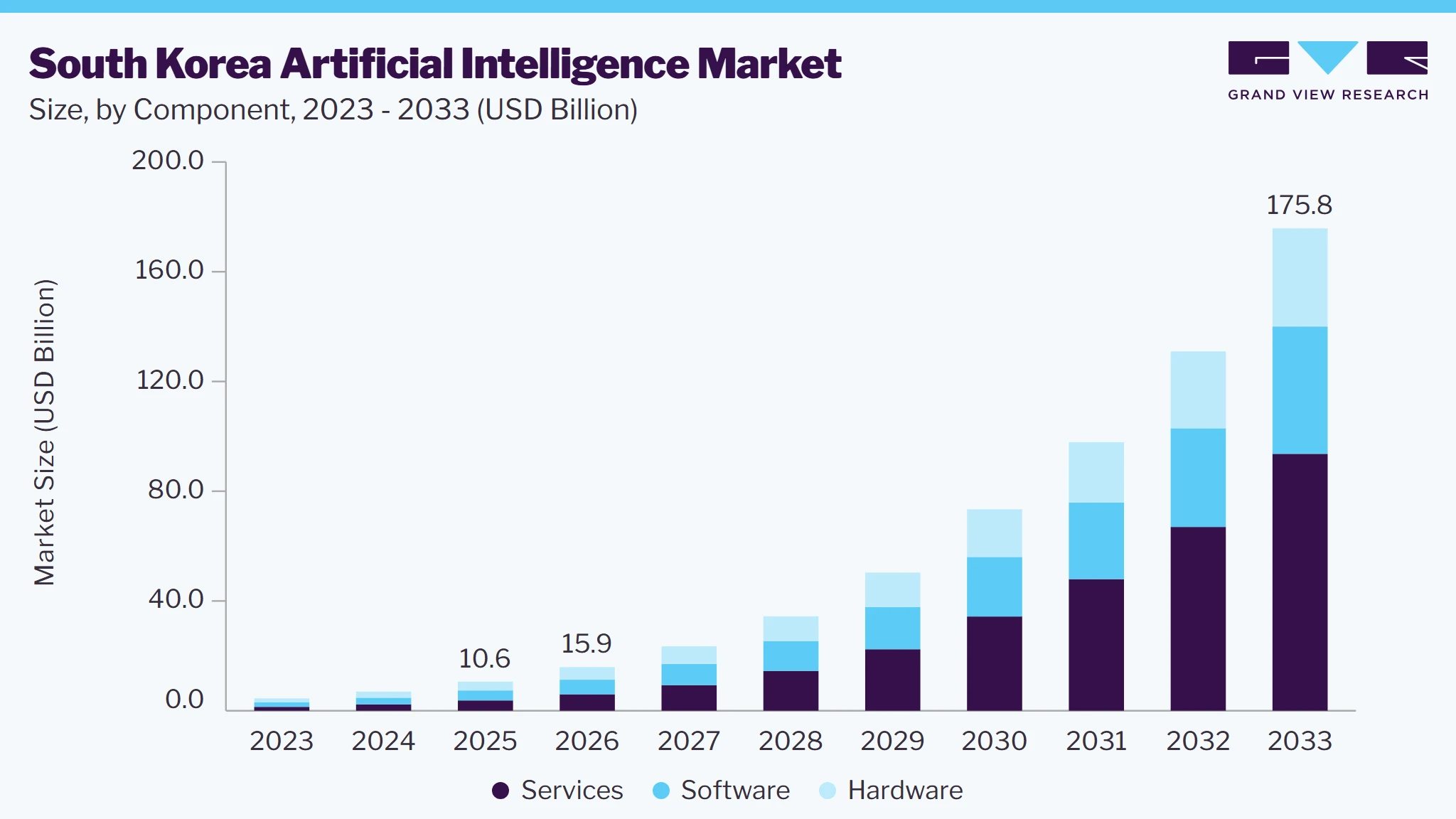
The South Korea artificial intelligence market size was valued at USD 10.6 billion in 2025 and is projected to grow from USD 15.9 billion in 2026 to USD 175.8 billion by 2033, at a CAGR of 41.0% from 2026 to 2033. The increasing focus on AI innovation, expanding enterprise deployment, and continued investments in advanced computing infrastructure are driving the growth of the market.
Key Market Trends & Insights
- By component: Services segment dominated the market, with a revenue share of 35.3% in 2025.
- By technology: Deep learning segment held the largest market share of 25.6% in 2025.
- By function: Operations segment held the largest market share of 20.3% in 2025.
- By end use: Healthcare segment led the market with the largest revenue share of 17.3% in 2025.
Market Size & Forecast
- Market size in 2025: USD 10.6 Billion
- Estimated market size in 2026: USD 15.9 Billion
- Projected market size by 2033: USD 175.8 Billion
- CAGR (2026-2033): 41.0%
South Korea’s AI market is experiencing significant growth due to the government’s continued investments in artificial intelligence, digital infrastructure, and national AI strategies. Public initiatives encouraging AI adoption across manufacturing, healthcare, finance, education, and public services are accelerating technology deployment throughout the economy. Financial incentives, regulatory support, and public-private collaborations are encouraging enterprises to integrate AI into business operations. This policy-driven ecosystem is creating favorable conditions for AI research, commercialization, and large-scale industry adoption.

South Korea’s globally competitive manufacturing and semiconductor sectors are increasingly adopting AI to enhance production efficiency, quality control, predictive maintenance, and supply chain optimization. AI-powered automation, computer vision, and industrial analytics are improving operational performance while reducing production costs and downtime. The country’s strong electronics ecosystem provides an ideal environment for developing and deploying advanced AI applications. Growing investments in smart factories and intelligent manufacturing continue to expand AI implementation across industrial operations.
The growing adoption of generative AI and enterprise AI solutions is driving the South Korea AI market as organizations seek greater productivity, automation, and data-driven decision-making. Businesses are deploying AI-powered assistants, intelligent search, cybersecurity solutions, customer service platforms, and software development tools across multiple industries. Increasing demand for localized large language models and AI services is encouraging technology companies to introduce industry-specific AI solutions. This expanding enterprise adoption is supporting continuous innovation while increasing AI investments across both private and public sectors.
Market Dynamics
Driver: Expansion of digital infrastructure, cloud capabilities, and data availability
The continuous expansion of South Korea’s digital infrastructure is providing a strong foundation for artificial intelligence adoption across industries. High-speed broadband connectivity, nationwide 5G deployment, and extensive digitalization of public and private services are generating significant volumes of high-quality data required for AI development. Advanced communication networks enable low-latency data transmission that supports AI applications in smart manufacturing, intelligent transportation, healthcare services, and financial operations. Improved connectivity allows enterprises to deploy AI-powered applications with greater reliability and operational efficiency. As digital infrastructure continues to advance, organizations are increasing investments in AI-enabled business transformation initiatives.
Restraint: Data privacy concerns and regulatory uncertainty
Data privacy concerns and the evolving regulatory environment pose key challenges to AI market growth in South Korea. Because AI applications rely on large volumes of personal, financial, healthcare, and enterprise data, organizations must comply with strict national data protection and cybersecurity requirements. As adoption expands across industries, businesses need robust data governance, secure data management, and advanced cybersecurity measures to protect sensitive information. Meeting changing privacy requirements can increase implementation complexity, operating costs, and deployment timelines. As a result, organizations must balance AI innovation with regulatory compliance to reduce legal and reputational risks.
Opportunity: Emergence of AI-as-a-Service (AIaaS) and cloud-based AI platforms
Cloud-based AI platforms offer scalable computing resources, AI development tools, GPU-enabled processing, and pre-trained models that simplify deployment across industries. They allow organizations to add capabilities such as predictive analytics, natural language processing, computer vision, speech recognition, and intelligent automation to existing business applications without heavy infrastructure investment. The growing use of hybrid and multi-cloud environments helps enterprises balance flexibility with data security and regulatory compliance. In addition, expanding domestic cloud infrastructure and high-performance data center capacity are improving reliability, processing efficiency, and scalability. These advances are helping organizations accelerate AI adoption while reducing deployment complexity.
Market Concentration & Characteristics
The market demonstrates a very high degree of innovation, supported by strong investments in AI research, semiconductor technologies, generative AI, and advanced machine learning models. Companies are continuously introducing new AI platforms, industry-specific applications, and next-generation AI chips to improve performance and efficiency. Close collaboration between industry, academia, and government further accelerates technological advancement. This innovation-driven ecosystem positions South Korea among the leading AI development hubs globally.

The South Korea AI market shows a moderately high level of end-user concentration, with demand primarily generated by manufacturing, electronics, telecommunications, financial services, healthcare, and public sector organizations. Large enterprises account for a significant share of AI investments due to their greater financial resources and digital maturity. However, adoption among small and medium-sized enterprises is gradually expanding with the availability of cloud-based AI solutions. This broadening customer base is contributing to steady market expansion while maintaining strong enterprise demand.
Analyst Perspective
The South Korea artificial intelligence market is entering a phase where competitive advantage is shifting from standalone AI models to integrated AI ecosystems combining semiconductors, cloud infrastructure, enterprise software, and industry-specific applications. The country’s leadership in advanced manufacturing, memory semiconductors, and digital connectivity provides a strong foundation for accelerating AI commercialization across manufacturing, healthcare, financial services, telecommunications, and the public sector. The defining competitive differentiator is likely to be the ability to combine proprietary AI models with high-performance computing infrastructure and domain-specific datasets to deliver scalable enterprise solutions. As government investment, domestic AI innovation, and enterprise adoption continue to expand, companies capable of integrating hardware, cloud platforms, and AI services into a unified ecosystem are expected to capture a larger share of long-term market value.
Component Insights
The services segment led the market in 2025, accounting for 35.3% of the market revenue, driven by rising demand for AI consulting, system integration, model development, deployment, and managed AI services as organizations accelerate digital transformation initiatives. The expansion of AI innovation hubs and increasing collaboration between technology providers, enterprises, and research institutions are further strengthening the country’s AI services ecosystem. For instance, in May 2025, Samsung SDS expanded its enterprise AI service portfolio by enhancing its generative AI consulting and implementation capabilities, helping organizations deploy AI-driven automation and data analytics solutions across multiple industries in South Korea.
The software segment is the significant growing segment during the forecast period, driven by the growing adoption of generative AI, machine learning, and computer vision solutions across manufacturing, financial services, healthcare, retail, and public administration. Additionally, the government’s focus on AI innovation, digital transformation, and the development of domestic large language models is accelerating demand for AI software platforms and development tools. For instance, in August 2025, LG AI Research expanded the capabilities of its EXAONE AI platform by introducing enhanced enterprise AI solutions for industries such as manufacturing, finance, and healthcare, supporting the broader adoption of advanced AI software across South Korea.
Technology Insights
The deep learning segment led the market with the largest revenue share of 25.6% in 2025. The deep learning segment is experiencing strong growth due to the availability of advanced AI chips, expanding high-performance computing infrastructure, and strong government support for AI research are fostering the development and commercialization of deep learning applications. For instance, in September 2025, SK Telecom introduced upgraded A.X (Aster/X) AI capabilities by integrating advanced deep learning models into its enterprise AI platform, enabling enhanced language understanding, AI assistants, and intelligent business automation for organizations across South Korea.
The machine vision segment is expected to grow at the fastest CAGR during the forecast period, driven by the widespread adoption of AI-powered visual inspection, robotics, autonomous systems, and quality control solutions across semiconductor, electronics, automotive, and manufacturing industries. The advancements in high-resolution imaging, edge AI, and computer vision algorithms are driving technology across healthcare, logistics, and retail. For instance, in November 2025, Samsung Electronics expanded the deployment of AI-powered machine vision systems across its semiconductor manufacturing facilities to improve defect detection, process optimization, and production efficiency through advanced computer vision and real-time analytics.
Function Insights
The operations segment led the market with the largest revenue share of 20.3% in 2025, driven by the growing investments in smart factories, digital transformation initiatives, and risk mitigation strategies are encouraging organizations to deploy predictive modeling. AI-enabled analytics and real-time monitoring solutions are helping enterprises improve productivity, reduce downtime, and enhance overall operational efficiency. For instance, in October 2025, POSCO DX expanded its AI-based smart factory solutions by integrating predictive analytics and intelligent operations management capabilities, enabling manufacturers in South Korea to optimize production processes and improve operational performance.
The sales and marketing segment is growing significantly in the coming years, due to the growing use of generative AI for content creation, digital advertising, and customer interaction is accelerating the adoption of AI-driven sales and marketing platforms. For instance, in September 2025, NHN DATA expanded its AI-powered marketing platform by introducing advanced customer data analytics and personalized campaign management capabilities, enabling businesses across South Korea to improve marketing performance and customer acquisition.
End Use Insights
The healthcare segment led the market with the largest revenue share of 17.3% in 2025, due to the government initiatives supporting digital healthcare, precision medicine, and AI-enabled medical research are accelerating the deployment of AI technologies across hospitals, research institutions, and life sciences organizations. For instance, in October 2025, Lunit expanded its AI-powered diagnostic portfolio by introducing enhanced medical imaging solutions for cancer detection and clinical decision support, enabling healthcare providers across South Korea to improve diagnostic accuracy and patient outcomes.

The automotive & transportation segment is anticipated to exhibit the fastest CAGR over the forecast period. This segment is driven by the growing investments in software-defined vehicles, electric mobility, and intelligent transportation infrastructure are accelerating the deployment of AI technologies across the automotive ecosystem. For instance, in September 2025, Hyundai Motor Group expanded its AI capabilities by integrating advanced AI technologies into autonomous driving development, smart manufacturing operations, and connected vehicle platforms, strengthening South Korea’s next-generation mobility ecosystem.
Key South Korea Artificial Intelligence Company Insights
Some key players in the South Korea artificial intelligence market, such as Samsung Electronics, Microsoft, Naver Corporation, SK Telecom and among others.
-
Samsung Electronics is a technology company that develops consumer electronics, semiconductor solutions, mobile devices, and enterprise technologies across global markets. Its offerings include Device eXperience (DX) and Device Solutions (DS), covering smartphones, memory chips, foundry services, displays, digital appliances, and AI-enabled platforms. The company integrates artificial intelligence across its semiconductor and device portfolio to support consumer, enterprise, and industrial applications. Samsung offers AI-enabled Galaxy devices, Samsung Gauss generative AI models, AI-powered home appliances, and advanced HBM memory solutions for AI servers in South Korea.
-
Microsoft develops software platforms, cloud infrastructure, productivity applications, enterprise solutions, and artificial intelligence technologies for businesses and consumers. Its portfolio includes cloud computing, business applications, operating systems, developer tools, cybersecurity, and AI services. Its cloud segment provides scalable infrastructure and AI development environments for organizations of different sizes. In South Korea, Microsoft offers Azure AI, Azure OpenAI Service, Microsoft 365 Copilot, GitHub Copilot, and AI infrastructure that supports generative AI development and enterprise deployment.
Key South Korea Artificial Intelligence Companies:
-
Samsung Electronics
-
Microsoft
-
Naver Corporation
-
SK Telecom
-
KT Corporation
-
Kakao Corp.
-
SK hynix
-
NVIDIA
-
LG AI Research
-
Google Cloud
-
NCSoft
-
Upstage
Competitive Benchmarking
|
Category |
Operating Strategies |
Competitive Edge |
Weakness |
|
Established Players (Samsung Electronics; Microsoft; NVIDIA; Google Cloud; SK hynix) |
|
|
|
|
Emerging Players (Upstage; LG AI Research) |
|
|
|
Recent Developments
-
In July 2026, Samsung Electronics announced the mass production of its PM1763 PCIe 6.0 enterprise SSD, designed for next-generation AI and high-performance computing (HPC) server environments. The SSD integrates the company’s 9th-generation V-NAND technology and a 4nm controller to deliver higher data transfer speeds, improved power efficiency, and optimized support for AI workloads.
-
In June 2026, Naver Corporation launched AI Tab, a generative AI-powered conversational search service, making the platform available to all users through its mobile and PC search interface. It also introduced a next-generation proprietary AI model optimized for large-scale commercial services, with additional domain-specific AI capabilities planned for real estate and healthcare.
-
In May 2026, Microsoft supported the launch of UiPath’s Automation Cloud in South Korea through its Azure platform, enabling locally managed cloud services with domestic data residency for enterprises. The initiative addresses regulatory and compliance requirements while providing access to enterprise automation capabilities on a local cloud infrastructure.
-
In March 2026, Upstage and AMD expanded their strategic collaboration to advance sovereign AI infrastructure in South Korea. Under the agreement, Upstage adopted AMD Instinct MI355 GPUs and the ROCm software ecosystem to support the development of large language models, document processing engines, and government-backed sovereign AI initiatives.
South Korea Artificial Intelligence Market Report Scope
|
Report Attribute |
Details |
|
Market size in 2025 |
USD 10.6 billion |
|
Estimated market size in 2026 |
USD 15.9 billion |
|
Projected market size by 2033 |
USD 175.8 billion |
|
Growth rate |
CAGR of 41.0% from 2026 to 2033 |
|
Base year |
2025 |
|
Actual data |
2021 – 2024 |
|
Forecast period |
2026 – 2033 |
|
Quantitative units |
Revenue in USD million/billion and CAGR from 2026 to 2033 |
|
Report coverage |
Revenue forecast, company ranking, competitive landscape, growth factors, and trends |
|
Segments covered |
Component, technology, function, end use |
|
Key companies profiled |
Samsung Electronics; Microsoft; Naver Corporation; SK Telecom; KT Corporation; Kakao Corp.; SK Hynix; NVIDIA; LG AI Research; Google Cloud; NCSoft; Upstage |
|
Customization scope |
Free report customization (equivalent up to 8 analysts working days) with purchase. Addition or alteration to country, regional & segment scope. |
|
Pricing and purchase options |
Avail customized purchase options to meet your exact research needs. Explore purchase options |
South Korea Artificial Intelligence Market Segmentation
This report forecasts revenue growth at country level and provides an analysis of the latest industry trends in each of the sub-segments from 2021 to 2033. For this study, Grand View Research has segmented the South Korea artificial intelligence market report based on component, function, technology, and end use.
-
Component Outlook (Revenue, USD Million, 2021 – 2033)
-
Hardware
-
Software
-
Services
-
-
Technology Outlook (Revenue, USD Million, 2021 – 2033)
-
Deep Learning
-
Machine Learning
-
Natural Language Processing
-
Machine Vision
-
Generative AI
-
-
Function Outlook (Revenue, USD Million, 2021 – 2033)
-
Cybersecurity
-
Finance and Accounting
-
Human Resource Management
-
Legal and Compliance
-
Operations
-
Sales and Marketing
-
Supply Chain Management
-
-
End Use Outlook (Revenue, USD Million, 2021 – 2033)
-
BFSI
-
Retail
-
Law
-
Healthcare
-
Advertising & Media
-
Automotive & Transportation
-
Agriculture
-
Manufacturing
-
Others
-
Research Methodology
The South Korea AI market figures in this report are based on a proven research process that combines executive interviews with secondary research from proprietary databases, company filings, and recognized regulatory and institutional sources. Market size is built through value-chain sizing-reconciling supply-side and demand-side estimates-and triangulated with bottom-up and top-down approaches. Every estimate passes multiple levels of expert validation before publication, with each South Korea AI segment quantified using the revenue-capture definitions in the table below.
Segment Definition
|
Segment – Component |
Revenue capture definition |
|
Hardware |
Revenue from the hardware segment includes AI processors, GPUs, NPUs, AI servers, edge AI devices, memory solutions, and networking infrastructure deployed for AI computing. It captures sales of physical systems that support AI model training, inference, and high-performance computing. |
|
Software |
The software segment comprises revenue generated from AI platforms, machine learning frameworks, foundation models, analytics software, AI development tools, and enterprise AI applications. It includes licensed software, subscriptions, and cloud-based AI platforms used across industries. |
|
Services |
Revenue under services includes consulting, system integration, deployment, customization, maintenance, managed services, and AI model optimization. It reflects professional and technical support provided to enable efficient AI implementation and long-term operational performance. |
|
Segment – Technology |
Revenue capture definition |
|
Deep Learning |
Revenue under this segment includes AI platforms and solutions based on multi-layer neural networks for image recognition, speech processing, recommendation systems, and predictive analytics. It also covers enterprise deployments supporting automation and intelligent decision-making. |
|
Machine Learning |
This segment captures revenue generated from supervised, unsupervised, and reinforcement learning solutions used for forecasting, fraud detection, customer analytics, and process optimization. Commercial software, platforms, and related AI services are included. |
|
Natural Language Processing |
Revenue comprises AI technologies that enable text and speech understanding, including chatbots, virtual assistants, language translation, document analysis, and sentiment analysis. Enterprise NLP platforms and language model applications are part of this segment. |
|
Machine Vision |
This segment includes revenue from AI-powered vision systems used for quality inspection, facial recognition, autonomous systems, medical imaging, and industrial automation. Hardware-integrated vision software and analytics solutions are also considered. |
|
Generative AI |
Revenue covers AI models that generate text, images, audio, video, software code, and other digital content for commercial applications. It includes foundation models, generative AI platforms, enterprise solutions, and related AI services. |
|
Segment – Function |
Revenue capture definition |
|
Cybersecurity |
Revenue includes AI platforms and services used for threat detection, security monitoring, fraud prevention, identity management, and automated incident response. It covers software licenses, subscriptions, implementation, and managed AI security services. |
|
Finance and Accounting |
This segment captures revenue from AI applications supporting financial planning, expense management, invoice processing, auditing, and financial forecasting. It also includes AI-enabled automation tools used across accounting operations. |
|
Human Resource Management |
Revenue is generated from AI solutions used for talent acquisition, employee engagement, workforce planning, learning, and performance management. It includes recruitment platforms, HR analytics, and intelligent employee support systems. |
|
Legal and Compliance |
This segment comprises revenue from AI software used for contract analysis, regulatory compliance, legal research, document review, and risk assessment. It also includes subscription-based legal AI platforms and advisory solutions. |
|
Operations |
Revenue covers AI applications that improve operational efficiency through workflow automation, predictive analytics, resource planning, and process optimization. It includes enterprise AI platforms deployed across business operations. |
|
Sales and Marketing |
This segment includes revenue from AI tools supporting customer analytics, personalized marketing, sales forecasting, lead scoring, and campaign optimization. It also covers conversational AI and recommendation engines used to enhance customer engagement. |
|
Supply Chain Management |
Revenue is derived from AI solutions used for demand forecasting, inventory optimization, logistics planning, warehouse automation, and supplier management. It includes software platforms that improve visibility and efficiency across supply chain operations. |
|
Segment – End Use |
Revenue capture definition |
|
Healthcare |
Revenue is generated from AI solutions used for medical imaging, clinical decision support, hospital workflow automation, patient monitoring, and drug discovery. The segment also includes AI platforms supporting diagnostics, personalized treatment, and healthcare administration. |
|
BFSI |
This segment captures revenue from AI applications in fraud detection, risk assessment, credit scoring, customer service, regulatory compliance, and algorithmic trading. It also includes intelligent automation across banking, insurance, and financial institutions. |
|
Law |
Revenue includes AI software used for legal research, contract analysis, document review, compliance management, and case preparation. Adoption across law firms and corporate legal departments contributes to this segment. |
|
Retail |
This segment covers AI revenue from recommendation engines, inventory optimization, demand forecasting, customer analytics, and automated checkout solutions. AI-powered marketing and personalized shopping experiences are also included. |
|
Advertising & Media |
Revenue is derived from AI platforms supporting content creation, audience targeting, campaign optimization, media analytics, and digital advertising. The segment also includes generative AI applications for creative production and content personalization. |
|
Automotive & Transportation |
This segment includes AI revenue from autonomous driving technologies, predictive vehicle maintenance, intelligent traffic management, fleet optimization, and connected mobility solutions. AI-enabled manufacturing processes for vehicles are also considered. |
|
Agriculture |
Revenue is generated through AI applications for precision farming, crop monitoring, yield prediction, livestock management, and agricultural robotics. The segment also includes AI-enabled data analytics supporting farm productivity. |
|
Manufacturing |
This segment captures revenue from AI deployed in predictive maintenance, quality inspection, industrial robotics, process automation, and smart factory operations. AI solutions used across production planning and supply chain optimization are also included. |
|
Others |
Revenue covers AI adoption across education, energy, telecommunications, public sector, logistics, hospitality, and other commercial industries. It includes industry-specific AI applications that do not fall under the primary end-use categories. |
Estimation Model
|
Layer Name |
Key Questions |
Description |
|
Adoption Layer |
Who adopts AI solutions? |
Identify enterprises, government organizations, SMEs, and institutions adopting AI technologies across industries. This establishes the addressable customer base for AI software, platforms, infrastructure, and services. |
|
Deployment Layer |
How widely is AI implemented? |
Apply AI adoption rates across end-use industries such as manufacturing, healthcare, BFSI, retail, and public services to estimate the number of active AI deployments. This converts the addressable customer base into AI implementation opportunities. |
|
Solution Layer |
Which AI solutions are deployed? |
Measure the distribution of AI spending across software, hardware, cloud AI, AI infrastructure, and professional services. This reflects technology penetration and solution mix across enterprise and government deployments. |
|
Monetization Layer |
How much revenue is generated? |
Apply the average spending per AI deployment across software licenses, cloud subscriptions, AI infrastructure, implementation, consulting, and maintenance services to estimate the total South Korea AI market revenue. |
Delivered Customizations
This report has been delivered with the following In-depth customizations
|
Client Request |
Customization Delivered |
Value Adds |
|
Market Entry & Expansion Assessment |
Regional demand sizing and forecasting Customer segmentation and buying behavior analysis Competitive landscape benchmarking Regulatory and distribution channel assessment |
Identified high-growth market opportunities Supported go-to-market strategy development Highlighted investment priorities and risks Enabled data-driven expansion planning |
|
Technology & Innovation Assessment |
Emerging technology trend analysis Innovation pipeline Technology adoption readiness assessment Ecosystem and partnership mapping |
Identified future growth areas Supported innovation roadmap planning Evaluated commercialization potential Strengthened strategic partnership decisions |
|
Customer & End-User Insights Study |
Consumer awareness and adoption analysis Purchase decision journey mapping Satisfaction and loyalty assessment Usage pattern and pain-point evaluation |
Revealed key adoption drivers and barriers Supported customer-centric product development Improved targeting and engagement strategy Identified opportunities for retention and upselling |
About the Author(s)
Next Generation Technologies Research Team
Technology · Next Generation Technologies
This report was authored by the next generation technologies research team at Grand View Research – comprising two research analysts, one senior research analyst, and one industry expert – with specialized expertise in the next generation technologies segment of the technology industry. All findings are based on proprietary technology databases, executive interviews, and regulatory analysis, subject to internal peer review prior to publication.

Related Posts