
Insider Brief A SAS survey of more than 500 global leaders found that uncertainty about real-world applications is now the top barrier to quantum AI adoption, surpassing cost. Organizations remain interested in quantum AI but face challenges including high implementation costs, limited expertise, unclear regulations, and a lack of available solutions. SAS plans to address
How ARC’s Taxonomy and Market Maps Drive Rapid Time to Industrial AI Value

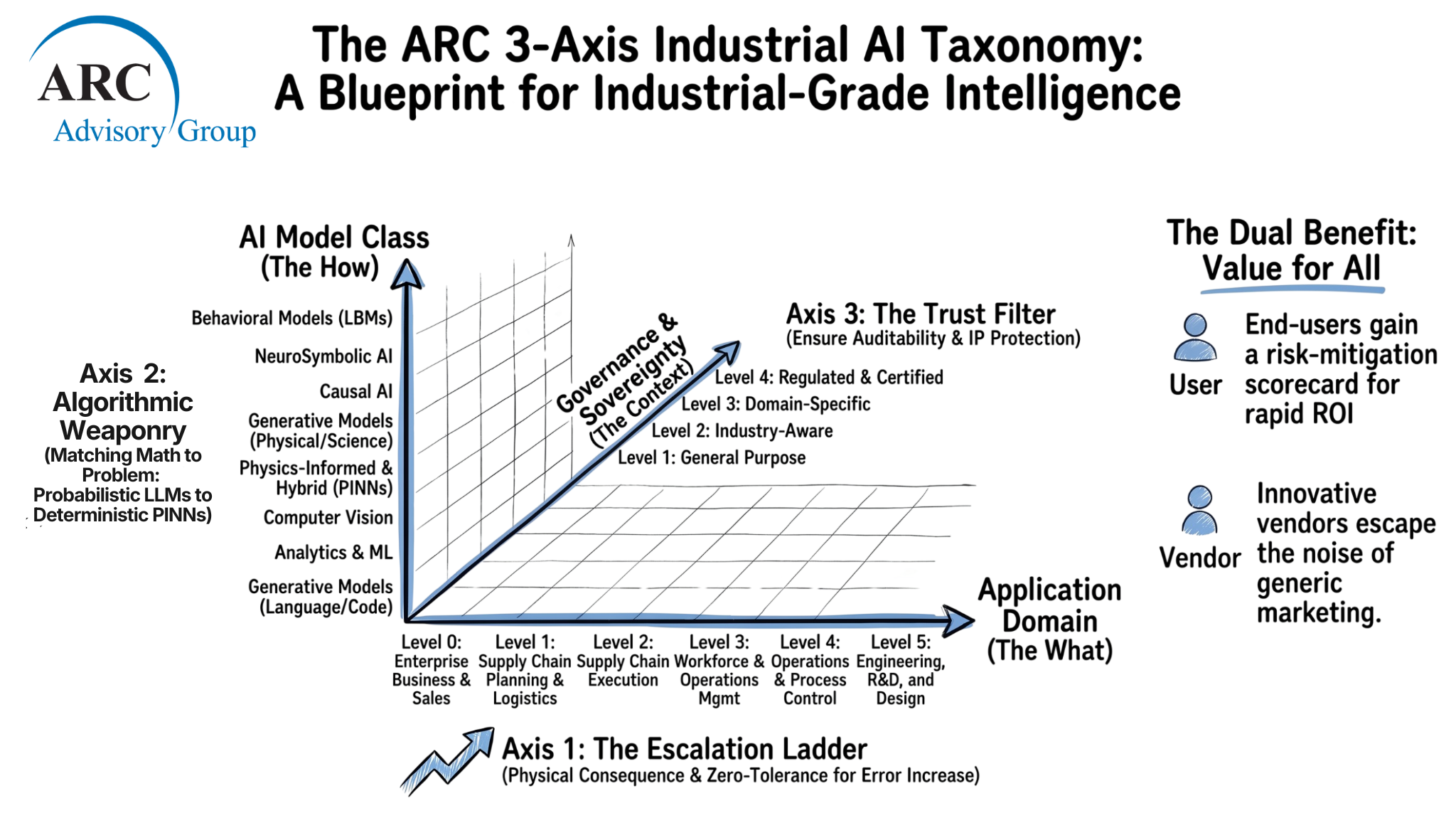
Over the course of this Voyage of Discovery, we have systematically deconstructed the noise of the “AI Wars,” dismantling generic marketing claims to build the comprehensive ARC 3-Axis Industrial AI Models Taxonomy. We have traced the escalating physical risks along the Application Domain axis, examined the sophisticated algorithmic weaponry required on the Model Class axis, and defined the rigid safety barriers necessary along the Governance axis.
Here is a brief recap of the ground we have covered:
-
Blog 1: Demystifying Industrial AI: A New Voyage of Discovery – We launched our exploration of the “Intelligence Divide,” highlighting the critical need to move past generic marketing hype and establish a definitive scorecard for industrial-grade AI.
-
Blog 2: Mapping the Battlefield: Axes 1 & 2 of the ARC Advisory Group Industrial AI Taxonomy – We established the hierarchical “Escalation Ladder of Physical Consequence” (Axis 1) and matched it with the specific mathematical architectures and algorithmic weaponry (Axis 2) required for those distinct operational theaters, specifically warning against the dangers of “LLM-Washing.”
-
Blog 3: The Pacesetter’s Advantage: Governance, Sovereignty, and Depth of Context (Axis 3) – We defined the ultimate proving ground of AI deployment, categorizing systems across four levels of maturity to ensure deterministic governance, legal auditability, and data sovereignty.
-
Blog 4: Meet the Industrial AI Archetypes (Part 1): Workforce Enablers & the Industrial Copilot – We mapped the market to reveal how Level 2 Industrial Copilots—and increasingly DIY Hyperscaler toolchains—are securely augmenting human capacity.
-
Blog 5: Meet the Industrial AI Archetypes (Part 2): Autonomous Execution Agents & First-Principles AI – We explored how AEAs bridge both the physical OT factory floor and enterprise IT, and how First-Principles AI is strictly bypassing language models to accelerate in-silico R&D at the engineering apex.
-
Blog 6: Meet the Industrial AI Archetypes (Part 3): Embodied Intelligence Systems, Certified Execution Agents, and Cyber-Physical Context Engines – We concluded our archetype mapping with the Embodied Intelligence Systems pioneering unstructured robotics, the rigid regulatory governance of Certified Execution Agents, and the essential Cyber-Physical Context Engines deploying AI-driven DataOps to organize the Industrial Data Fabric.
The ARC 3-Axis Industrial AI Models Taxonomy at a Glance
Before translating this framework into actionable procurement, it is critical to have a definitive, concise reference guide to the ARC 3-Axis Taxonomy.
Axis 1: Application Domain (The Escalation Ladder of Physical Consequence)
-
Level 0: Enterprise Business & Sales – Manages cognitive and semantic enterprise data with a high tolerance for probabilistic errors.
-
Level 1: Supply Chain Planning & Logistics Strategy – Navigates complex enterprise knowledge graphs to optimize multi-echelon networks without direct physical manipulation.
-
Level 2: Supply Chain Execution & Autonomous Fulfillment – Orchestrates agentic coordination and spatial awareness for the real-time movement of physical goods.
-
Level 3: Workforce, Service, & Operations Management – Governs the augmented interaction between human workers and heavy machinery using prescriptive guidance.
-
Level 4: Operations & Process Control – Requires strict mathematical constraint and deterministic logic to execute zero-tolerance closed-loop kinetic operations.
-
Level 5: Engineering, R&D, and Design – Dictates downstream physical reality and safety through physics-bounded mathematical simulation and generative design.
Axis 2: AI Model Class (The Algorithmic Weaponry)
-
Generative Models (Language/Code): Utilize probabilistic large and small language models strictly for semantic search, workflow orchestration, and coding.
-
Analytics & ML: Rely on traditional data-driven prescriptive models to identify historical trends within structured time-series data.
-
Computer Vision: Applies vision transformers and neural networks at the edge for advanced spatial computing and automated inspection.
-
Physics-Informed & Hybrid Models (PINNs): Embed first-principles physics directly into neural networks to mathematically prevent physical hallucinations.
-
Generative Models (Physical/Science): Employ geometric deep learning, diffusion architectures, and quantum machine learning for the de novo design of physical matter.
-
Causal AI: Maps generative processes using structural causal models to pinpoint root causes without relying on statistical guesswork.
-
NeuroSymbolic AI: Fuses statistical pattern-matching with hard-coded, deterministic logic to ensure absolute auditor reliability.
-
Behavioral Models (LBMs): Translate environmental perception directly into fluid physical action to drive embodied intelligence and advanced robotics.
Axis 3: Domain Specificity, Governance, & Sovereignty (The Trust Filter)
-
Level 1: General Purpose (Horizontal AI) – Operates with zero industrial governance and carries extreme misapplication risk in operational technology environments.
-
Level 2: Industry-Aware – Establishes a contextual advantage using retrieval-augmented generation on proprietary data but requires strict human-in-the-loop validation.
-
Level 3: Domain-Specific (Deep Science) – Executes bounded, supervised autonomy strictly constrained by the immutable laws of physical reality or enterprise logic.
-
Level 4: Regulated & Certified – Delivers mathematically validated proof and immutable audit trails for autonomous deployment in highly scrutinized, safety-critical industries.
Answering the Uncompromising Questions
A theoretical taxonomy, no matter how rigorous, is merely an academic exercise if it does not translate into operational execution. Throughout this series, we have repeatedly highlighted the urgent, uncompromising questions that our industrial end-user clients are asking us to pose to the vendor community:
-
If this agentic model makes an autonomous decision that shuts down my production line, who is legally and financially accountable for the downtime?
-
When an OSHA or FDA inspector arrives unannounced, how do we audit the opaque decision-making path—inputs, model steps, and outputs—of a deep learning algorithm?
-
What makes the system explainable and traceable enough that veteran operators will actually trust it, drive continuous improvement, and systematically transfer their hard-earned tribal knowledge to the next generation through it?
-
Can you mathematically guarantee that this AI will never violate our hard-coded functional safety limits, pressure thresholds, or thermodynamic boundaries?
-
If we expose proprietary batch recipes, setpoints, or 3D CAD designs to optimize yield, what prevents that leakage into shared public model training data—or into another customer’s outputs?
The ARC Translation Layer: Reports, Market Maps, and Rapid Time to Value
The fundamental question for our industrial end-user clients is: How do we use this framework to answer these liability questions, minimize pilot risk, and achieve rapid time to value?
Our upcoming suite of research deliverables is explicitly designed to be the ultimate procurement scorecard, acting as a translation layer between operational needs and vendor realities:
-
The 3-Axis Taxonomy: This framework provides the vocabulary for end-users to demand specificity. Instead of asking for “Machine Learning,” buyers can now demand “a Level 3, Physics-Informed Neural Network operating at Domain Level 4.”
-
The Industrial AI Market Analysis Report (MAR): This foundational report leverages a newly modernized RFI structure that forces vendors to explicitly declare their structural realities. For example, vendors must now definitively declare whether they are utilizing Generative Models (Language/Code) or Generative Models (Physical/Science), immediately exposing generic chatbots masquerading as deep science engines.
-
The AI Archetypes Report: This report deep-dives into the specific capabilities, integration requirements, and vendor ecosystems of each of the strategic archetypes outlined in this blog series.
-
The ARC Market Maps (Industrial Copilots & Autonomous Execution Agents): We are currently developing highly granular market maps for the most intensely contested battlegrounds. Whether an organization is searching for an IT-centric Enterprise Execution Agent to route global logistics, or an OT-centric Physical Execution Agent to manage a chemical reactor, these maps provide the precise intelligence needed to match the right vendor to the exact operational problem.
By applying these tools, end-users can cut through the hype, ensure capital is deployed only on architectures capable of delivering verifiable business value, and finally achieve rapid time to value.
The Vendor Imperative: Rewarding Deep Industrial Innovation
Conversely, this research framework is highly valuable for the technology vendor ecosystem. For too long, software vendors and domain experts who have invested millions of dollars and years of R&D into building highly defensible, physics-informed hybrid models or rigorous Causal AI architectures have been forced to compete on a flat playing field against consumer-grade, text-generating conversational wrappers.
The ARC 3-Axis Taxonomy fundamentally levels this playing field. By evaluating solutions across our hierarchical framework, vendors who possess deep, domain-specific capabilities—those who provide actual “Contextual Advantages” and strictly governed determinism—will finally receive the distinct market recognition and competitive differentiation they deserve.
A Final Call to Arms
The era of pilot purgatory and fragmented AI science experiments is over. The blueprint for the Cyber-Physical Industrial Architecture of the future is now available.
-
To our Industrial End-Users: Stop buying isolated AI tools and hoping they will magically integrate later. Set up a briefing with ARC’s Executive Insight Service to utilize this new 3-Axis Taxonomy and our upcoming Market Maps as your strategic procurement scorecard.
-
To the Industrial Technology Vendor Community: The ARC Industrial AI Models MAR and Archetype Market Maps are officially underway. If your organization is delivering tangible business value through Causal AI, NeuroSymbolic logic, Large Behavior Models, or highly specialized Industrial Copilots, you need to be mapped accurately in this definitive report to stand out from the noise.
If you have not already done so, this is your final call to arms to respond to the ARC Advisory Group RFI and engage with our analyst team. Help us map your deep capabilities so we can accurately advise the global industrial market.
Engage with ARC Advisory Group
The Industrial AI (R)Evolution is moving faster than ever. To dive deeper into the frameworks and data shaping the future of the industrial sector, explore my latest research:
-
Navigating the AI Wars and the escalating Industrial Robot Wars
-
Closing the Digital Divide by Embracing Industrial AI
-
Assembling your Industrial-Grade Data Fabric
-
Charting the new frontier of Physical Intelligence and transitioning to a Cyber-Physical Industrial Architecture (CPIA)
-
Mapping your maturity and strategy with ARC’s 3-Axis Industrial AI Models Taxonomy
Where do you stand in the Industrial AI (R)Evolution? Take our Industrial AI Assessment to benchmark your organization’s maturity, identify critical gaps in your IT/OT/ET convergence, and get actionable recommendations to accelerate your path to becoming an Industrial AI Pacesetter.
Don’t guess what your global operations or prospective customers need. Use empirical data to align your stakeholders and de-hype the market with ARC Advisory Group’s Voice of Market Service.
For tailored recommendations on governing and guiding major people, process, and technology decisions across the enterprise, cloud, industrial edge, and AI, please contact Colin Masson at [email protected].
Or, set up a meeting with my fellow Analysts and I at ARC Advisory Group to find out more about our Executive Insights Service for Industrial organizations and our Industrial AI Insights Service for Vendors.

Related Posts