Insider Brief A SAS survey of more than 500 global leaders found that uncertainty about real-world applications is now the top barrier to quantum AI adoption, surpassing cost. Organizations remain interested in quantum AI but face challenges including high implementation costs, limited expertise, unclear regulations, and a lack of available solutions. SAS plans to address
How the Brain Transforms Daily Life into Surreal Dreams – Neuroscience News
Summary: Why do some dreams feel like cinematic masterpieces while others are like static on a television? A large-scale study has decoded the “semantic structure” of over 3,700 dreams.
Using advanced Natural Language Processing (NLP), researchers found that dreams are not random neurological “noise.” Instead, they are a sophisticated reinterpretation of our lives, shaped by our personality traits, our cognitive habits (like mind-wandering), and even global events like the COVID-19 pandemic.
Key Facts
- Reinterpretation over Replay: The brain rarely “replays” daily events like a movie. Instead, it takes fragments of work, school, or healthcare settings and reorganizes them into immersive, surreal landscapes.
- The Mind-Wandering Link: People who frequently daydream or “mind-wander” during the day tend to have more fragmented, rapidly shifting dream scenarios.
- Dream Valuation: Individuals who believe dreams are meaningful and significant actually experience perceptually richer and more vivid dream content—suggesting that our attitude toward sleep influences its immersive quality.
- Societal Echoes: Comparing dreams from the 2020 lockdowns to later years, researchers noted that pandemic dreams were characterized by themes of “constraint” and high emotional intensity, which faded as people adapted psychologically.
- AI as a Dream Interpreter: The study proved that AI models can analyze the meaning and structure of dream reports with the same accuracy as human experts, allowing for massive, scalable research into the human subconscious.
Source: IMT
Why do our dreams sometimes feel vivid and immersive, while at other times they seem fragmented or difficult to interpret?
A new study conducted by researchers at the IMT School for Advanced Studies Lucca provides new insights into what determines the content of dreams, showing that both individual characteristics and shared life experiences play a key role in shaping what we dream.
The research, published in Communications Psychology, analyzed over 3,700 reports of dream and waking experiences collected from 287 participants aged 18 to 70. Over a two-week period, volunteers recorded their experiences daily, while researchers gathered detailed information about their sleep patterns, cognitive abilities, personality traits, and psychological characteristics.
Using advanced natural language processing (NLP) techniques, the team was able to quantitatively analyze the semantic structure of dreams. The findings reveal that dream content is not random or chaotic, but instead reflects a complex interplay between personal traits, such as tendency to mind-wander, interest in dreams, and sleep quality, and external events, including large-scale societal experiences like the COVID-19 pandemic.
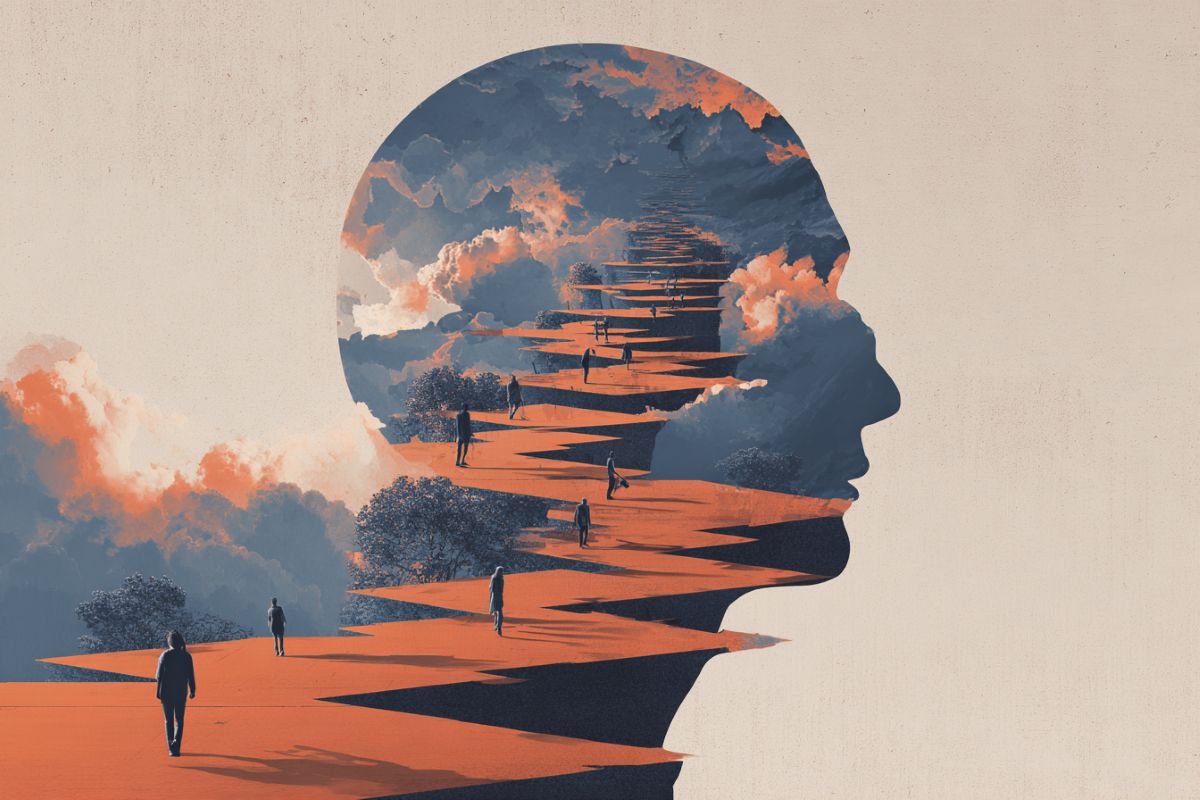
When examining the words participants used to describe both their daily lives and their dreams, the research team observed how everyday life is transformed during sleep. Rather than simply replaying waking experiences, dreams appear to reinterpret them. Elements from daily routines, such as work environments, healthcare settings, or education, do not reappear as they are.
Instead, they are reorganized into vivid, immersive scenarios, often blending together different contexts and shifting perspectives into unfamiliar landscapes. This suggests that dreams do not just reflect reality, but actively reshape it, integrating fragments of past experiences with imagined or anticipated ones to create novel, sometimes surreal, scenarios.
These transformations also vary across individuals. For example, individuals more prone to mind-wandering tended to report more fragmented and rapidly changing dream scenarios, while those who had a strong belief in the value, meaning, and significance of dreaming in general and of their dreams in particular, experienced perceptually richer and more immersive dream content.
Analyses of data collected during the COVID-19 lockdown by researchers at Sapienza University of Rome, and compared with data gathered in the subsequent months and years by the IMT School team, showed that dreams during the lockdown were characterized by heightened emotional intensity and more frequent references to constraints and limitations, reflecting the broader social context.
These effects gradually diminished over time, suggesting that dream content evolves in parallel with psychological adaptation to major life events.
“Our findings show that dreams are not just a reflection of past experiences, but a dynamic process shaped by who we are and what we live through,” explains Valentina Elce, researcher at the IMT School and lead author of the paper.
“By combining large-scale data with computational methods, we were able to uncover patterns in dream content that were previously difficult to detect.”
The study also highlights the potential of artificial intelligence in dream research, demonstrating that NLP models can reliably capture the meaning and structure of dream reports with accuracy comparable to human independent evaluators. This opens new possibilities for studying consciousness, memory, and mental health in a scalable and reproducible way.
Funding: This work was supported by a grant from the BIAL Foundation (#091/2020) and by the TweakDreams ERC Starting Grant (#948891). The research was conducted at the IMT School for Advanced Studies Lucca, in collaboration with researchers from Sapienza University of Rome and the University of Camerino.
Key Questions Answered:
Q: If I dream about work, does it mean I’m stressed?
A: Not necessarily. The study shows that work is a “fragment” the brain uses to build a dream. However, the AI found that your brain usually transforms your office into an “unfamiliar landscape.” If you are replaying the office exactly as it is, it might indicate a lack of the usual “surreal processing” that helps with emotional adaptation.
Q: Why are my dreams so much more vivid than my friend’s?
A: It could be your “Dream Interest.” The research found a strong correlation between how much you value your dreams and how “rich” they feel. If you pay attention to them and consider them important, your brain seems to allocate more resources to creating immersive scenarios.
Q: Can AI really understand my “weird” dreams?
A: Surprisingly, yes. NLP models don’t just look at words; they look at the semantic structure, the way ideas relate to each other. The researchers found AI can identify the same emotional and thematic patterns that a trained psychologist would, but it can do it for thousands of dreams in seconds.
Editorial Notes:
- This article was edited by a Neuroscience News editor.
- Journal paper reviewed in full.
- Additional context added by our staff.
About this AI and dream research news
Author: Chiara Palmerini
Source: IMT
Contact: Chiara Palmerini – IMT
Image: The image is credited to Neuroscience News
Original Research: Open access.
“Individual traits and experiences predict the content of dreams” by Valentina Elce, Giorgia Bontempi, Serena Scarpelli, Bianca Pedreschi, Pietro Pietrini, Luigi De Gennaro, Michele Bellesi, Giulio Bernardi & Giacomo Handjaras. Communications Psychology
DOI:10.1038/s44271-026-00447-2
Abstract
Individual traits and experiences predict the content of dreams
Dreams are universal yet highly idiosyncratic experiences. While memories and personal concerns are known to influence dream content, how such influences evolve over time and how stable individual traits shape dreaming remain unclear.
Here, we systematically quantified the semantic structure of dreams in a large, multimodal dataset comprising 3366 reports of dreams and waking experiences collected from 207 adults between 2020 and 2024, alongside demographic, cognitive, psychometric, and sleep measures.
To this end, we combined large language model-assisted evaluation of hypothesis-driven semantic dimensions and a data-driven lexical domain approach.
Relative to waking reports, dreams shifted from self-referential, thought-centered narratives to perceptual experiences dominated by visuo-spatial details, multiple characters, and bizarre events.
Stable traits, including attitude toward dreaming, mind-wandering propensity, and subjective sleep quality, selectively influenced dream content.
A second, independent dataset collected during the first 2020 COVID-19 lockdown (80 participants) allowed us to examine the impact of a major external stressor on dream semantics.
During lockdown, dreams showed increased references to limitations and heightened emotional intensity, effects that gradually normalized over the following years.
These findings demonstrate that stable individual traits and incidental experiences jointly shape dream semantics.

Related Posts