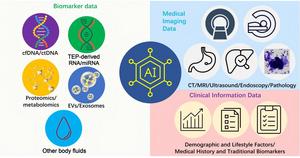
What if cancer screening no longer had to look for one cancer at a time? Cancer screening has long followed a one-organ-at-a-time model: mammography for breast cancer, colonoscopy for colorectal cancer, low-dose CT for lung cancer, and cervical testing for cervical cancer. These programs save lives, but they also leave gaps. Many cancers still lack
AI proteomics: from protein identification to virtual cells – Nature Methods
References
-
Aebersold, R. & Mann, M. Mass spectrometry-based proteomics. Nature 422, 198–207 (2003).
Article PubMed Google Scholar
-
Guo, T., Steen, J. A. & Mann, M. Mass-spectrometry-based proteomics: from single cells to clinical applications. Nature 638, 901–911 (2025). This review provides an up-to-date overview of MS-based proteomics, tracing its evolution from large-scale quantification to ultrasensitive single-cell and spatial analysis and discussing its translation into clinical applications such as biomarker discovery and diagnostics.
Article PubMed Google Scholar
-
Lindsay, R. K., Buchanan, B. G., Feigenbaum, E. A. & Lederberg, J. DENDRAL: a case study of the first expert system for scientific hypothesis formation. Artif. Intell. 61, 209–261 (1993).
Article Google Scholar
-
Mann, M., Kumar, C., Zeng, W.-F. & Strauss, M. T. Artificial intelligence for proteomics and biomarker discovery. Cell Syst. 12, 759–770 (2021).
Article PubMed Google Scholar
-
Kalhor, M., Lapin, J., Picciani, M. & Wilhelm, M. Rescoring peptide spectrum matches: boosting proteomics performance by integrating peptide property predictors into peptide identification. Mol. Cell. Proteomics 23, 100798 (2024).
Article PubMed PubMed Central Google Scholar
-
Demichev, V., Messner, C. B., Vernardis, S. I., Lilley, K. S. & Ralser, M. DIA-NN: neural networks and interference correction enable deep proteome coverage in high throughput. Nat. Methods 17, 41–44 (2020). A widely adopted tool based on a neural network for improving peptide and protein identification in MS-based proteomics.
Article PubMed Google Scholar
-
Bittremieux, W. et al. Deep learning methods for de novo peptide sequencing. Mass Spectrom. Rev. 45, 507–526 (2026).
Article PubMed Google Scholar
-
Xiao, Q. et al. High-throughput proteomics and AI for cancer biomarker discovery. Adv. Drug Deliv. Rev. 176, 113844 (2021).
-
Kustatscher, G. et al. Understudied proteins: opportunities and challenges for functional proteomics. Nat. Methods 19, 774–779 (2022).
Article PubMed Google Scholar
-
Lee, M. Recent advances in deep learning for protein-protein interaction analysis: a comprehensive review. Molecules 28, 5169 (2023).
Article PubMed PubMed Central Google Scholar
-
Qian, L. et al. AI-empowered perturbation proteomics for complex biological systems. Cell Genomics 4, 100691 (2024).
Article PubMed PubMed Central Google Scholar
-
Mani, D. R. et al. Cancer proteogenomics: current impact and future prospects. Nat. Rev. Cancer 22, 298–313 (2022).
Article PubMed PubMed Central Google Scholar
-
Savage, S. R. et al. Pan-cancer proteogenomics expands the landscape of therapeutic targets. Cell 187, 4389-4407.e15 (2024).
-
Bunne, C. et al. How to build the virtual cell with artificial intelligence: priorities and opportunities. Cell 187, 7045–7063 (2024). This article presents a framework for building virtual cells with AI, combining multi-scale biological state representations and virtual instruments to simulate cellular dynamics and enable predictive modeling.
Article PubMed PubMed Central Google Scholar
-
Qian, L., Dong, Z. & Guo, T. Grow AI virtual cells: three data pillars and closed-loop learning. Cell Res. 35, 319–321 (2025).
Article PubMed PubMed Central Google Scholar
-
Perez-Riverol, Y. et al. The PRIDE database at 20 years: 2025 update. Nucleic Acids Res. 53, D543–D553 (2025).
Article PubMed PubMed Central Google Scholar
-
Doerr, A. Proteomics data reuse with MassIVE-KB. Nat. Methods 16, 26 (2019).
Article PubMed Google Scholar
-
Panagakis, Y. et al. Tensor methods in computer vision and deep learning. Proc. IEEE 109, 863–890 (2021).
-
Deng, J. et al. ImageNet: a large-scale hierarchical image database. In IEEE Conf. Computer Vision and Pattern Recognition 248–255 (IEEE, 2009).
-
Berman, H. M. et al. The Protein Data Bank. Nucleic Acids Res. 28, 235–242 (2000).
Article PubMed PubMed Central Google Scholar
-
Omenn, G. S. et al. The 2024 report on the human proteome from the HUPO Human Proteome Project. J. Proteome Res. 23, 5296–5311 (2024).
-
Deutsch, E. W. et al. Proteomics standards iInitiative at twenty years: current activities and future work. J. Proteome Res. 22, 287–301 (2023).
-
Li, Y. et al. Proteogenomic data and resources for pan-cancer analysis. Cancer Cell 41, 1397–1406 (2023).
-
Rodriguez, H., Zenklusen, J. C., Staudt, L. M., Doroshow, J. H. & Lowy, D. R. The next horizon in precision oncology: proteogenomics to inform cancer diagnosis and treatment. Cell 184, 1661–1670 (2021).
Article PubMed PubMed Central Google Scholar
-
Tully, B. et al. Addressing the challenges of high-throughput cancer tissue proteomics for clinical application: ProCan. Proteomics 19, 1900109 (2019).
-
He, F. et al. π-HuB: the proteomic navigator of the human body. Nature 636, 322–331 (2024).
-
Bittremieux, W., May, D. H., Bilmes, J. & Noble, W. S. A learned embedding for efficient joint analysis of millions of mass spectra. Nat. Methods 19, 675–678 (2022).
Article PubMed PubMed Central Google Scholar
-
Pan, Q., Shai, O., Lee, L. J., Frey, B. J. & Blencowe, B. J. Deep surveying of alternative splicing complexity in the human transcriptome by high-throughput sequencing. Nat. Genet. 40, 1413–1415 (2008).
-
Phan, L. et al. The evolution of dbSNP: 25 years of impact in genomic research. Nucleic Acids Res. 53, D925–D931 (2025).
-
Chung, C.-R. et al. dbPTM 2025 update: comprehensive integration of PTMs and proteomic data for advanced insights into cancer research. Nucleic Acids Res. 53, D377–D386 (2025).
-
Wen, B. et al. Assessment of false discovery rate control in tandem mass spectrometry analysis using entrapment. Nat. Methods 22, 1454–1463 (2025). This article establishes a rigorous theoretical framework for evaluating FDR control in proteomics using entrapment experiments.
-
Tran, N. H. et al. NovoBoard: a comprehensive framework for evaluating the false discovery rate and accuracy of de novo peptide sequencing. Mol. Cell. Proteomics 23, 100849 (2024).
Article PubMed PubMed Central Google Scholar
-
Sanh, V., Debut, L., Chaumond, J. & Wolf, T. DistilBERT, a distilled version of BERT: smaller, faster, cheaper and lighter. Preprint at arXiv https://doi.org/10.48550/arXiv.1910.01108 (2020).
-
Shazeer, N. et al. Outrageously large neural networks: the sparsely-gated mixture-of-experts layer. Preprint at arXiv https://doi.org/10.48550/arXiv.1701.06538 (2017).
-
von Mering, C. et al. Comparative assessment of large-scale data sets of protein–protein interactions. Nature 417, 399–403 (2002).
-
Garlick, J. M. & Mapp, A. K. Selective modulation of dynamic protein complexes. Cell Chem. Biol. 27, 986–997 (2020).
Article PubMed PubMed Central Google Scholar
-
Huttlin, E. L. et al. Dual proteome-scale networks reveal cell-specific remodeling of the human interactome. Cell 184, 3022–3040.e28 (2021).
-
Bludau, I. et al. Complex-centric proteome profiling by SEC-SWATH-MS for the parallel detection of hundreds of protein complexes. Nat. Protoc. 15, 2341–2386 (2020).
-
Xu, Y., Fan, X. & Hu, Y. In vivo interactome profiling by enzyme‐catalyzed proximity labeling. Cell Biosci. 11, 27 (2021).
-
Bajpai, A. K. et al. Systematic comparison of the protein-protein interaction databases from a user’s perspective. J. Biomed. Informatics 103, 103380 (2020).
-
Wu, S., Zhang, S., Liu, C.-M., Fernie, A. R. & Yan, S. Recent advances in mass spectrometry-based protein interactome studies. Mol. Cell. Proteomics 24, 100887 (2025).
-
Feng, S. et al. Hypergraph models of biological networks to identify genes critical to pathogenic viral response. BMC Bioinformatics 22, 287 (2021).
-
Method of the Year 2024: spatial proteomics. Nat. Methods 21, 2195–2196 (2024).
-
Goltsev, Y. et al. Deep profiling of mouse splenic architecture with CODEX multiplexed imaging. Cell 174, 968–981.e15 (2018).
-
Angelo, M. et al. Multiplexed ion beam imaging of human breast tumors. Nat. Med. 20, 436–442 (2014).
-
Mund, A. et al. Deep Visual Proteomics defines single-cell identity and heterogeneity. Nat. Biotechnol. 40, 1231–1240 (2022). This article introduces Deep Visual Proteomics, an AI-driven framework that integrates imaging and ultrasensitive mass spectrometry to map protein expression at single-cell resolution, advancing spatial and functional proteomics.
-
Rosenberger, F. A. et al. Deep Visual Proteomics maps proteotoxicity in a genetic liver disease. Nature 642, 484–491 (2025).
-
Nordmann, T. M. et al. Spatial proteomics identifies JAKi as treatment for a lethal skin disease. Nature 635, 1001–1009 (2024).
-
Xu, Y. et al. Multimodal single cell-resolved spatial proteomics reveal pancreatic tumor heterogeneity. Nat. Commun. 15, 10100 (2024).
-
Bury, A. G. et al. A subcellular cookie cutter for spatial genomics in human tissue. Anal. Bioanal. Chem. 414, 5483–5492 (2022).
-
Dong, Z. et al. Spatial proteomics of single cells and organelles on tissue slides using filter-aided expansion proteomics. Nat. Commun. 15, 9378 (2024).
-
Qin, R., Ma, J., He, F. & Qin, W. In-depth and high-throughput spatial proteomics for whole-tissue slice profiling by deep learning-facilitated sparse sampling strategy. Cell Discov. 11, 21 (2025).
Article PubMed PubMed Central Google Scholar
-
Hu, B. et al. High-resolution spatially resolved proteomics of complex tissues based on microfluidics and transfer learning. Cell 188, 734–748.e22 (2025). This study combines microfluidics with transfer learning to achieve high-resolution, spatially resolved proteomics of complex tissues, providing an AI-driven approach that enables precise and high-throughput mapping of tissue microenvironments and advances spatial proteomics applications.
-
Mitchell, D. C. et al. A proteome-wide atlas of drug mechanism of action. Nat. Biotechnol. 41, 845–857 (2023).
-
Zecha, J. et al. Decrypting drug actions and protein modifications by dose- and time-resolved proteomics. Science 380, 93–101 (2023).
Article PubMed PubMed Central Google Scholar
-
Eckert, S. et al. Decrypting the molecular basis of cellular drug phenotypes by dose-resolved expression proteomics. Nat. Biotechnol. 43, 406–415 (2025).
-
Zhao, W. et al. Large-scale characterization of drug responses of clinically relevant proteins in cancer cell lines. Cancer Cell 38, 829–843.e4 (2020).
-
Yuan, B. et al. CellBox: interpretable machine learning for perturbation biology with application to the design of cancer combination therapy. Cell Syst. 12, 128–140.e4 (2021). This study presents CellBox, an interpretable machine learning framework that models cellular responses to perturbations, enabling AI-driven prediction and rational design of effective cancer combination therapies and thereby advancing predictive and mechanistic proteomics in perturbation biology.
-
Vogel, C. & Marcotte, E. M. Insights into the regulation of protein abundance from proteomic and transcriptomic analyses. Nat. Rev. Genet. 13, 227–232 (2012).
Article PubMed PubMed Central Google Scholar
-
Liu, Y., Beyer, A. & Aebersold, R. On the dependency of cellular protein levels on mRNA abundance. Cell 165, 535–550 (2016).
Article PubMed Google Scholar
-
Chung, H. et al. Joint single-cell measurements of nuclear proteins and RNA in vivo. Nat. Methods 18, 1204–1212 (2021).
-
Zitnik, M., Agrawal, M. & Leskovec, J. Modeling polypharmacy side effects with graph convolutional networks. Bioinformatics 34, i457–i466 (2018).
Article PubMed PubMed Central Google Scholar
-
Cao, Z.-J. & Gao, G. Multi-omics single-cell data integration and regulatory inference with graph-linked embedding. Nat. Biotechnol. 40, 1458–1466 (2022).
-
Gayoso, A. et al. Joint probabilistic modeling of single-cell multi-omic data with totalVI. Nat. Methods 18, 272–282 (2021).
-
Gao, Y., Feng, Y., Ji, S. & Ji, R. HGNN+: general hypergraph neural networks. IEEE Trans. Pattern Anal. Mach. Intell. 45, 3181–3199 (2023).
-
Xu, H. et al. A whole-slide foundation model for digital pathology from real-world data. Nature 630, 181–188 (2024).
-
Senior, A. W. et al. Improved protein structure prediction using potentials from deep learning. Nature 577, 706–710 (2020).
-
Cui, H. et al. Towards multimodal foundation models in molecular cell biology. Nature 640, 623–633 (2025).
-
Roohani, Y. H. et al. Virtual Cell Challenge: toward a Turing test for the virtual cell. Cell 188, 3370–3374 (2025).
-
Karr, J. R. et al. A whole-cell computational model predicts phenotype from genotype. Cell 150, 389–401 (2012).
-
Macklin, D. N. et al. Simultaneous cross-evaluation of heterogeneous E. coli datasets via mechanistic simulation. Science 369, eaav3751 (2020).
-
Ye, C. et al. Comprehensive understanding of Saccharomyces cerevisiae phenotypes with whole-cell model WM_S288C. Biotechnol. Bioeng. 117, 1562–1574 (2020).
-
Österlund, T., Nookaew, I., Bordel, S. & Nielsen, J. Mapping condition-dependent regulation of metabolism in yeast through genome-scale modeling. BMC Syst. Biol. 7, 36 (2013).
-
Rood, J. E. et al. The Human Cell Atlas from a cell census to a unified foundation model. Nature 637, 1065–1071 (2025).
-
Theodoris, C. V. et al. Transfer learning enables predictions in network biology. Nature 618, 616–624 (2023).
-
Hao, M. et al. Large-scale foundation model on single-cell transcriptomics. Nat. Methods 21, 1481–1491 (2024).
Article PubMed Google Scholar
-
Sun, R. et al. A perturbation proteomics-based foundation model for virtual cell construction. Preprint at bioRxiv https://doi.org/10.1101/2025.02.07.637070 (2025).
-
Adduri, A. K. et al. Predicting cellular responses to perturbation across diverse contexts with State. Preprint at bioRxiv https://doi.org/10.1101/2025.06.26.661135 (2025).
-
Desiere, F. et al. The PeptideAtlas project. Nucleic Acids Res. 34, D655–D658 (2006).
-
Choi, M. et al. MassIVE.quant: a community resource of quantitative mass spectrometry–based proteomics datasets. Nat. Methods 17, 981–984 (2020).
-
Dai, C. et al. quantms: a cloud-based pipeline for quantitative proteomics enables the reanalysis of public proteomics data. Nat. Methods 21, 1603–1607 (2024). This study introduces quantms, a cloud-based, automated pipeline for quantitative proteomics that facilitates large-scale reanalysis of public datasets, advancing AI-driven proteomics by providing standardized, accessible and reproducible data resources for machine learning applications.
-
Liu, Z. et al. DIA-BERT: pre-trained end-to-end transformer models for enhanced DIA proteomics data analysis. Nat. Commun. 16, 3530 (2025). This study develops DIA-BERT, a pretrained end-to-end transformer model that enhances DIA proteomics data analysis, demonstrating how large language model architectures can be adapted to improve peptide identification, quantification and overall AI-driven interpretation of MS data.
-
Gao, H. et al. iDIA-QC: AI-empowered data-independent acquisition mass spectrometry-based quality control. Nat. Commun. 16, 892 (2025).
Article PubMed PubMed Central Google Scholar
-
Jun, A. et al. MassNet: billion-scale AI-friendly mass spectral corpus enables robust de novo peptide sequencing. Preprint at bioRxiv https://doi.org/10.1101/2025.06.20.660691 (2025).
-
Rehfeldt, T. G. et al. ProteomicsML: an online platform for community-curated data sets and tutorials for machine learning in proteomics. J. Proteome Res. 22, 632–636 (2023).
Article PubMed PubMed Central Google Scholar
-
Zolg, D. P. et al. Building ProteomeTools based on a complete synthetic human proteome. Nat. Methods 14, 259–262 (2017).
-
Marx, H. et al. A large synthetic peptide and phosphopeptide reference library for mass spectrometry–based proteomics. Nat. Biotechnol. 31, 557–564 (2013).
Article PubMed Google Scholar
-
Kryshtafovych, A., Schwede, T., Topf, M., Fidelis, K. & Moult, J. Critical assessment of methods of protein structure prediction (CASP)—round XIV. Proteins 89, 1607–1617 (2021).
-
Mann, S. P., Treit, P. V., Geyer, P. E., Omenn, G. S. & Mann, M. Ethical principles, constraints, and opportunities in clinical proteomics. Mol. Cell. Proteomics 20, 100046 (2021).
Article PubMed PubMed Central Google Scholar
-
Bandeira, N., Deutsch, E. W., Kohlbacher, O., Martens, L. & Vizcaíno, J. A. Data management of sensitive human proteomics data: current practices, recommendations, and perspectives for the future. Mol. Cell. Proteomics 20, 100071 (2021).
Article PubMed PubMed Central Google Scholar
-
Cai, Z. et al. Federated deep learning enables cancer subtyping by proteomics. Cancer Discov 15, 1803–1818 (2025). This study applies federated deep learning to proteomics data for cancer subtyping, demonstrating how privacy-preserving AI frameworks can integrate decentralized datasets to enhance model generalization, data security and precision in AI-driven clinical proteomics.
Article PubMed PubMed Central Google Scholar
-
Vašíček, J. et al. ProHap enables human proteomic database generation accounting for population diversity. Nat. Methods 22, 273–277 (2025).
Article PubMed Google Scholar
-
Qian, L. et al. Towards the construction of a virtual yeast. Nature 655, 59–70 (2026).
Article PubMed Google Scholar
Download references
Acknowledgements
T.G., Y.S., J.A., Z.L., R.S., L.Q., Y.C., Z.D., Y.D. and H.G. acknowledge the National Key R&D Program of China (grant no. 2022YFF0608403), the National Natural Science Foundation of China (Key Joint Research Program) (grant no. U24A20476), National Natural Science Foundation of China (Major Research Plan) (grant no. 92259201), National Natural Science Foundation of China (Young Scientist Fund) (grant no. 32401239), Zhejiang Provincial Natural Science Foundation of China (grant no. LQ24C050002) and National Key R&D Program of China (grant no. 2021YFA1301600). B.Z. acknowledges the Robert and Janice McNair Foundation. M.M. acknowledges the Max Planck Society for the Advancement of Science. W.B. acknowledges the Research Foundation–Flanders (G087625N and G0AHY25N). C.L. was supported by an Australian Research Council (ARC) Future Fellowship (FT240100798) and a National Health and Medical Research Council of Australia (NHMRC) Ideas Grant (2024/GNT2037597). C.C. and F.H. were supported by the National Key Research and Development Program of China (2024YFA1210400 and 2021YFA1301603) and the National Natural Science Foundation of China (32088101). J.A.V. and Y.P.-R. acknowledge BBSRC grants BB/X001911/1, BB/V018779/1, BB/Y513829/1, Wellcome grant 223745/Z/21/Z and EMBL core funding. S.H.P. was supported by NIGMS/National Institutes of Health award R01GM147653. H.H. acknowledges BBSRC grant BB/X002179/1. V.D. was supported by BMBF grant 161L0221. M.L. acknowledges the National Key R&D Program of China (no. 2022YFA1304603), the National Key Research and Development Program of China (2024YFA1306400) and Canadian NSERC grant OGP0046506. Y.W. was supported by direct national funding from the Chinese Ministry of Technology to Pengcheng Laboratory, Research and Development Program of Guangzhou Laboratory (SRPG22-001). G.S.O. acknowledges National Institutes of Health grants P30ES017885-11-S1 and U24CA271037. C.M.O. was supported by the Canada Research Chairs program (950-01-126) and the Canadian Institutes for Health Research Foundation Grant program (FDN-148408). E.W.D. acknowledges National Institutes of Health grants R01 GM087221 and R24 GM148372. L.C. was supported by the Natural Science Foundation of China (T2341007, T2350003, 12131020, 42450084, 42450135, 12326614, 12426310, 12301620 and 42450192), Shenzhen Medical Research Fund (E250200621,E250200620), Tianfu Jincheng Laboratory (TFJCPI20260001) and Zhejiang Province Vanguard Goose-Leading Initiative (2025C01114). We acknowledge the support of the π-Hub project.
Ethics declarations
Competing interests
T.G. is the founder of Westlake Omics Inc. B.Z. received research funding from AstraZeneca and consulting fees from Inotiv. M.M. is an indirect investor in Evosep. X.L. has a project contract with Bioinformatics Solutions Inc. J.R.K. is an employee of Bruker Ltd. Milton, Canada. Y.X. is an employee of Thermo Fisher Scientific. B.B.S. is currently a full-time employee of Bristol Myers Squibb. V.D. holds shares in Aptila Biotech. M.R. is the founder and shareholder of Eliptica Ltd. C.S. is a scientific advisor for Cytoreason Ltd. The remaining authors declare no competing interests.
Peer review
Peer review information
Nature Methods thanks the anonymous reviewers for their contribution to the peer review of this work. Primary Handling Editor: Arunima Singh, in collaboration with the Nature Methods team.
Additional information
Publisher’s note Springer Nature remains neutral with regard to jurisdictional claims in published maps and institutional affiliations.
Supplementary information
Supplementary Table 1 (download XLSX )
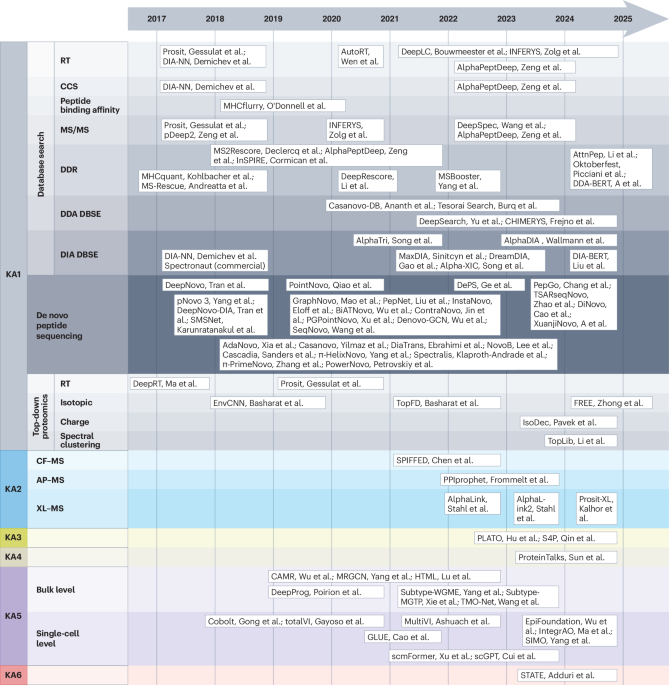
The table summarizes software and tools that apply traditional machine learning or deep learning models across the six key areas of MS-based proteomics discussed in the Perspective. It includes their corresponding subsections, modules, publication year, software/outcome name, model, model type, specific tasks, last corresponding author, first author and journal article link.
Rights and permissions
Springer Nature or its licensor (e.g. a society or other partner) holds exclusive rights to this article under a publishing agreement with the author(s) or other rightsholder(s); author self-archiving of the accepted manuscript version of this article is solely governed by the terms of such publishing agreement and applicable law.
Reprints and permissions
About this article

Cite this article
Sun, Y., A, J., Liu, Z. et al. AI proteomics: from protein identification to virtual cells. Nat Methods (2026). https://doi.org/10.1038/s41592-026-03085-y
Download citation
-
Received:
-
Accepted:
-
Published:
-
Version of record:
-
DOI: https://doi.org/10.1038/s41592-026-03085-y

Related Posts