What if cancer screening no longer had to look for one cancer at a time? Cancer screening has long followed a one-organ-at-a-time model: mammography for breast cancer, colonoscopy for colorectal cancer, low-dose CT for lung cancer, and cervical testing for cervical cancer. These programs save lives, but they also leave gaps. Many cancers still lack
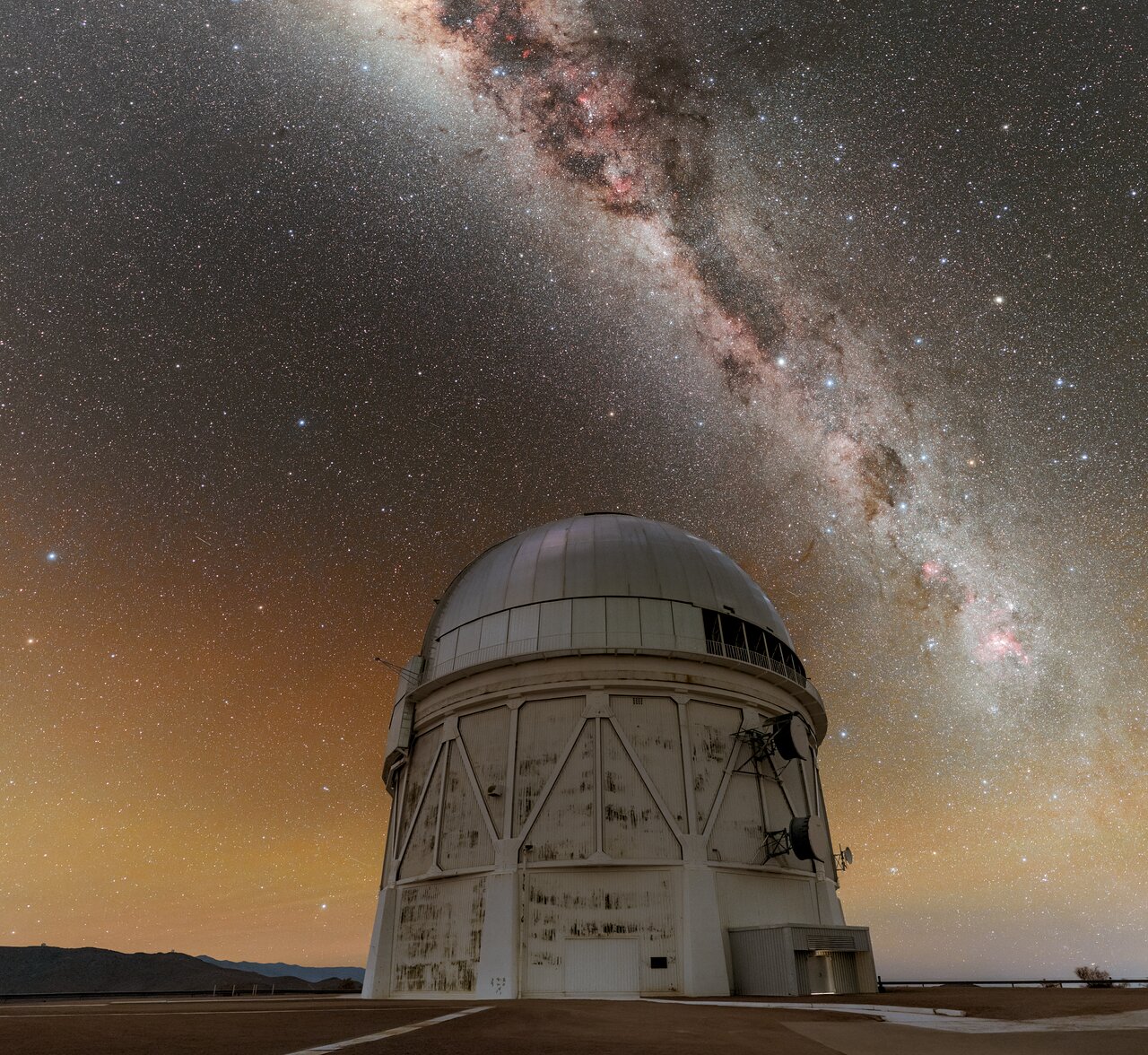
First AI-driven Telescope Goes Stargazing
ann26016 — Announcement
31 July 2026
An artificial intelligence system has, for the first time, successfully planned and managed observations on a national facility, demonstrating a new way to make the most of scarce observing time. Trained on 13 years of historical data, the system generated an observing schedule for the NSF Víctor M. Blanco 4-meter Telescope and revised it in real time as weather and other conditions changed.
Every night, astronomers must carefully assess changing weather, the intensity of moonlight, and shifting atmospheric conditions before deciding where to point a telescope. It’s a constant balancing act designed to squeeze as much science as possible from every precious hour beneath dark skies.
Now, scientists associated with the U.S. National Science Foundation (NSF)-Simons Foundation AI Institute for the Sky (SkAI, pronounced “sky”) have developed a new artificial intelligence (AI) tool that automatically determines where a telescope should point. After developing the tool, scientists successfully used the AI system to schedule observations with the 570-megapixel U.S. Department of Energy-fabricated Dark Energy Camera (DECam), mounted on the NSF Víctor M. Blanco 4-meter Telescope at NSF Cerro Tololo Inter-American Observatory (CTIO) in Chile.
Not only did the system generate an observing plan, but it also adapted that plan in real time as environmental conditions changed. By automating routine scheduling decisions, the innovation will help telescopes collect the best possible data. “This is an important milestone toward more autonomous observatories,” says University of Chicago’s Alex Drlica-Wagner, who co-led the project. “One of the main achievements is that we set up all the infrastructure needed to deploy this self-driving telescope on a national observatory. Currently, I would say its performance is comparable to a human’s ability. As the next step, we plan to teach the computer to do a better job than a human.”
“It is exciting to see ideas from AI and reinforcement learning brought to telescope scheduling, where every decision must balance changing conditions and scarce observing time,” says Northwestern University’s Aravindan Vijayaraghavan, who co-led the project with Drlica-Wagner. “Developing intelligent scheduling systems for astronomical surveys also raises fascinating new machine learning problems, and we are excited to continue exploring them through this project.”
Sometimes, astronomers wait months for a chance to use a major telescope. A poorly positioned telescope could return less sharp images or washed-out images flooded by moonlight, making faint or distant objects even more difficult to detect. And the opportunity to redo the failed observation might be months away. “Large telescopes are national or international resources,” says Drlica-Wagner. “Many astronomers around the world want time to use these telescopes, and that time is limited. If everyone could use their time more efficiently, then the community will be able to do more science.”
The team at SkAI developed a deep-learning scheduling system. Rather than programming AI with rules astronomers have developed over decades, the researchers let the system learn on its own. They trained a deep-learning model on historical observations from the DOE-funded Dark Energy Survey (DES) [1]. “We trained the model on years of historical observations by showing it where the telescope was pointing at one moment and asking it to predict the next observation,” says Drlica-Wagner. “Then we compared its prediction to what astronomers actually did and asked it to correct its mistakes. After repeating this process many times, it learned how to schedule observations without being explicitly taught how the brightness of the Moon, the atmospheric conditions, or the many other factors affect the quality of astronomical observations.”
This past spring and summer, the intelligent scheduling system completed two successful observing runs on the Blanco Telescope — one of the world’s most productive astronomical facilities that has had its telescope control software continuously upgraded. For this initial deployment, the goal was to get the AI to perform about as well as human schedulers. The team’s next goal is to teach the AI not just to mimic human decision-making but improve upon it. By exploring observing strategies humans might never consider, AI eventually could make telescopes even more efficient.
As next-generation telescopes, including the NSF–DOE Vera C. Rubin Observatory, begin producing unprecedented amounts of astronomical data, intelligent scheduling systems could help companion telescopes respond more efficiently and maximize the scientific value of every observation run.
“If we can automate this technical operational task so it requires less human effort, then astronomers can have more time to think about more scientifically interesting problems and focus on discovery,” says Drlica-Wagner.
Notes
[1] The Dark Energy Survey was an international astronomy project conducted from 2013 to 2019 that mapped hundreds of millions of galaxies to understand why the expansion of the Universe is speeding up.
More information
The Dark Energy Camera (DECam) was designed specifically for the Dark Energy Survey (DES). It was funded by the U.S. Department of Energy (DOE) and was built and tested at DOE’s Fermilab.
NSF NOIRLab, the U.S. National Science Foundation center for ground-based optical-infrared astronomy, operates the International Gemini Observatory (a facility of NSF, NRC–Canada, ANID–Chile, MCTIC–Brazil, MINCyT–Argentina, and KASI–Republic of Korea), NSF Kitt Peak National Observatory (KPNO), NSF Cerro Tololo Inter-American Observatory (CTIO), the Community Science and Data Center (CSDC), and NSF–DOE Vera C. Rubin Observatory (in cooperation with DOE’s SLAC National Accelerator Laboratory). It is managed by the Association of Universities for Research in Astronomy (AURA) under a cooperative agreement with NSF and is headquartered in Tucson, Arizona.
The scientific community is honored to have the opportunity to conduct astronomical research on I’oligam Du’ag (Kitt Peak) in Arizona, on Maunakea in Hawai‘i, and on Cerro Tololo and Cerro Pachón in Chile. We recognize and acknowledge the very significant cultural role and reverence of I’oligam Du’ag to the Tohono O’odham Nation, and Maunakea to the Kanaka Maoli (Native Hawaiians) community.
Led by Northwestern University, SkAI is a National AI Research Institute jointly funded by the NSF and the Simons Foundation. SkAI brings together researchers in astronomy, AI, and related fields to develop trustworthy AI tools that accelerate scientific discovery, advance cutting-edge astronomical surveys and instruments, and train the next generation of interdisciplinary scientists.
Links
- Press release from Northwestern University
- Photos of the Víctor M. Blanco 4-meter Telescope
- Videos of the Víctor M. Blanco 4-meter Telescope
- Photos of DECam
- Images taken by DECam
- Images taken with the NSF Víctor M. Blanco 4-meter Telescope
Contacts
Alex Drlica-Wagner
University of Chicago/Fermi National Accelerator Laboratory
Email:
Guillermo Damke
NSF NOIRLab
Email:
Josie Fenske
Public Information Officer
NSF NOIRLab
Email:

Related Posts